Snowflake and Databricks both sell consumption, and they measure it in different currencies. Snowflake sells credits: one credit costs $2.00 on Standard, $3.00 on Enterprise, and $4.00 on Business Critical in AWS US East, and a Medium warehouse burns four credits an hour. Databricks sells DBUs: one DBU costs $0.15 on Jobs Compute, $0.55 on All-Purpose Compute, and $0.70 on SQL Serverless in the same region, on the Premium tier. The trap is that neither number is the bill. A credit buys a fixed hour of a fixed warehouse size; a DBU buys a unit of processing whose dollar price changes with the compute type, and on classic compute the cloud VMs are billed separately on top. A team that compares $3.00 against $0.15 and concludes Databricks is twenty times cheaper has compared a warehouse-hour against a processing unit.
Who this guide is for, and who should stop here
This guide is for a team choosing the platform that will run its analytics, pipelines, and machine-learning work on AWS US East, priced on the vendors' on-demand list prices as published in October and November 2026. It is for the buyer who will measure a workload in credits on one side and DBUs on the other and wants the monthly total before signing. It is not for a buyer who needs a single per-unit winner: credits and DBUs are not interchangeable units, and any guide that declares one cheaper per unit without naming the workload is selling a conclusion, not a comparison. It is not for a team that has already committed to one cloud's native stack — if the data already lives in BigQuery or Synapse, the migration cost dwarfs the rate-card difference, and the right comparison is our ClickHouse vs Snowflake vs BigQuery analytics warehouse pricing guide. If the question is how data gets into either platform, price the pipeline first in the Fivetran vs Airbyte vs Stitch ELT pipeline pricing playbook.
Snowflake: credits, editions, and the warehouse clock
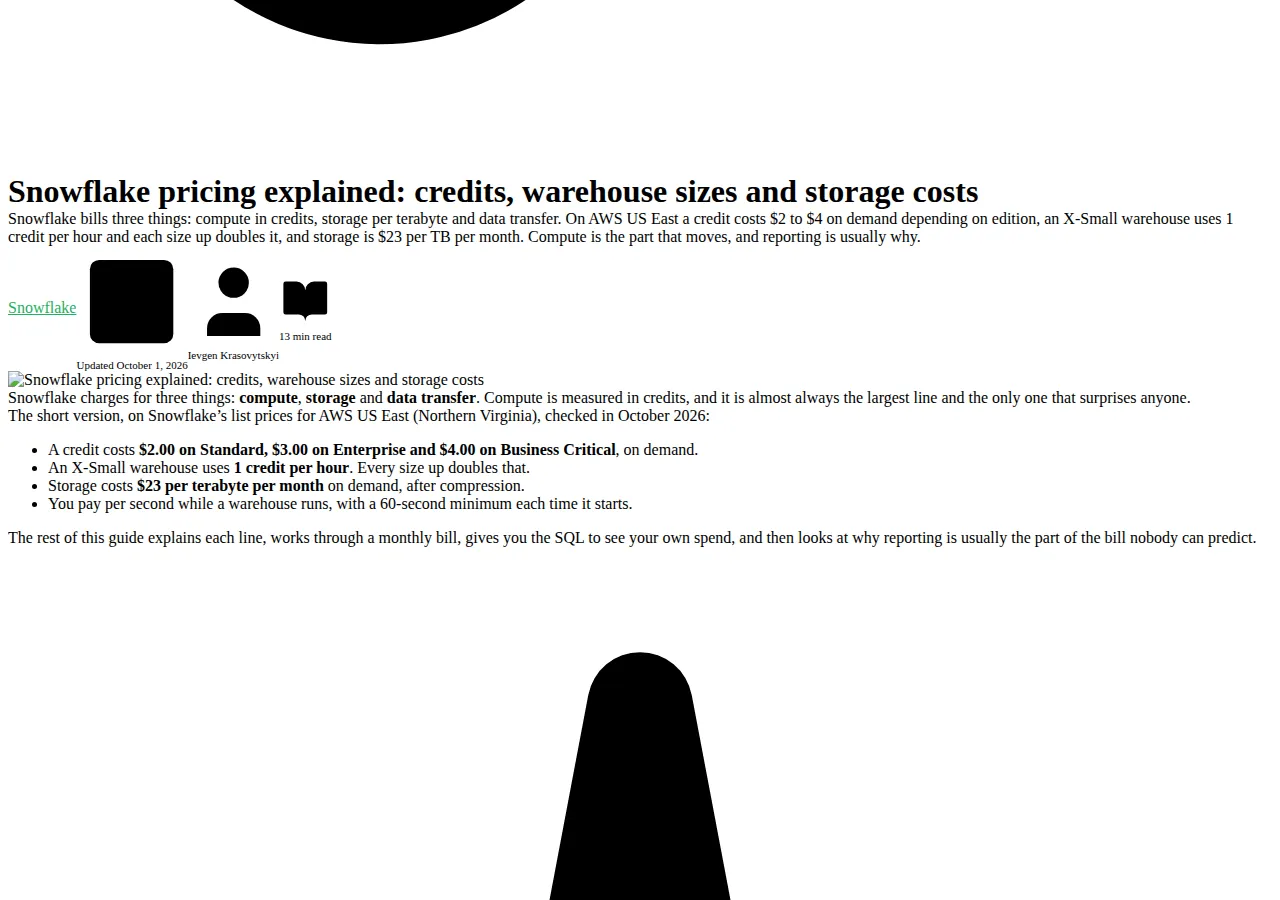
Snowflake charges for three things: compute in credits, storage per terabyte, and data transfer. The credit price depends on the edition, the cloud, the region, and whether the buyer pays on demand or prepays capacity. On demand in AWS US East (Northern Virginia), one credit costs $2.00 on Standard, $3.00 on Enterprise, and $4.00 on Business Critical, with Virtual Private Snowflake at $6.00. The same credit costs 30 percent more in Frankfurt — $2.60, $3.90, and $5.20 — and storage costs $23 per terabyte per month on AWS US East, measured on the average stored after compression. Pre-purchased capacity lowers the credit price, but the discount is negotiated per order and unpublished, so this guide prices on demand throughout.
The warehouse is the clock: its size sets how many credits it burns per hour — whether or not a query is executing. On a standard Gen1 warehouse, X-Small burns 1 credit an hour, Small 2, Medium 4, Large 8, X-Large 16, and the sizes double to 6X-Large at 512. Billing is per second with a 60-second minimum each time a warehouse starts or resumes. The edition decides the feature set: Standard is the entry offering with one day of Time Travel, Enterprise adds multi-cluster warehouses, 90-day Time Travel, and sensitive-data detection, and Business Critical adds private network connections, customer-managed keys, and HIPAA, PCI DSS, and FedRAMP support. This guide prices Enterprise as the default because that is the edition most teams actually run.
The Gen2 trap is the detail that changes the bill by a third. Snowflake's newer Gen2 warehouses burn more credits per hour for the same size name: a Medium is 5.4 credits an hour on AWS and GCP instead of 4, and an X-Small is 1.35 instead of 1. A team that creates a Medium warehouse with default settings on AWS Enterprise pays $16.20 an hour, not the $12.00 the Gen1 table gives — a 35 percent premium for the same size label. The consumption table prices Gen2 separately, and the pricing page's edition table does not warn the buyer which generation a new warehouse gets. > [!WARNING]
Databricks: DBUs, compute types, and the second bill
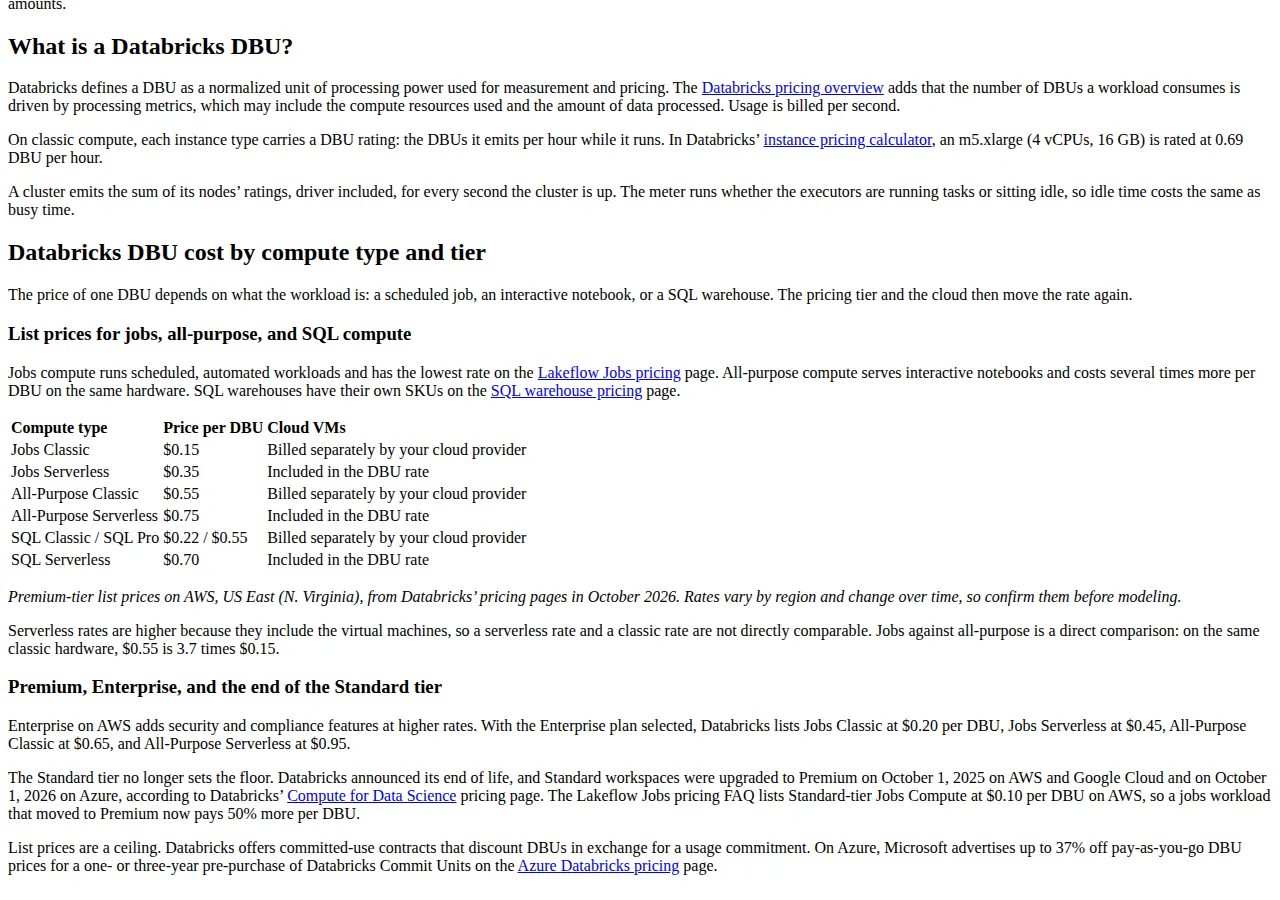
Databricks charges in Databricks Units, and the dollar price of a DBU depends on which compute type burns it. On the Premium tier in AWS US East, Jobs Compute costs $0.15 per DBU on classic clusters and $0.35 serverless; All-Purpose Compute costs $0.55 classic and $0.75 serverless; SQL warehouses cost $0.22 classic, $0.55 for Pro, and $0.70 serverless. The Enterprise tier raises Jobs Classic to $0.20 per DBU, Jobs Serverless to $0.45, All-Purpose Classic to $0.65, and All-Purpose Serverless to $0.95, while the SQL rates stay the same. Databricks retired its Standard tier on AWS and Google Cloud in October 2025 and on Azure in October 2026, so Premium is now the entry tier.
The second bill is the one first-time buyers miss. On classic compute, the DBU rate is the platform fee only: the cloud provider bills the virtual machines separately, and Databricks says so directly on its own pricing page — non-serverless estimates do not include the cost of the required cloud services. Serverless rates are higher because they include the machines. Cloud infrastructure routinely runs 50 to 100 percent of the DBU charges on classic compute, which means a Jobs Classic workload priced at $150 in DBUs costs $225 to $300 once the VMs are added. A serverless rate and a classic rate are therefore not directly comparable, and any comparison that puts $0.15 next to $0.35 without adding the VM line is understating the classic cost by half.
The compute-type spread is the largest single lever on the Databricks bill. Jobs Compute at $0.15 per DBU and All-Purpose Compute at $0.55 per DBU run the same workload on the same hardware; the difference is that Jobs runs scheduled, unattended work and All-Purpose runs interactive notebooks. The identical workload costs 3.7 times more on All-Purpose for no functional difference, and the single most avoidable Databricks cost mistake is running a scheduled, unattended job on All-Purpose Compute instead of Jobs Compute. Committed-use contracts discount the DBU rate, with larger commitments earning larger discounts, but the discount is negotiated and unpublished, so this guide prices list throughout.
The same workload, priced on both meters
Snowflake's meter is fully determined by warehouse size and hours, so the monthly bill for a scheduled SQL workload is exact. Databricks' meter is determined by DBU volume, so the bill is stated per 1,000 DBUs, with the VM line added as the 50-to-100-percent range the platform's own cost guides report. The two meters cannot be converted into each other without running the workload, and this guide does not pretend otherwise.
| Snowflake workload | Credits | Enterprise cost | Standard cost |
|---|---|---|---|
| Medium warehouse, 8 hrs/day × 22 days | 704 | $2,112 | $1,408 |
| Medium warehouse, left running 24/7 | 2,880 | $8,640 | $5,760 |
| X-Small warehouse, 100 hrs/month | 100 | $300 | $200 |
| Storage, 10 TB | — | $230 | $230 |
| Databricks workload, per 1,000 DBUs | DBU fee | Plus cloud VMs (classic only) | Configured total |
|---|---|---|---|
| Jobs Compute, classic | $150 | $75–$150 | $225–$300 |
| Jobs Compute, serverless | $350 | Included | $350 |
| All-Purpose Compute, classic | $550 | $275–$550 | $825–$1,100 |
| All-Purpose Compute, serverless | $750 | Included | $750 |
| SQL Classic warehouse | $220 | $110–$220 | $330–$440 |
| SQL Serverless warehouse | $700 | Included | $700 |
Three facts fall out of the tables. First, the edition premium is 50 percent on every Snowflake credit: the same 704-credit month costs $2,112 on Enterprise against $1,408 on Standard, and the buyer who needs Enterprise features pays that premium on all of it, not on a line item. Second, the idle warehouse is the most expensive line in the guide: a Medium left running 24/7 costs $8,640 a month on Enterprise, against $2,112 run eight hours a day on working days — auto-suspend is the difference between a $2,000 bill and an $8,600 one. Third, the serverless premium is honest on both sides: Databricks Jobs Serverless at $350 for 1,000 DBUs costs more than Jobs Classic at $150, but the classic total is $225 to $300 once the VMs are added, so the real serverless premium is 17 to 56 percent, not 133 percent.
The decision table
| Workload | Platform | Why | Authority |
|---|---|---|---|
| Scheduled ETL pipelines | Databricks Jobs Compute | $0.15 per DBU, the lowest rate on either card; runs unattended by design | Databricks Lakeflow Jobs pricing |
| Interactive notebooks and data science | Databricks All-Purpose, or Snowflake | $0.55 per DBU plus VMs, against a right-sized warehouse at $12/hr Enterprise | Databricks Compute for Data Science pricing |
| BI dashboards, SQL analytics | Either, measured | SQL Serverless $0.70 per DBU infra-included vs a Medium warehouse at $12–$16.20/hr | Databricks SQL pricing; Snowflake consumption table |
| Machine learning, Python-heavy work | Databricks, or Snowflake Snowpark | Snowpark-optimized warehouses burn 6 credits/hr at Medium vs 4 standard | Snowflake consumption table |
| Regulated data, HIPAA / PCI DSS | Snowflake Business Critical | $4.00 per credit buys the compliance feature set in one edition | Snowflake pricing page |
| Spiky, unpredictable SQL | Databricks SQL Serverless | No warehouse to size, no idle burn, infra included in the DBU rate | Databricks SQL pricing |
The crossover to remember is not a rate but a measurement. Credits and DBUs cannot be converted on paper, so the buyer who models both on the same workload for one week gets a real number, and the buyer who trusts a rate-card comparison gets a marketing number. Run the trial on the workload that costs the most, not the one easiest to move, and measure idle separately from work time: idle is where both platforms quietly take the largest share of the bill.
Founder & CEO Insight — Enow A. Jovial
The measurement sequence
The sequence matters because the trial is the only honest conversion between credits and DBUs. Run it in order, and do not sign a capacity commitment until the trial numbers are in hand.
- [x] Step 1: Name the workload. Pick the single most expensive workload — the nightly pipeline, the dashboard fleet, or the training job — and write down its current cost, its run hours, and its data volume.
- [x] Step 2: Price Snowflake on the schedule. Size the warehouse to the workload, set auto-suspend to minutes, and price the hours at the Gen2 rate unless the warehouse is explicitly Gen1. Add storage at $23 per terabyte.
- [x] Step 3: Price Databricks on the compute type. Assign each job to Jobs, All-Purpose, or SQL, and price the DBU rate for that type on Premium. Add the VM line at 50 to 100 percent of the DBU fee on classic compute, or use the serverless rate with the machines included.
- [x] Step 4: Run both for one week. Execute the same workload on both platforms, capture the credits burned and the DBUs consumed, and price both at list. Do not annualize a single day.
- [x] Step 5: Measure idle separately. Record the hours the warehouse sat running with no query and the hours the cluster sat up with no notebook attached. Price the idle line on its own — it is usually the largest line.
- [x] Step 6: Decide on the configured total. Compare the full monthly total — platform fee, cloud bill, storage, and idle — not the per-unit rate. Then, and only then, negotiate a capacity or committed-use contract against the measured volume.
For the three-way warehouse comparison that prices ClickHouse alongside Snowflake, the ClickHouse vs Snowflake vs BigQuery analytics warehouse pricing guide runs the same storage and scan math. For the pipeline that feeds either platform, the Fivetran vs Airbyte vs Stitch ELT pipeline pricing playbook prices the ingestion layer. Run the trial math through the ROI calculator before the first production run, and re-read both vendors' consumption tables the week you sign — these November 2026 reads age fast.