Every analytics warehouse is only as good as the pipeline that feeds it, and the pipeline is where the bill hides. Fivetran, Airbyte, and Stitch all move data from SaaS apps and databases into a warehouse, and all three will quote a starting price that has almost nothing to do with what you will pay at your volume. They do not sell the same thing: Fivetran sells monthly active rows per connection, Airbyte sells credits, and Stitch sells flat row tiers. Until you convert your volume into each vendor's meter, the prices are not comparable.
The three products also differ in what they are. Fivetran is a managed ELT service with 700+ fully managed connectors. Airbyte is two products in one brand: Airbyte Core, the open-source edition you self-host on your own Kubernetes cluster, and Airbyte Cloud, the managed service metered in credits. Stitch is the oldest of the three — a cloud-only ELT service built on the open-source Singer spec, owned by Qlik — and its own site now directs new buyers toward Qlik Talend Cloud.
Three meters, three bills
| Vendor | Meter | Entry price | What the meter counts |
|---|---|---|---|
| Fivetran | Monthly Active Rows (MAR) per connection | Free to 500,000 MAR; paid from $5 base per connection | Each distinct row key changed in the month, counted once |
| Airbyte Cloud | 6 credits per million API rows; 4 per GB of database data | Standard $20/month, 5 credits included, $5 per extra credit | API rows; gigabytes in transit from databases and files |
| Stitch | Rows replicated per month, flat tiers | Standard from $100/month | Rows replicated, in tiers from 5 million to 300 million a month |
The meter decides the bill more than the rate does: a row that changes thirty times in a month is one MAR on Fivetran however many times it syncs, while Airbyte's customer pays for the gigabytes that move. Full-refresh syncs are the exception everywhere: Airbyte charges every row synced on a full refresh, and Fivetran counts the rows that change. A forced reset after a schema change is billable on both — the reset is a cost decision, not a housekeeping one.
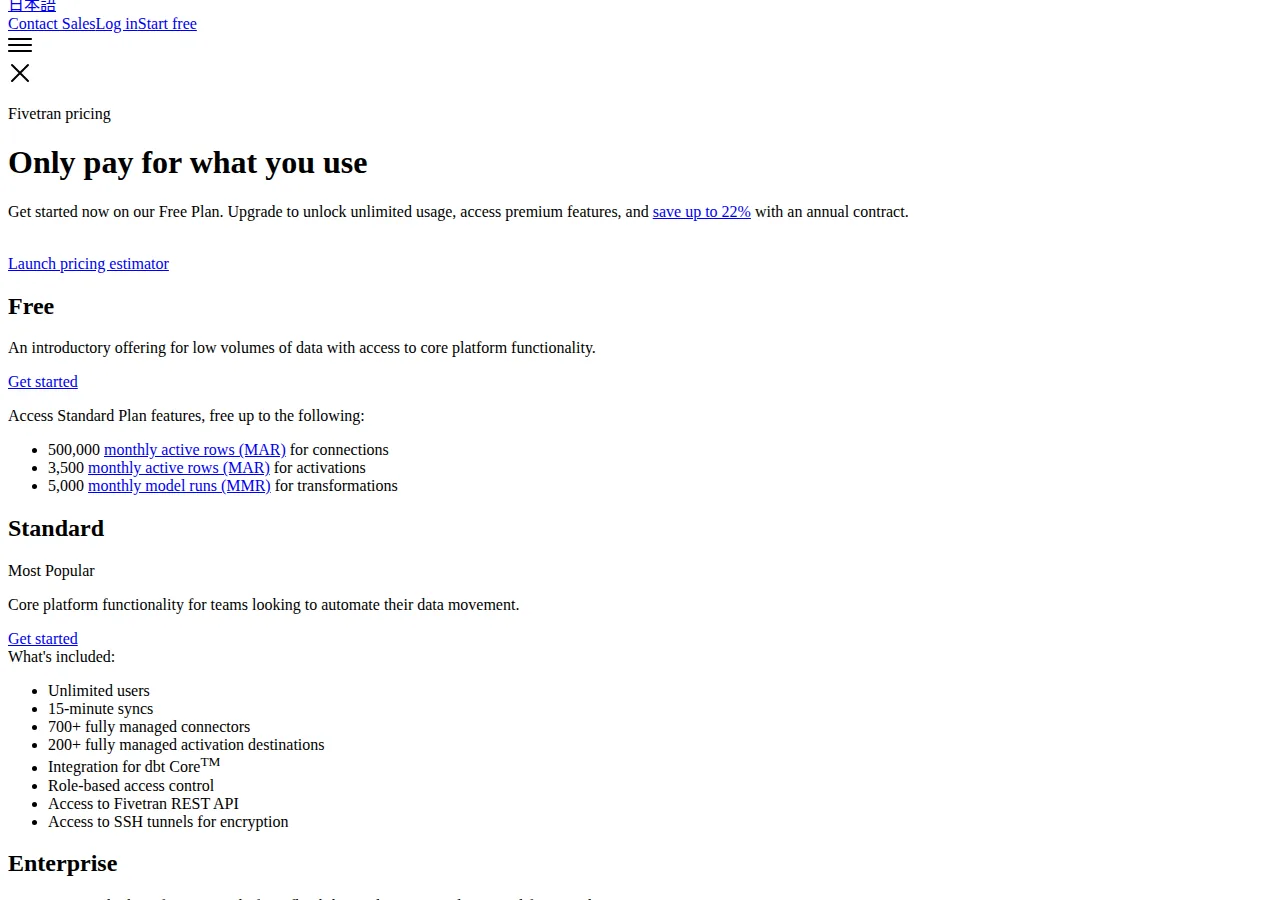
On Standard, a connection with 1 to 1 million MAR carries a $5 base plus $495 per million above the band start: 100,000 MAR costs $54.50, 500,000 costs $252.50, 1 million costs $500. Above 1 million the rate falls — $170 per million to 4 million, then $58 per million — so 10 million MAR in one connection costs $1,358. Enterprise runs about a third higher, Business Critical a little over twice as high. Free covers 500,000 connection MAR a month plus 3,500 activation MAR and 5,000 model runs. Since January 1, 2026, deleted source rows count as MAR, raising the bill of any source with heavy churn.
Airbyte's pricing changed on September 21, 2026, and most ranking guides still show the old plans: Standard moved from $10 a month with four credits to $20 a month with five, and the extra credit from $2.50 to $5. At $5 a credit, one credit covers about 167,000 API rows or 250 MB of database or file data — $30 per million API rows and $20 per gigabyte of database data once the included credits are used. Plus sells fixed credit packages from $189 a month for 40 credits up to $4,999 for 2,000, adding SSO and 15-minute syncs. Pro and Enterprise Flex price by capacity — Data Workers — through sales. The Cloud trial runs 14 days or 400 credits, whichever runs out first. Airbyte Core carries no licence fee under the Elastic License 2.0, but the servers and the engineer time are not free: self-hosting trades a vendor invoice for cluster time, Helm upgrades, and on-call.
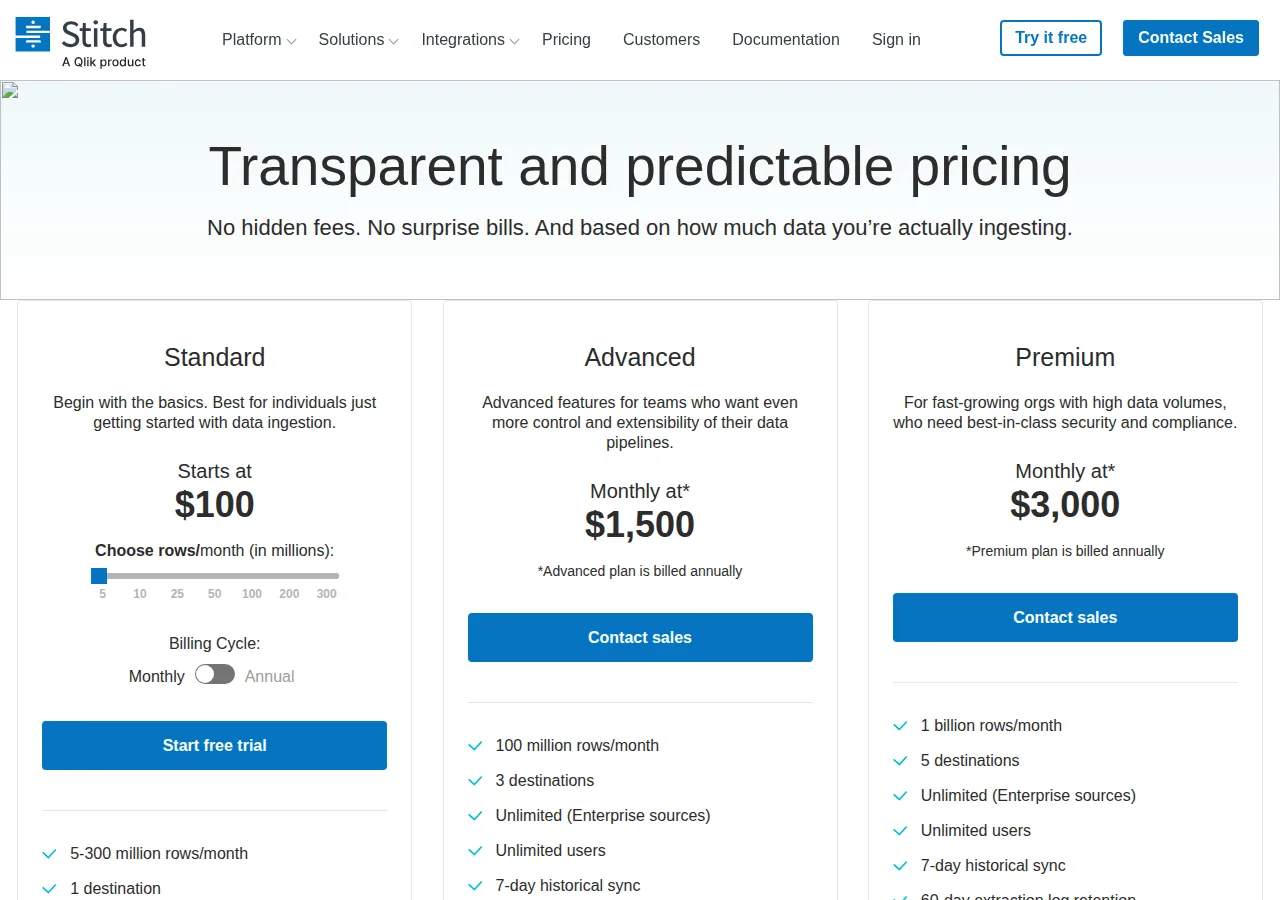
Stitch is the simplest to price and the hardest to grow with. Standard starts at $100 a month for 5 million rows, stepping up through row tiers to 300 million, with one destination, ten Standard sources, and five users. Advanced is $1,500 a month billed annually for 100 million rows, three destinations, unlimited sources and users. Premium is $3,000 a month billed annually for 1 billion rows and five destinations. The catalog holds around 130 to 140 sources, the minimum schedule is 30 minutes, and only one replication job runs at a time per integration — if a job is still running when the next is due, the new one is skipped. Stitch extracts and loads only: no transformations, with log-based incremental replication for MySQL, PostgreSQL, Oracle, SQL Server, MongoDB, and DynamoDB.
The worked example: 3 million rows and 5 gigabytes a month
Take a constructed illustration: a team syncs 3 million API rows a month plus 5 GB a month from a PostgreSQL database into Snowflake. The volume is the same on all three; only the meter changes.
Fivetran. The 3 million rows land in one connection at 3 million MAR. The Standard curve charges a $500 base at 1 million MAR plus $170 per million above it.
Airbyte Cloud, Standard. The API rows cost 6 credits per million and the database volume 4 credits per GB: 3 million rows is 18 credits, 5 GB is 20 credits, 38 in total. Standard includes 5 credits for $20; each extra credit is $5.
Stitch. The 3 million rows sit inside the entry tier of 5 million rows.
The same volume costs $840 on Fivetran, $185 on Airbyte, and $100 on Stitch. Fivetran's per-connection MAR curve is priced for teams that value the managed connector catalog and the 15-minute syncs. At this volume, the premium is $655 a month over Stitch and $740 a month over Airbyte's meter.
Now scale the same illustration to 100 million API rows. Fivetran's published curve puts 100 million MAR at $2,893.52 on Standard. Airbyte needs 600 credits — $20 plus 595 extra credits at $5, or $2,995 a month on Standard overage, before the database volume. Stitch's 100 million rows land on the Advanced tier at $1,500 a month billed annually. The ranking flips: at 100 million rows, Stitch is cheapest, Fivetran second, Airbyte most expensive. There is no cheapest ELT vendor, only a cheapest vendor at a given volume.
The per-connection trap: Fivetran's curve bills each connection alone
Fivetran's volume discount stops at each connection: ten connections at 1 million MAR each cost ten times the 1-million-MAR price, not the 10-million-MAR price.
The same 10 million rows cost $5,000 across ten connections and $1,358 in one — a 3.7x multiple for the same data. Six million MAR split across ten connections at 600,000 each costs 10 times $302, or $3,020 a month, against $1,126 in one 6-million-MAR connection. The fix is architectural: consolidate sources into fewer, larger connections where the connector allows it, and count the MAR per connection — not per account — before signing.
Founder & CEO Insight — Enow A. Jovial
Sync frequency, CDC, and the limits that decide the choice
| Capability | Fivetran | Airbyte Cloud | Stitch |
|---|---|---|---|
| Fastest sync, paid plans | 15 min (Standard); 1 min (Enterprise) | 15 min (Plus); 5 min (Pro); hourly (Standard) | 30 min, all plans |
| Change data capture | Log-based CDC | Log-based CDC | Log-based incremental on major databases |
| Transformations | dbt Core, metered in model runs (5,000 free a month) | dbt on Cloud | None — extract and load only |
| Reverse ETL / activations | Activations, metered separately | Available on higher tiers | None |
| Self-hosted option | Hybrid Deployment (Enterprise) | Airbyte Core, free software | None — cloud only |
| Connector catalog | 700+ fully managed | 700+ | ~140 sources |
| Authority | Fivetran pricing + Service Consumption Table, Feb 1, 2026 | Airbyte pricing, Sep 21, 2026 | Stitch pricing, Oct 2026 |
The sync-frequency row is the one that kills the most evaluations. A team that needs five-minute freshness cannot buy it on Fivetran Standard or on Airbyte Standard: Fivetran's one-minute syncs need Enterprise, Airbyte's five-minute syncs need Pro, and Stitch cannot go below 30 minutes at any price. Stitch's 130-odd sources cover the common SaaS apps and the major databases, but a team with a long tail of niche sources will hit the catalog wall. And the transformation row decides the architecture: if the warehouse needs dbt models run inside the pipeline, Stitch forces a second tool.
Who should pick which — and who should not
Pick Fivetran when the connector catalog is the constraint: 700+ fully managed connectors and 15-minute syncs on Standard, for a team that would rather pay the MAR premium than operate a pipeline. Do not pick it when the volume is spread across many small connections, or on a high-churn source, where the deleted-rows change raises the bill.
Pick Airbyte Cloud when the volume is large and the sources are mixed: credits price rows and gigabytes on one meter, Plus buys 15-minute syncs and SSO at $189 for 40 credits, and the same connector code runs in Core if you ever need to self-host. Do not pick Standard when syncs must run faster than hourly, and do not build a business case on any guide that still quotes $2.50 a credit.
Pick Airbyte Core when data residency or a sub-five-minute sync cadence is a hard requirement and the team already operates Kubernetes. The software is free; the cluster, the upgrades, and the on-call are the price. Do not pick Core to save money on a small volume — at 3 million rows, Cloud Standard costs $185 a month.
Pick Stitch when the shape is simple: a handful of common sources, a single destination, row volume under the tier, and no transformations. At $100 a month for 5 million rows it is the cheapest honest price in this guide. Do not pick it when the catalog, the 30-minute floor, or the absence of transformations will force a second tool within a year.
The Stitch problem: a product being absorbed
The price comparison above treats Stitch as a going concern, and that needs a correction. Stitch was acquired by Talend in 2018, and Qlik acquired Talend in 2023. Stitch still runs as a standalone product with its own pricing and catalog, and Qlik has announced no end-of-life date — but its site now directs new buyers toward Qlik Talend Cloud, and reviewers describe new connector and feature velocity as slow since the acquisition. The $100 entry price is real and the product works today, but a team that adopts Stitch now is adopting a product whose owner is steering new customers elsewhere. That is a different risk from price: the risk of migrating off a pipeline in twelve months and re-validating every warehouse table. For a new deployment, that risk is usually worth more than the $85 a month Stitch saves over Airbyte at 3 million rows.
The same discipline applies to the other two vendors. Fivetran merged with dbt Labs in June 2026, and Airbyte restructured its plans twice in 2026. None of the three prices in this guide is permanent — the figures are list prices from the vendors' own pages as read in November 2026. Confirm them on the pricing page before you sign, and re-run the worked example with your own volumes.
The selection sequence
- Measure the volume in each meter. Count rows per connection for Fivetran, API rows and database gigabytes for Airbyte, and total rows for Stitch. If you cannot state all three, measure first.
- Price the same volume three ways. Use the worked example above as the template: one connection on Fivetran, credits on Airbyte Standard, row tier on Stitch. The cheapest at your volume is the shortlist.
- Check the frequency floor. If the business needs five-minute freshness, only Fivetran Enterprise and Airbyte Pro qualify; if 30 minutes is enough, Stitch stays in the running.
- Check the catalog. List every source. One source outside Stitch's ~140, or outside the tier you priced, removes Stitch from the shortlist.
- Check the exit. Ask each vendor what a migration off the product costs — connector rebuilds, historical re-syncs, and the full-refresh bill.
- [x] Volume measured in all three meters, from the trial.
- [x] Same volume priced three ways, with your numbers.
- [x] Frequency floor confirmed — 15, 5, or 30 minutes, against the requirement.
- [x] Catalog checked source by source.
- [x] Exit priced, before signing.
The warehouse comparison in the ClickHouse vs Snowflake vs BigQuery guide prices the destination these pipelines feed, and the serverless database guide prices the operational databases they read from. Price the pipeline, the warehouse, and the database together. Run the numbers through the pricing calculator once the three meters are known, and let the volume — not the starting price — choose the vendor.