ClickHouse vs Snowflake vs BigQuery: Analytics Warehouse Pricing
A founder storing 10 terabytes and scanning 50 terabytes a month can pay $463 a month or $1,286 a month for the same workload shape — and both numbers can be correct. The gap is not a discount. It is the meter. ClickHouse bills compute units by the hour, Snowflake bills credits by the warehouse-hour, and BigQuery bills terabytes scanned. Every rate below comes from a vendor pricing page opened this cycle: ClickHouse and BigQuery from their own published pages, Snowflake from its consumption table as reported by three independent 2026 guides — its own pricing page renders no figures in a browser. The message-queue pricing comparison and the streaming pricing comparison face the same unit mismatch.
Who this is for — and who should stop here
This guide is for a founder, data lead, or engineer choosing the warehouse for a product's analytics. You roughly know your volumes and want the monthly bill before committing.
It is not for a team needing a transactional database: warehouses scan millions of rows, they do not run checkouts. It is not a benchmark: no query was run for this guide. The subject is price, and only price.
> [!FOUNDER]
> "Every warehouse vendor will show you a price that looks small. The price is never the lie. The lie is the unit it is printed in. A credit, a slot, and a scanned terabyte are three different rulers, and a vendor picks the ruler that makes its own number look smallest. Convert all three to the same workload before you believe any of them."
> — Enow A. Jovial, Founder & Chief Executive Officer
What an analytics warehouse is
An analytics warehouse is a database built for reading a lot of data at once. It stores data in columns, so a query summing a year of revenue reads only the revenue column. Storage and compute are separate: data sits still cheaply while query machines spin up and down.
ClickHouse Cloud is managed open-source ClickHouse, scaling to zero when idle. Snowflake is fully managed: compute is a virtual warehouse you size, start, and stop; storage is a separate per-terabyte charge. BigQuery is Google's serverless warehouse: pay for the data each query scans, or reserve slots, virtual CPUs, by the hour. On BigQuery a wide query costs most, on Snowflake a slow query, on ClickHouse a service left running.
The three meters, converted
A Snowflake credit is not a BigQuery slot, and neither is a ClickHouse compute unit.
| Meter | What one unit is | What it costs | Authority |
| :--- | :--- | :--- | :--- |
| ClickHouse unit | 8 GiB RAM, 2 vCPUs, per minute | $0.2181 Basic, $0.2985 Scale, $0.3903 Enterprise per unit-hour, us-east-1 | ClickHouse pricing page |
| Snowflake credit | One hour of an X-Small warehouse (Gen1); each size up doubles credits/hour | $2.00 Standard, $3.00 Enterprise, $4.00 Business Critical per credit, on-demand, AWS US East | Consumption Table, eff. 30 Sep 2026 |
| BigQuery slot | One virtual CPU, per second, one-minute minimum | $0.04 Standard, $0.06 Enterprise, $0.10 Enterprise Plus per slot-hour, us-central1 | Google Cloud pricing page |
| BigQuery scanned TiB | One tebibyte processed by a query | $6.25 per TiB, first 1 TiB per month free | Google Cloud pricing page |
A Snowflake Small burns 2 credits an hour, doubling to 512 for a 6X-Large. Four ClickHouse units (8 vCPUs, 32 GiB RAM) are the models' small service; a Snowflake Small and BigQuery on-demand are the equivalents.
ClickHouse Cloud: the meter
Storage is $25.30 per TB per month on every tier, metered on compressed size in object storage, plus backups. The vendor's FAQ states analytical data typically compresses around 10 times.
Compute is metered per minute per unit-hour; one unit is 8 GiB of RAM and 2 vCPUs. Rates for N. Virginia (us-east-1) are $0.2181 per unit-hour on Basic, $0.2985 on Scale, and $0.3903 on Enterprise. Basic caps storage at 1 TB; Scale adds unlimited storage and more zones; Enterprise adds single sign-on and private networking.
!ClickHouse Scale tier pricing
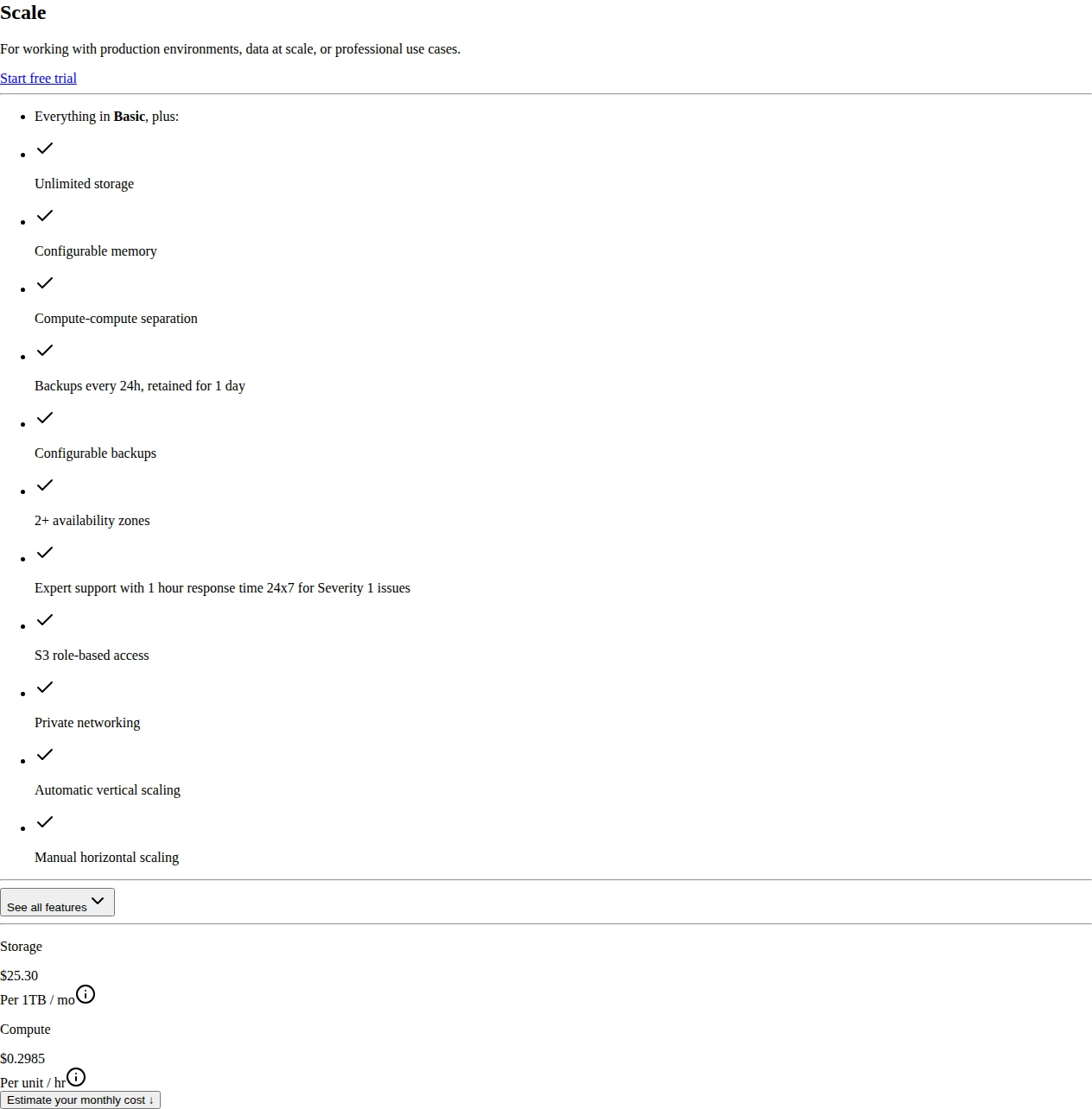
Compute scales to zero when idle; storage is billed continuously. Eight business hours a day costs roughly a quarter of around-the-clock. Internet egress starts at $0.1152 per GB, inter-region egress at $0.0312 per GB; ingress is free.
> [!TIP]
> Set a maximum autoscaling limit on every ClickHouse service on the day you create it. Without a cap, a runaway query can scale the service to a size you never approved.
Snowflake: the meter
A credit is one hour of an X-Small warehouse. On-demand list price per credit in AWS US East is $2.00 on Standard, $3.00 on Enterprise, and $4.00 on Business Critical, per the Service Consumption Table effective 30 September 2026, as reported by three independent 2026 guides. Pre-purchased capacity lowers the rate; guides report discounts of 15 to 30 percent by volume and term.
On Gen1, X-Small uses 1 credit per hour, doubling at each size to 512 for a 6X-Large. Warehouses bill per second with a 60-second minimum per start, burning credits for every second they run, query or not. New standard warehouses default to Gen2, which uses 1.35 times the credits per hour of Gen1 on AWS and GCP (1.25 times on Azure).
Storage is billed per TB per month on the daily average of compressed data, and the published record disagrees with itself. Older guides cite $40 on-demand with $23 on a capacity contract. A June 2026 check found the on-demand list for AWS US East is $23 per TB per month, $20 to $40.50 across regions, with $40 the pre-2026 rate. This guide uses $23; if your account still bills $40, add $17 per TB per month to every Snowflake storage line below.
Standard buys the core warehouse with one day of Time Travel; Enterprise adds multi-cluster warehouses, 90-day Time Travel, materialized views, and search optimization at 50 percent more per credit; Business Critical adds private connectivity, customer-managed keys, and failover at twice the Standard price. The same 1,000 credits cost $2,000 on Standard, $3,000 on Enterprise, and $4,000 on Business Critical in AWS US East.
BigQuery: the meter
On-demand pricing charges $6.25 per TiB of data processed by each query, with the first 1 TiB per month free. Capacity pricing charges per slot-hour: $0.04 on Standard, $0.06 on Enterprise, $0.10 on Enterprise Plus, pay-as-you-go in us-central1, with one-year and three-year discounts (Standard $0.036/$0.032, Enterprise $0.054/$0.048, Enterprise Plus $0.09/$0.08). Slots are virtual CPUs billed per second; commitments start at 50 slots.
!BigQuery on-demand pricing row

Storage prices four combinations. Active logical is $0.000031507 per GiB-hour — $23.552 for 1 TiB for a full month in Google's example. Long-term logical (unmodified 90 days) is $0.000021918, or $16.38 per TiB-month. Active physical is $0.000054795, or $40.96; long-term physical is $0.000027397, or $20.48. Logical bills data as stored; physical bills compressed bytes plus time travel and failsafe storage. Any edit resets the 90-day timer.
Cost controls are why on-demand survives at scale. Queries that error or hit the cache are free; charges round up to the nearest MB with a 10 MB minimum; and maximum bytes billed caps a query. Partitioning and clustering shrink the bytes processed, and the bytes processed are the bill.
The decision table
| Question | ClickHouse Cloud | Snowflake | BigQuery | Authority |
| :--- | :--- | :--- | :--- | :--- |
| Cost when idle? | Storage only; compute scales to zero | Storage only if warehouses suspended | Storage only; no provisioned compute | Vendor pages |
| Cheapest small service? | 4 units, business hours: $210.14/month (Scale) | Small warehouse, business hours: $1,056/month (Ent.) | No always-on cost; pay per TiB scanned | Models below |
| Worst bad query? | Autoscaling without a cap | Warehouse left running | Full-table scan, no partition filter | Pricing mechanics |
| Storage rate? | $25.30 per TB/month, all tiers | $23 per TB/month on-demand list, AWS US East | $23.55 per TiB/month active logical | Vendor pages |
| Cost of scale? | Add units at $0.2985 per unit-hour (Scale) | Double credits at every size step | Add slots at $0.04–$0.10/slot-hour, or scan more TiB | Vendor pages |
| Who should not buy? | Teams wanting zero ops | Spiky concurrency, no auto-suspend | Queries scanning whole tables | Editorial analysis |
Profile A: 10 TiB stored, 50 TiB scanned a month
Both profiles hold the workload constant: a small service used 8 hours a day, 22 days a month (176 hours). ClickHouse: 4 units on Scale. Snowflake: a Small warehouse on Enterprise. BigQuery: on-demand scanning, which has no hours. Profiles are in tebibytes; the other two publish per-terabyte rates, so their storage lines are understated by about 10 percent (10 TiB is 10.995 TB).
$
\text{BigQuery total} = (10 \times \$23.552) + ((50 - 1) \times \$6.25) = \$235.52 + \$306.25 = \$541.77
$
$
\text{Snowflake Enterprise total} = (10 \times \$23) + (2 \times 176 \times \$3.00) = \$230 + \$1,056 = \$1,286
$
$
\text{ClickHouse Scale total} = (10 \times \$25.30) + (4 \times 176 \times \$0.2985) = \$253 + \$210.14 = \$463.14
$
Snowflake Standard is $230 plus 352 credits at $2.00 ($704), or $934 a month. ClickHouse on Basic would be $406.54 — but Basic caps storage at 1 TB, so Scale is the honest comparison. The spread is the compute line: storage differs by $23 across all three; compute differs by $846.
Profile B: 100 TiB stored, 500 TiB scanned a month
Profile B multiplies the data by ten and holds compute constant — the same 4 units, the same Small warehouse, the same 176 hours. BigQuery's bill grows with the data; the other two compute bills move with hours and size, not scanned volume.
$
\text{BigQuery total} = (100 \times \$23.552) + ((500 - 1) \times \$6.25) = \$2,355.20 + \$3,118.75 = \$5,473.95
$
$
\text{Snowflake Enterprise total} = (100 \times \$23) + (2 \times 176 \times \$3.00) = \$2,300 + \$1,056 = \$3,356
$
$
\text{ClickHouse Scale total} = (100 \times \$25.30) + (4 \times 176 \times \$0.2985) = \$2,530 + \$210.14 = \$2,740.14
$
The ranking flips: at 100 TiB stored and 500 TiB scanned, BigQuery is the most expensive by a wide margin, because its $6.25 line grows linearly while the other compute lines stand still. Snowflake Standard is $3,004. Sensitivity: Snowflake Medium doubles Enterprise compute to $2,112 (total $4,412); Large to $4,224 (total $6,524 — past BigQuery). ClickHouse 8 units doubles compute to $420.29 (total $2,950.29, still cheapest).
> [!KEY TAKEAWAY]
> BigQuery wins when scans are small and sporadic — no always-on compute to pay for. Snowflake and ClickHouse win when scans are large and steady — compute priced by the hour, not the byte. Find your scanned volume first.
The breakeven: on-demand scanning against reserved slots
One hundred Standard slots around the clock cost 100 × 730 × $0.04, or $2,920 a month. On-demand scanning costs $6.25 per TiB above the first free TiB.
$
\text{Breakeven scanned TiB} = 1 + \frac{\$2,920}{\$6.25} = 1 + 467.2 = 468.2 \text{ TiB per month}
$
Below about 468 TiB a month, on-demand beats 100 reserved Standard slots; above it, the reservation wins. At Enterprise rates ($4,380 a month) the breakeven is 701.8 TiB; at Enterprise Plus ($7,300) it is 1,169 TiB. Run this with your own slot count before signing a commitment.
A Snowflake X-Small left running on Enterprise costs $2,190 a month; a Medium $8,760 — so auto-suspend, not size, is the first cost control. Four ClickHouse units around the clock on Scale cost $871.62 a month — and scale-to-zero cuts that to the storage line alone when nobody queries.
The risk layer
> [!WARNING]
> The most expensive failure is not a high rate. It is a meter running while nobody is watching: a Snowflake warehouse left running over a holiday weekend, a BigQuery dashboard refreshing a full-table scan every five minutes, a ClickHouse service with no autoscaling cap. Set the guardrails on the day you create the service, not the day the invoice arrives.
Runaway scans are BigQuery's risk: one query against an unpartitioned table scans the whole table, and an hourly dashboard scans it 720 times a month. Defend with partitioning, clustering, maximum bytes billed, and project cost controls.
Storage creep is the shared risk: all three bill storage continuously and none deletes data for you. Any edit resets BigQuery's 90-day timer, so a nightly-appended table never reaches long-term pricing.
Egress only shows up when you leave. ClickHouse publishes internet egress from $0.1152 per GB and inter-region from $0.0312 per GB. Snowflake and BigQuery also charge to leave, at rates that depend on destination — which is why this guide prints no egress rate for them. Before migrating out, price the exit: moving 100 TiB can exceed a month of the warehouse itself.
The selection checklist
1. Measure scanned volume first: total thirty days of query history before choosing a meter.
2. Measure stored volume after compression: load a sample and read the billed size.
3. Price always-on cost separately from per-query cost; infrequent queries favor no fixed compute.
4. Set guardrails on day one: BigQuery byte caps, Snowflake auto-suspend at 60 seconds, ClickHouse autoscaling limits.
5. Check the edition against the features: Enterprise Snowflake costs 50 percent more per credit.
6. Check the tier against the caps: ClickHouse Basic caps storage at 1 TB.
7. Run the breakeven with your own numbers; if close, stay on on-demand.
8. Price the exit before the entry: get egress rates in writing first.
9. Confirm the region: Snowflake credits cost more in Frankfurt than in Virginia.
10. Re-price quarterly: rates and defaults changed in 2026 and will change again.
Who should not buy any of these three
A team with under a terabyte of data should not buy any of these three: a managed Postgres or a DuckDB file answers the same questions for less. A team whose queries are all single-row lookups should not buy a warehouse at all. And a team that cannot name its scanned volume, stored volume, and query window should not sign a commitment. Buy a month of on-demand first, measure the three numbers, then run the models with your own figures. The pricing calculator checks the same arithmetic on your numbers. The object storage pricing comparison prices the storage layer the data often lands on first.
At 10 TiB stored and 50 TiB scanned: ClickHouse Scale $463.14, BigQuery $541.77, Snowflake Enterprise $1,286 — the whole spread is the compute line. At 100 TiB and 500 TiB scanned: ClickHouse $2,740.14, Snowflake Enterprise $3,356, BigQuery $5,473.95. Buy the warehouse whose meter matches your workload: scanned volume first, stored volume second, hours third.