An individual who owns a foreign corporation outright faces a tax result no corporation ever would: the company's profit is taxed to the individual every year, at individual rates, with no credit for the foreign tax already paid. A $5,000,000 inclusion can cost $1,850,000 at the 37% top individual rate, while a domestic corporation on the same $5,000,000 would deduct half the GILTI portion, claim a deemed-paid credit, and pay a fraction of that. Section 962 lets the individual borrow the corporation's tax treatment for one year at a time. On the regulation's own facts, the election cuts the tax on $5,000,000 of inclusions from $882,000 before credits to $104,000 after.
Who this is for
This is for a United States shareholder who is an individual — including a trust or estate — with amounts included under section 951(a) from a CFC: subpart F income and, through section 951A(f)(1)(A), the GILTI inclusion, now Net CFC Tested Income from 2026. The typical reader is a founder who owns a foreign operating company directly, or an investor with a 10% or greater CFC stake.
Do not use it blindly. The election taxes the inclusion at a flat 21% corporate rate, so if your marginal rate is below 21% and the inclusion is pure subpart F with no foreign tax to credit, the election can cost more than doing nothing — the comparison is in the decision table below. Do not use it if you cannot track the section 962 earnings and profits pools year by year. The election changes the tax on the inclusion, not the inclusion: Form 5471 and the rest of the compliance stack still apply, as our IRS Form 5471 foreign corporation reporting playbook sets out.
Hold the CFC through a single-member LLC and the LLC is disregarded: you are the US shareholder, and the election is yours — the statement carries your SSN or ITIN, with the LLC's EIN identifying it. Hold it through an S-Corp or C-Corp and the corporation is the US shareholder, not you — section 962 is not available at your level. The inclusion is income tax only — no FICA or SECA applies. Have a CPA confirm the structure before you elect.
Founder & CEO Insight — Enow A. Jovial
What section 962 actually changes
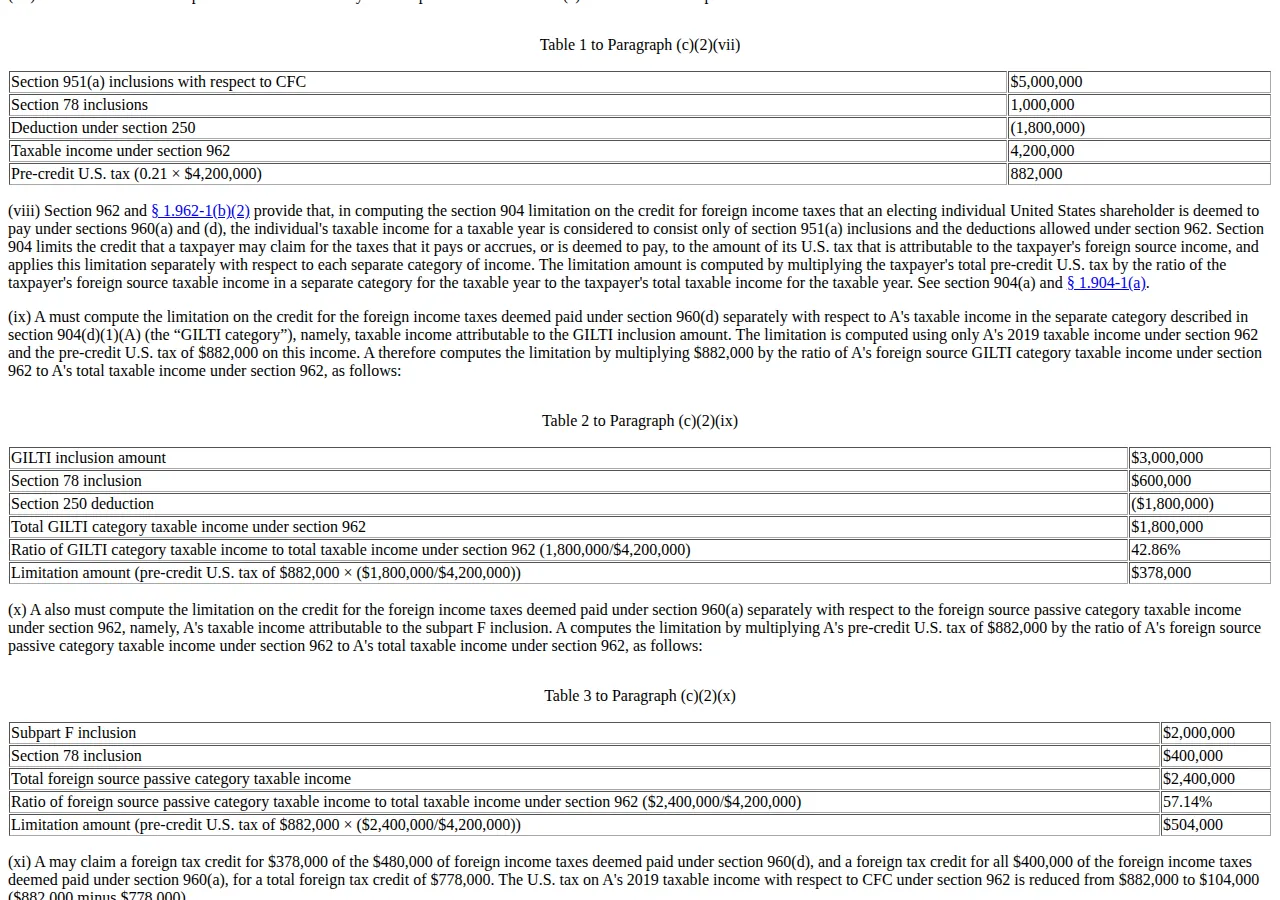
Section 962(a) does two things. Under (a)(1), the tax on section 951(a) amounts is computed as if the individual were a domestic corporation: the flat 21% rate under section 11 replaces the individual schedule under section 1. Under (a)(2), the section 960 foreign tax credit applies as if the amounts were received by a domestic corporation — the individual is deemed to have paid the CFC's foreign taxes on the inclusion, and can credit them.
Treas. Reg. § 1.962-1 fills in the three mechanics:
- The section 78 gross-up. Under § 1.962-1(b)(1)(i)(A), the electing shareholder includes in gross income the foreign taxes deemed paid under section 960, computed without the 80% haircut section 960(d) applies to GILTI. The gross-up raises the inclusion, and it raises the credit by the same amount.
- The section 250 deduction. Under § 1.962-1(b)(1)(i)(B)(3), the deductions allowed include the section 250 deduction a domestic corporation gets — 50% of the GILTI inclusion plus its section 78 gross-up, for tax years through 2025. Individuals otherwise never get this deduction.
- The deemed-paid credit. Under § 1.962-1(b)(2), sections 960(a) and 960(d) apply as though the inclusion were received by a domestic corporation: 100% of the foreign tax on the subpart F portion, 80% on the GILTI portion (90% from 2026).
Section 962(b) adds the procedure: the election is made as the Secretary prescribes, and once made it may not be revoked except with the Secretary's consent. The manner is in Treas. Reg. § 1.962-2(b): a statement filed with the return, carrying the five items below.
The regulation's worked example
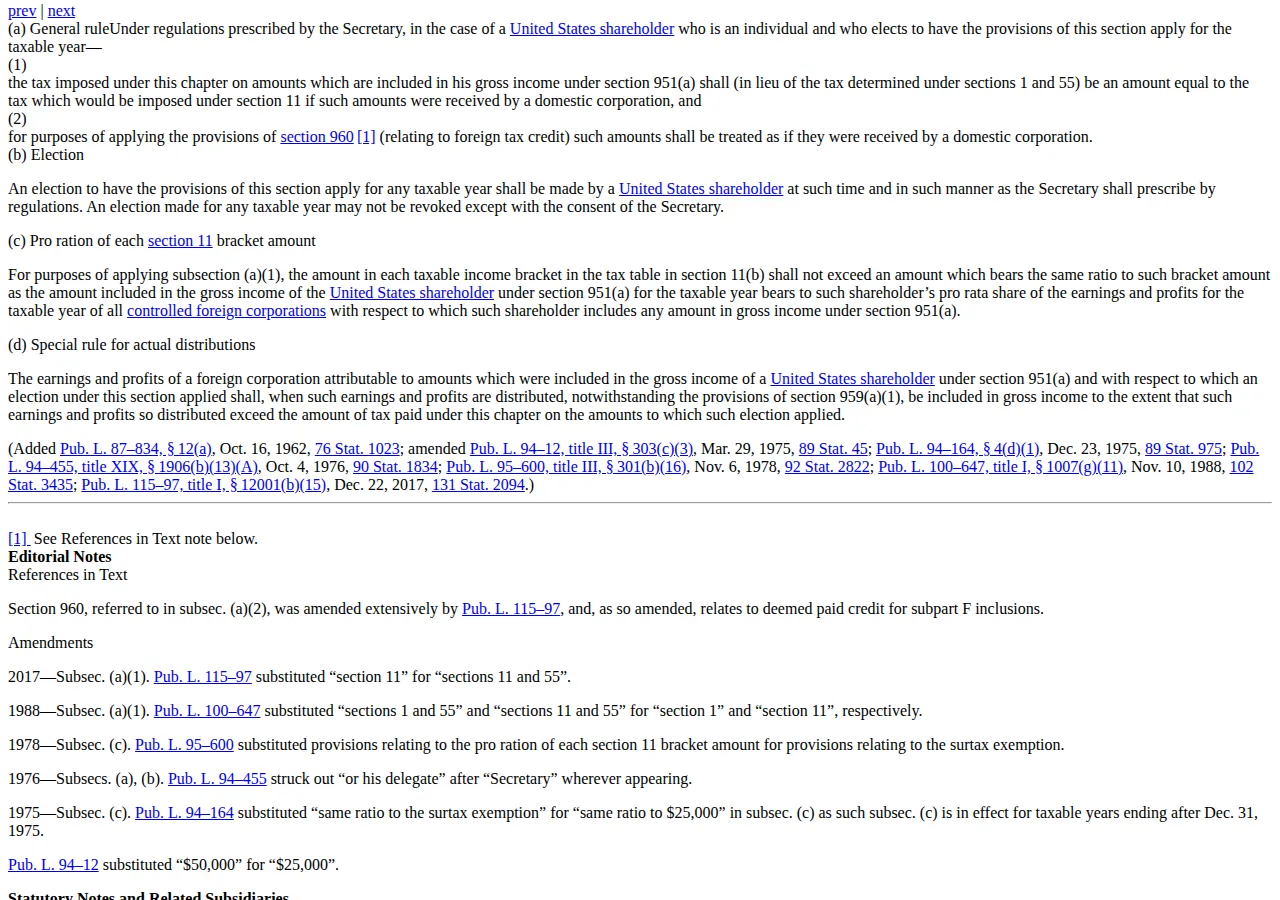
Treas. Reg. § 1.962-1(c) contains a complete worked example; every number below is the Treasury's. Individual A owns 100% of CFC. For 2019, CFC earns $6,000,000 before foreign tax, pays $1,000,000, and is left with $5,000,000: $3,000,000 of tested income (the GILTI inclusion) and $2,000,000 of passive subpart F income. Of the $1,000,000 tax, $600,000 attaches to the tested income and $400,000 to the subpart F income. A elects section 962 and claims credits under section 901.
Step 1 — the inclusions. A includes $5,000,000 under section 951(a): the $3,000,000 GILTI amount (a section 951(a) inclusion by section 951A(f)(1)(A)) plus the $2,000,000 subpart F amount.
Step 2 — the section 78 gross-up. A is deemed to pay $600,000 under section 960(d) on the GILTI portion and $400,000 under section 960(a) on the subpart F portion, and must include the full $1,000,000 in gross income under section 78, computed without the 80% limitation.
Step 3 — the section 250 deduction. A deducts 50% of the GILTI inclusion plus its section 78 gross-up:
Step 4 — taxable income and pre-credit tax.
Pre-credit tax = 0.21 × $4,200,000 = $882,000.
Step 5 — the section 904 limitation, computed separately by category. The GILTI limitation is $882,000 × ($1,800,000 / $4,200,000) = $378,000, so only $378,000 of the $480,000 deemed-paid GILTI credit is usable; $102,000 carries over. The passive limitation is $882,000 × ($2,400,000 / $4,200,000) = $504,000, so the full $400,000 subpart F credit is usable.
Step 6 — the net tax. Net section 962 tax = $882,000 − $378,000 − $400,000 = $104,000.
That is a 2.08% effective rate on $5,000,000 of inclusions. Without the election, the same $5,000,000 would be taxed at individual rates — up to 37% under section 1(j), or $1,850,000 at the top rate — with no section 250 deduction and no deemed-paid credit for the CFC's $1,000,000 of foreign tax. The regulation also taxes A's other $3,000,000 at $1,074,988 under section 1(j): 35.8% effective against 2.08% on the elected inclusions. That contrast is the whole case for the election.
Elect or not: the decision table
| Factor | Without the election | With the section 962 election | Authority |
|---|---|---|---|
| Rate on the inclusion | Individual rates under § 1, up to 37% | Flat 21% under § 11 | 26 U.S.C. §§ 962(a)(1), 1(j), 11(b) |
| Section 250 deduction | Not available to individuals | 50% through 2025, 40% from 2026 | Treas. Reg. § 1.962-1(b)(1)(i)(B)(3) |
| Deemed-paid credit | None | § 960(a) 100% on subpart F; § 960(d) 80% GILTI / 90% NCTI | 26 U.S.C. § 962(a)(2); Treas. Reg. § 1.962-1(b)(2) |
| Credit limitation | N/A | Separate § 904 baskets: GILTI vs passive | Treas. Reg. § 1.962-1(c)(2)(viii)–(xi); § 904 |
| Tax on actual distribution | Excluded as PTEP under § 959(a)(1) | Second tax on the excess over tax paid | 26 U.S.C. § 962(d); Treas. Reg. § 1.962-3(b)(1) |
| Small subpart F-only inclusion | Cheaper: 12% beats 21% | Costs more: flat 21%, no § 250 deduction | § 962(a)(1); § 1(j) rate table |
The last row is the boundary that matters most. Take a $50,000 pure subpart F inclusion, no foreign tax, and an individual in the 12% bracket: without the election the tax is $6,000; with it, 21% × $50,000 = $10,500 — the election loses $4,500. It earns its keep when the inclusion is large, when a GILTI portion carries the section 250 deduction, or when foreign tax credits are available. Run the comparison on your own numbers; price it with the ROI Calculator.
The second tax
The election's price is section 962(d): earnings and profits attributable to elected inclusions are not excluded on distribution the way ordinary PTEP are under section 959(a)(1). Instead, the distribution is included in gross income to the extent it exceeds the tax paid under chapter 1 on the elected amounts.
Treas. Reg. § 1.962-3 splits the pool in two. Excludable section 962 earnings and profits equal the income tax paid under chapter 1 on the elected amounts — on the regulation's facts, $104,000 of distributions come home tax-free. Taxable section 962 earnings and profits are everything above that, taxed again when distributed. Keep a running ledger of the two buckets for each CFC, by year, and time distributions against the excludable balance first. The failure mode is electing in a distribution year without modelling the second tax: the cash arrives, the tax follows, the saving evaporates.
Without the election, the full $5,000,000 would be PTEP, excludable on distribution under section 959(a)(1) — but the individual would have paid up to $1,850,000 for it. With the election, the individual pays $104,000 on inclusion and keeps $104,000 of excludable earnings and profits; the remaining $4,896,000 is taxable again only if distributed. A founder who leaves profit in the company may never pay the second tax; a founder who distributes every dollar every year pays it every year — so the distribution plan belongs in the decision.
The 2026 rewrite: GILTI becomes NCTI
The One Big Beautiful Bill Act (Pub. L. 119-21, July 4, 2025) rewrites the regime for tax years beginning after December 31, 2025. GILTI becomes Net CFC Tested Income (NCTI) under section 951A as amended; the 10% return on tangible assets (QBAI) is repealed, so 100% of tested income is in scope; the section 250 deduction falls from 50% to 40%; and the deemed-paid credit under section 960(d) rises from 80% to 90%. The effective corporate rate before credits rises from 10.5% to 12.6%. Our Form 8992 GILTI inclusion playbook carries the full 2026 transition.
What does the rewrite do to the election? Re-run the example on 2026 rules — this is our editorial derivation, not a Treasury figure. The section 250 deduction becomes 40% × ($3,000,000 + $600,000) = $1,440,000; taxable income under section 962 becomes $5,000,000 + $1,000,000 − $1,440,000 = $4,560,000; and the pre-credit tax becomes 21% × $4,560,000 = $957,600. The deemed-paid NCTI credit is now 90% × $600,000 = $540,000, capped by section 904 at $957,600 × 47.37% = $453,600. The passive credit is still $400,000 in full. Total credit: $853,600. Net tax: $957,600 − $853,600 = $104,000.
Net tax: $104,000 — identical to the 2019 result, because the smaller deduction added $75,600 of pre-credit tax and the larger credit added exactly $75,600 of usable credit. That coincidence is specific to these facts: a higher-tax CFC would see the credit side win, a zero-tax CFC only the deduction cut. Re-run the computation on your CFC's actual foreign tax rate before electing.
Filing the election: the statement
Treas. Reg. § 1.962-2(b) prescribes the manner: a statement filed with the return for the year, carrying five items:
- The name, address, and taxable year of each CFC on which the shareholder is a United States shareholder, and of every other entity in the applicable chain of ownership under section 958(a).
- The amounts, corporation by corporation, included in the shareholder's gross income for the year under section 951(a).
- The shareholder's pro rata share of the earnings and profits of each such CFC, and the foreign income, war profits, excess profits, and similar taxes paid on them.
- The distributions received during the year from each CFC, split between excludable section 962 earnings and profits, taxable section 962 earnings and profits, and other earnings and profits, by source year.
- Any further information the Commissioner prescribes by forms and accompanying instructions.
The election may be made only by an individual United States shareholder — including a trust or estate, and an individual who is a shareholder by constructive ownership under section 958(b). Section 962(c) pro-rates the section 11 brackets for partial owners by the ratio of the inclusion to the shareholder's pro rata share of the CFCs' earnings and profits.
Execution checklist
- [x] Step 1 — Confirm shareholder status. Verify 10% ownership (direct or constructive under section 958) and a section 951(a) or 951A inclusion for the year.
- [x] Step 2 — Run both computations. Compute the tax with the election (21% on inclusion plus section 78, less section 250, less deemed-paid credits by section 904 basket) and without it (individual rates, no section 250, no deemed-paid credit). Elect only if it wins after the section 904 limits.
- [x] Step 3 — Model the distribution. Project the section 962(d) second tax on planned distributions; if distributions are imminent, the advantage may be smaller than the inclusion math suggests.
- [x] Step 4 — Re-run on 2026 rules. For tax years beginning after December 31, 2025, use the 40% section 250 deduction, the 90% deemed-paid credit, and the NCTI base with no QBAI exclusion.
- [x] Step 5 — Draft and file the statement. Prepare the five-item statement under Treas. Reg. § 1.962-2(b), corporation by corporation, and attach it to the timely filed return; keep a copy with the ledger.
- [x] Step 6 — Open the ledger and re-decide annually. Record excludable versus taxable section 962 earnings and profits for each CFC, by year, and update it on every distribution. Re-run steps 2–4 every year — the inclusion mix, the foreign tax rate, and the distribution plan all change the answer.