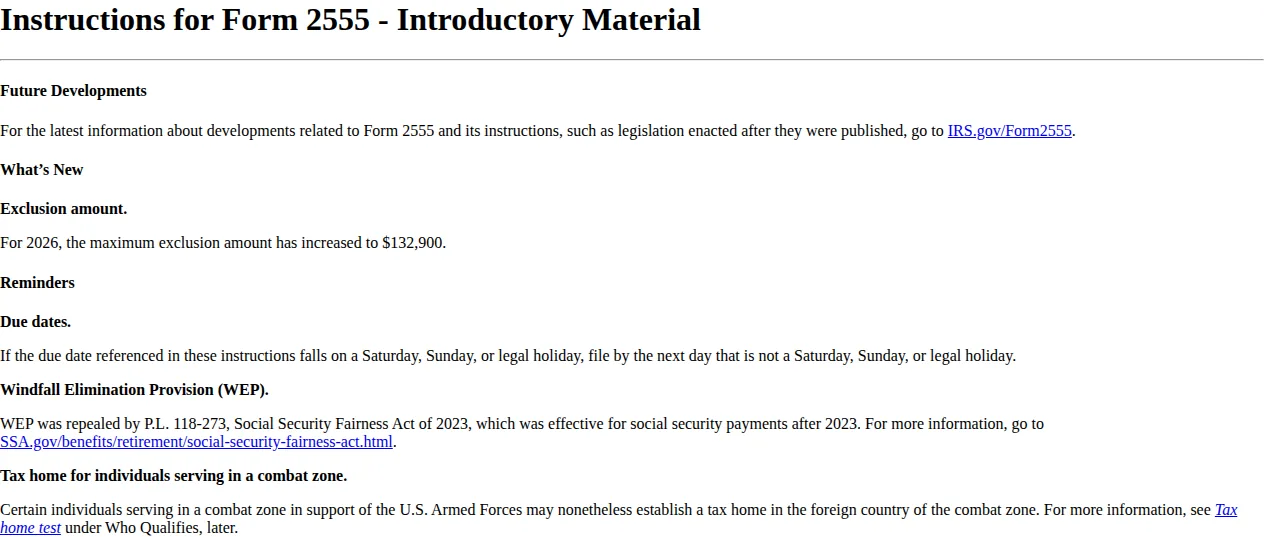
Section 911 lets a US citizen or resident alien working abroad exclude a slice of foreign earned income from US income tax. For 2026 the slice is $132,900, set by Rev. Proc. 2025-32, with housing on top.
The statute in one paragraph
Section 911(a) excludes, at a qualified individual's election, the foreign earned income exclusion amount and the housing cost amount from gross income. The election is made separately for each. Section 911(b)(1) defines foreign earned income as amounts from sources within a foreign country for services performed during the qualifying period. Section 911(b)(2)(D) sets the base exclusion at $80,000, increased by the cost-of-living adjustment for taxable years beginning after 2005 and rounded down to the next lowest multiple of $100 — producing $130,000 for 2025 and $132,900 for 2026.

Who qualifies: tax home plus one of two tests
Three gates: a foreign tax home throughout the qualifying period, foreign earned income, and either test — bona fide residence or physical presence. A tax home is the regular place of business or post of duty.
The bona fide residence test requires an uninterrupted period of bona fide residence in a foreign country that includes an entire taxable year — January 1 through December 31 for a calendar-year filer. It is open to US citizens and to resident aliens who are citizens or nationals of a treaty country. Living abroad for a year does not automatically create bona fide residence; intention decides it.
The physical presence test is arithmetic, not intent. Section 911(d)(1)(B) requires presence in a foreign country or countries for at least 330 full days in any 12 consecutive months. The 330 days need not be consecutive, the 12-month period can straddle two calendar years, and a full day is a 24-hour period starting at midnight.

Worked example one — the physical presence count. A consultant's 12-month period runs March 1, 2026, through February 28, 2027 — 365 days. She spends 35 days in the United States and 330 days in foreign countries: 365 minus 35 equals 330. One more US day — 36 days, 329 foreign days — and the test fails by a single day; 329 days earns no partial credit.
The foreign earned income exclusion limit
The maximum exclusion is the smaller of the annual limit for the year and the taxpayer's foreign earned income for the year minus the housing exclusion. For 2025 the limit is $130,000 under Rev. Proc. 2024-40; for 2026 it is $132,900 under Rev. Proc. 2025-32. A partial-year qualifying period prorates the limit on a daily basis.
Worked example two — proration. A taxpayer's qualifying period in 2026 runs January 1 through October 3, 2026 — 276 days. The daily rate is $132,900 divided by 365, or about $364.11 per day, and the exclusion is $132,900 multiplied by 276 and divided by 365: $100,494.25.
Section 911(b)(2)(A) caps the exclusion at foreign earned income minus the housing exclusion: a taxpayer with $140,000 of foreign earned income and a $14,736 housing exclusion can exclude at most $125,264, even though the annual limit is $132,900.
Married couples get two limits: if both spouses work abroad with foreign tax homes and each meets one of the tests, each can exclude up to the annual maximum, $265,800 combined for 2026.
Excluded from foreign earned income: pension and annuity income, interest, ordinary dividends, capital gains, alimony, and amounts paid by the US Government to its own employees.
The housing exclusion and deduction
The housing amount is qualifying housing expenses minus the base housing amount. Section 911(c)(1)(B) sets the base at 16 percent of the annual exclusion limit, computed daily: $21,264 for 2026 — 16 percent of $132,900, as Notice 2026-25 states — and $20,800 for 2025. Section 911(c)(2) caps qualifying housing expenses at 30 percent of the annual exclusion limit, also daily: $39,870 for a full 2026 year ($109.23 per day) and $39,000 for 2025 ($106.85 per day).
Qualifying housing expenses include rent, utilities other than telephone charges, property insurance, nonrefundable lease fees, furniture rental, residential parking, and household repairs. They do not include deductible interest and taxes, mortgage principal, depreciation, domestic labor, or pay television.
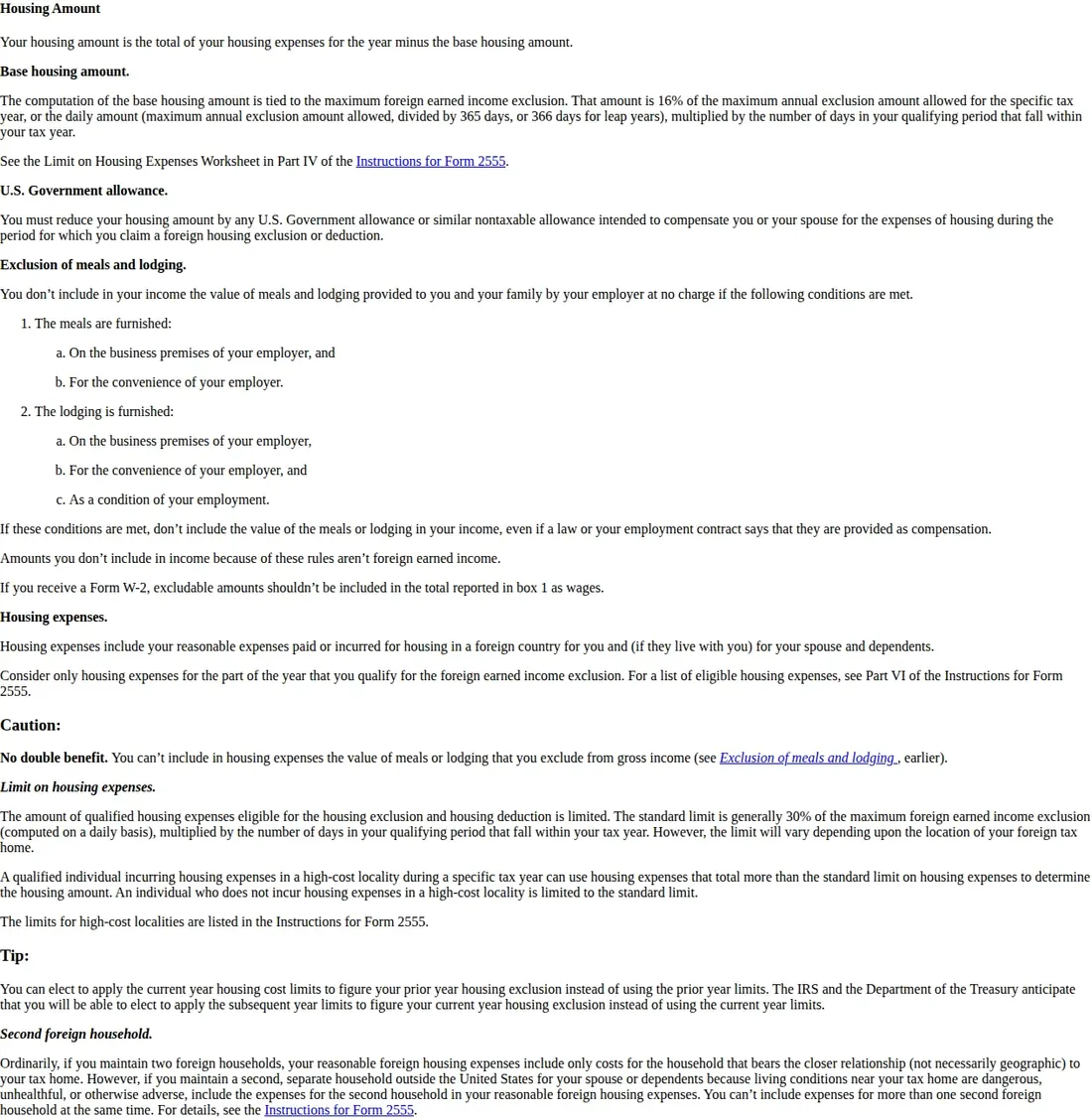
Amounts paid with employer-provided amounts are excluded. Amounts paid from self-employment earnings are deducted instead, limited to foreign earned income minus the foreign earned income exclusion, with any excess carried forward one year only.
Worked example three — the employed expatriate, full year 2026. A software engineer earns $180,000 of foreign salary, qualifies for the full year, and pays $36,000 of housing expenses. Her housing cost amount is $36,000 minus $21,264, or $14,736. Her exclusion is the full $132,900, because $180,000 minus $14,736 is $165,264, above the limit. Her total exclusion is $147,636, and $32,364 of her salary stays taxable.
Worked example four — the self-employed consultant. A consultant earns $150,000 of foreign self-employment income and pays $30,000 of housing expenses in 2026. Her housing cost amount is $30,000 minus $21,264, or $8,736. Her deduction limit is $150,000 minus $132,900, or $17,100, so the full $8,736 is deductible; her total benefit is $141,636.
Notice 2026-25 lists higher limits city by city under section 911(c)(2)(B): Hong Kong $114,300 ($313.15 per day), Singapore $86,700 ($237.53), London $68,600 ($187.95), Tokyo $67,300 ($184.38).
Worked example five — the high-cost city. An executive in Hong Kong pays $90,000 of housing expenses in 2026. The Hong Kong cap of $114,300 does not bind, so her housing cost amount is $90,000 minus $21,264, or $68,736. At the standard cap it would be $18,606 — a $50,130 difference.
The stacking order: section 911(f)
Section 911(f)(1) taxes the remaining income at the excess of the tax on taxable income plus the excluded amount over the tax on the excluded amount. The excluded dollars still occupy the bottom brackets.
Worked example six — stacking, 2026, single filer. Take the engineer from worked example three: $180,000 of foreign salary, $147,636 excluded, $32,364 of earned income remaining. Add $20,000 of US-source interest, for $52,364 after the exclusion, and subtract the 2026 single standard deduction of $15,750, for taxable income of $36,614. The 2026 single brackets run 10 percent to $12,400, 12 percent to $50,400, 22 percent to $105,700, and 24 percent to $201,775. Tax on $184,250 ($36,614 plus $147,636) is $17,966 plus 24 percent of $78,550, or $36,818. Tax on the excluded $147,636 alone is $17,966 plus 24 percent of $41,936, or $28,030.64. The tax due is $36,818 minus $28,030.64, or $8,787.36. Tax on $36,614 alone would be $1,240 plus 12 percent of $24,214, or $4,145.68. Stacking costs $8,787.36 minus $4,145.68, or $4,641.68, because the excluded dollars filled the brackets below 24 percent first.
The foreign tax credit interaction
Section 911(d)(6) denies any deduction, exclusion, or credit allocable to amounts excluded under section 911(a). Publication 54 states the rule plainly: once the election is made, no foreign tax credit or deduction is allowed for foreign taxes on the income excluded. The credit survives only on the part that stays taxable, allocated proportionally.
Worked example seven — the credit allocation. The engineer paid $45,000 of foreign income tax on her $180,000 salary, a 25 percent effective rate. Her excluded income is $147,636, so the foreign tax allocable to it is $45,000 multiplied by $147,636 and divided by $180,000 — the ratio is 0.8202, and $45,000 times 0.8202 is $36,909.00. The creditable remainder is $45,000 minus $36,909.00, or $8,091. She keeps an $8,091 foreign tax credit.
Run both computations before electing: the exclusion wins when the foreign tax on the excluded income is less than the US tax it saves, and the credit wins when the foreign tax is higher.
Filing mechanics: the forms behind the election
Form 2555 attaches to Form 1040, and the exclusion lands on Schedule 1, line 8d. The housing deduction is computed in Part IX and claimed as an adjustment to income, with any excess carried forward one year only. The exclusion never touches FICA or SECA: it removes income from gross income, not from FICA wages or SECA net earnings, so self-employment income still flows through Schedule SE and pays SECA tax on the full net profit. A CPA files the return under the taxpayer's SSN or ITIN. A consultant operating through a single-member LLC still pays SECA tax on the Schedule SE net profit, and the wages behind an employee's exclusion come from a Form W-2 carrying the employer's EIN.
The decision table
| Situation | Result | Authority |
|---|---|---|
| Tax home abroad, 330 full days in 12 months | Qualified individual | § 911(d)(1)(B) |
| Tax home abroad, bona fide resident for an entire tax year | Qualified individual | § 911(d)(1)(A) |
| Full-year qualifying period, 2026 | FEIE up to $132,900 | § 911(b)(2)(D); Rev. Proc. 2025-32 |
| Housing expenses, employer-paid | Housing exclusion | § 911(a)(2); § 911(c)(1) |
| Housing expenses, self-employment earnings | Housing deduction, capped at FEI less FEIE | § 911(c)(4) |
| Listed high-cost city | Housing cap from Notice 2026-25 | § 911(c)(2)(B); Notice 2026-25 |
| Foreign tax on excluded income | No credit or deduction | § 911(d)(6) |
| Remaining income after exclusion | Taxed at stacked rates | § 911(f)(1) |
| Election revoked | No re-election before the 6th year after revocation without IRS consent | § 911(e)(2) |
| US Government employee abroad | Income does not qualify | Form 2555 instructions |
Revocation and re-election
The election applies to the year made and all subsequent years unless revoked, under section 911(e)(1); not filing Form 2555 in a later year counts as a revocation. Revoke by attaching a statement to the return for the first year the exclusion is not claimed.
Section 911(e)(2) sets the price: except with the Secretary's consent, a taxpayer who revokes may not make another election under section 911 before the 6th taxable year after the revocation year. Revoke for 2026 and the door stays shut for 2027 through 2031, with re-election earliest in 2032. Publication 54 states the same rule as a 5-year bar, and re-election inside it requires a ruling request to the Associate Chief Counsel (International). The same deemed revocation happens silently when a taxpayer later claims the foreign tax credit, additional child tax credit, or earned income credit.
Who should not use this
First, US Government employees working abroad: the income does not qualify. Second, taxpayers in high-tax countries whose foreign tax exceeds the US tax: the foreign tax credit alone can reduce the US bill to zero while preserving the three credits the election forfeits. Third, taxpayers who need the earned income credit or additional child tax credit: the election bars both for that year. Fourth, taxpayers whose foreign earned income barely exceeds the limit: with $140,000 of income, the $132,900 exclusion leaves $7,100, and the $15,750 standard deduction brings taxable income to zero with or without it — the exclusion buys nothing and costs the credits. Fifth, anyone whose abode is in the United States: the Form 2555 instructions give the offshore oil-rig worker returning to a US family home on off-days as the example. Sixth, anyone who revoked within the last five years without IRS approval: no re-election until the 6th year after the revocation year.
One more boundary: the exclusion is an income tax exclusion, not a self-employment tax exclusion — Publication 54's consultant with $95,000 of income and a $68,000 net profit owes self-employment tax on the full $68,000.
Related reading: IRS Form 2555 foreign earned income exclusion playbook. Section 250 FDII and GILTI deduction playbook. remote employee state income tax nexus and payroll playbook. Before electing, run the stacking comparison in the Self-Employed Tax and Quarterly Estimator.
Founder & CEO Insight — Enow A. Jovial
Execution checklist
- [x] Confirm the tax home is in a foreign country, not the United States.
- [x] Count 330 full days in 12 months, or confirm bona fide residence for a full tax year.
- [x] Compute the prorated FEIE limit and housing cost amount.
- [x] Run the section 911(f) stacking computation first.
- [x] Compare the exclusion with the foreign tax credit alone.
- [x] Attach Form 2555 to a timely filed return and keep the day-count records.