The Foreign Earned Income Exclusion Playbook: Section 911, Form 2555, and the 2026 Numbers
An American who lives and works abroad pays US tax on worldwide income: a salary earned in London or Singapore still lands on a Form 1040. Section 911 is the pressure valve — up to $132,900 of foreign earned income for 2026, plus a housing amount, claimed on Form 2555. It is an election, not an automatic right: the tests are counted in days, the tax on what you keep is stacked on the excluded income, no credit attaches to an excluded dollar, and revoking it locks you out for five years.
The 2026 numbers
| Figure | 2026 | Authority |
|---|---|---|
| Maximum foreign earned income exclusion | $132,900 | Rev. Proc. 2025-32, § 4.39 |
| Base housing amount (full year) | $21,264 | Notice 2026-25, § 2 |
| Limit on housing expenses (full year) | $39,870 | Notice 2026-25, § 2 |
Recent caps: $120,000 (2023), $126,500 (2024), $130,000 (2025), $132,900 (2026). The cap is indexed under section 911(b)(2)(D)(ii): the $80,000 base rises by the cost-of-living adjustment, rounded down to the next $100.
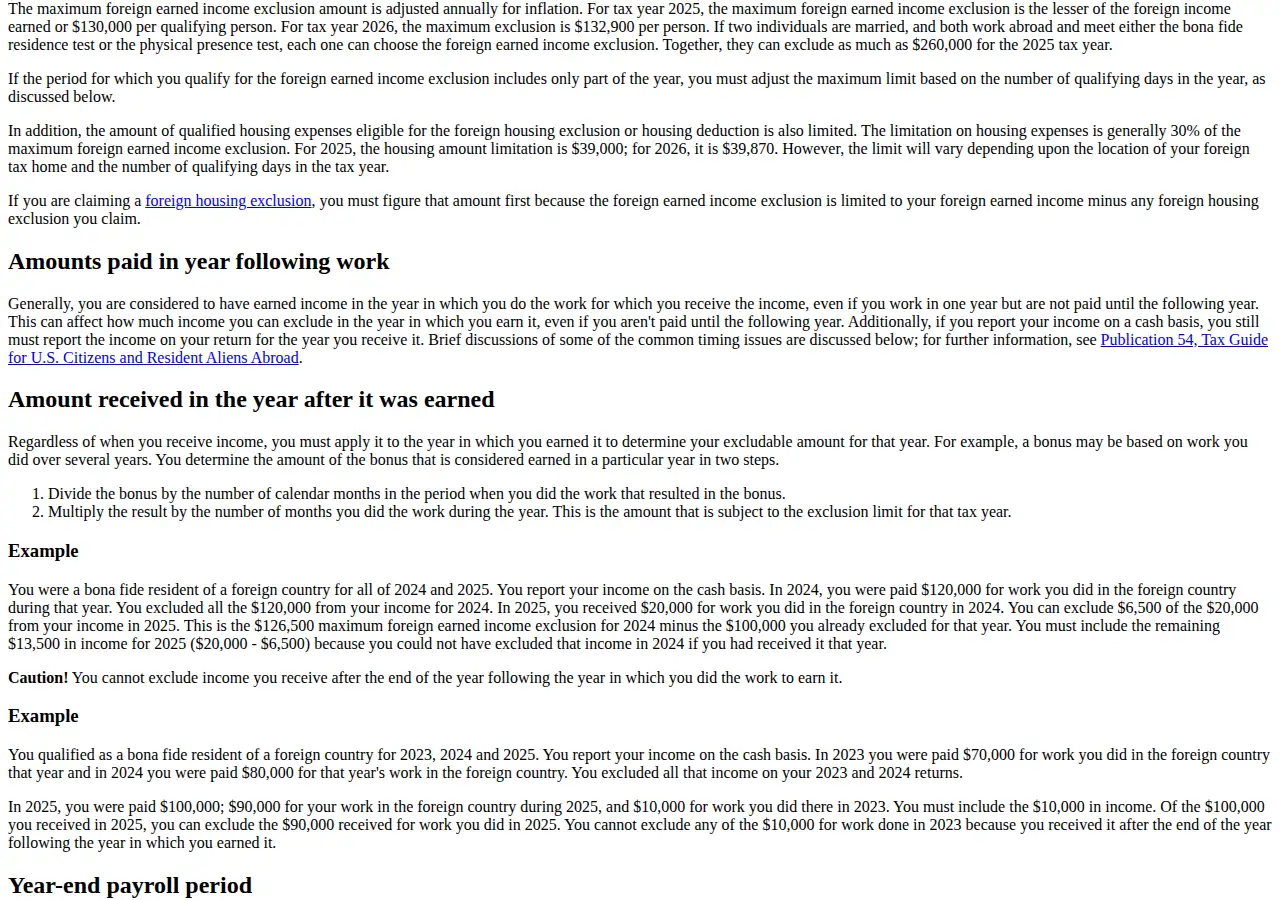
Housing arithmetic: the base is 16 percent of the cap, the general limit 30 percent:
Both are computed daily, so a partial year scales by qualifying days over 365. High-cost cities get higher limits — Hong Kong $114,300, Geneva $116,900, Singapore $86,700, London $68,600.
Who qualifies: tax home plus one test
Section 911(d)(1) requires a tax home in a foreign country — your principal place of work under section 162(a)(2). Section 911(d)(3) bars one for any period your abode is in the United States, unless you serve in a presidentially designated combat zone. The test is expectation: working abroad indefinitely, not temporarily. A two-year assignment with a return ticket and a house kept in Ohio fails the gate.
| Test | Who can use it | What it requires | Authority |
|---|---|---|---|
| Bona fide residence | US citizen; treaty-country citizen who is a resident alien | Bona fide resident abroad for an uninterrupted period including an entire tax year | § 911(d)(1)(A) |
| Physical presence | US citizen or resident alien | 330 full days in a foreign country during any 12 consecutive months | § 911(d)(1)(B) |
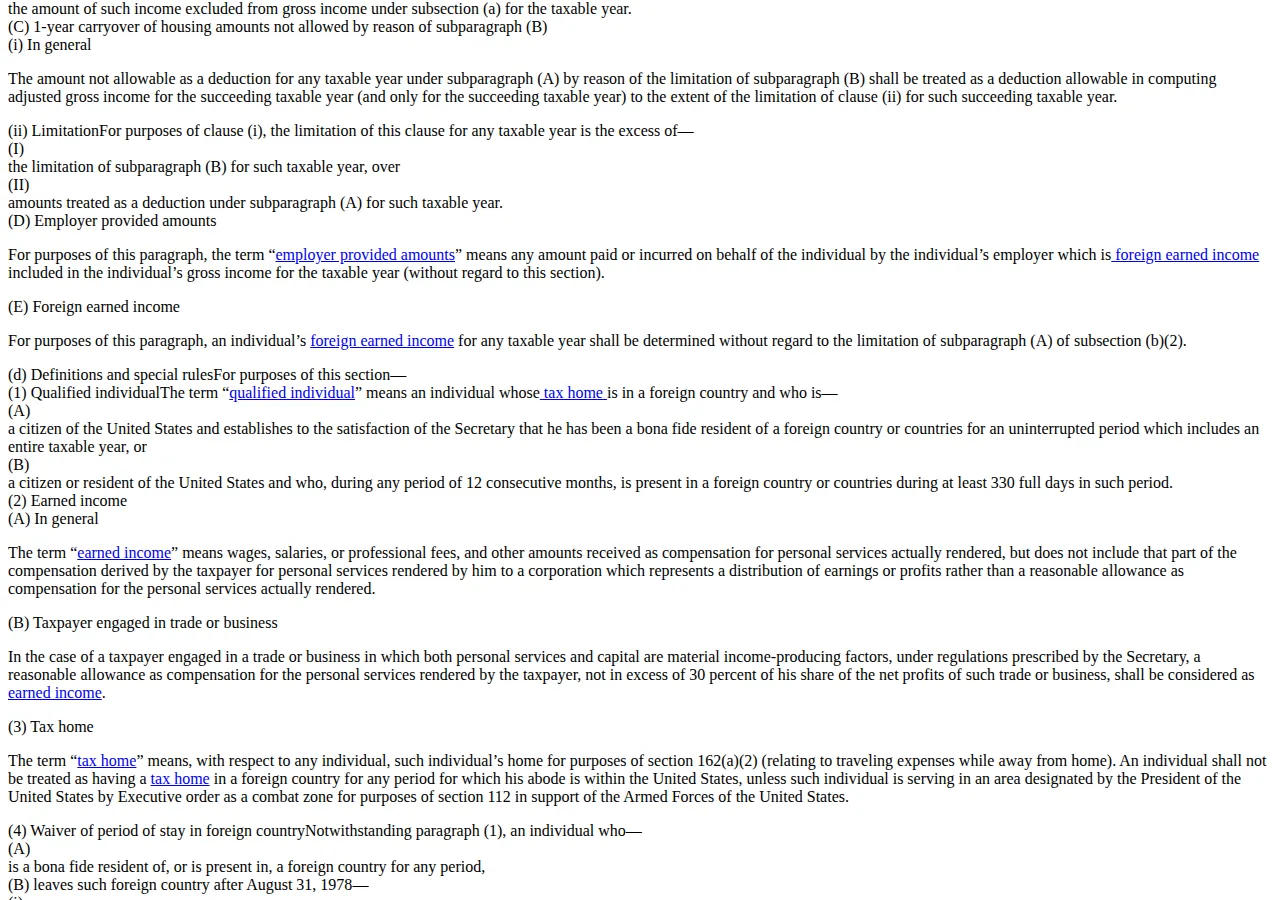
Bona fide residence turns on intention: your words and acts are the evidence, and when they conflict, acts carry more weight. A definite, temporary purpose with a return at the end is not bona fide residence; an extended stay abroad can be. One act kills it: under section 911(d)(5), telling a foreign country's authorities you are not its resident — and being held not subject to its income tax as a resident — means you are not a bona fide resident for section 911.
The physical presence test is arithmetic. A "full day" is the 24-hour period starting at midnight; the 330 days need not be consecutive, and days in the United States or over international waters do not count. The 12-month period can straddle years, and section 911(d)(4) waives the stay requirement if war or civil unrest forces you out.
What counts as foreign earned income
Foreign earned income is pay for personal services performed in a foreign country: wages, salaries, professional fees, and other compensation, including noncash pay such as a home or a car, plus allowances and reimbursements. If your business uses both services and capital as material income-producing factors, only a reasonable allowance for your services counts — capped at 30 percent of your share of net profits under section 911(d)(2)(B). Pay that is really a distribution of corporate earnings is not earned income.
Not foreign earned income: pensions and annuities, including Social Security; interest, dividends, capital gains, and alimony; pay from the US Government or its agencies; amounts received after the end of the tax year following the year of the services; and employer contributions to a nonexempt trust or nonqualified annuity. Meals and lodging excludable under section 119 are also outside it — never counted twice. See our Form 1040-NR playbook for the return a nonresident alien files instead, and our tie-breaker playbook for the dual-residency question.
The housing exclusion and deduction
The housing cost amount under section 911(c)(1) is your housing expenses for the year, capped at the limit, minus the base housing amount. Eligible: rent, utilities other than telephone charges, real and personal property insurance, nonrefundable lease fees, rental of furniture and accessories, residential parking, and household repairs. Excluded: deductible interest and taxes, buying or improving a house, mortgage principal, depreciation, domestic labor, pay television, or buying furniture.
Who paid decides the treatment. Employer-provided housing is excluded from gross income under section 911(a)(2). Other amounts — the usual case for a self-employed person — are a deduction under section 911(c)(4), limited to foreign earned income minus amounts excluded under section 911(a); any excess carries forward one year only, then dies. The housing exclusion is figured first: the earned income exclusion is limited to foreign earned income minus any housing exclusion claimed. Section 911(d)(7) caps the total at foreign earned income for the year. Married couples figure housing jointly or separately when they share a household.
Worked example — Hong Kong housing, employer-provided
Worked example — an employee in Hong Kong for all of 2026. Salary $200,000; the employer also pays $90,000 of rent directly to the landlord. Foreign earned income is $290,000 — employer-provided amounts are included in gross income before section 911 applies — and the $90,000 of housing sits inside Hong Kong's 2026 limit of $114,300:
The housing exclusion is figured first, so the earned income exclusion is limited to $290,000 minus $68,736, or $221,264 — above the $132,900 cap, so the full cap applies:
Taxable foreign income remaining is $88,364.
Worked example — the tax stack under section 911(f)
Worked example — a single filer for 2026 with a foreign salary of $180,000 and US-source wages of $40,000. Gross income is $220,000; the exclusion removes $132,900, so adjusted gross income is $87,100; less the 2026 single standard deduction of $16,100, taxable income is $71,000.
Section 911(f) sets the trap: the tax is not the tax on $71,000, but the tax on $71,000 plus the excluded $132,900, minus the tax on the $132,900 alone:
Both legs use the 2026 single table in Rev. Proc. 2025-32, section 4.01: tax on $203,900 is $41,024 plus 32 percent of the $2,125 over $201,775; tax on $132,900 is $17,966 plus 24 percent of the $27,200 over $105,700. The tax on $71,000 alone would be $10,332 — so stacking costs $6,878 against the naive reading. The exclusion still saves $24,494: without it the tax on $203,900 would be $41,704. The tax estimator runs this two-leg computation.
The no-double-benefit rule
Section 911(d)(6) is one sentence with a long reach: no deduction, exclusion, or credit is allowed to the extent properly allocable to amounts excluded under section 911. Form 2555 Part VIII applies it, prorating disallowed items by the ratio of excludable income to total foreign earned income.
The foreign tax credit is where it bites. Worked example — $30,000 of foreign tax paid on $200,000 of foreign earned income, with a $132,900 exclusion:
The same dollar cannot be both excluded and credited. Unused credit carries back 1 year and forward 10 years. Form 2555 line 44 carries the mechanism onto the return: deductions in arriving at adjusted gross income — the deductible part of self-employment tax and Schedule C expenses are the named examples — are added back to the extent allocable to excluded income.
Self-employment: the exclusion stops at income tax
The exclusion reduces regular income tax, not self-employment tax: section 1402(a)(11) writes it into the definition of net earnings from self-employment. Schedule SE still taxes 92.35 percent of net earnings at 15.3 percent — 12.4 percent for Social Security up to the $184,500 wage base for 2026, plus 2.9 percent for Medicare with no ceiling.
Worked example — the IRS's own method, restated for 2026. A consultant abroad has Schedule C gross receipts of $150,000, expenses of $50,000, net income of $100,000, and self-employment tax of $14,130; the deduction for half the SE tax is $7,065. The exclusion is $132,900, and the ratio of excluded to total foreign earned income is $132,900 over $150,000:
The $14,130 of self-employment tax is still due in full, computed on the unreduced $100,000 — while the income-tax exclusion is $82,340, not $132,900.
Form 2555, line by line
- Part I: tax home and dates; then Part II for bona fide residence or Part III for physical presence — one test, not both.
- Part IV: total foreign earned income, including noncash pay and allowances.
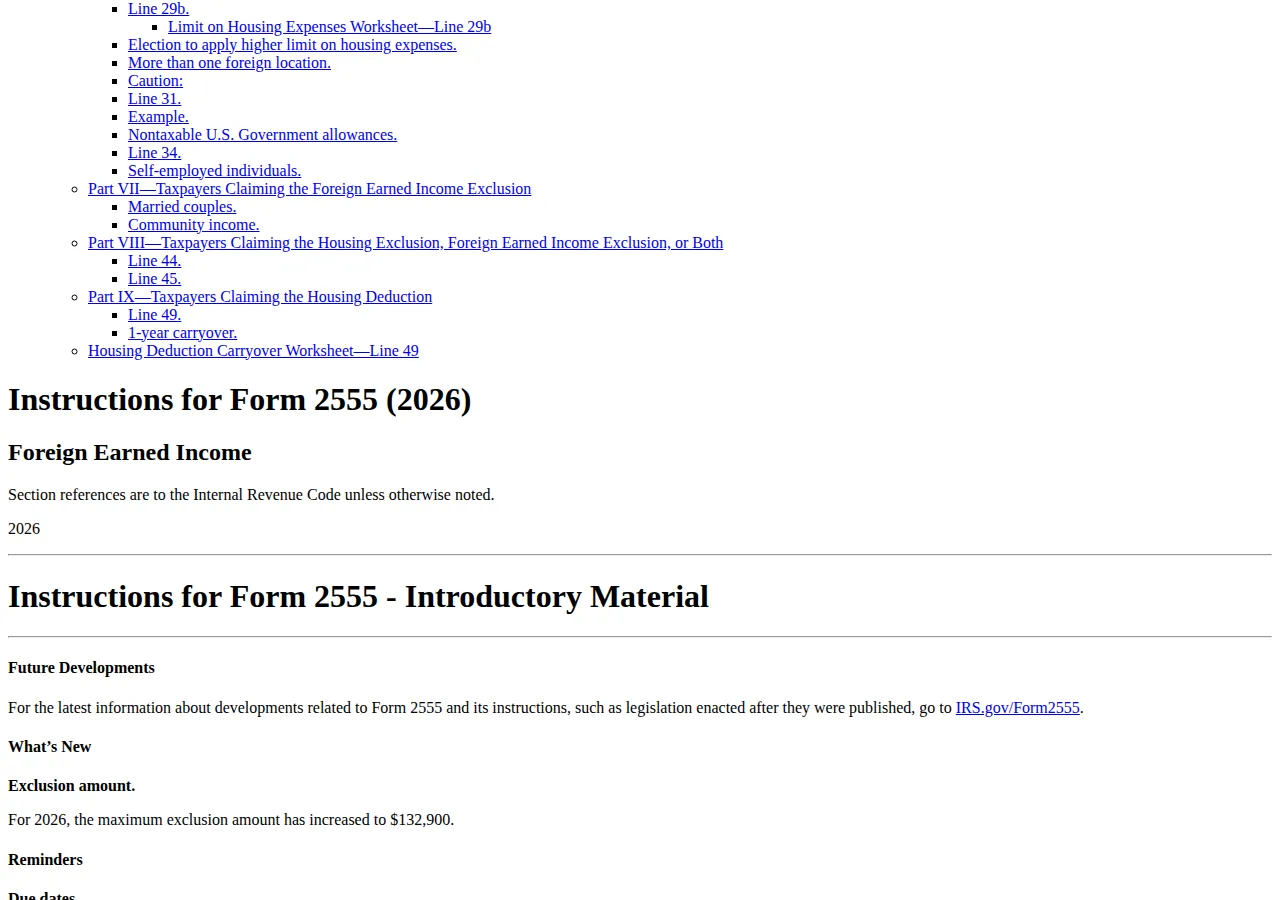
- Part VI for housing: line 28 expenses, line 29a the city if listed in Notice 2026-25, line 29b the limit, line 31 qualifying days.
- Part VII for the exclusion, Part VIII for the allocation; line 44 adds back deductions allocable to excluded income.
- Line 45 goes on Schedule 1 (Form 1040), line 8d, as a negative number. For the housing deduction, complete Part IX; the one-year carryover goes on line 49.
- File Form 2555 even if the exclusion zeroes your liability — it applies only if claimed on a filed return, and the income must still be reported.
- If you cannot meet a test by the deadline, file Form 2350 for an extension.
- Keep the day count: passport stamps, boarding passes, a calendar of the 12-month window.
File under your SSN or ITIN. Your employer's EIN is on the Form W-2; FICA withholding is unaffected, and a self-employed filer pays SECA tax on the full net earnings. Entity form decides whether pay is earned income: an LLC taxed as a sole proprietorship passes profit through, an S-Corp salary counts, a C-Corp dividend does not. Have a CPA review the structure first.
Revocation and the five-year lockout
The election is sticky: section 911(e)(1) makes it apply to the year made and every later year unless revoked. Section 911(e)(2) lets you revoke for any year after the election year — but without the Secretary's consent, you may not re-elect before the sixth taxable year after the revocation year. Revoke for 2028 and the earliest re-election is 2034: five full tax years, 2029 through 2033, pass first. Decide the exclusion-versus-credit question with a CPA before the first Form 2555.
Who should not elect it
Do not elect if your foreign tax rate is high enough that the credit alone wipes out your US tax. The credit has no cap, carries forward, and leaves deductions intact; the exclusion caps at $132,900 and forces the section 911(d)(6) proration. Do not elect for a short assignment that meets neither test, and do not assume the exclusion travels to your state return — several states, California most prominently, do not follow section 911. You also cannot receive the earned income credit in a year you claim the exclusion, so a lower-income household should compare first. The break-even calculator compares the two on your own numbers.
Founder & CEO Insight — Enow A. Jovial
Execution checklist
- Confirm a foreign tax home and no US abode.
- Choose a test: bona fide residence including a full tax year, or 330 full days in 12 months.
- Total foreign earned income; strip out pensions, investment income, US Government pay, and late amounts.
- Figure the housing amount first: expenses capped at the limit, minus the $21,264 base.
- Scale by qualifying days over 365 for a partial year.
- Prorate the foreign tax credit and deductions allocable to the excluded income.
- Run the section 911(f) two-leg computation, never the tax on the remainder alone.
- File Form 2555 with the return and report the income in full; enter line 45 on Schedule 1, line 8d.
- Pay self-employment tax on the full net earnings.
- Keep the day-count log and housing receipts with the return.
The credit side of the expat return: the Foreign Tax Credit playbook works the § 904 limitation, the de minimis election, and the carryforward.