Section 461 Economic Performance: The Accrual-Method Playbook — When a Deduction Is Actually Incurred
Meridian Fabrication, a calendar-year accrual C corporation, signs a $240,000 annual maintenance contract on December 15, 2026, and pays it in full the same day. The cash leaves the bank in 2026. The deduction does not. Under § 461(h), economic performance on a services liability occurs as the services are provided — January through December 2027 — so Meridian deducts $20,000 a month in 2027, nothing in 2026. At 21 percent, that timing moves $50,400 of tax benefit a full year later, because the deduction follows the work, not the payment.
The general rule: § 461(a) and the all-events test
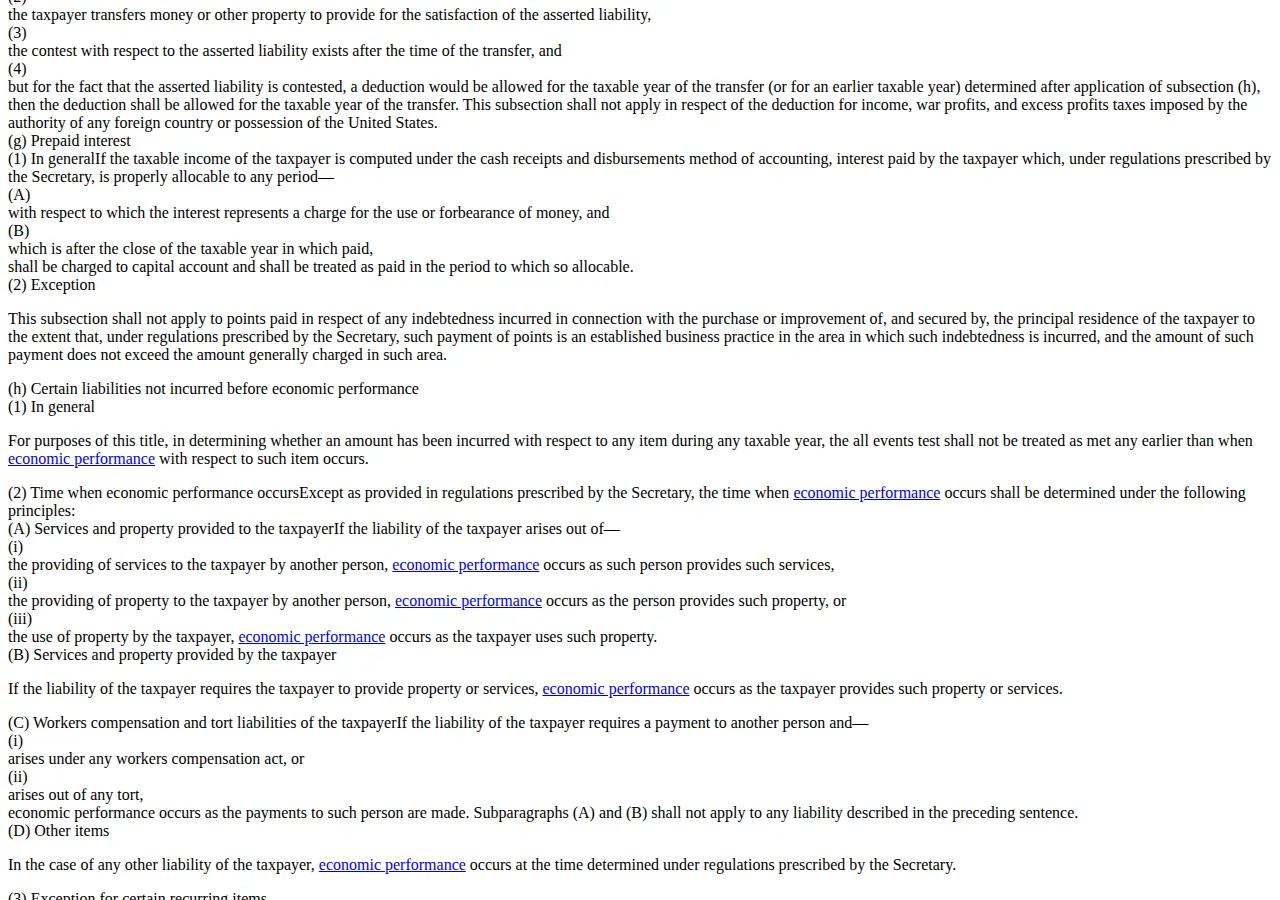
Section 461(a) states the rule in one sentence: the amount of any deduction or credit "shall be taken for the taxable year which is the proper taxable year under the method of accounting used in computing taxable income." For a cash-method taxpayer, that year is usually the year of payment; for an accrual-method taxpayer, the all-events test decides it — and, since 1984, economic performance on top of it.
The all-events test is defined in § 461(h)(4) and restated in Reg. § 1.461-1(a)(2)(i): it "is met with respect to any item if all events have occurred which determine the fact of liability and the amount of such liability can be determined with reasonable accuracy." Two prongs: the fact of the liability fixed, the amount determinable with reasonable accuracy.
Before 1984, meeting the all-events test was enough. Section 461(h)(1) changed that: "the all events test shall not be treated as met any earlier than when economic performance with respect to such item occurs."
The decision table: when economic performance occurs
| Liability arises from | Economic performance occurs | Authority |
|---|---|---|
| Services or property provided to the taxpayer | As the services or property are provided | § 461(h)(2)(A); Reg. § 1.461-4(d)(2) |
| Use of property by the taxpayer | Ratable over the period of use | § 461(h)(2)(A)(iii); Reg. § 1.461-4(d)(3) |
| Workers compensation or tort liability | As payments are made to the person owed | § 461(h)(2)(C); Reg. § 1.461-4(g)(2) |
| Taxes (other than foreign creditable taxes) | As the tax is paid to the government | Reg. § 1.461-4(g)(6) |
| Insurance, warranty, or service contracts | As the premium or payment is made | Reg. § 1.461-4(g)(5) |
| Rebates, refunds, awards, prizes | As payment is made to the person owed | Reg. § 1.461-4(g)(3)–(4) |
The table splits into two families. The first — services, property, use of property — is performance-based: economic performance tracks the work or the use. The second — workers compensation, tort, taxes, insurance, rebates — is payment-based: economic performance occurs only when money reaches the person owed; paying into a trust, escrow, or court-administered fund does not count until the fund pays the person owed. The cash-vs-accrual guide covers which method a business uses; this guide covers what the accrual method lets you deduct.
Worked example 1: services and property — the work decides the year
Publication 538 gives the cleanest illustration: a calendar-year taxpayer buys office supplies in December 2026, receives the supplies and the bill in December, and pays in January 2027. The deduction belongs to 2026 — the liability is fixed, the amount determinable, and economic performance occurred in 2026. Payment in January changes nothing.
Reverse the facts and the answer reverses: pay $9,600 in December 2026, but the supplies arrive in January 2027, and the $9,600 is deductible in 2027. The delivery date alone moves the deduction across the year-end line.
Use of property works the same way, spread ratably. Meridian leases warehouse space at $18,000 a month and pays $54,000 on December 31, 2026, for January through March 2027. Under Reg. § 1.461-4(d)(3), economic performance occurs ratably over the period of use, so Meridian deducts $0 in 2026 and $18,000 a month in 2027. Together with the maintenance contract, Meridian has $294,000 of cash paid in 2026 with no 2026 deduction, deferring $61,740 of tax benefit at 21 percent:
The $61,740 arrives in 2027 as the services are provided and the space is used — a year late, and at an illustrative 6 percent discount rate the delay costs $3,494.72.
Worked example 2: when payment is the performance
For the second family, the rule flips: payment is the event. A workers compensation claim or a tort liability is not incurred when the accident happens or when the settlement is signed. Section 461(h)(2)(C) provides that economic performance on a workers compensation or tort liability "occurs as the payments to such person are made." Reg. § 1.461-4(g)(2) extends the same payment rule to breach of contract and violation of law.
Consider a $90,000 tort settlement signed in December 2026, payable $30,000 a year in 2027, 2028, and 2029. The liability is fixed in fact and amount in 2026, but no payment has been made, so the deduction is $30,000 in each of 2027, 2028, and 2029, and $0 in 2026. At 21 percent, the tax benefit is $6,300 a year for three years, not $18,900 in the signing year.
The same payment rule covers taxes, insurance, and rebates. Under Reg. § 1.461-4(g)(6), economic performance on a tax liability occurs as the tax is paid to the governmental authority that imposed it. Under Reg. § 1.461-4(g)(5), economic performance on insurance occurs as the premium is paid: the regulation's examples treat a $500,000 premium and a $360,000 premium as incurred in the year each is paid. Under Reg. § 1.461-4(g)(3), a rebate or refund is incurred as it is paid to the customer.
The recurring-item exception does not rescue workers compensation or tort liabilities: § 461(h)(3)(C) states that the exception "shall not apply to any item described in subparagraph (C) of paragraph (2)." A tort settlement paid over three years stays spread over three years.
Worked example 3: the recurring-item exception and the 8½-month rule
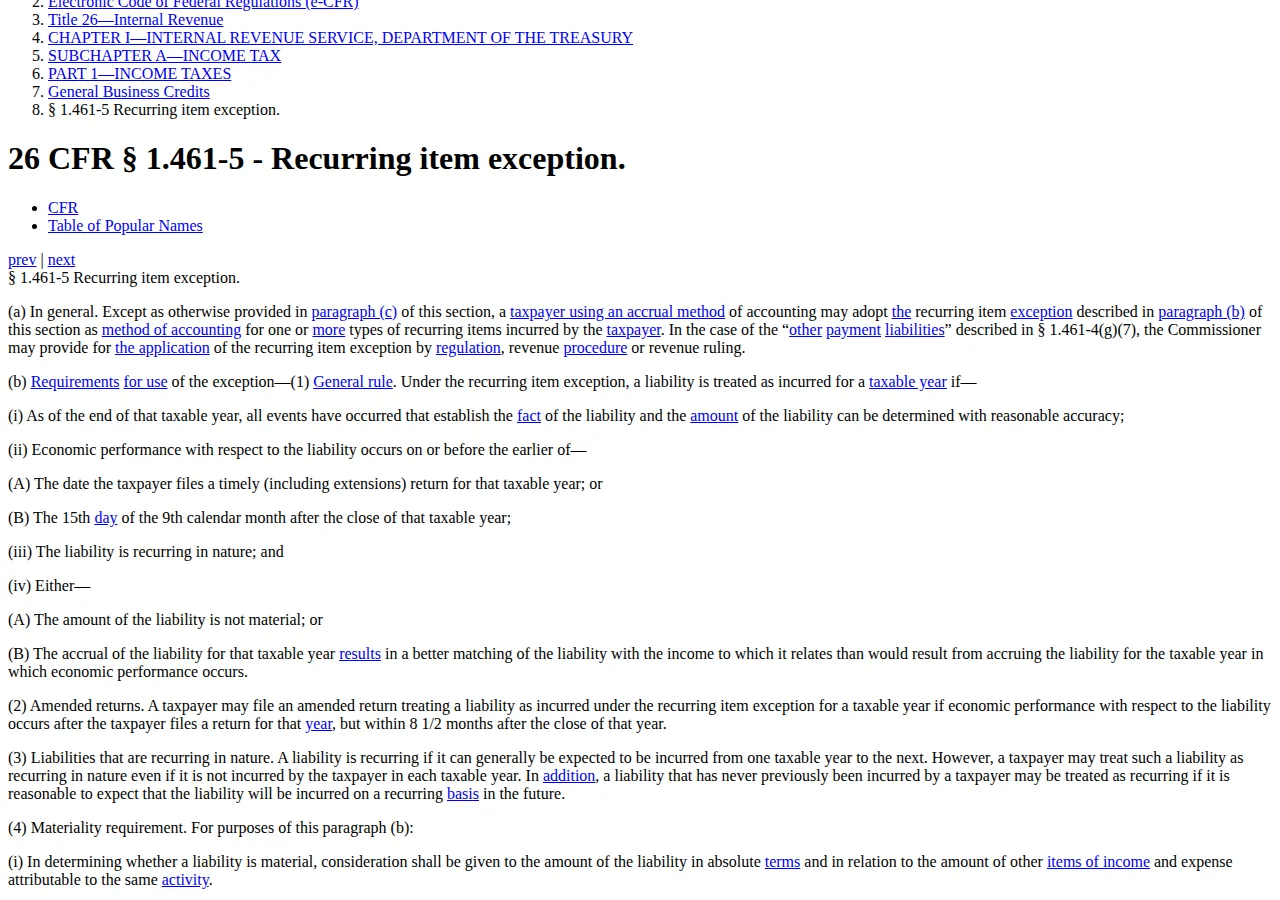
The recurring-item exception in § 461(h)(3) is the one door back into the earlier year. An item is treated as incurred in the year the all-events test is met — even though economic performance has not yet occurred — if four conditions hold: the all-events test is met that year; economic performance occurs within the shorter of a reasonable period or 8½ months after year-end; the item is recurring and consistently treated; and either the item is not material, or accruing it earlier produces a better match against income.
For a calendar-year taxpayer, 8½ months after December 31 is September 15. The regulation's own example, Reg. § 1.461-5(e), Example 1, shows the rule in action. Y corporation, a calendar-year accrual-method taxpayer, manufactures video cassette recorders and offers a $500 refund to any dissatisfied purchaser. During 1992, 100 purchasers request a refund — a $50,000 liability, fixed in fact and amount by December 31, 1992. Y refunds $30,000 on or before September 15, 1993, and the remaining $20,000 after that date but before the end of 1993. The $30,000 is incurred for 1992, because payment occurred within 8½ months of the close of 1992. The $20,000 is incurred for 1993, because its payment fell after September 15, 1993. One liability, two years, split by a single date:
Two details matter. First, the deadline is the earlier of the 8½-month date or the timely return filing date (including extensions) — a taxpayer that files on March 15 has a March 15 deadline, unless it files an amended return under Reg. § 1.461-5(b)(2). Second, the matching prong is deemed satisfied for rebates, refunds, awards, insurance, warranty and service contracts, and taxes under Reg. § 1.461-5(b)(5)(ii).
Who must use the accrual method: the § 448 test
Economic performance only matters to accrual-method taxpayers, so the next question is who is forced onto it. Section 448(a) bars the cash method for C corporations, partnerships with a C corporation partner, and tax shelters — with three exits in § 448(b): farming businesses, qualified personal service corporations, and any corporation or partnership meeting the § 448(c) gross receipts test. The test averages gross receipts for the three prior tax years; the $25,000,000 statutory figure is indexed for inflation, and Rev. Proc. 2025-32 sets it at $32,000,000 for 2026.
Alder Manufacturing had gross receipts of $28,000,000 in 2023, $33,000,000 in 2024, and $35,000,000 in 2025:
Alder's average does not exceed $32,000,000, so it meets the test for 2026 and may keep using the cash method. Birch, at $30,000,000, $34,000,000, and $36,000,000, averages $33,333,333 and fails — so it must use the accrual method for 2026. The test is re-run every year, aggregation rules under § 448(c)(2) combine related businesses treated as a single employer, and gross receipts are net of returns and allowances, not cost of goods sold.
Changing methods: Form 3115 and the § 481(a) adjustment
A taxpayer changing its method of accounting — cash to accrual, or into or out of the recurring-item exception — must secure the Secretary's consent first under § 446(e); the vehicle is Form 3115. The Form 3115 method-change guide covers the filing; what matters here is the arithmetic. When a method changes, § 481(a) requires an adjustment that prevents the same dollars from being deducted twice or never deducted at all, taken into account over the period in Rev. Proc. 2015-13 § 7.03: one taxable year for a negative adjustment, four taxable years for a positive adjustment, taken ratably.
Suppose a company switching from cash to accrual has a positive § 481(a) adjustment of $400,000 — receivables and accrued items never counted under the cash method:
At 21 percent, that is $21,000 a year for four years. A negative adjustment of the same $400,000 is taken entirely in the year of change, worth $84,000 in a single year. The direction decides whether the change is a four-year drip or a one-year event — which is why the § 481(a) computation belongs in the decision, not after it.
The filing detail is where operators get caught. Form 3115 is filed with the timely filed return for the year of change, and the return carries the taxpayer's EIN. A single-member LLC files under the LLC's own EIN, not the owner's SSN or ITIN, and a CPA checks the Form 3115 figure ties to the § 481(a) adjustment. The same discipline applies to S-Corp and C-Corp filers. Keep the workpapers — contract, delivery, and payment dates — because § 461 is a timing rule, and timing is proved with dates. The § 163(j) business interest limitation is the other timing-sensitive limit that shares the return with § 461.
Execution checklist: apply § 461 in one pass
- Step 1 — Identify the method. Cash or accrual, and whether the § 448 test forces accrual for the year.
- Step 2 — Sort liabilities by family. Services, property, use of property: performance family. Workers comp, tort, taxes, insurance, rebates: payment family.
- Step 3 — Test the all-events prongs. Is the liability fixed in fact and determinable in amount? If either fails, nothing is incurred yet.
- Step 4 — Date the economic performance. Services and property: the performance date. Use of property: the ratable period. Payment family: the date money reaches the person owed.
- Step 5 — Check the recurring-item exception. If performance falls after year-end but before September 15, and the item is recurring, consistent, and immaterial or better matched, accrue it in the earlier year.
- Step 6 — Watch the filing deadline. The recurring-item deadline is the earlier of the 8½-month date or the timely return date.
- Step 7 — Price the deferral. A $600,000 deferral at 21 percent is $126,000 of tax paid a year early, worth $7,132.08 at an illustrative 6 percent:
- Step 8 — File the change if the method moves. Any change to or from the recurring-item exception, or from cash to accrual, goes through Form 3115 with the § 481(a) adjustment computed first.
Founder & CEO Insight — Enow A. Jovial
Section 461 is a calendar. The deduction belongs to the year the work is done, the property is delivered, the space is used, or the person owed is paid — and the recurring-item exception is the only door that opens the earlier year. Run the numbers on your own deferred deductions through the profit calculator: $294,000 prepaid at 21 percent is $61,740 of tax benefit.