Most tax credits reward a purchase. Section 45Q rewards a subtraction: every metric ton of carbon oxide a facility captures and does not release earns a credit, for twelve years, at a rate the statute sets per ton. For a decade the headline numbers were $85 for storage and $60 for enhanced oil recovery. Those figures are now wrong for every new facility. The One Big Beautiful Bill Act, Public Law 119-21, standardized the base credit at $17 per metric ton for facilities placed in service after July 4, 2025, whatever the carbon is used for. The $85 figure survives only as the multiplied rate, for projects clearing the prevailing-wage and apprenticeship test.
The statute: what § 45Q actually says
Section 45Q sits inside the general business credit under § 38, so it offsets income tax dollar for dollar. Subsection (a) states the credit as three per-ton amounts. Paragraph (a)(1) pays $20 per metric ton for carbon captured by equipment placed in service before the Bipartisan Budget Act of 2018 and disposed of in secure geological storage. Paragraph (a)(2) pays $10 per ton for the same vintage used as a tertiary injectant in a qualified enhanced oil or natural gas recovery project, or utilized under subsection (f)(5). Paragraph (a)(3) covers everything placed in service on or after the 2018 Act: the applicable dollar amount under subsection (b)(1), for twelve years from the date the equipment was originally placed in service.
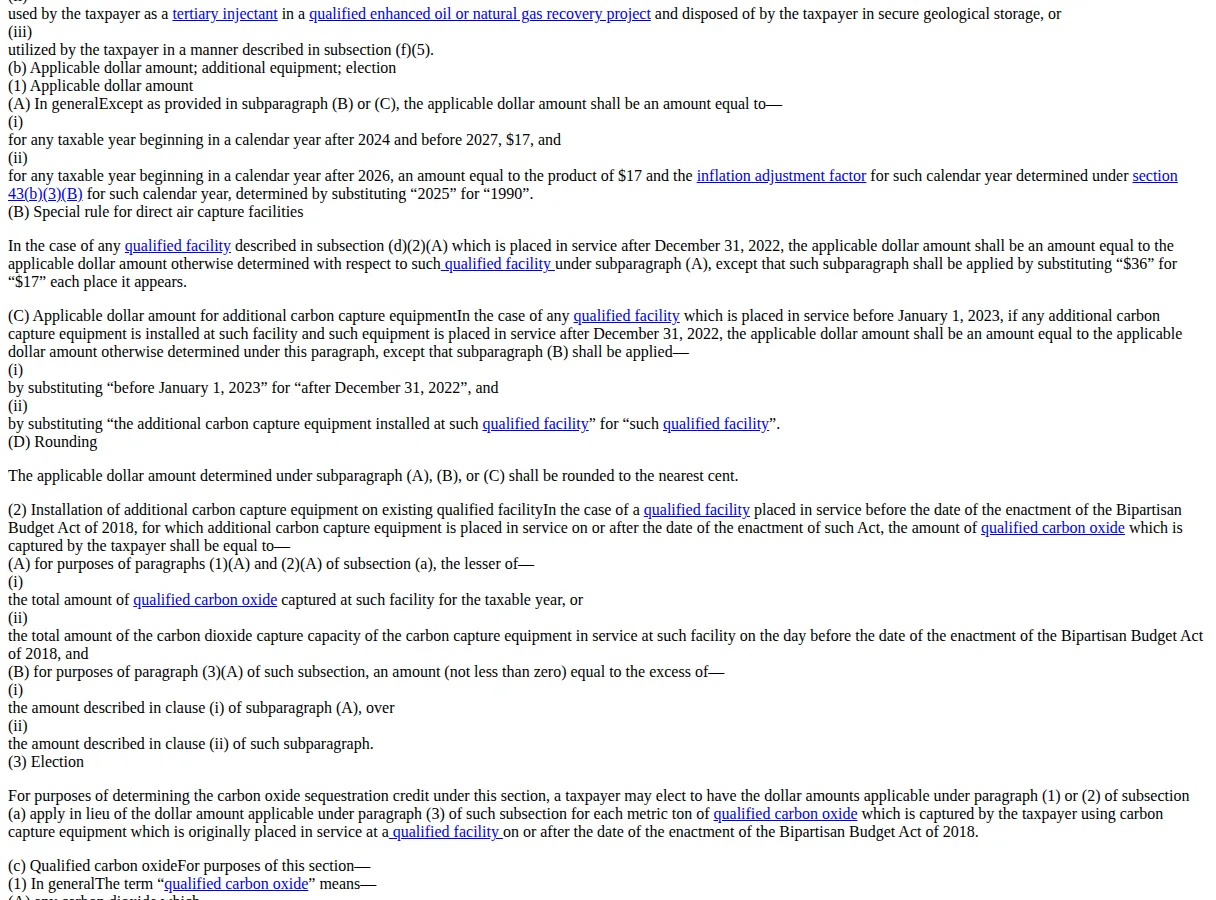
Subsection (b)(1) is where the current law lives. The base applicable dollar amount is $17 for any taxable year beginning in a calendar year after 2024 and before 2027, and $17 multiplied by an inflation adjustment factor for years after 2026. For direct air capture facilities placed in service after December 31, 2022, the statute substitutes $36 for $17. Subsection (h) multiplies the whole credit by five where the facility satisfies the prevailing-wage and apprenticeship requirements — the mechanism behind the familiar $85 and $180 figures.
Two boundaries in subsection (f) decide what counts. First, § 45Q(f)(1): the credit applies only to carbon oxide captured and disposed of, used, or utilized within the United States or a U.S. possession. Second, § 45Q(f)(2) defines secure geological storage — deep saline formations, oil and gas reservoirs, unminable coal seams — verified under the EPA Greenhouse Gas Reporting Program (40 CFR Part 98, Subpart RR) or CSA/ANSI ISO 27916:19.
The rates: three vintages, one table
The December 2025 Instructions for Form 8933 publish the rates as a vintage table, keyed to the placed-in-service date; base rates are before the 5× multiplier.
| Vintage (placed in service) | Storage (base / ×5) | EOR or utilization (base / ×5) | Authority |
|---|---|---|---|
| Before Feb 9, 2018 (equipment) | $28.43 / $142.15 | $14.21 / $71.05 | § 45Q(a)(1)–(2), inflation-adjusted per Notice 2025-25 |
| Before Jan 1, 2023 (facility) | $46.96 / $234.80 | $32.54 / $162.70 | § 45Q(b)(1) pre-IRA interpolation per Notice 2018-93 |
| After 2022, before July 5, 2025 | $17 / $85 | $12 / $60 | § 45Q(b)(1), IRA 2022 schedule |
| After July 4, 2025 | $17 / $85 | $17 / $85 | § 45Q(b)(1) as amended by P.L. 119-21 (OBBBA) |
| Direct air capture, after 2022 | $36 / $180 | $26 / $130 | § 45Q(b)(1)(B) |
Before July 5, 2025, storage paid $25 a ton more than EOR with the multiplier. After July 4, 2025, the columns are identical: $17 base, $85 multiplied — the EOR discount is gone, and the rate no longer picks the disposition. The DAC premium survived ($36/$180 storage, $26/$130 EOR and utilization), and nothing in OBBBA reprices a facility already in service.
The OBBBA break: July 4, 2025
The Instructions for Form 8933 (12/2025) state the change in one paragraph under "What’s New": "Public Law 119-21, commonly known as the One Big Beautiful Bill Act, standardized the base credit amount at $17 per metric ton for facilities that capture carbon dioxide for different uses and utilization of qualified carbon oxide. For facilities or equipment placed in service after July 4, 2025, and before 2027, the credit is $17 per metric ton of qualified carbon oxide."
Three consequences follow. First, the boundary is placed in service, not beginning of construction. Equipment entering service in August 2025 takes the $17 flat schedule; a facility placed in service on July 3, 2025 keeps the $17/$12 split for its whole 12-year period — one day of delay can be worth $25 a ton on every EOR ton for twelve years. Second, OBBBA added a foreign-entity bar: no § 45Q credit for any tax year beginning after July 4, 2025 if the taxpayer is a specified foreign entity under § 7701(a)(51)(B), or a foreign-influenced entity under § 7701(a)(51)(D). Check the ownership chain before the first ton is claimed. Third, the construction deadline did not move: § 45Q(d)(1) still requires construction to begin before January 1, 2033. The credit is being repriced, not phased out. Our §45L/§179D termination guide covers the energy credits OBBBA did terminate — the contrast is the point: §45Q survived with a new rate, while the building-efficiency credits did not survive at all.
The door: qualified-facility thresholds
Section 45Q(d) sets three gates: construction begins before January 1, 2033; the capture equipment is in the original planning and design, or its construction begins before that date; and the facility captures enough, measured annually.
| Facility type | Minimum capture per year | Extra test | Authority |
|---|---|---|---|
| Direct air capture | 1,000 metric tons | None | 26 U.S.C. § 45Q(d)(2)(A) |
| Electricity generating | 18,750 metric tons | Capture design capacity ≥ 75% of the unit’s baseline carbon oxide production | § 45Q(d)(2)(B) |
| Any other facility | 12,500 metric tons | None | § 45Q(d)(2)(C) |
The 12,500-ton floor for industrial facilities is the number most projects miss on first reading — the pre-IRA threshold was 25,000 tons, and older guidance still circulates. At the multiplied $85 rate, the floor itself is worth $1,062,500 a year; below it, the credit is zero, not pro-rated.
$
\text{Minimum Annual Credit (industrial)} = 12{,}500 \times \$85 = \$1{,}062{,}500
$
The 75-percent design-capacity test for power plants is the sharper gate: measured against baseline carbon oxide production of the applicable generating unit, not the plant's total emissions, and judged on design capacity — the equipment must be designed to capture three quarters of the unit's baseline output, whether or not it runs at that rate every hour.
A worked example: one industrial facility, two vintages
Take an ethanol plant capturing 100,000 metric tons a year into a saline formation. It meets the prevailing-wage and apprenticeship requirements, so the 5× multiplier applies.
Placed in service June 2025 (pre-OBBBA schedule), storage:
$
\text{Annual Credit} = 100{,}000 \times \$85 = \$8{,}500{,}000
$
$
\text{12-Year Total} = \$8{,}500{,}000 \times 12 = \$102{,}000{,}000
$
Same plant, EOR offtake instead of storage, June 2025:
$
\text{Annual Credit (EOR)} = 100{,}000 \times \$60 = \$6{,}000{,}000
$
The storage choice was worth $2,500,000 a year, $30,000,000 over the credit period. Placed in service August 2025 (post-OBBBA schedule), the EOR column is $85 too — the same $8,500,000 a year, $102,000,000 total. The $30,000,000 storage premium evaporates, and the EOR offtake — which usually pays the plant for the CO2 as a commodity — becomes the better deal on total economics, because the credit no longer penalizes it.
Without the multiplier, the same plant claims $17 a ton, or $1,700,000 a year. The multiplier is worth $6,800,000 a year — four times the base credit. Wage records, apprentice ratios, and a Form 7220 per facility are not paperwork; they are $6.8 million a year on a mid-size plant.
The traps, in order of how often they bite
Claiming the old rates. Every secondary source published before December 2025 prints the $85/$60 split without the OBBBA qualifier. The Instructions for Form 8933 (12/2025) are the controlling vintage table — check the revision date on any rate source, and confirm the placed-in-service date against the schedule.
Missing the 12-year clock. The credit runs twelve years from the date the equipment was originally placed in service, per § 45Q(a)(3)(A). A facility entering service in stages claims each tranche on its own clock; additional equipment starts its own twelve years, and the amount for additional equipment on a pre-2018 facility is capped at the lesser of total capture or the pre-2018 equipment's capacity.
Recapture. A recapture event occurs when qualified carbon oxide for which a credit was claimed ceases to be captured, disposed of, or used during the recapture period. The test is annual and aggregate: recapture occurs when the leaked amount in a tax year exceeds the amount disposed of or used as a tertiary injectant in that same year, under Regulation § 1.45Q-5. A small leak does not trigger recapture. When it does trigger, the recapture amount, the leaked quantity, the original credit rate, and a statement of how the leak was discovered go on Schedule D of Form 8933. Monitoring is therefore a tax function: Subpart RR reporting is the evidence that keeps the credit.
Utilization without a lifecycle analysis. Carbon utilized under § 45Q(f)(5) — in chemicals, building materials, or other products — earns the credit only on the carbon dioxide equivalents determined under an approved lifecycle analysis, and the displacement factor limits the credit to the emissions actually displaced. No approved LCA, no credit.
Forgetting the registration. Claiming the credit as a payment under § 6417 or transferring it under § 6418 both require pre-filing registration with the IRS — a precondition, not a formality. An unregistered transfer is not a transfer.

Filing it: Form 8933, elections, and the money
Form 8933 is the claim. Part I identifies the facility, the capture equipment, and the disposition type; Part II identifies the claimant; Part III computes the credit — line 1g for storage, line 2g for EOR, line 3i for utilization — at the applicable rate for the vintage. Schedules A through F carry the certifications. An EOR claim needs a petroleum engineer's certification and the operator's continued certification; a storage claim needs Subpart RR or ISO 27916:19 reporting.
Three elections decide who gets paid. The § 45Q(b)(3) election substitutes the older (a)(1)/(a)(2) amounts for the (a)(3) amount. The § 45Q(f)(3)(B) election lets the capturer allow the disposer, injector, or utilizer to claim the credit — the standard structure where the capture plant and the storage operator differ. The § 45Q(f)(6) election covers the equipment owner where the facility owner is someone else. Each election is certified on Schedule E.
Then the money: use the credit against your own tax under § 38, transfer it for cash under § 6418, or take direct pay under § 6417 for applicable entities. The transfer market prices §45Q credits at a discount to face value — the buyer's price for recapture risk and compliance work. A credit with clean Subpart RR reporting, a filed Form 7220, and a registered transfer commands a tighter discount. The same OBBBA law also restored domestic research expensing — see our §174 guide — so a capture project with an R&D arm should model both changes together. If the numbers need a second pair of eyes, run them through our Tax Estimator — it will not replace a CPA, but it will catch a misplaced decimal before the IRS does.
Execution checklist
- [x] Fix the vintage first: confirm each tranche's placed-in-service date, then read the December 2025 instructions — $17 flat after July 4, 2025; $17/$12 before; $46.96/$32.54 pre-2023.
- [x] Test the thresholds: 1,000 tons DAC, 18,750 tons plus 75 percent design capacity for power, 12,500 tons otherwise — annually, construction begun before January 1, 2033.
- [x] Price the multiplier: prevailing wage plus 15 percent apprentice labor hours plus a Form 7220 per facility is worth 4× the base credit — $68 a ton.
- [x] Choose the disposition on economics: after OBBBA, storage and EOR pay the same $85 multiplied rate — let the offtake price and geology decide.
- [x] Register before you transfer: pre-filing registration is a precondition for § 6418 transfer and § 6417 direct pay, not a post-closing filing.
- [x] Monitor like a tax function: Subpart RR or ISO 27916:19 reporting defeats recapture; a leak only recaptures when it exceeds the year's disposed tons.
- [x] Re-price every old model: any deck or term sheet still showing $60 for EOR on a post-July-4-2025 facility is wrong by $25 a ton for twelve years.
Founder & CEO Insight — Enow A. Jovial