Two tax incentives for energy-efficient buildings end on June 30, 2026, and almost nothing else about them is the same. The §45L credit pays the builder of a new energy-efficient home $2,500 to $5,000 per unit and dies on the acquisition date. The §179D deduction pays the owner of a commercial building up to $5.94 per square foot in 2026 and dies on the construction start. Confuse the two triggers and a project that looks safe loses everything: a home acquired one day late loses its whole credit, and a retrofit whose construction starts one day late loses its whole deduction. Figures as read on November 16, 2026.
The law: two sections, one date, two triggers
The enrolled text of H.R.1 states both terminations in plain language. SEC. 70507, "Termination of Energy Efficient Commercial Buildings Deduction," adds a new §179D(i): "This section shall not apply with respect to property the construction of which begins after June 30, 2026." SEC. 70508, "Termination of New Energy Efficient Home Credit," amends §45L(h) by striking "December 31, 2032" and inserting "June 30, 2026" — both had run to that date under the Inflation Reduction Act. Our editorial analysis of the enrolled text corrects a number circulating in draft form: the terminations are §§ 70507 and 70508, not §§ 70512 and 70513.
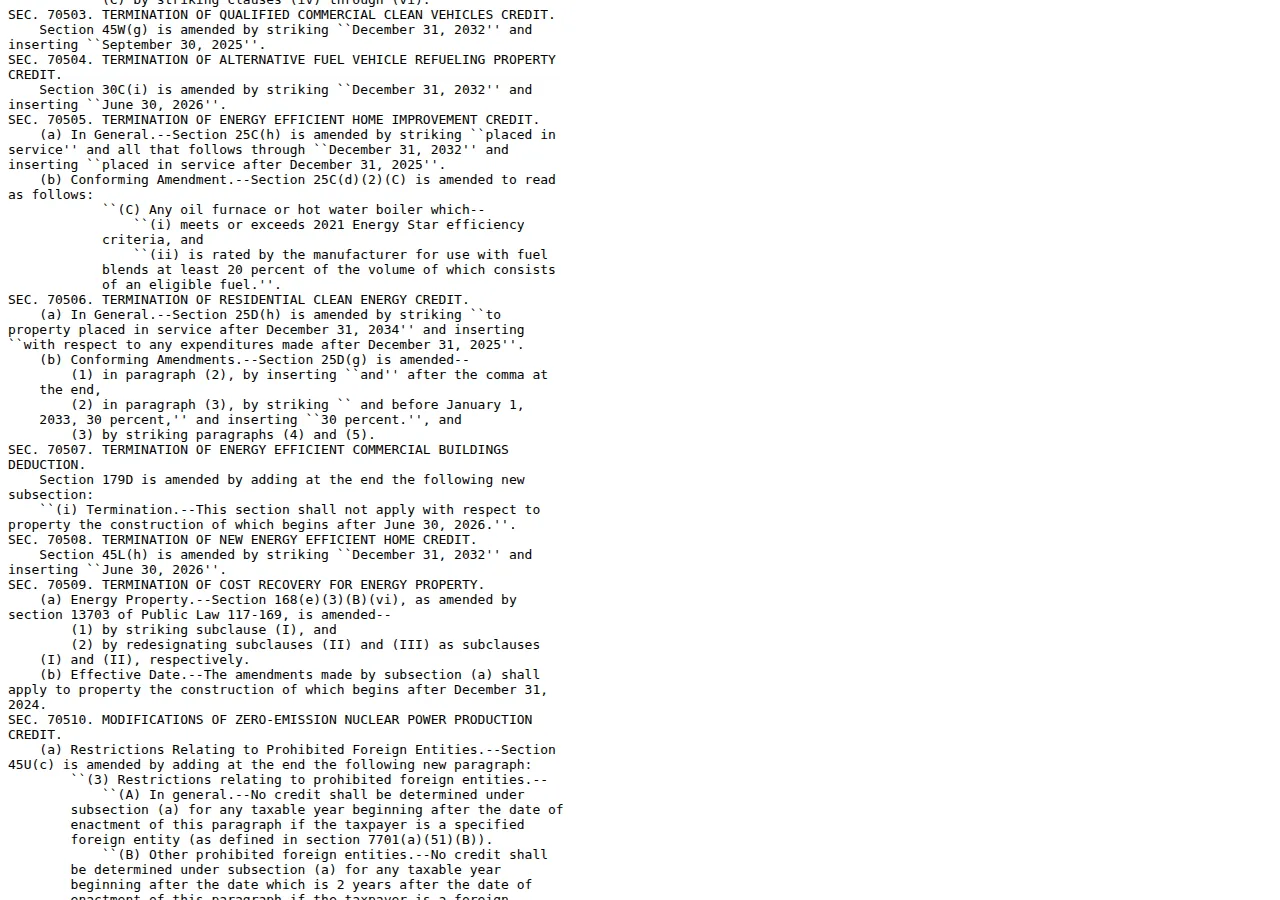
The IRS has already rewritten its guidance. The December 2025 Form 8908 instructions state that P.L. 119-21 changed the §45L termination date from December 31, 2032 to June 30, 2026, and the IRS §179D page, last reviewed October 27, 2026, states the same construction-beginning cutoff. Neither page allows a grace period, a placed-in-service exception, or a transition rule.
§45L: $2,500 to $5,000 per home, and the wage gate only moves multifamily
Section 45L pays the eligible contractor — the person who constructed the home, or the manufactured-home producer under §45L(b)(1) — for each qualified new energy efficient home acquired by another person for use as a residence. The home must be in the United States, its construction substantially completed after enactment, and it must meet the energy saving requirements of §45L(c). The amount turns on building type, program tier, and — for multifamily only — prevailing wages.
| Home type and tier | No prevailing wage | Prevailing wage met (§45L(g)) |
|---|---|---|
| Single-family / manufactured, ENERGY STAR | $2,500 | $2,500 |
| Single-family / manufactured, DOE Zero Energy Ready Home | $5,000 | $5,000 |
| Multifamily unit, ENERGY STAR | $500 | $2,500 |
| Multifamily unit, DOE Zero Energy Ready Home | $1,000 | $5,000 |
The wage point is the one most summaries get wrong. Section 45L(g)(1) applies only to "a qualifying residence described in subsection (a)(2)(B)" — the multifamily unit. A single-family builder paying below the prevailing wage loses nothing; a multifamily developer paying below it loses 80 percent of the credit. A 40-home subdivision:
ext{ENERGY STAR credit} = 40 imes $2,500 = $100,000
ext{Zero Energy Ready credit} = 40 imes $5,000 = $200,000
A 120-unit multifamily building, ENERGY STAR:
ext{No prevailing wage credit} = 120 imes $500 = $60,000
ext{Prevailing wage credit} = 120 imes $2,500 = $300,000
ext{Zero Energy Ready + prevailing wage credit} = 120 imes $5,000 = $600,000
Three compliance facts: First, the home must be certified to an eligible version of the ENERGY STAR program — and the version matters more than the label. In 2025 a single-family home had to be certified to Single-Family New Home National v3.2; a home certified under v3.1 was still ENERGY STAR certified but did not qualify for the credit. Second, the contractor must obtain the certification before the home is acquired and before claiming the credit — a certificate dated after the closing does not cure the claim. Third, the credit reduces the builder's basis in the home, which lowers cost of goods sold (COGS) when it is sold. Partnerships and S corporations file Form 8908 under the contractor's EIN and the credit flows to the partners or shareholders; an LLC taxed as a partnership or an S-Corp claims the same way, while a C-Corp contractor claims on its own return. Because §45L is a general business credit under IRC § 38, an unused credit carries back 1 year and forward 20 years under § 39(a)(1). A CPA should test the credit limitation before promising the full amount in year one.
§179D: the per-square-foot scale, indexed every year
Section 179D is a deduction, not a credit, priced per square foot rather than per unit. The property must be energy efficient commercial building property: depreciable property installed on or in a United States building within the scope of Reference Standard 90.1, as part of the interior lighting, heating, cooling, ventilation, and hot water systems, or the building envelope, and certified under a plan designed to cut total annual energy and power costs by 25 percent or more against a Standard 90.1 reference building (§179D(c)(1)). The deduction is the lesser of the installed cost or the maximum per-square-foot amount.
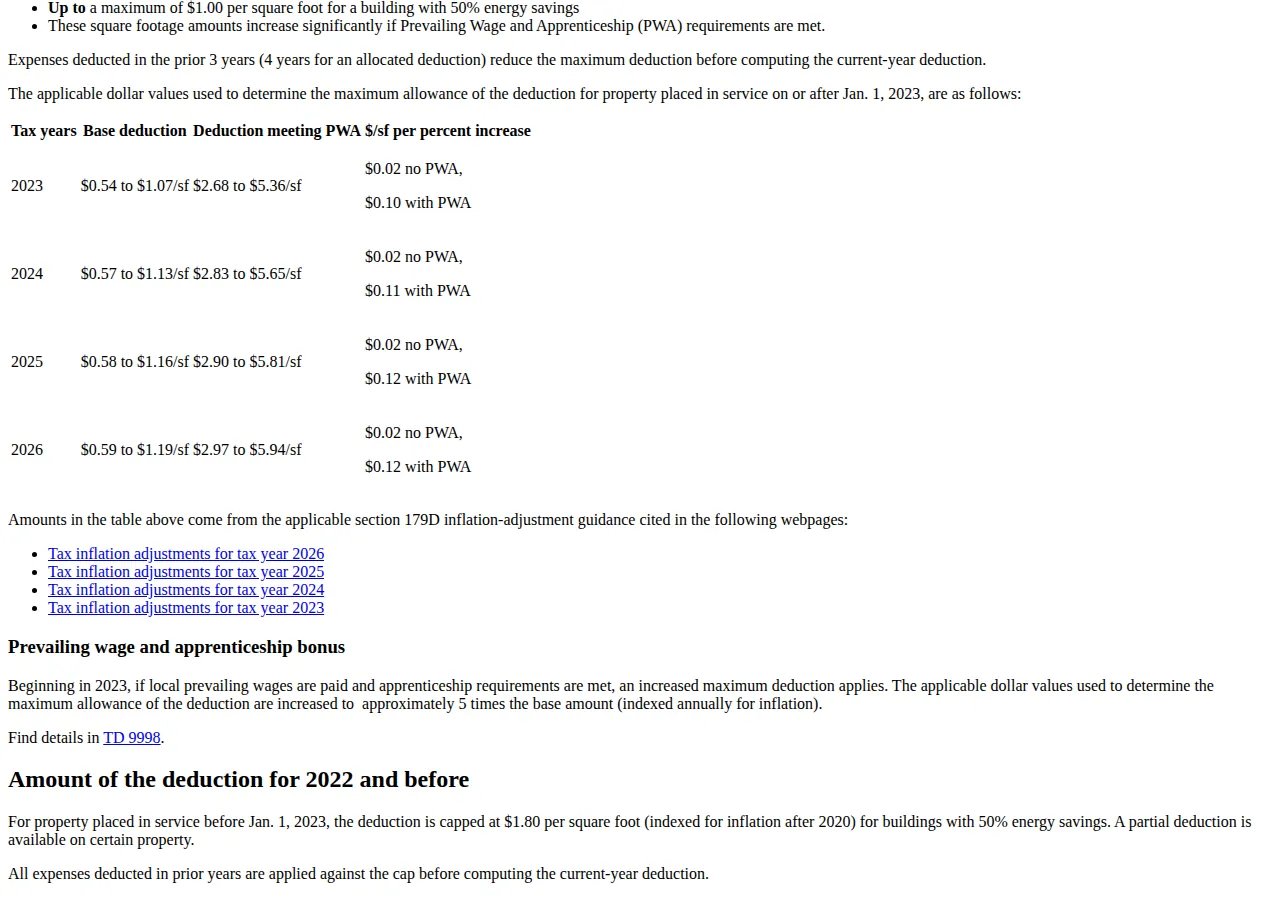
| Tax year | Base per sq ft | PWA deduction per sq ft | Per-point increase |
|---|---|---|---|
| 2024 | $0.57 to $1.13 | $2.83 to $5.65 | $0.02 no PWA, $0.11 with PWA |
| 2025 | $0.58 to $1.16 | $2.90 to $5.81 | $0.02 no PWA, $0.12 with PWA |
| 2026 | $0.59 to $1.19 | $2.97 to $5.94 | $0.02 no PWA, $0.12 with PWA |
The statute behind the table is §179D(b)(2): $0.50 per square foot at 25 percent savings, plus $0.02 per point above 25 percent, capped at $1.00 — the range runs from 25 to 50 percent. With prevailing wage and apprenticeship met, §179D(b)(3) substitutes $2.50, $0.10, and $5.00. A 100,000 square foot office at 40 percent savings:
ext{Applicable value} = $0.50 + (40 - 25) imes $0.02 = $0.50 + $0.30 = $0.80 ext{ per sq ft}
ext{Deduction} = 100{,}000 imes $0.80 = $80,000
The same building, with Davis-Bacon wages and apprenticeship met:
ext{Applicable value (PWA)} = $2.50 + (40 - 25) imes $0.10 = $2.50 + $1.50 = $4.00 ext{ per sq ft}
ext{Deduction (PWA)} = 100{,}000 imes $4.00 = $400,000
ext{Applicable value (2026, PWA)} = $2.97 + (40 - 25) imes $0.12 = $2.97 + $1.80 = $4.77 ext{ per sq ft}
ext{Deduction (2026, PWA)} = 100{,}000 imes $4.77 = $477,000
At the 50 percent ceiling the 2026 PWA table tops out at $5.94 — the published table governs over the increment formula, which would give $5.97. History caps the deduction too: amounts claimed on the same building in the prior 3 taxable years (4 if allocated) reduce the current-year maximum under §179D(b)(1)(B). With $180,000 claimed in the prior 3 years:
ext{Maximum deduction (2026, PWA, 50%)} = 100{,}000 imes $5.94 = $594,000
ext{Remaining deduction} = $594,000 - $180,000 = $414,000
Two §179D features have no §45L equivalent. First, the designer allocation (§179D(d)(3)): where the building is owned by a specified tax-exempt entity — the United States, a state or political subdivision, an Indian tribal government, an Alaska Native Corporation, or another tax-exempt organisation — the deduction may be allocated to the person primarily responsible for the design. The designer, not the owner, claims it. Second, the retrofit alternative in §179D(f): a building placed in service at least 5 years before the qualified retrofit plan can earn the deduction on an energy use intensity basis. Under §179D(e), the property's basis is reduced by the deduction. Claim it on Form 7205, and measure the model against the ASHRAE standard the IRS prescribes — Standard 90.1-2019 for property placed in service after December 31, 2026.
The two triggers are not the same — price the mistake
Treating June 30, 2026 as one deadline is the most expensive error in this playbook. It is two deadlines with two different clocks: a §45L home acquired July 1, 2026 earns $0, and a §179D project whose construction begins July 1, 2026 earns $0. Neither failure can be cured by finishing early — neither trigger is the placed-in-service date.
| Scenario | §45L result | §179D result | Authority |
|---|---|---|---|
| Home acquired June 30, 2026 | Credit allowed | Not applicable | § 45L(h) |
| Home acquired July 1, 2026 | $0 — credit terminated | Not applicable | § 45L(h) |
| Construction begins June 30, 2026, placed in service 2027 | Not applicable | Deduction allowed | § 179D(i) |
| Construction begins July 1, 2026, placed in service 2026 | Not applicable | $0 — deduction terminated | § 179D(i) |
The §45L cliff, 40-home subdivision:
ext{Credit if acquired June 30, 2026} = 40 imes $2,500 = $100,000
ext{Credit if acquired July 1, 2026} = 40 imes $0 = $0
The §179D cliff, 200,000 square foot retrofit, 40 percent savings, 2026 PWA:
ext{Deduction if construction begins June 30, 2026} = 200{,}000 imes $4.77 = $954,000
ext{Deduction if construction begins July 1, 2026} = $0
A one-day slip costs $100,000 on the builder's deal and $954,000 on the retrofit. The dates on the contracts, the wage records, and the certification letters are the tax position. Our bonus depreciation 100 percent OBBBA 2026 playbook covers the other OBBBA timing change in these projects, and our cost segregation study playbook covers the building's components once the §179D deduction is claimed. Run the combined picture through our tax estimator before the board signs off.
Founder & CEO Insight — Enow A. Jovial
Who should not chase this
A developer whose homes will not be acquired until the second half of 2026 should stop pricing the §45L credit into the pro forma — a model still carrying $2,500 per home overstates the return by that amount per unit. A commercial owner whose retrofit cannot begin construction before July 1, 2026 should stop carrying the §179D deduction and price the retrofit on energy savings alone. A multifamily developer who cannot pay Davis-Bacon prevailing wages should model the $500 base credit, not the $2,500 figure. A designer counting on a §179D allocation for a tax-exempt client's building should confirm it in writing before the design is delivered — the allocation is permitted by the statute, not automatic. The incentives reward projects already in motion with their paperwork in order, not projects that start after the deadline hoping for a transition rule.
Execution checklist
- [x] Step 1: Name the trigger for each project: §45L, the acquisition date on the closing documents; §179D, the date construction begins, evidenced by the contract and the first work on site. Write both dates on the project file.
- [x] Step 2: Pull every closing and construction start forward of June 30, 2026 where the incentive is material: a §45L closing in July 2026 must move to June 30 or the credit is lost; a §179D start in July 2026 must move to June 30 or the deduction is lost. Get the new dates in writing.
- [x] Step 3: Verify the certification version and date: for §45L, confirm the ENERGY STAR version on the certificate is the eligible version for the acquisition year and predates the acquisition; for §179D, confirm the energy model, the ASHRAE 90.1 version, and the qualified individual's certification are complete before filing.
- [x] Step 4: Prove the wage and apprenticeship record before claiming the higher tier: Davis-Bacon payroll records for every laborer and mechanic, including FICA withholding, apprenticeship ratios and hours under §45(b)(8) for §179D, and the §45L(g) wage records for multifamily. A higher-tier claim without the payroll file is one the IRS can reverse.
- [x] Step 5: File on the right form and model the basis cost: Form 8908 for §45L and Form 7205 for §179D, with the general business credit limitation and the §39 carryback and carryforward tested by your CPA, and the basis reduction reflected before filing.