Cost Segregation Study Playbook: 5, 7, and 15-Year Property
A $2,000,000 commercial building is depreciated over 39 years under 26 U.S.C. § 168(c). A cost segregation study asks how much of it is not the building at all — carpet, specialty wiring, parking lot, furniture — that the tax code depreciates over 5, 7, or 15 years. The study creates no new deduction. It moves deductions from year 30 to year 1 — with 100 percent bonus, the reclassified pieces are deducted in full in year 1.
The study is an engineering document with a tax conclusion: an engineer prices the building's components from construction records and assigns each a recovery period. The IRS reads it against Publication 5653, the Cost Segregation Audit Techniques Guide (Rev. 2-2025), which warns it is "not an official IRS pronouncement and may not be cited as authority." It is the examiner's manual.
The statute: the building is 39 years, its parts are not
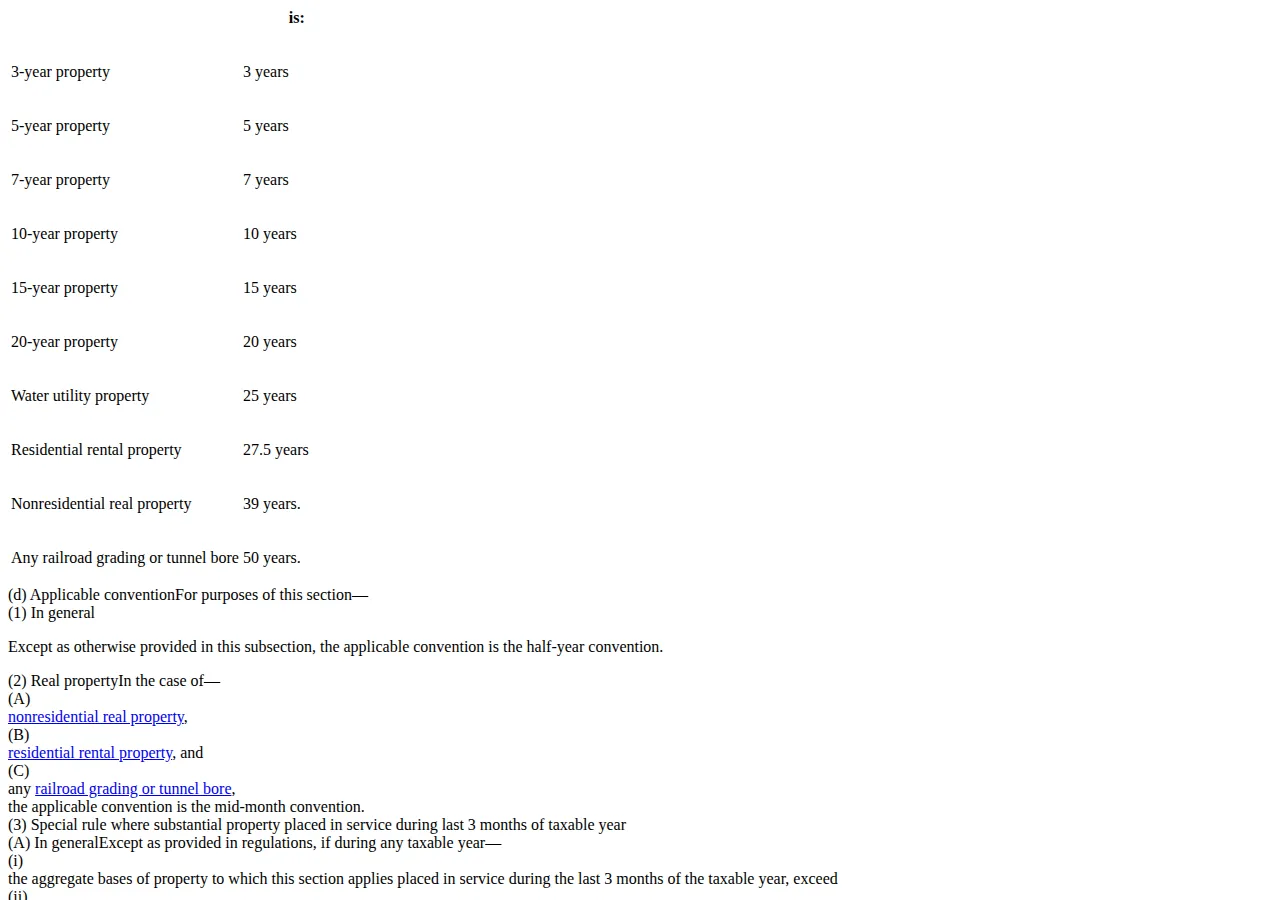
Section 167(a) allows "a reasonable allowance for the exhaustion, wear and tear" of property used in a trade or business or held for the production of income; § 168 fixes how fast it is taken: 5- and 7-year property at 200 percent declining balance under § 168(b)(1), 15-year property at 150 percent under § 168(b)(2), residential rental at 27.5 years and nonresidential real property at 39 years, both straight line under § 168(b)(3).
The default for a commercial building is the last row: 39 years, straight line, mid-month convention under § 168(d)(2). Reclassified property escapes that row and takes the half-year convention under § 168(d)(1).
The percentages in this guide describe one example building, not a market average.
§ 1245 vs § 1250: the line the study moves
The legal test is not the recovery period. It is whether a component is § 1245 property — tangible personal property, equipment, furniture, fixtures — or § 1250 property, the building and its structural components. The audit guide: § 1245 property "has a shorter recovery period (e.g., 5 or 7 years)" while a building "must use straight-line depreciation."
Hospital Corporation of America v. Commissioner, 109 T.C. 21 (1997), settled the test: decorative millwork, specialty electrical, and removable partitions were tangible personal property, not structural components, because they were not inherently permanent. The test is whether the item can be removed without damage and whether it serves the business inside, not the building's operation.
Three families carry most reclassifications: 5-year property — carpeting, vinyl flooring, decorative lighting, specialty electrical; 7-year property — office furniture and fixtures; and 15-year land improvements under asset class 00.3 of Rev. Proc. 87-56 — parking lots and sidewalks — with a 20-year class life under § 168(e)(1). Qualified improvement property — an interior improvement placed in service after the building was first placed in service — is also 15-year property under § 168(e)(3)(E) and § 168(e)(6).
The worked example: a $2,000,000 office building
Take a nonresidential office building bought for $2,500,000: $500,000 to land, $2,000,000 to the building. Land is never depreciable. Placed in service in March 2026, it clears the January 19, 2025 line for 100 percent bonus. The study reclassifies 37 percent of the building basis:
| Component class | Share | Amount | Period | Authority |
|---|---|---|---|---|
| 5-year property | 18% | $360,000 | 5 years | § 168(c) |
| 7-year property | 7% | $140,000 | 7 years | § 168(c) |
| 15-year property | 12% | $240,000 | 15 years | § 168(c), (e)(1) |
| 39-year property | 63% | $1,260,000 | 39 years | § 168(c) |
| Total | 100% | $2,000,000 | — | § 167(a) |
Year 1 without a study:
Year 1 with the study, MACRS alone (Pub. 946 Table A-1):
With 100 percent bonus:
That is $724,978.63 more than the no-study year 1. At the 37 percent top rate in § 1(j)(2), the year-1 tax value is $268,242.09 with bonus, $32,924.31 without. Over five years the MACRS-only study adds $447,543.19 of deductions ($165,590.98 of tax value); the year-2 addition alone is $153,311.64.
Price the study on net present value, not the year-1 headline. Total depreciation over 39 years is $2,000,000 with or without the study; nothing is created. Discounting the full incremental stream at 6 percent, the MACRS-only acceleration is worth $297,995.59 and the bonus acceleration $417,809.00. If the fee exceeds the NPV at your discount rate, the study loses money even though the deduction looks large.
Our section 179 vs bonus depreciation guide covers the election next to this one; our 1031 exchange playbook covers the depreciation clock on a trade.
Bonus depreciation: the January 19, 2025 line
Bonus depreciation is the multiplier that makes a study pay in year 1 instead of year 6. Under the Tax Cuts and Jobs Act the rate phased down 20 points a year: 80 percent in 2023, 60 percent in 2024, 40 percent in 2025, 20 percent in 2026. The One Big Beautiful Bill Act (P.L. 119-21, signed July 4, 2025) replaced the phase-down with a permanent 100 percent rate in § 168(k)(1)(A) — but only for qualified property acquired after January 19, 2025, under § 70301(c)(1).
| Property acquired | Placed in service | Bonus rate |
|---|---|---|
| After January 19, 2025 | After January 19, 2025 | 100%, permanent |
| On or before January 19, 2025 | 2025 | 40% (60% LPP) |
| On or before January 19, 2025 | 2026 | 20% |
The acquisition date is the trap. Under § 70301(c)(4), property is not treated as acquired after the date a written binding contract is entered into. Sign a binding contract on January 10, 2025 and close in March, and the building is on the 40-percent side though you paid in March. Notice 2026-11 confirms the framework: taxpayers rely on Reg. § 1.168(k)-2 with the 2017 dates replaced by January 19, 2025, including the 10-percent safe harbor for construction begun.
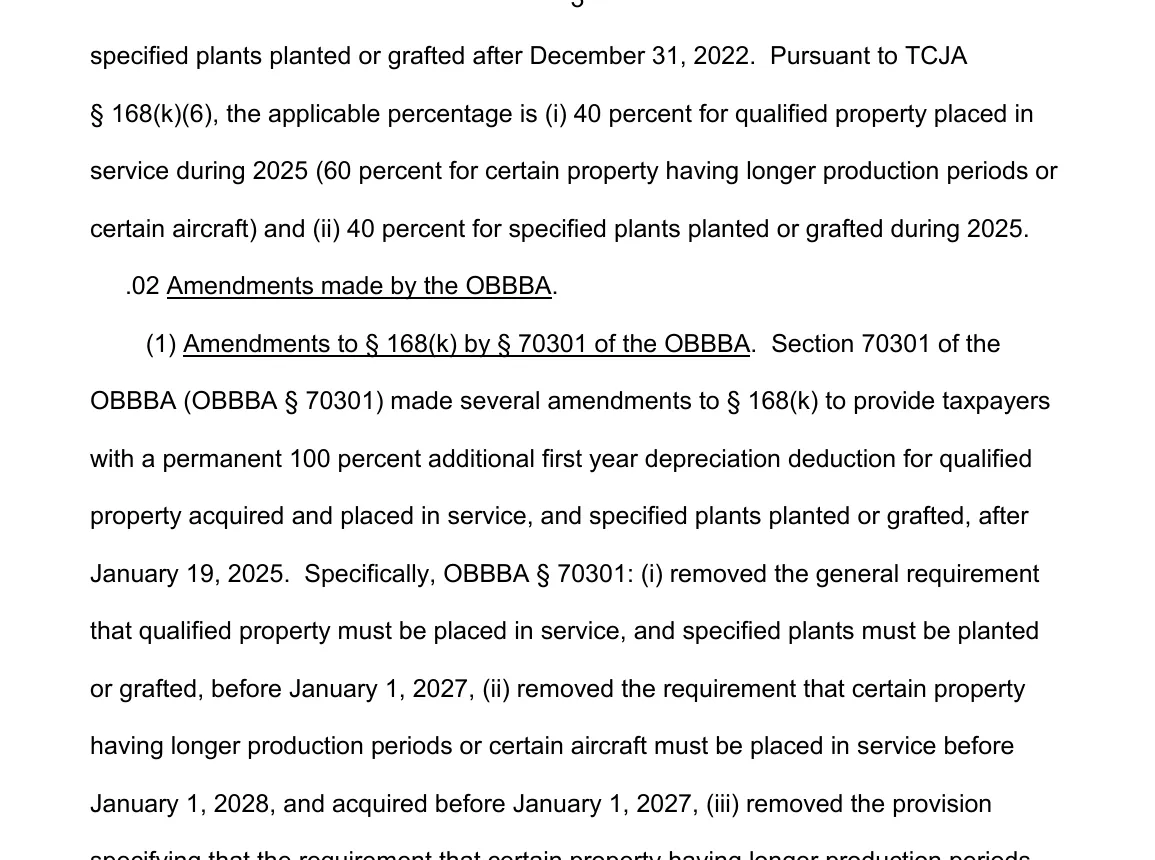
Two elections sit inside the same notice. Section 168(k)(10) lets a taxpayer elect 40 percent instead of 100 percent — 60 percent for longer production period property — but only for property placed in service in the first taxable year ending after January 19, 2025. Section 168(k)(7) lets a taxpayer elect out of bonus for a class of property — the right move for expiring net operating losses, a decoupling state, or a low-income year. Run the tax estimator at your own marginal rate before choosing — the 37 percent math assumes the deduction is usable in the year it is taken.
What a quality study contains: six approaches, thirteen elements
The guide describes six approaches and prescribes none: detailed engineering from actual cost records — "the most methodical and accurate approach" — detailed engineering cost estimate, survey or letter, residual estimation, sampling or modeling, and the rule of thumb, a fixed percentage from industry averages that an examiner should view with caution.
Chapter 4 lists thirteen principal elements — preparer expertise, methodology, documentation, interviews, nomenclature, numbering, legal analysis, take-off, asset lists, reconciliation, indirect costs, § 1245 listing, and related aspects.
Element 10 kills weak studies: allocated costs must reconcile to total actual costs, dollar for dollar. A study allocating $2,100,000 of components to a $2,000,000 building fails on its face. Element 1 matters because the guide states there are no prescribed qualifications — anyone can write a study. A study by a construction engineer is, in the guide's words, "more reliable than one conducted by someone with no engineering or construction background." Ask for credentials, methodology, and reconciliation.
The late study: Form 3115 and the § 481(a) catch-up
A study in the placed-in-service year goes on that year's return. A study three years later is the common case and needs no amended returns. A change in recovery period or convention from reclassification is a change in accounting method, and the adjustment is made under § 481(a), which takes into account adjustments "determined to be necessary solely by reason of the change in order to prevent amounts from being duplicated or omitted."
The vehicle is Form 3115, filed with the timely filed return for the year of change. The study attaches to the return of the LLC that owns the building, identified by its EIN — never the owner's SSN — and the CPA who prepares the return signs Form 3115. An S-corp owner takes the acceleration through the K-1; a C-corp takes it at the entity level. Two designated change numbers in Rev. Proc. 2025-23 cover a late study: DCN 7 under § 6.01, from an impermissible to a permissible method, and DCN 200 under § 6.12, for a permissible-to-permissible MACRS reclassification. One rule matters: under § 6.01(1)(a)(i), the impermissible method must have been used in at least two taxable years immediately preceding the year of change. A building placed in service in the year just before the change falls under § 6.01(1)(b) — amend that year's return instead.
Take the same $2,000,000 building, placed in service in January 2023, with the study done in 2026. Through 2025 the owner claimed $151,709.40: $49,145.30 for 2023 at 11.5 months, plus $51,282.05 in 2024 and 2025. The correct figure recomputes each closed year under that year's law — a 2023 date gets 2023's 80 percent bonus rate, not 2026's 100 percent:
The $613,951.12 is a negative § 481(a) adjustment — a deduction in the year of change, 2026, in one year; a positive adjustment is spread over four years. At 37 percent it is worth $227,161.91 of tax in 2026, if the taxpayer can use it. The two-year rule is the gate: a building placed in service in 2025 with a study in 2026 has only one return on the old method, so the 2025 return is amended.
Founder & CEO Insight — Enow A. Jovial
Who should not do this
Rental losses are passive under § 469 unless the owner is a real estate professional: more than half of personal services in real property trades or businesses with material participation, and more than 750 hours in those businesses, under § 469(c)(7). Without that status, the § 469(i) $25,000 offset phases out at 50 cents per dollar of AGI over $100,000 and disappears at $150,000. A high-income owner with a day job and one rental can hold a $613,951 catch-up deduction suspended until sale or qualification.
Our Schedule E rental income playbook covers how rental losses are reported and when the passive-loss limits let you use them.
A study is a tax document, not a book document — GAAP keeps the building at 39 years while the tax return accelerates.
Execution checklist: run a study in one pass
- Step 1 — Fix the dates. Confirm acquisition and placed-in-service dates, and whether a binding contract predates January 19, 2025 — the bonus rate follows the contract date.
- Step 2 — Split land from building. Land is never depreciable; the study allocates only the building basis — $2,000,000 of a $2,500,000 purchase here.
- Step 3 — Gather the construction records. Drawings, specifications, contracts, change orders, invoices, payment requests.
- Step 4 — Commission the study before the return is filed. An engineer with construction and tax-law experience, a written methodology, and a reconciliation.
- Step 5 — File it on the return, or on Form 3115. Placed-in-service year: on the return. Later year: Form 3115, DCN 7 or DCN 200, with the § 481(a) adjustment.
- Step 6 — Test usability before you celebrate. Real estate professional status, the $25,000 offset phase-out, state conformity, exit recapture. A deduction you cannot use is a number on a schedule, not money.
Get the dates and documents right, and the arithmetic here is the arithmetic on your return.