IRC §385: Debt vs. Equity Recharacterization Playbook
A parent lends its subsidiary $10,000,000 at 6 percent and deducts $600,000 a year. The subsidiary is thinly capitalized, the note is subordinated to the bank, no payment date is enforced, and the parent owns every share. On paper it is debt. Under section 385 it may be equity — and if it is, the $600,000 a year is not interest at all: it is a dividend, the deduction vanishes, and the tax bill arrives with interest and penalties attached. This playbook works the statute, the court test, the regulation, and the dollar cost of each failure mode; the companion section 163(j) playbook covers the interest cap after debt survives section 385.
The statute: section 385(a), (b), and (c)
Congress added section 385 in 1969. Section 385(a) authorizes the Secretary to prescribe regulations deciding whether an interest in a corporation is stock or indebtedness, or partly each. Section 385(b) names five factors the regulations must weigh: a written unconditional promise to pay a sum certain with fixed interest; subordination or preference; the debt-to-equity ratio; convertibility into stock; and the relationship between stock and debt holdings. The list is expressly non-exhaustive, which is why the courts built a longer test around it.
Section 385(c) is the trap most issuers overlook: the characterization chosen at issuance binds the issuer and every holder, but not the Secretary. Calling an instrument debt binds the issuer while leaving the IRS free to recharacterize it as stock. A holder who disagrees must disclose the inconsistent treatment under section 385(c)(2), or the issuer's label binds the holder too. An EIN application and a board resolution do not change this: the label is a statement, not a shield.
The court test: sixteen factors, no single answer
With no widely applicable final regulations under section 385 for decades after 1969, the courts decided these cases one by one. The Tax Court's sixteen-factor test in Estate of Mixon remains the working framework, and every factor asks about economic reality rather than paperwork: a written promise, a fixed rate, subordination, the ratio, convertibility, proportionality, intent, the outside-lender test, the source and use of funds, capitalization, and enforceability. No single factor controls — but thin capitalization plus proportionality plus a failure to enforce has lost more cases than any other combination.
| Factor | Debt | Equity | Authority |
|---|---|---|---|
| Written promise, fixed maturity date | Signed note, fixed maturity | No maturity date | §385(b)(1) |
| Fixed rate of interest | Stated rate, paid on schedule | Contingent on profits | §385(b)(1) |
| Subordination | Ranks with trade creditors | Subordinated to all outside debt | §385(b)(2) |
| Debt-to-equity ratio | Below 3:1 | Above 5:1 | §385(b)(3) |
| Proportionality | Held by outsiders | Held pro rata to stock | §385(b)(5) |
| Creditor remedies | Default triggers collection or suit | No remedy exercised; payments ignored | Estate of Mixon factors |
Case in point: Fin Hay Realty Co. v. United States, 398 F.2d 694 (3d Cir. 1968). Two shareholders each put $10,000 into stock and $53,000 into 6 percent demand notes — 5.3:1, pro rata, no outside creditor, notes the corporation could not repay for years. The IRS disallowed the interest deductions for 1959–1962; the Third Circuit affirmed, holding the advances were capital contributions because form did not match economic reality. Ratio plus proportionality plus a note no outsider would buy loses.
Worked math 1: the recharacterization bill
Take OpCo, a C-Corp subsidiary with $1,000,000 of equity. HoldCo advances $10,000,000 on a 6 percent interest-only note, five-year maturity, subordinated to OpCo's bank line. Under U.S. GAAP the note is a liability on OpCo's books; book treatment and tax treatment differ. OpCo deducts $600,000 of interest a year, worth $126,000 annually at the 21 percent corporate rate in section 11(b). If the note is recharacterized as equity, the $600,000 payment is a distribution under section 301: a dividend to the extent of OpCo's earnings and profits under section 301(c)(1), then a return of capital reducing HoldCo's stock basis under section 301(c)(2), then gain under section 301(c)(3). OpCo gets no deduction at all — model it on the profit calculator before signing.
HoldCo owns 100 percent of OpCo, so the dividend qualifies for the 100 percent dividends-received deduction under section 243(a)(3) and HoldCo pays no tax on the $600,000. The group's net cost is $126,000 a year at OpCo — $630,000 over the note's life — plus state tax, interest, and penalties on the underpayment. With a foreign parent it is worse: a dividend can attract withholding tax that interest might have avoided under a treaty. A CPA reviewing the file asks first whether the note would survive the outside-lender test — that single question predicts most of the others.
Worked math 2: the thin-capitalization ratio
The ratio in section 385(b)(3) is the factor founders can compute before signing. OpCo has $1,000,000 of equity and takes on $9,000,000 of related-party debt — a 9:1 ratio.
No statute fixes a safe ratio; courts have respected ratios above 3:1 when the other factors were clean. But a bank lending at 3:1 supports only $3,000,000 against that equity base, leaving $6,000,000 unsupported — $360,000 a year of interest at 6 percent, the amount an examiner will target first.
The cure is unglamorous: contribute equity before borrowing, or borrow from a bank with a parent guarantee instead of lending directly. A guarantee fee must be arm's length — but a bank loan with a market rate, a fixed maturity, and a lender that enforces its remedies scores on nearly every factor in the table at once.
The regulation: Treas. Reg. § 1.385-3
The regulation that bites today is Treas. Reg. § 1.385-3, which recharacterizes debt mechanically — no multi-factor balancing, no intent inquiry. It applies to a covered debt instrument: debt issued by a domestic corporation to another member of its expanded group — corporations connected through at least 80 percent common stock ownership by vote or value. The general rule in paragraph (b)(2) treats the instrument as stock when issued in a distribution, in exchange for expanded group stock other than in an exempt exchange, or for property in an asset reorganization to the extent a shareholder receives the instrument for its stock. A note issued as a dividend is stock from the day issued.
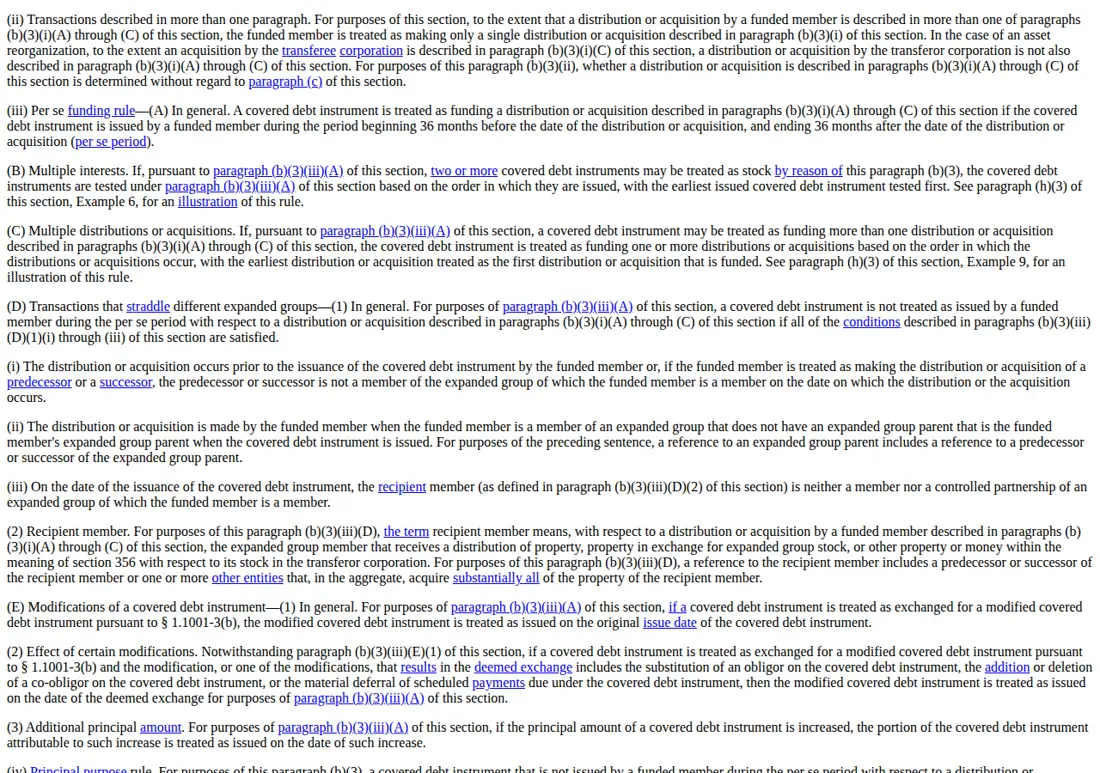
A covered debt instrument issued in exchange for property is treated as stock to the extent it funds a distribution to an expanded group member, an acquisition of expanded group stock, or an acquisition of property in an asset reorganization. The per se funding rule in paragraph (b)(3)(iii) supplies the tripwire: a debt instrument issued during the period beginning 36 months before the distribution or acquisition and ending 36 months after it — a 72-month window — is treated as funding it. A January 2024 distribution and a December 2026 loan fall inside the window, and the loan is stock. Outside the window, the principal purpose rule in paragraph (b)(3)(iv) still applies.
First, the threshold exception in paragraph (c)(4): a covered debt instrument is not treated as stock if the aggregate adjusted issue price of instruments that would be treated as stock does not exceed $50,000,000, and only the excess is recharacterized — a $60,000,000 covered note produces $10,000,000 of stock and $50,000,000 of surviving debt. Second, paragraphs (c)(2) and (c)(3) exclude control-preserving subsidiary-stock acquisitions, compensatory stock, dealer acquisitions, distributions out of current-year earnings and profits, and capital-contribution offsets. Third, qualified short-term debt instruments — short-term funding arrangements and cash-pool balances satisfying the 270-day test or the specified-current-assets test — are carved out.
The rise and fall of the documentation rules
On October 21, 2016, T.D. 9790 (81 FR 72858) published final and temporary regulations in two halves: documentation rules in Treas. Reg. § 1.385-2, and distribution rules in § 1.385-3. The documentation rules would have applied to interests issued after January 1, 2019, as delayed by Notice 2017-36; T.D. 9880 removed them in their entirety on November 4, 2019. The distribution rules survived, were finalized in T.D. 9897 in May 2020, and remain in effect — a split regime in which no checklist guarantees debt treatment and § 1.385-3 operates whether or not the paperwork is perfect.
The section 163(j) interplay
Section 385 decides whether a payment is interest at all; section 163(j) then caps the deduction for genuine business interest at business interest income plus 30 percent of adjusted taxable income plus floor plan financing interest. IRS FS-2026-14 (August 19, 2026) confirms the figures: the 30 percent cap, the $32,000,000 gross-receipts threshold for the small-business exemption in 2026, and the restored depreciation, amortization, and depletion addback for years beginning after December 31, 2024.
Take OpCo with adjusted taxable income of $4,000,000, no business interest income, and $1,500,000 of business interest expense. The cap is 30 percent of $4,000,000, or $1,200,000, so $300,000 is disallowed and carried forward under section 163(j)(2). Now suppose $600,000 of that $1,500,000 is interest on a note recharacterized under section 385: that $600,000 is not interest, so it never enters the section 163(j) computation — the remaining $900,000 falls inside the $1,200,000 cap and is fully deductible, while the $600,000 is tested as a dividend under section 301 and cannot be carried forward. The section 163(j) playbook works the cap in full. Fix the characterization first: disallowed interest under section 163(j) is temporary, but a recharacterized payment is gone permanently.
Scenario: the dividend that was supposed to be a loan
Scenario: a U.S. group with a foreign parent needs $20,000,000 in its U.S. operating company. The parent advances it on a 7 percent note, interest payable annually, ten-year maturity, no security, no covenants; the operating company has $2,000,000 of equity — a 10:1 ratio. In year two the operating company misses an interest payment and the parent does nothing — no default notice, no renegotiation, no collection effort. The payment is later made, labeled interest, and deducted. Our editorial analysis found this fact pattern fails at least five factors at once: the ratio, the failure to enforce, the absence of an outside lender, proportionality, and the source of payments — the "interest" is paid only when cash is spare. The exposure is $1,400,000 of annual interest and $294,000 a year in lost tax benefit at 21 percent. The fix, before the advance: a $6,000,000 equity contribution bringing the ratio to 2.5:1, a bank-rate clause with a default remedy the parent is prepared to use, and a written note the parent actually enforces.
Who should not use related-party debt
Related-party debt is a tool for groups that can pass the outside-lender test; it punishes everyone else. A single-member LLC taxed as a disregarded entity has no section 385 issue — but the moment it elects corporate treatment, the rules apply in full. An S-Corp borrowing from its shareholders faces a different risk: recharacterized debt becomes a second class of stock, terminating the S election under section 1361(b)(1)(D). A C-Corp planning a tax-free reorganization should check the funding rule first — the reorganization playbook and the section 351 playbook both assume the capital structure described is respected. A group with a foreign parent should model withholding on the dividend alternative first: the treaty rates on interest and dividends are rarely the same. If the instrument cannot pass the outside-lender test, contribute the money as equity: the tax cost is visible up front instead of arriving as an audit adjustment.
Founder & CEO Insight — Enow A. Jovial
Execution checklist: the debt file
- [x] Step 1: Run the ratio first — Compute debt-to-equity first; add equity until a bank would accept the ratio.
- [x] Step 2: Draft a real note — Fixed maturity, stated rate, unconditional promise to pay — signed before the money moves.
- [x] Step 3: Price it at arm's length — Document the comparable rate under section 482.
- [x] Step 4: Enforce the terms — Pay interest on schedule; send a default notice when a payment is missed.
- [x] Step 5: Screen the 72-month window — List every distribution, stock acquisition, and reorganization within 36 months of issuance.
- [x] Step 6: Apply the $50 million threshold — Aggregate covered debt that would be treated as stock; only the excess over $50,000,000 counts.
- [x] Step 7: Run section 163(j) second — Model the cap on genuine interest only.
- [x] Step 8: Check the S-Corp and withholding angles — A recharacterized note can end an S election; a dividend to a foreign parent can attract withholding.
- [x] Step 9: Have a CPA review the file — The note, the ratio, the enforcement history, and the funding-rule screen.