IRC Section 368: Tax-Free Reorganization Playbook
Two corporations combine. In an ordinary sale, shareholders recognize gain on the full appreciation of their stock and the target recognizes gain on its assets. Section 368 offers a different route: if the combination fits one of the seven types the statute defines, the exchange is tax-free at both levels. The tax is not forgiven — it is deferred, carried inside the basis of the new stock and the transferred assets until a later taxable sale. This playbook maps the seven types, the two continuity gates, the boot rules and the basis arithmetic.
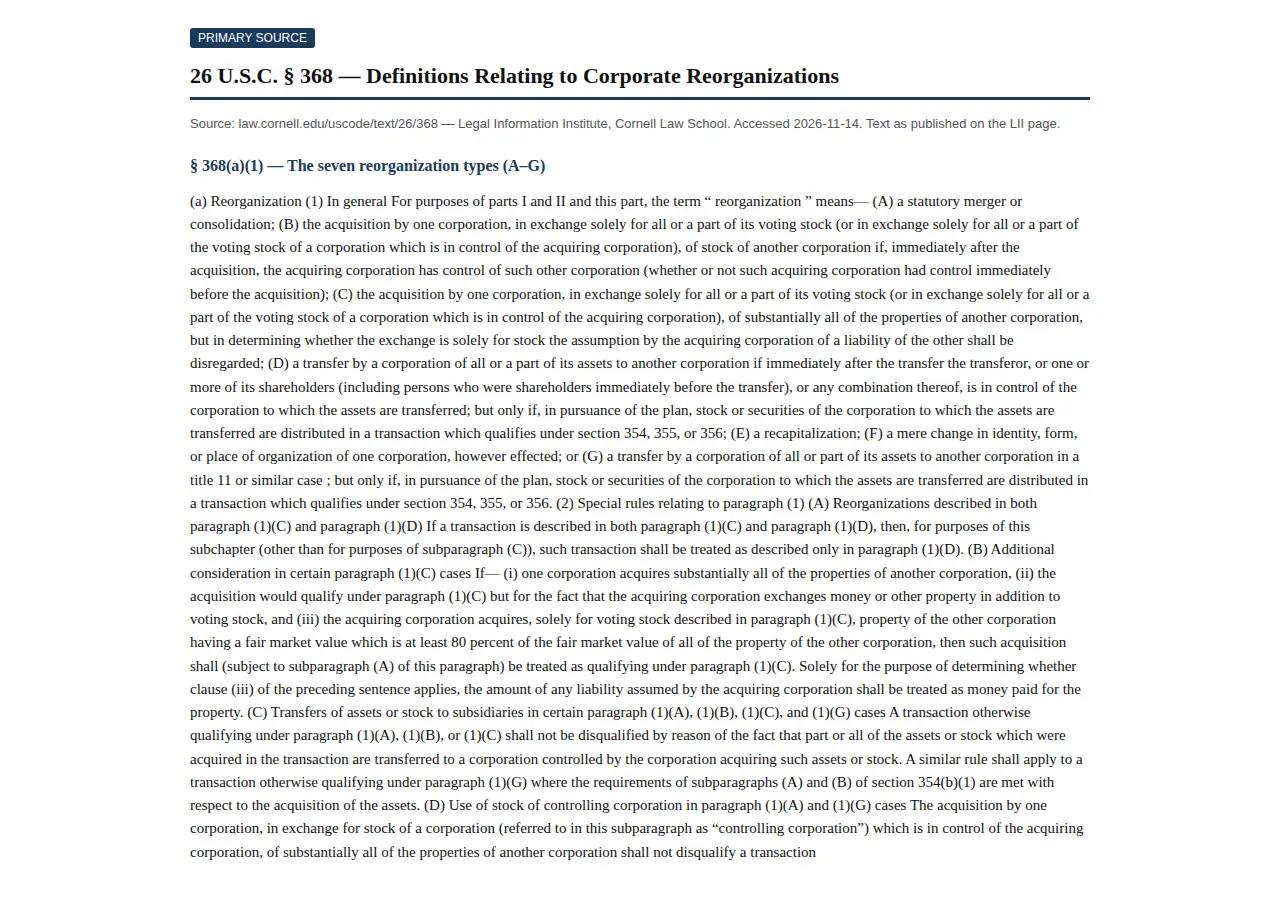
The seven types, in the statute's own words
Section 368(a)(1) lists the reorganizations, lettered A through G. The list is closed: a transaction fitting none of the seven is not a reorganization, however commercial its purpose. The screenshot below is the statute text, from Cornell LII, captured 2026-11-14.
| Type | What it is | The hard edge | Authority |
|---|---|---|---|
| A — Statutory merger or consolidation | Merger under state law into one surviving corporation | Flexible consideration; cash boot taxed under section 356 | IRC § 368(a)(1)(A) |
| B — Stock-for-stock acquisition | Acquirer buys target stock solely for its voting stock and ends with control | "Solely for voting stock" — one dollar of cash kills a Type B | IRC § 368(a)(1)(B) |
| C — Stock-for-assets acquisition | Acquirer buys substantially all of the target's properties solely for voting stock | 80 percent test in section 368(a)(2)(B); target must distribute what it receives | IRC § 368(a)(1)(C) |
| D — Divisive or acquisitive transfer | Transfer of assets to a corporation the transferor (or its shareholders) controls | Only if stock or securities are distributed under sections 354, 355, or 356 | IRC § 368(a)(1)(D) |
| E — Recapitalization | A corporation reshuffles its own capital structure | Same corporation; no second corporation involved | IRC § 368(a)(1)(E) |
| F — Mere change | Change in identity, form, or place of organization of one corporation | One corporation, new form — a reincorporation, not a combination | IRC § 368(a)(1)(F) |
| G — Bankruptcy transfer | Transfer of assets to another corporation in a title 11 or similar case | Only if stock or securities are distributed under section 354, 355, or 356 | IRC § 368(a)(1)(G) |
Three details decide real deals. Control in section 368(c) means at least 80 percent of the combined voting power of all voting classes and at least 80 percent of the shares of all other classes — a Type B acquirer ending with 75 percent has not acquired control. Section 368(a)(2)(C) lets an acquirer drop acquired assets or stock into a controlled subsidiary without disqualifying a Type A, B, or C deal. Section 368(a)(2)(D) permits a triangular merger using the controlling corporation's stock, provided no stock of the acquiring corporation is used — a parent can acquire a target through a merger subsidiary and stay in Type A.
The tax-free incorporation playbook covers formation — section 351, where property goes into a new corporation for stock. Section 368 picks up where section 351 stops.
The two gates: continuity of business enterprise and continuity of interest
Fitting a letter is not sufficient. Treasury Regulation § 1.368-1(b) adds two requirements: continuity of the business enterprise under paragraph (d) and continuity of interest under paragraph (e).
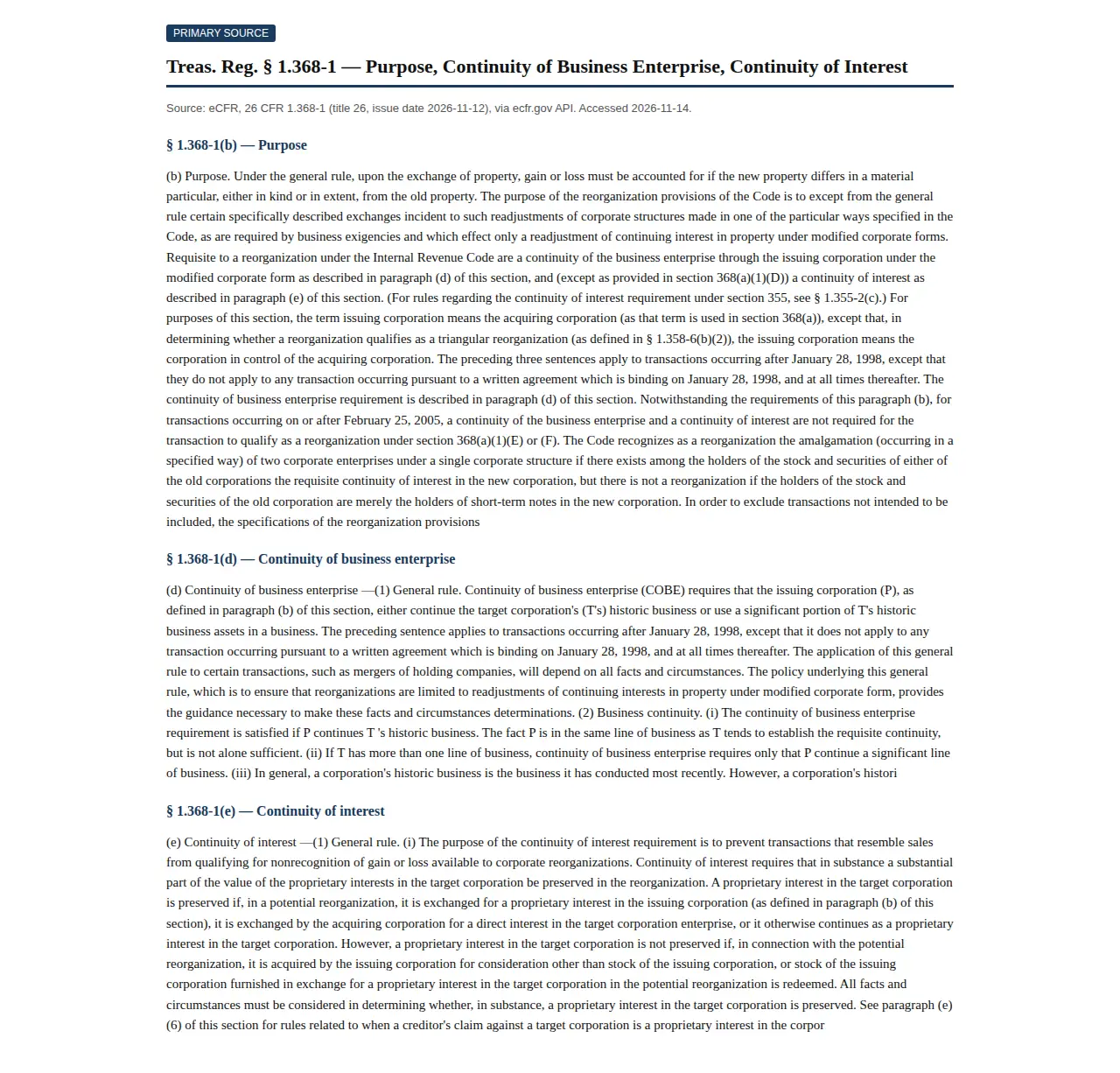
Continuity of business enterprise asks whether the business continues. Regulation § 1.368-1(d)(1) requires the issuing corporation to continue the target's historic business or to use a significant portion of its historic business assets in a business. If the target has more than one line, continuing a significant line suffices. A corporation's historic business is the business it conducted most recently — not one entered into as part of the plan. An acquirer that buys a corporation, shuts it and sells off its assets has not continued the business enterprise. Run the numbers on the profit calculator before assuming the deferral survives a wind-down.
Continuity of interest asks whether the owners continue. Regulation § 1.368-1(e)(1) requires that in substance a substantial part of the value of the proprietary interests in the target be preserved — exchanged for a proprietary interest in the issuing corporation or otherwise continued. A proprietary interest is not preserved if acquired for consideration other than issuing-corporation stock, or if stock furnished in the exchange is redeemed. The test is facts and circumstances, and the regulation fixes no percentage. A deal paying target shareholders 90 percent cash and 10 percent stock has the economics of a sale.
One exception: for transactions on or after February 25, 2005, neither test is required under section 368(a)(1)(E) or (F).
Worked example 1: a Type A merger with boot — the shareholder's tax
Take a Target shareholder with a $400,000 basis in stock worth $1,000,000. Acquirer merges Target into itself by statutory merger. She receives Acquirer voting stock worth $800,000 and $200,000 in cash. An illustrative scenario with stated assumptions, not a reported transaction.
Her realized gain is the amount realized less her basis:
Section 354 would shelter the exchange if it were solely for stock. It is not — $200,000 of cash boot. Section 356(a)(1) caps the recognized gain at the boot:
Her basis in the Acquirer stock follows section 358(a): the same as the property exchanged, decreased by money received and increased by gain recognized:
She now holds $800,000 of Acquirer stock with a $400,000 basis, so the $400,000 deferred gain sits inside that stock, taxed when she sells it. The $200,000 of cash was taxed now. Nothing vanished; the gain moved. Section 356(a) recognizes no loss on boot.
Worked example 2: the Type C 80 percent test
The asset route. Target has properties worth $10,000,000 and liabilities of $2,000,000, which Acquirer assumes. Acquirer pays voting stock worth $8,000,000 and $500,000 in cash. Section 368(a)(1)(C) requires the acquisition to be solely for voting stock, but section 368(a)(2)(B) saves the deal if the acquirer acquires, solely for voting stock, property worth at least 80 percent of the fair market value of all the target's property. For that test, any liability assumed is treated as money paid.
The stock portion meets the threshold exactly, so the acquisition qualifies under section 368(a)(1)(C) despite $500,000 cash — still boot to the target's shareholders when distributed, taxed under section 356. Two requirements remain: under section 368(a)(2)(G), the acquired corporation must distribute what it receives under the plan — in practice the target liquidates — and section 368(a)(2)(A) treats a transaction described in both (C) and (D) as described only in (D). If Acquirer had paid only $7,000,000 in stock and $1,500,000 in cash, the stock portion would be 70 percent and Type C qualification would fail outright. Set the consideration mix before the plan is adopted, not after.
Worked example 3: the corporate level — carryover basis and the value of deferral
At the corporate level, section 361(a) provides that no gain or loss is recognized to a corporation that is a party to a reorganization when it exchanges property in pursuance of the plan. Section 362(b) sets the acquiring corporation's basis in the transferred property: the same as in the transferor's hands, increased by gain recognized to the transferor. Suppose Target transfers assets with a basis of $3,000,000 and fair market value of $5,000,000 to Acquirer, with no gain recognized to Target:
Section 11(b) taxes income at 21 percent, so the deferred corporate gain represents:
That $420,000 is not saved; it is postponed until Acquirer sells the assets in a taxable transaction, the gain measured from the same $3,000,000 starting point. Section 381 adds a consequence: in a qualifying acquisition of assets, the acquiring corporation succeeds to the target's tax attributes — net operating loss carryovers, earnings and profits, capital loss carryovers, and accounting methods — subject to sections 382 and 384.
The boot traps that tax more than the cash
Boot is not always taxed as capital gain. Section 356(a)(2) provides that if the exchange has the effect of a dividend distribution, determined with section 318(a) attribution, the gain is treated as a dividend to the extent of the distributee's ratable share of undistributed earnings and profits. A shareholder who keeps a meaningful continuing interest and takes cash can find part of the gain recharacterized as a dividend — ordinary income, not capital gain — because the cash looks like a distribution, not a sale.
Securities carry their own trap. Section 354(a)(2) denies nonrecognition where the principal amount of securities received exceeds the principal amount surrendered, or where securities are received and none surrendered. Swapping a $100,000 bond for a $150,000 bond is not a tax-free exchange of the extra $50,000 of principal. Debt assumption is the third trap: under section 357, an assumed liability is generally not treated as boot in a section 361 exchange, but section 357(b) taxes the assumption if the principal purpose was tax avoidance, and section 357(c) taxes the excess where liabilities exceed the basis of property transferred.
The cross-border cousin is the section 367(d) IP transfer playbook: where section 368 defers gain on a domestic combination, section 367 can deny nonrecognition when the reorganization crosses a border. Run the domestic analysis first, then the cross-border analysis — never the reverse. The gain side sits in the QSBS gain-exclusion playbook: section 1202 can exclude gain on qualified small business stock entirely, while section 368 merely defers it.
Operator boundaries
This playbook is for the founder, CFO, CPA, or tax adviser of a domestic C-Corp combining with, acquiring, or splitting from another domestic corporation, where consideration is predominantly stock and the business will continue. It is not for a cash sale, which is taxable and priced as taxable; not for a transaction whose real purpose is to cash out the owners while keeping a merger's form; not for S-Corps, where subchapter S termination and built-in gains change the analysis, or LLCs taxed as partnerships; and not for cross-border combinations, where section 367 changes the answer.
Founder & CEO Insight — Enow A. Jovial
Run the reorganization: execution checklist
- Pick the letter first. Match the transaction to one of the seven types in section 368(a)(1).
- Adopt a written plan of reorganization by board action before the exchange.
- Test continuity of business enterprise under Regulation § 1.368-1(d): the issuing corporation continues the target's historic business or uses a significant portion of its historic business assets.
- Test continuity of interest under Regulation § 1.368-1(e): a substantial part of the target shareholders' proprietary interests is preserved in issuing-corporation stock; count every cash payment, including dissenters and fractional shares.
- Price the boot shareholder by shareholder. Apply section 356(a)(1) to each holder — recognized gain is the lesser of realized gain and boot — then run the dividend test in section 356(a)(2) and the securities test in section 354(a)(2).
- Compute the carryover bases and check section 357. Shareholder basis under section 358, corporate asset basis under section 362; record deferred gain inside each and tie it to the GAAP books.
- Track the section 381 attributes. Carry over net operating losses, earnings and profits, and capital loss carryovers; test sections 382 and 384.
- File the Regulation § 1.368-3 statement on or with each party corporation's return for the year of the exchange.
- Keep the plan, valuations, and basis schedules. The deferral is proved by records.
The decision in advance
Decide the consideration mix, the surviving business, and the basis records before adoption. A merger that fits a section 368 type, keeps the business running, and pays its owners mostly in stock defers the gain at both levels — $200,000 taxed now on $200,000 of boot, $400,000 deferred inside the new stock, $420,000 of corporate tax postponed on a $2,000,000 asset gain.