What § 383 actually does
Section 382 is the provision every deal team knows: after an ownership change — more than 50 percentage points of stock changing hands among 5-percent shareholders over three years — the pre-change net operating loss can shelter only a capped slice of post-change income each year. Section 383 is its quieter sibling: what happens to the credits carried forward alongside the loss?
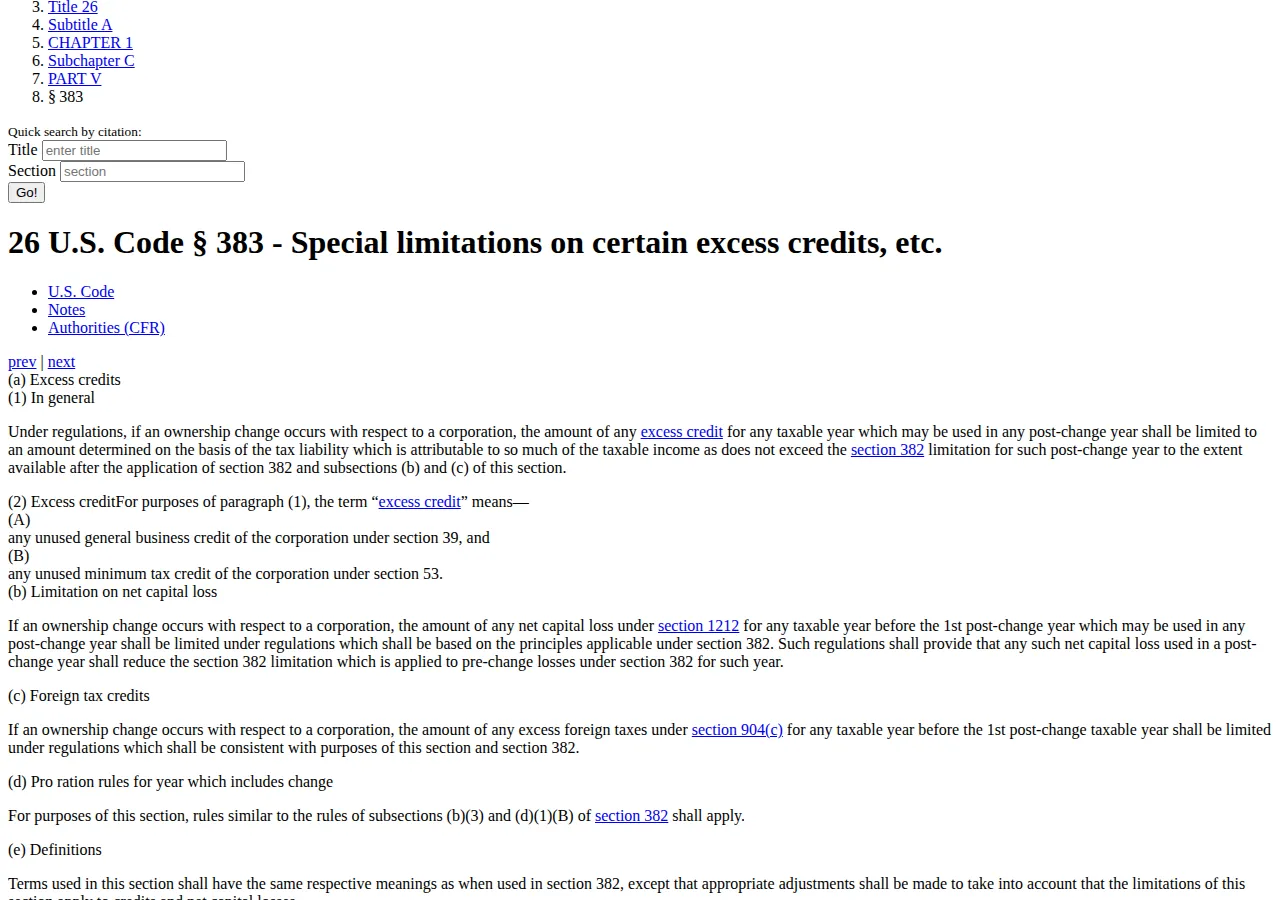
The answer is in 26 U.S.C. § 383(a)(1). Under regulations, if an ownership change occurs, "the amount of any excess credit for any taxable year which may be used in any post-change year shall be limited to an amount determined on the basis of the tax liability which is attributable to so much of the taxable income as does not exceed the section 382 limitation for such post-change year to the extent available after the application of section 382 and subsections (b) and (c) of this section." The limit is a tax cap, not a dollar cap: the credits can offset only the tax due on income up to the § 382 limitation, after the losses have had their turn.
Section 383(a)(2) defines the "excess credit" narrowly: any unused general business credit under § 39, and any unused minimum tax credit under § 53. The general business credit is the big one: under § 38(b) it pools dozens of component credits — the research credit under § 41, the work opportunity credit, the low-income housing credit — into one credit, and under § 39 the unused balance carries back one year and forward twenty, oldest vintage first. A foreign tax credit carryover and a net capital loss are handled by § 383(b) and (c), not by the excess-credit rule.
Three consequences surprise first-time buyers. First, the credit limit is a fraction of the income limit: at 21 percent, a $2,090,000 § 382 limitation supports at most $438,900 of credit use a year. Second, losses absorb the limitation before credits do — Treasury Regulation § 1.383-1(d)(2) orders the use: losses first, credits second, FTC carryovers third — so in a year when the losses eat the whole limitation, the credit limit is zero even though the return shows hundreds of thousands of dollars of tax. Third, the § 38(c) cap applies on top: a credit that survives § 383 still cannot exceed net income tax minus the greater of the tentative minimum tax or 25 percent of net regular tax above $25,000.
The formula: tax on the limitation that is left
Treasury Regulation § 1.383-1(c)(6) states the § 383 credit limitation as the corporation's regular tax liability minus the liability that would result if an additional deduction equal to the § 382 limitation remaining after pre-change losses were taken. In plain terms, take the § 382 limitation, subtract the pre-change losses actually used, and apply the corporate rate to what is left — capped by the tax actually owed.
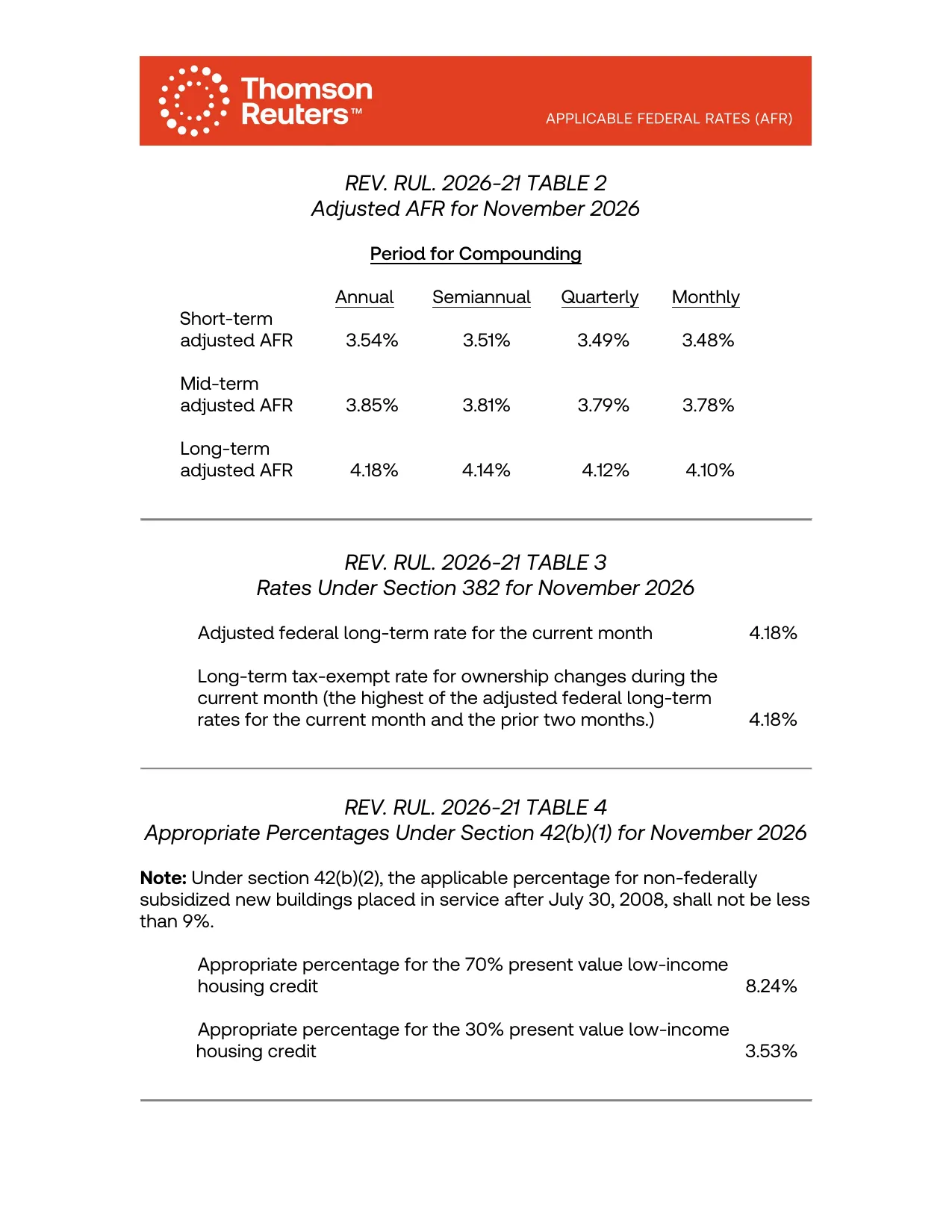
Section 383(d) imports the proration rules of § 382(b)(3) and § 382(d)(1)(B): in the year that includes the change date, the limitation is apportioned by days. Section 383(e) imports § 382's definitions wholesale. The § 382 limitation is the value of the old loss corporation multiplied by the long-term tax-exempt rate under § 382(f)(1) — the highest of the adjusted federal long-term rates for the change month and the two months before it, published monthly by the IRS. For a November 2026 change, that rate is 4.18 percent under Rev. Rul. 2026-21, Table 3.
Worked example: Meridian Robotics and the $3,000,000 credit pile
The facts are the same ones the § 382 limitation playbook works from: the two provisions share one limitation and one change date. Meridian Robotics Inc. carries a $12,000,000 pre-change NOL; on 15 November 2026 an ownership change occurs, the stock's fair market value immediately before the change is $50,000,000, and the long-term tax-exempt rate for November 2026 is 4.18 percent. Meridian also carries $3,000,000 of unused general business credits — research credits under § 41, pooled through § 38 — earned in 2024, so the § 39 clock runs to 2044.
Step one is the shared limitation:
At 21 percent, the most credit that limitation can ever support in a year is $438,900 — and only in a year when no pre-change loss absorbs any of it. The $3,000,000 pile needs 6.8 years of full-pace use to burn, and the losses get the first claim on the limitation for years.
Year one is the high-income year, and it shocks buyers. Suppose Meridian earns $4,000,000 before the NOL. The § 172 eighty-percent cap allows at most $3,200,000 of NOL, so the § 382 limitation of $2,090,000 governs. Meridian uses $2,090,000 of NOL, leaving taxable income of $1,910,000 and tax of $401,100 at 21 percent. The § 382 limitation remaining is zero, so the § 383 credit limitation is zero, and Meridian uses zero of its $3,000,000 in credits in a year when it pays $401,100 of federal tax. The NOL falls to $9,910,000.
Year two is the low-income year, and it shows the second cap. Suppose Meridian earns $1,000,000 before the NOL. The eighty-percent cap allows $800,000 of NOL, leaving taxable income of $200,000 and tax of $42,000. The § 382 limitation remaining is $1,290,000. The § 383 credit limitation is the tax attributable to income up to that remaining limitation — but taxable income after the NOL is only $200,000, so the attributable tax is 21 percent of $200,000, or $42,000. Then § 38(c) bites: the credit cannot exceed $42,000 minus the greater of the tentative minimum tax (zero for a corporation) or 25 percent of net regular tax above $25,000 — 25 percent of $17,000, or $4,250 — giving a § 38(c) cap of $37,750. Meridian uses $37,750 in year two; $2,962,250 remains.
| Year | Income before NOL | NOL used | Tax at 21% | § 382 limit left | § 383 limit | § 38(c) cap | Credits used |
|---|---|---|---|---|---|---|---|
| Year 1 | $4,000,000 | $2,090,000 | $401,100 | $0 | $0 | $401,100 | $0 |
| Year 2 | $1,000,000 | $800,000 | $42,000 | $1,290,000 | $42,000 | $37,750 | $37,750 |
Credits starve while the NOL is alive. Only after the $12,000,000 NOL is exhausted — about six high-income years at $2,090,000 a year — does the credit pace reach its $438,900 ceiling, and the $3,000,000 pile then needs roughly seven more years: about thirteen years from the change date.
The twenty-year clock is the real deadline
The § 39 carryforward is generous on paper — one year back, twenty years forward — and it is the reason sellers present a credit pile as a durable asset. Under § 383 it is a wasting asset with two clocks against it: the § 39 vintage, since credits earned in 2024 expire in 2044, oldest first under § 38(d); and the § 383 pace, since a post-2017 NOL carries forward indefinitely while the credits die at year twenty.
Run the numbers forward. The NOL is exhausted around year six; the credits then burn at up to $438,900 a year and clear around year thirteen, leaving seven years of slack — comfortable, if every year is a high-income year. But two low-income years like year two in the first five push the burn later by more than the two years lost, and three bad years in the first decade can push it past year twenty. Price the credits on the § 383 schedule, not on the face amount, and put the schedule in the purchase agreement.
Founder & CEO Insight — Enow A. Jovial
The other two legs: capital losses and foreign tax credits
Section 383 is three limitations in one section. Section 383(b) covers pre-change net capital losses under § 1212: a net capital loss from before the first post-change year can be used in a post-change year only on § 382 principles, and any capital loss used in a post-change year reduces the § 382 limitation applied to pre-change NOLs for that year. For a corporation, § 1212(a) carries a net capital loss back three years and forward five years, far shorter than the NOL's indefinite carryforward and the credit's twenty years. A $1,000,000 pre-change capital loss used in a post-change year consumes $1,000,000 of the § 382 limitation the NOL would otherwise have used.
Section 383(c) covers excess foreign taxes under § 904(c). A foreign tax credit carryover — one year back, ten years forward — is limited after an ownership change under regulations consistent with the purposes of § 383 and § 382. The regulation, § 1.383-1(d)(2), puts FTC carryovers last: pre-change losses first, pre-change credits second, FTC third. A multinational target with a large FTC carryover and a large NOL is the worst case in the section: the FTC sits behind both the NOL and the general business credit, and its ten-year clock is the shortest of the three.
| Attribute | Statute | Carryforward | § 383 treatment |
|---|---|---|---|
| Pre-change NOL | § 172 | Indefinite (post-2017) | § 382 income cap, first |
| General business credit | §§ 38, 39 | 1 back, 20 forward | § 383(a) tax cap, second |
| Minimum tax credit | § 53 | Carried forward under § 53 | § 383(a) tax cap, second |
| Net capital loss | § 1212 | 3 back, 5 forward | § 383(b), reduces § 382 limit |
| Excess foreign taxes | § 904(c) | 1 back, 10 forward | § 383(c), consistent with § 382 |
The continuity trap and the change-year proration
Two more provisions decide whether the credit limit is the modelled number or zero. The first is continuity of business enterprise under § 382(c)(1), imported through § 383(e). If the loss corporation does not continue its business enterprise for the two-year period beginning on the change date, the § 382 limitation is zero — and because § 383(a)(1) keys the credit limit to the § 382 limitation, the § 383 credit limitation is zero with it. A buyer who acquires Meridian, shuts the operating business in month fourteen, and keeps the shell for its tax attributes has bought attributes the statute values at zero.
The second is proration. Section 383(d) applies rules similar to § 382(b)(3) and § 382(d)(1)(B) to the year that includes the change date, so the limitation is apportioned by days. On Meridian's 15 November 2026 change date, only 46 days count, and the § 383 credit limitation for that year is correspondingly small. A change dated 2 January buys a full year of limitation.
The filing operation
The § 383 analysis is worthless if it is not on the return. Treasury Regulation § 1.382-11 requires the loss corporation to include a statement entitled "STATEMENT PURSUANT TO § 1.382-11(a)" on or with its return for each year in which an owner shift occurs, carrying the ownership-change computation the § 383 limit depends on. The credit vintages are tracked on Form 3800, General Business Credit, vintage by vintage, oldest first under § 38(d). The return is Form 1120, with the § 383 computation attached as a schedule for each post-change year.
- [x] Step 1 — Build the attribute inventory before signing: every attribute by vintage, with its expiry year.
- [x] Step 2 — Run the ownership-change test and compute the § 382 limitation: track every 5-percent shareholder's movement over the three-year testing period, then multiply value before the change by the rate for the change month — 4.18 percent for November 2026 under Rev. Rul. 2026-21.
- [x] Step 3 — Model the § 383 schedule year by year: losses first, credits second, FTC third, § 38(c) every year, the § 39 clock on every vintage.
- [x] Step 4 — Price the credits on the schedule, not the face amount: discount for credits the model shows expiring unused.
- [x] Step 5 — Confirm two-year business continuity in writing: a discontinuation inside two years zeroes the limitation and the credits with it.
- [x] Step 6 — File the § 1.382-11 statement and the Form 3800 vintage schedule.
Run the same discipline on the loss side first: the § 172 NOL carryforward playbook prices the carryforward, the § 382 limitation playbook works the ownership-change test and the income cap, and the § 41 research credit playbook shows where most of a technology target's general business credit comes from. Price the stack with the tax estimator before the letter of intent is signed.