IRC §355: The Tax-Free Spin-Off Playbook
A corporation with two businesses under one roof wants to split them apart: the software division goes one way, the logistics division the other, and every shareholder ends up holding stock in both. Sell one division and the gain is taxed at once; spin it off under section 355 and no shareholder pays tax. This playbook works the statute as written, with reproducible math for control, basis allocation, and the gain on failure. The companion reorganization playbook covers the Type D reorganization behind most spin-offs.
The four conditions in section 355(a)
Section 355(a) grants nonrecognition only when four conditions are all satisfied. First, the distributing corporation must distribute solely stock or securities of a controlled corporation it controls immediately before the distribution. Second, the transaction must not be used principally as a device for distributing either corporation's earnings and profits. Third, the active-business requirements of section 355(b) must be satisfied. Fourth, the distributing corporation must distribute all of the controlled stock and securities it held before the distribution, or distribute a control amount under section 368(c) and establish that retaining the rest was not part of a tax-avoidance plan. The rule applies whether or not the distribution is pro rata or part of a D reorganization. Two traps: controlled stock bought in taxable transactions within five years is boot, and nonqualified preferred stock is other property.
Worked math 1: the control test
Section 368(c) defines control as at least 80 percent of the total combined voting power of all classes entitled to vote and at least 80 percent of all other classes. Both prongs must clear 80 percent; 79 percent on either one fails. A C-Corp planning a spin-off runs this test twice: on its ownership before the distribution, and on the amount distributed if it retains any stock.
Take a controlled corporation with 10,000,000 voting shares and 10,000 nonvoting shares outstanding. Holding 8,500,000 of each is 85 percent on both prongs — control. Holding 7,900,000 voting shares is 79 percent and fails, even with 100 percent of the nonvoting class — the test has no averaging and no cure.
Worked math 2: splitting basis
Section 358(a) carries basis forward: the basis of the stock received equals the basis of the stock exchanged, less boot and money received, plus gain recognized. In a clean spin-off the shareholder recognizes no gain, so the entire old basis splits between the two stocks by relative fair market value.
A shareholder holds distributing stock with a basis of $100,000. Immediately after the spin-off the distributing stock is worth $600,000 and the controlled stock $400,000. The allocation is $100,000 times $400,000 divided by $1,000,000: $40,000 of basis in the controlled stock, leaving $60,000 in the distributing stock. Appraisers commonly anchor value on an EBITDA multiple. The distributing corporation reports the action on Form 8937 and furnishes each shareholder a statement of the allocation. The profit calculator will not do this allocation.
The five-year active business test
Section 355(b) requires both corporations to be engaged immediately after the distribution in the active conduct of a trade or business — or, for a holding company, the distributing corporation to hold nothing but stock or securities in the controlled corporations. The test has four conjunctive requirements: the corporation actively conducts a trade or business; the business has been actively conducted throughout the five-year period ending on the distribution date; the business was not acquired within that period in a taxable transaction; and control of the business corporation was not acquired within that period, unless tax-free.
The five-year clock is the provision that kills the most spin-offs, because it cannot be shortened by effort or by money: a business bought in a taxable acquisition three years ago cannot be spun off for another two years. "Active conduct" means the corporation itself runs the business — collecting rent on a single property or holding a portfolio of securities does not count.
The device test and Reg. § 1.355-2
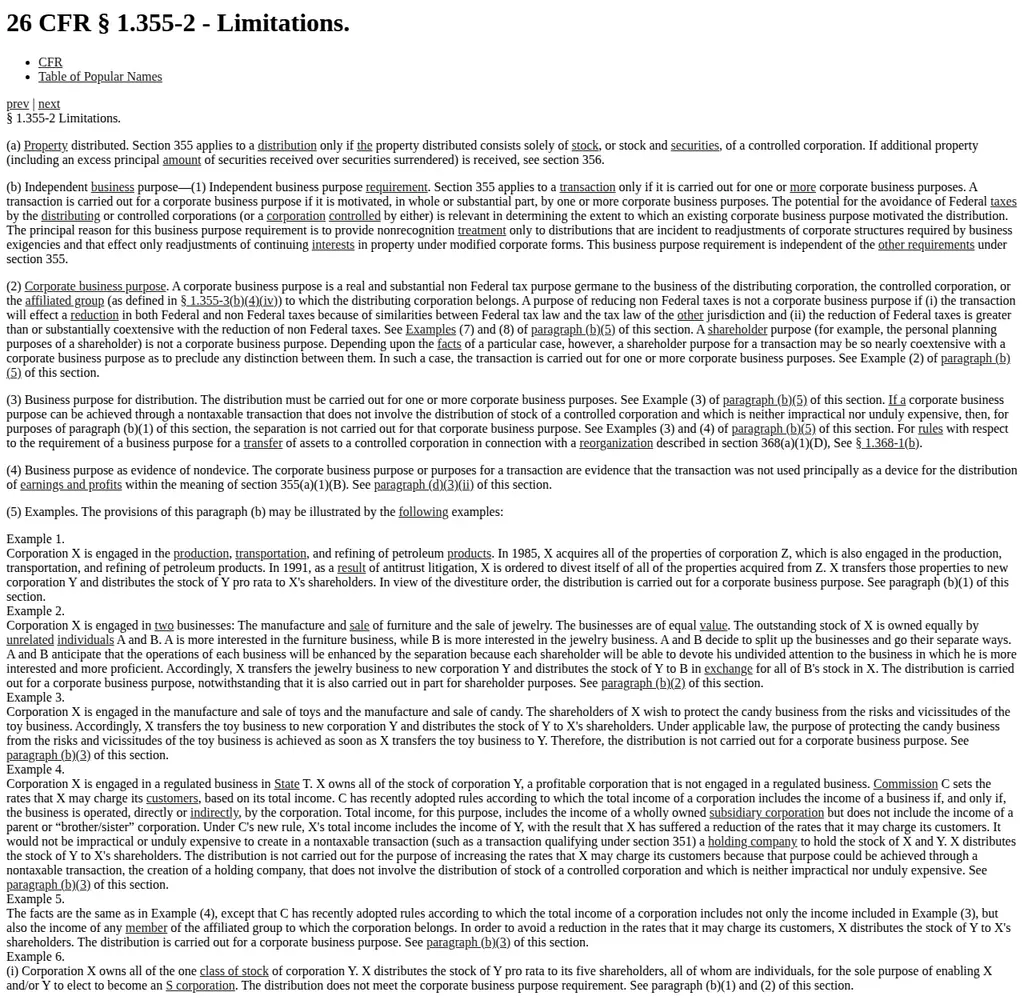
The device test asks whether the transaction was used principally as a device for distributing earnings and profits. The statute gives one safe harbor: the mere fact that distributees later sell stock does not, by itself, prove device, unless the sale was arranged before the distribution. Treas. Reg. § 1.355-2 fills in the facts-and-circumstances analysis: a pro rata distribution and a subsequent sale of stock are evidence of device, and a genuine corporate business purpose is evidence of nondevice.
A pro rata spin-off followed by a sale of one company's stock is economically a dividend followed by a sale — minus the dividend tax. The strongest defense is a documented business purpose the distribution itself serves. The regulation's examples draw the line: shareholders who want to protect a candy business from the risks of a toy business achieve that by transferring the toy business to a new corporation, so distributing the new corporation's stock serves no additional purpose; but a corporation ordered by an antitrust court to divest properties has a corporate business purpose.
Business purpose and continuity of interest
The regulation requires that the distribution be carried out for one or more corporate business purposes. A corporate business purpose is a real and substantial non-Federal-tax purpose germane to the business of either corporation or the affiliated group. A shareholder purpose, such as personal planning, is not a corporate business purpose.
Two further requirements ride along. Continuity of interest requires the historic shareholders to keep a continuing equity interest — a spin-off that cashes them out is not a readjustment. And the transaction must be incident to a readjustment required by business exigencies, such as satisfying a regulator or resolving a shareholder deadlock. One regulation example shows a failing purpose clearly: a distribution made solely to enable an S corporation election fails, because becoming an S-Corp is a shareholder tax election.
The decision table
| Situation | Result | Authority |
|---|---|---|
| All controlled stock distributed pro rata | Tax-free if all gates hold | §355(a)–(b) |
| Control amount distributed, remainder retained | Tax-free only if retention is not tax avoidance | §355(a) |
| Business acquired in a taxable deal inside 5 years | Fails the business test | §355(b) |
| Cash or other property handed to shareholders | Boot: gain recognized up to the boot's value | §356(a) |
| Appreciated non-stock property distributed | Corporate-level gain as if sold at FMV | §355(c) |
| 50% or more bought within 5 years before the distribution | Disqualified distribution | §355(d) |
| 50% or more acquired as part of a plan around the distribution | Morris Trust gain | §355(e) |
| Investment assets are two-thirds or more of total assets | Section 355 does not apply | §355(g) |
Section 355(d): the purchased-stock trap
Section 355(d) targets the purchase-and-strip: acquire a corporation, then spin off its assets. If a distribution is disqualified, the controlled stock is not qualified property, so the distributing corporation recognizes gain as if it sold it at fair market value. A distribution is disqualified if, immediately after it, any person holds disqualified stock — stock acquired by purchase during the five-year period ending on the distribution date — constituting a 50-percent or greater interest.
Suppose an investor bought 55 percent of the distributing corporation for cash three years before the distribution. If the controlled stock distributed is worth $20,000,000 with a basis of $6,000,000, the distributing corporation recognizes a $14,000,000 gain, and at the 21 percent corporate rate in section 11(b) the tax is $2,940,000 — payable by the corporation, not the shareholders. The cure is usually time: wait until the purchase falls outside the five-year window.
Section 355(e): the Morris Trust limit
Section 355(e) is the provision the tax world calls the Morris Trust rule, after the transaction that prompted Congress to enact it. If a distribution is part of a plan under which one or more persons acquire a 50-percent or greater interest in either corporation, the distributing corporation recognizes gain as if it sold the controlled stock at fair market value.
The statute supplies a presumption that does most of the work: an acquisition during the four-year period beginning two years before the distribution date is treated as pursuant to a plan unless it is established otherwise. An acquisition of 51 percent eighteen months after the spin-off is presumed part of the plan. A plan is disregarded when, immediately after its completion, both corporations are members of a single affiliated group.
A controlled corporation worth $40,000,000 with a basis of $12,000,000 produces a $28,000,000 corporate gain when a 51 percent acquisition inside the window triggers section 355(e), and at 21 percent the tax is $5,880,000.
Section 355(c) and the boot rule
Section 355(c) provides that no gain or loss is recognized to the distributing corporation on a qualifying distribution that is not part of a plan of reorganization. The same subsection then takes back the benefit for appreciated property that is not qualified property: if the corporation distributes other property and the fair market value exceeds the adjusted basis, gain is recognized as if the property were sold at fair market value.
At the shareholder level, section 356 taxes gain only up to the money and the fair market value of the other property received. The worked math follows section 356(a) and section 358(a) together.
A shareholder with a $30,000 basis receives controlled stock worth $50,000 plus $5,000 cash. Gain realized is $55,000 minus $30,000, or $25,000; gain recognized is the lesser of that and the $5,000 of boot, so $5,000. The new basis is $30,000 minus the $5,000 boot plus the $5,000 gain recognized, which is $30,000 — and the $20,000 of remaining built-in gain waits for the sale.
Section 355(g): the investment-company wall
Section 355(g) denies section 355 entirely when either corporation is a disqualified investment corporation immediately after the transaction and any person holds a 50-percent or greater interest in it who did not hold it before. That means investment assets of two-thirds or more of all its assets: $70,000,000 against $100,000,000 total is 70 percent, above the line, and the spin-off is taxable from the first dollar.
Who should not use a section 355 spin-off
A spin-off is a restructuring tool for operating C-Corp groups with two genuine businesses, and it punishes everyone else. A single-member LLC taxed as a disregarded entity has no stock to distribute and cannot use section 355 at all; an LLC that has elected corporate treatment can, but the election must predate the planning. An S-Corp faces a second wall: if the distributing corporation recognizes gain under section 355(c), (d), or (e), the section 1374 built-in gains tax can take a further bite. A founder planning to sell one of the two companies within two years should price the Morris Trust exposure into the deal or wait out the window — a 51 percent acquisition inside four years converts a tax-free split into a $5,880,000 tax bill. A group with material NOL carryforwards should model the split first: NOLs stay with the corporation that generated them, and a section 382 ownership change can cap their use after the split. The section 351 playbook covers the contribution that usually precedes a spin-off; the section 367(d) playbook covers an IP-heavy business offshore.
Founder & CEO Insight — Enow A. Jovial
Execution checklist: the spin-off file
- [x] Step 1: Map both businesses — Each business, its revenue, employees, and the date active conduct began; calendar the eligibility date if either is under five.
- [x] Step 2: Run the control test — Both section 368(c) prongs at 80 percent, before the distribution and on retained stock.
- [x] Step 3: Value both companies — Relative-FMV appraisal behind the section 358 allocation, reconciled to the old basis.
- [x] Step 4: Document the business purpose — Board paper naming the purpose the distribution serves.
- [x] Step 5: Clear the device factors — No pro rata distribution followed by a planned sale; record the nondevice evidence.
- [x] Step 6: Screen sections 355(d), (e), and (g) — Stock purchases in five years, acquisition talks in two, investment-asset ratios.
- [x] Step 7: Get the new EIN and file Form 8937 — Controlled corporation applies on Form SS-4; distributing corporation reports and furnishes basis statements.
- [x] Step 8: Record at book value — Under U.S. GAAP, execute the post-spin balance sheets and tax sharing agreement.
- [x] Step 9: Have a CPA review the file — Section 355(b) history, section 355(e) window, and basis allocation.