IRC §338: Stock Purchase vs Asset Purchase — the (g) and (h)(10) Election Playbook
A buyer who wants a company's assets faces a fork: buy the assets and get a stepped-up basis but inherit assignment problems, or buy the stock and get a clean transfer but inherit the seller's low inside basis. Section 338 removes the fork. If the buyer makes a qualified stock purchase and elects under §338, the target is treated as having sold all of its assets at fair market value at the close of the acquisition date and repurchased them the next morning at that value. The stock deal is taxed as an asset deal.
The qualified stock purchase: the 80 percent test
Nothing in §338 applies until there is a qualified stock purchase, defined in §338(d)(3). A qualified stock purchase is any transaction or series of transactions in which stock of one corporation possessing at least 80 percent of the total combined voting power of all classes of stock entitled to vote, and at least 80 percent of the total number of shares of all other classes of stock (except nonvoting stock which is limited and preferred as to dividends), is acquired by another corporation by purchase during the 12-month acquisition period. Three elements matter. First, the 80 percent threshold is measured under §1504(a)(2), the affiliated-group test. Second, the acquisition must be by purchase: stock acquired by gift, by bequest, in a §351 exchange, or in a tax-free reorganisation does not count, and §338(h)(3) excludes stock acquired from a related person and stock whose basis is determined by reference to the seller's basis. Third, the 12-month acquisition period begins with the first acquisition by purchase, and the acquisition date is the first day the 80 percent is reached — the day the threshold is crossed, not the day the deal closes, if the buyer bought in stages. A buyer who acquires 79 percent has made no qualified stock purchase at all.
The deemed sale and the deemed purchase: §338(a) and (b)
Once the election is made, §338(a) treats old target as having sold all of its assets at the close of the acquisition date at fair market value in a single transaction, and new target as having purchased them as of the beginning of the day after. The corporation does not dissolve; only the tax attributes reset.
Section 338(b) sets the deemed purchase price: the grossed-up basis of the purchasing corporation's recently purchased stock plus the basis of its nonrecently purchased stock, adjusted under regulations for the target's liabilities and other relevant items. The gross-up converts a stock price into an asset price: if the buyer paid $8,000,000 for 80 percent of the stock, the grossed-up basis is $10,000,000, because $8,000,000 divided by 80 percent is the price of the whole company. The regulations then add the target's liabilities to reach the adjusted grossed-up basis (AGUB). The §754 playbook covers the partnership analogue, where the same step-up idea runs through §734 and §743 instead.
Worked math 1: ADSP, AGUB, and the deemed gain
Scenario: a hypothetical target, Meridian Components Inc. Buyer Apex Holdings purchases 100 percent of Meridian's stock for $10,000,000 cash on June 30, 2026. Meridian's liabilities are $2,000,000. Its assets at fair market value are cash of $500,000, receivables of $1,500,000, equipment worth $6,000,000 with a tax basis of $3,000,000, and goodwill worth the plug figure computed below. The old aggregate basis is $5,000,000.
Under Treas. Reg. §1.338-4(b)(1), ADSP is the sum of the grossed-up amount realised on the recently purchased stock and the liabilities of old target. At 100 percent, no gross-up is needed:
The deemed gain is ADSP less the old aggregate basis of $5,000,000:
At the 21 percent corporate rate used throughout this playbook as a stated assumption, the tax is:
Under Treas. Reg. §1.338-5, the adjusted grossed-up basis (AGUB) — the amount for which new target is deemed to have purchased the assets — equals the same $12,000,000 here: the grossed-up basis of the recently purchased stock ($10,000,000) plus old target's liabilities ($2,000,000). ADSP and AGUB coincide at 100 percent for cash; they diverge when the buyer acquires less than 100 percent or holds nonrecently purchased stock. Run the same arithmetic on your own target with our Tax & Quarterly Estimator.
Allocating the price: the residual method in Reg. §1.338-6
ADSP and AGUB are totals; the allocation decides what the buyer actually deducts. Treas. Reg. §1.338-6 allocates both amounts under the residual method, in classes from Class I through Class VII: Class I is cash; Class II is actively traded personal property and certificates of deposit; Class III is accounts receivable; Class IV is inventory; Class V is all other tangible property; Class VI is §197 intangibles other than goodwill; Class VII is goodwill and going concern value. Each class is filled at fair market value in order, and goodwill takes whatever remains.
For Meridian, the $12,000,000 allocates as cash $500,000 (Class I), receivables $1,500,000 (Class III), equipment $6,000,000 (Class V), and goodwill $4,000,000 (Class VII, the plug). The step-up is $3,000,000 on the equipment and $4,000,000 of newly created goodwill. Section 338(h)(10)(C) requires the buyer and the selling group's common parent to report the goodwill allocation to the Secretary. Get an appraisal before the acquisition date, not after the return is due.
Worked math 2: does the step-up pay for its tax?
The $7,000,000 of step-up splits into $3,000,000 on equipment and $4,000,000 of goodwill. Goodwill is a §197 intangible amortised straight-line over 15 years:
The equipment step-up is illustrated straight-line over 7 years; actual MACRS would front-load the deductions, so this is the conservative case:
Combined, the step-up shelters $146,000 of tax per year. Against the $1,470,000 deemed-sale tax:
Ten years is a long payback, and it ignores the time value of money: discounted at any positive rate, the present value of $146,000 a year for 15 years is less than $1,470,000, so on these numbers the election loses money unless the seller absorbs the deemed-sale tax in the price or the seller's group can shelter the deemed gain. Run the payback before signing, with the actual appraisal and the actual rate.
The §338(g) election: unilateral, irrevocable, and buyer-funded
The (g) election is the default §338 election and the only one available for most targets. The purchasing corporation makes it alone, on Form 8023, with no seller consent required — which is why sellers resist it. Under §338(g)(1) it is due not later than the 15th day of the 9th month after the acquisition month: for a June 30, 2026 acquisition date, that is March 15, 2027. Under §338(g)(3) it is irrevocable, with no late relief in the statute.
The economics of a (g) election are double taxation in the open. Old target pays tax on the deemed asset sale, and the sellers pay tax again on the gain from selling their stock, because the (g) election does nothing to the stock sale itself. The buyer owns old target's tax liability the moment the stock changes hands, so a rational buyer reduces the stock price by the deemed-sale tax and a rational seller resists or demands a gross-up. That negotiation, not the statute, decides whether a (g) election happens.
The §338(h)(10) election: joint, and the stock-sale gain disappears
Section 338(h)(10) is the election buyers prefer, available only in defined cases. Under §338(h)(10)(A), where the target was a member of the selling consolidated group before the transaction and recognises gain or loss as if it sold all of its assets in a single transaction, the target is treated as a member of the selling consolidated group for that sale, and, to the extent provided in regulations, no gain or loss is recognised on the stock sold by members of the selling group. The deemed sale still happens — the buyer still gets the stepped-up basis — but the deemed-sale gain is reported inside the selling group's consolidated return, where the group's NOL and credits can shelter it.
The election is joint. The Instructions for Form 8023 state that where a §338(h)(10) election is made, Form 8023 must be filed jointly by the purchasing corporation and the common parent of the selling consolidated group (or the selling affiliate, or, for an S corporation target, all of the target's shareholders).
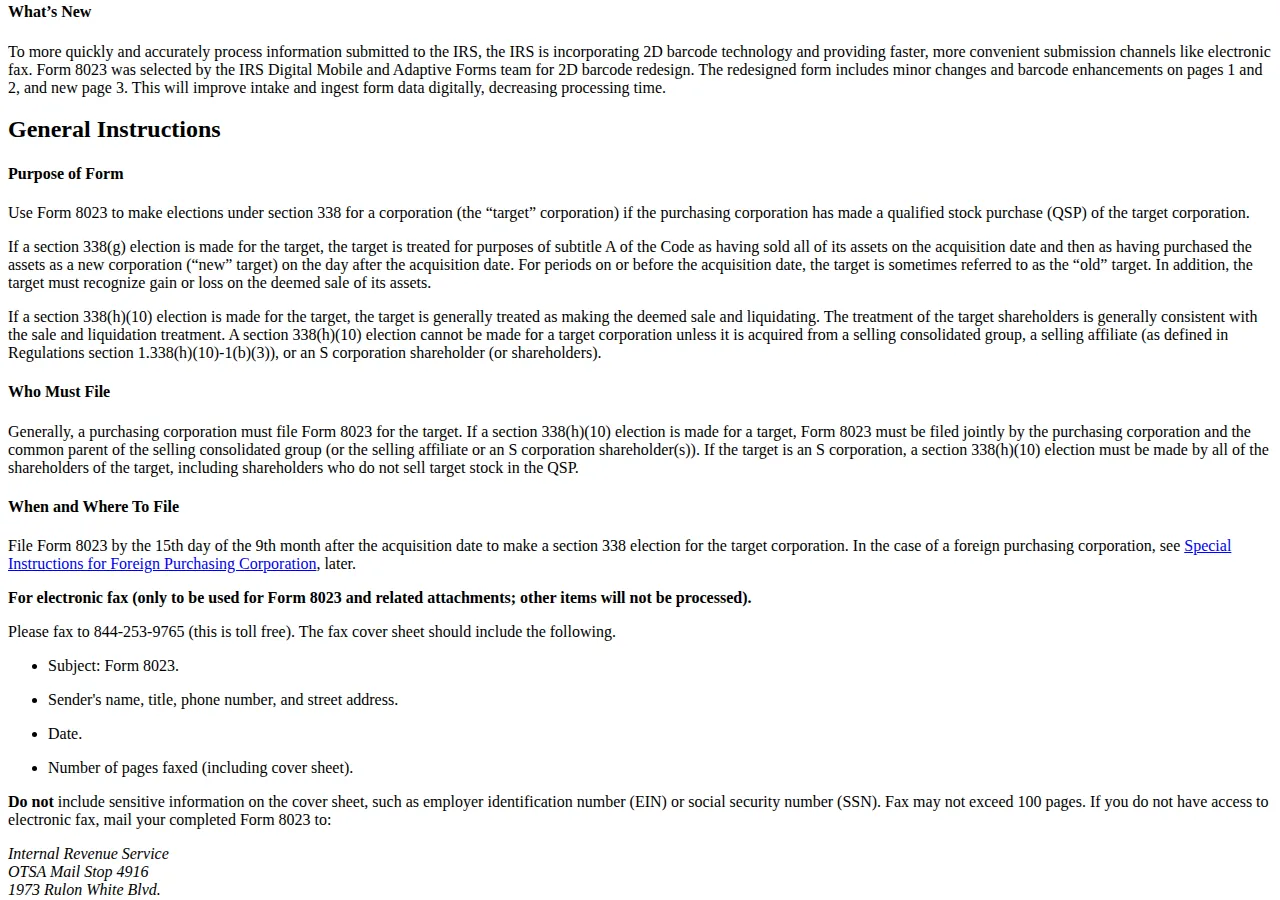 A §338(h)(10) election cannot be made unless the target is acquired from a selling consolidated group, a selling affiliate as defined in Treas. Reg. §1.338(h)(10)-1, or an S corporation. For an S-Corp target, the election converts the deal into a deemed asset sale followed by a deemed liquidation, taxed once at the shareholder level instead of twice.
When (h)(10) beats (g) — and when it cannot be used at all
| Question | §338(g) | §338(h)(10) |
|---|---|---|
| Who elects | Purchasing corporation alone | Jointly with the common parent of the selling group (or selling affiliate / all S corporation shareholders) |
| Eligible targets | Any target after a qualified stock purchase | Only a selling-group member, a selling affiliate, or an S corporation |
| Tax on the sellers' stock sale | Fully taxable | No gain or loss recognised on stock sold by members of the selling group |
| Deemed-sale tax | Borne by old target; buyer owns the liability after closing | Reported inside the selling group's return, where NOL and credits can shelter it |
| Seller cooperation needed | None | Yes — the joint filing is the price of the benefit |
The (h)(10) election beats (g) whenever it is available and the selling group can shelter the deemed gain. It cannot be used at all for a standalone C-Corp target. Not every state follows §338 — confirm the target's states before modelling the benefit.
The traps: deemed elections, old target's final return, and the calendar
Three traps catch buyers who treat §338 as a formality. First, §338(e) creates a deemed election: if the purchasing corporation acquires an asset of the target during the consistency period — outside an ordinary-course sale or a carryover-basis acquisition — it is treated as having made a §338 election, so an asset purchase from the target can spring a deemed election the buyer never intended, with the tax attached. Second, under Treas. Reg. §1.338-10, the deemed-sale tax of a (g) election is reported on old target's final return for the year ending at the close of the acquisition date, and new target begins a fresh taxable year the next day. Third, §338(h)(13) excludes the deemed-sale tax from estimated-tax computations under §6655 — no underpayment penalty, but no reduction in the tax itself.
Who this is for — and who must stay away
This playbook is for the buyer acquiring at least 80 percent of a corporation by purchase and deciding, before signing, whether the asset basis is worth its tax; and for the seller deciding whether to cooperate with an (h)(10) election.
It is not for a buyer acquiring less than 80 percent — there is no qualified stock purchase and no election. It is not for a buyer whose target's assets are already at fair market value basis. It is not for a tax-free reorganisation, where the §368 playbook governs instead.
Founder & CEO Insight — Enow A. Jovial
Run the §338 desk: execution checklist
- Confirm the qualified stock purchase. At least 80 percent by purchase, inside the 12-month period.
- Classify the target. Selling group, selling affiliate, or S corporation — (h)(10) is available. Anything else — (g) only.
- Appraise the assets before the acquisition date. Fair market values drive the allocation; Classes I through VII fill in order, goodwill takes the remainder.
- Compute ADSP and AGUB, the deemed gain, the tax, and the payback on the annual shields.
- Negotiate who bears the deemed-sale tax in the purchase agreement — price discount, gross-up, or seller cooperation on (h)(10) — before closing.
- Check §338(e). An asset purchase from the target can spring a deemed election.
- File Form 8023 by the 15th day of the 9th month after the acquisition month, jointly with the common parent for (h)(10).
- File old target's final return for the year ending at the close of the acquisition date; open new target's first year the next day.
The decision in advance
Section 338 rewards the buyer who prices the deemed-sale tax before signing. The (h)(10) election is the better instrument wherever it is available; the (g) election is the fallback for every other target, usable only at a price that already contains its tax.