IRC §267: Related-Party Transactions Playbook
A father sells rental property to his daughter at a $200,000 loss and claims the deduction. His corporation accrues $120,000 of interest to its controlling shareholder and deducts it. Both fail: section 267(a)(1) disallows the loss outright, and section 267(a)(2) holds the interest deduction until the shareholder reports the income. The companion section 385 playbook covers recharacterized related-party debt, and the section 163(j) playbook covers the interest cap once a deduction survives section 267.
The loss rule: section 267(a)(1)
Section 267(a)(1) states the rule in one sentence: no deduction shall be allowed in respect of any loss from the sale or exchange of property, directly or indirectly, between persons specified in subsection (b). The words directly or indirectly carry the weight: a sale through a broker still counts — the Supreme Court settled that in McWilliams, below. The only escape in paragraph (a)(1) is a distribution in complete liquidation. The rule catches losses only: a gain on a related-party sale is recognized immediately, and the disallowed loss cannot be carried forward. Section 267(d) transfers its value to the buyer as a gain offset on a later outside sale.
Who is related: section 267(b) and the 50 percent line
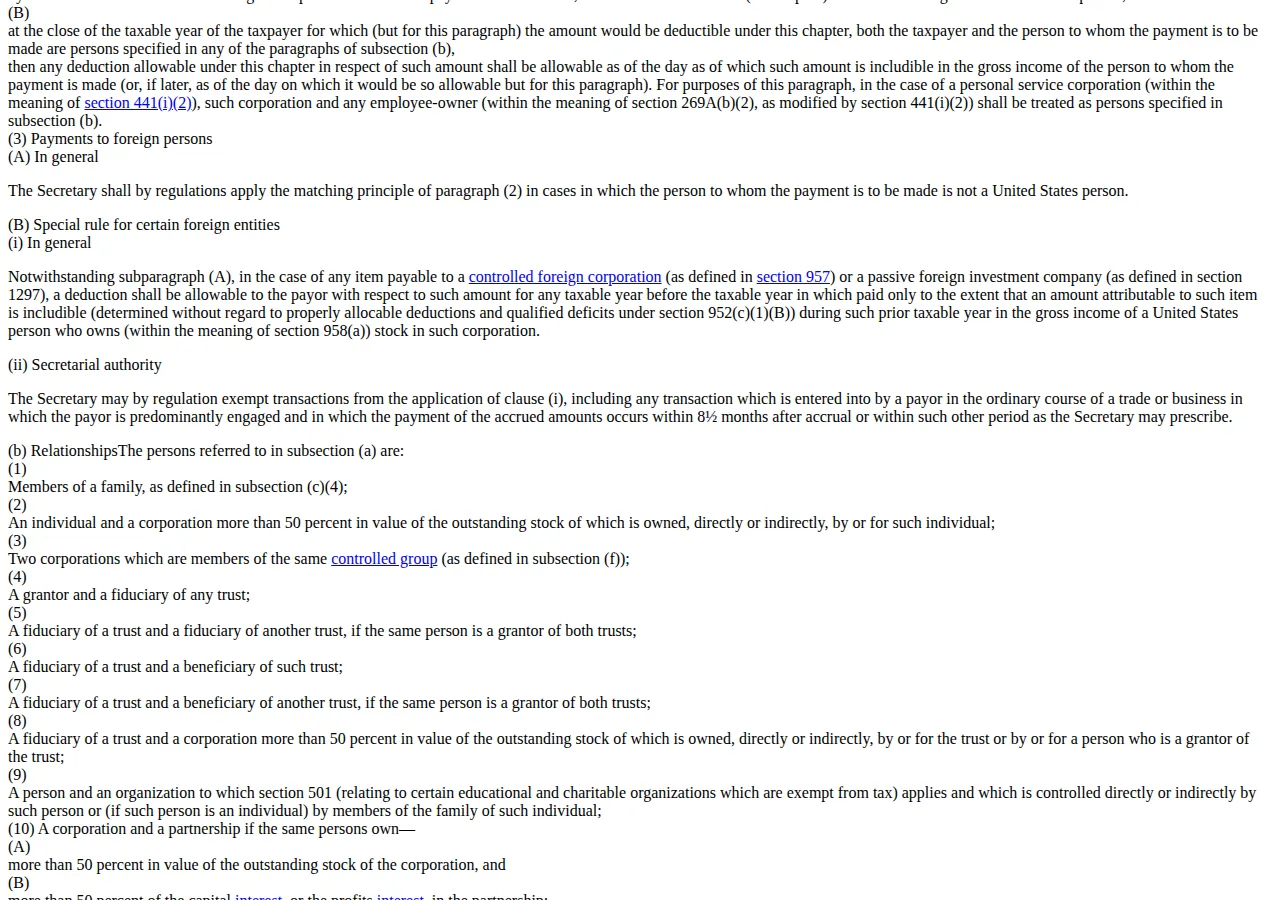
Section 267(b) lists thirteen relationships; the table covers the ones that catch operating businesses and families.
| Relationship | Test | Authority |
|---|---|---|
| Family members | Brothers, sisters, spouse, ancestors, lineal descendants | §267(b)(1), (c)(4) |
| Individual and corporation | Individual owns more than 50% of the stock by value | §267(b)(2) |
| Two corporations | Members of the same controlled group under §267(f) | §267(b)(3) |
Section 267(c)(4) defines family narrowly: brothers and sisters, spouse, ancestors, and lineal descendants only. Aunts, uncles, cousins, and in-laws are not family.
Worked math 1: the disallowed loss and the section 267(d) offset
From IRS Publication 544 (2025): a brother sells stock to his sibling for $7,600; his cost basis was $10,000. His loss is $2,400 and it is not deductible. The buyer later sells the same stock to an unrelated party for $10,500, a gain of $2,900. Under section 267(d) the buyer recognizes gain only to the extent it exceeds the loss previously disallowed — $500 of the $2,900 is recognized.
Publication 544 gives the mirror image: if the buyer instead sells the stock for $6,900, the buyer realizes a $700 loss — and the brother's $2,400 disallowed loss is gone forever.
Constructive ownership: section 267(c)
Section 267(c)(1) attributes stock owned by a corporation, partnership, estate, or trust proportionately to its shareholders, partners, or beneficiaries. Section 267(c)(2) treats an individual as owning stock owned by family members, even if the individual owns none. Section 267(c)(3) treats an individual who owns any stock — other than stock attributed only through family under paragraph (c)(2) — as owning stock owned by a partner. Section 267(c)(5) caps the chain: entity-attributed stock counts as actually owned, but family- or partner-attributed stock cannot be re-attributed.
Regulation Example 1: A owns 75 percent and his wife AW owns 25 percent of M Corporation, and M owns 80 percent of O Corporation. A constructively owns 60 percent of O and AW constructively owns 20 percent. AW's father is treated as constructively owning AW's 25 percent of M and 20 percent of O.
Example 2 shows the partner trap: two partners each own 50 percent of the N Corporation, and each is treated as owning the other's stock — more than 50 percent each.
The matching rule: section 267(a)(2) and the 2½-month deadline
Under section 267(a)(2), when an accrual-basis taxpayer accrues an expense or interest owed to a related cash-basis person, the deduction is allowed only as of the day the amount becomes includible in the payee's gross income. Treas. Reg. § 1.267(a)-1(b) supplies the deadline: if the amount is not paid within the taxable year of accrual or within 2½ months after its close, and is not otherwise includible in the payee's income by constructive receipt, no deduction is allowed. For a calendar-year taxpayer that deadline is March 15. The regulation's example: M Corporation accrued interest in 1956 to its sole shareholder A and paid nothing by March 15, 1957 — no deduction was allowable for 1956 or any later year. One valve exists: notes issued in payment within the year or the 2½-month window count as paid to the extent of their fair market value. A March 14 note saves the deduction; a March 16 note does not.
Worked math 2: the cost of missing March 15 by one day
Take OpCo, a calendar-year accrual-method C corporation, and its cash-method sole shareholder. On December 31, 2026, OpCo accrues $120,000 of interest on a shareholder loan, unpaid in 2026 and unpaid by March 15, 2027. The deduction is disallowed for 2026 and for every later year — the $120,000 never produces a deduction, even when OpCo pays it in full in June 2027. At the 21 percent corporate rate in section 11(b), the lost deduction costs $25,200 of tax outright.
Now suppose OpCo pays on March 16, 2027 — one day late. The deduction is allowed in 2027, not 2026: a one-year deferral, not a permanent loss. At a stated 5 percent discount rate, deferring the $25,200 tax saving by one year costs $1,200 in present value. Calendar the 2½-month deadline, and pay — or issue a note at fair market value — before March 15. Check the amounts with the profit calculator.
Case in point: McWilliams v. Commissioner, 331 U.S. 694 (1947)
John P. McWilliams managed his wife Brooks B. McWilliams' large independent estate, as well as his own. In 1940 and 1941 he ordered his broker to sell certain stock for one spouse and buy the same shares for the other, at as nearly the same price as possible, telling the broker he wanted tax losses. The Commissioner disallowed the losses under section 24(b) of the 1939 Code, the predecessor of section 267. The Tax Court allowed the deductions; the Sixth Circuit reversed; and the Supreme Court affirmed on June 16, 1947. The Court held that section 24(b) states an absolute prohibition — not a presumption — against the allowance of losses on sales between members of certain designated groups. Routing a related-party loss through a broker or an exchange does not clean it, and Publication 544 says so expressly for prearranged broker cross-trades.
Pass-through entities: section 267(e)
Section 267(e) extends the matching rule to pass-through entities — partnerships and S-Corp companies. For section 267(a)(2) purposes, the entity itself, any owner of a capital or profits interest or of S-Corp stock, and any person related to any of those persons are all treated as specified in section 267(b). Constructive ownership follows section 267(c), except the partner rule does not apply and a C-Corp's interests are attributed only at 5 percent or more ownership. A disregarded single-member LLC is its owner for §267 purposes, so a sale between owner and LLC is disallowed; record each related entity's EIN in the file. Two carve-outs: section 267(a)(2) does not apply to guaranteed payments under section 707(c), and section 267(e)(5) shelters certain low-income housing partnership expenses and interest — payable within 10 years, interest only up to 12 percent. GAAP may book an accrued expense the tax return omits, and a disallowed loss creates no NOL — pay by ACH before March 15 and keep the record with your CPA.
Controlled groups: section 267(f) and the deferral that is not a denial
Section 267(f) defines a controlled group by reference to section 1563(a), with more than 50 percent substituted for at least 80 percent. Two corporations in the same controlled group are related under section 267(b)(3), so a loss on a sale between them is caught by section 267(a)(1) — but subsection (f)(2) changes the consequence: the loss is deferred until the property is transferred outside the controlled group and loss would be recognized under consolidated return principles. Section 267(f)(3) exempts domestic international sales corporations, ordinary-course inventory sales where a party is a foreign corporation, and certain foreign-currency loan losses. Section 267(g) adds a final boundary: section 267(a)(1) does not apply to transfers between spouses or incident to divorce under section 1041(a).
Worked math 3: the deferred controlled-group loss
Sub A and Sub B are members of a controlled group. On June 30, 2026, Sub A sells manufacturing equipment to Sub B: adjusted basis $500,000, price $200,000. The $300,000 loss is caught by section 267(a)(1) — but under section 267(f)(2) it is deferred, not denied. On March 31, 2028, Sub B sells the equipment outside the group to an unrelated buyer for $260,000, recognizing a $60,000 gain. The property has left the group, so the deferred $300,000 loss is released, producing a net $240,000 loss recognized in 2028.
At the 21 percent corporate rate, the $300,000 deferral is worth $63,000 of tax the group cannot use until the equipment leaves the group.
Decision table: which rule catches which transaction
| Transaction | Treatment | Authority |
|---|---|---|
| Sale at a loss to a spouse, sibling, parent, or child | Loss disallowed; buyer gets §267(d) gain offset later | §267(a)(1), (b)(1), (d) |
| Sale at a loss to a corporation the seller controls over 50% | Loss disallowed; §267(c) decides control | §267(a)(1), (b)(2), (c) |
| Accrued expense owed to a related cash-basis payee, unpaid past 2½ months | Deduction deferred until payee reports the income | §267(a)(2); Reg. § 1.267(a)-1(b) |
Scenario: the December 31, 2026 sale that bought nothing
Scenario: Daniel owns 100 percent of OpCo; his daughter Maya runs a rental property business. On December 15, 2026, Daniel sells a warehouse to Maya: adjusted basis $900,000, price $700,000. The $200,000 loss is disallowed under section 267(a)(1) — father and daughter are family under section 267(c)(4), and fair market value changes nothing. At a stated assumed 24 percent marginal rate, Daniel loses $48,000 of tax benefit. In the same month, OpCo accrues a $90,000 year-end bonus to Daniel, who reports on the cash method. OpCo does not pay the bonus in 2026 or by March 15, 2027. Under section 267(a)(2) the $90,000 deduction is disallowed for 2026 and for every later year — even though OpCo pays it in full on April 2, 2027. At the 21 percent corporate rate the lost deduction costs OpCo $18,900 of tax. The two failures compound: $48,000 plus $18,900 is $66,900 of tax cost. Maya's basis is $700,000; a later outside sale at $950,000 leaves only $50,000 of her $250,000 gain recognized after the $200,000 offset. The fix: sell the warehouse to an unrelated buyer; and pay the bonus — or issue a note at fair market value — before March 15, 2027.
Who should not use related-party transfers
A founder who needs a loss deduction should not sell a depreciated asset to family or to a controlled entity — sell to an unrelated buyer, or hold the asset and harvest the loss on a genuine third-party sale. An accrual-basis corporation with a cash-basis controlling shareholder should not accrue large year-end amounts it cannot pay by March 15; the matching rule turns a timing benefit into a permanent loss. A partnership should not assume section 267 is the only rule in play: section 707(b) governs partnership loss disallowance, and section 267(e) widens the matching rule to every owner of a capital or profits interest. If the transaction cannot survive the attribution test, the 2½-month test, and the controlled-group test, use an unrelated party. The section 351 playbook covers the tax-free contribution alternative.
Founder & CEO Insight — Enow A. Jovial
Execution checklist: the section 267 file
- [x] Step 1: Map the relationships — Run the section 267(c) attribution by hand.
- [x] Step 2: Test the 50 percent line — More than 50 percent triggers the rule; exactly 50 percent does not.
- [x] Step 3: Price the loss before signing — Compute the disallowed loss and the tax cost first.
- [x] Step 4: Calendar March 15 — Pay or issue a note at fair market value before the 2½-month deadline.
- [x] Step 5: Record the section 267(d) offset — Note the disallowed loss in the buyer's file.
- [x] Step 6: Screen controlled-group sales — Flag intercompany losses as deferred.
- [x] Step 7: Check section 707(b) for partnerships — Section 707(c) guaranteed payments escape the matching rule.
- [x] Step 8: Check section 1041 for spouses — Transfers between spouses or incident to divorce are outside section 267(a)(1).
- [x] Step 9: Have a CPA review the file — Attribution worksheet, payment dates, deferred-loss schedule.