Section 263A UNICAP Inventory Capitalization Playbook
Section 263A UNICAP Inventory Capitalization Playbook
A manufacturer spends $1,176,000 on factory overhead and deducts all of it. The return is wrong. Section 263A says the direct costs of property produced, plus its proper share of indirect costs, are not deducted when paid — they are included in inventory costs and recovered through cost of goods sold (COGS) when the goods sell. The $294,000 in ending inventory is a deduction next year, when the goods leave the warehouse. The operation: what capitalizes, what stays deductible, the two simplified methods, the interest gate, and the small-business exemption. The valuation choice — FIFO, LIFO, or weighted average — sits in the inventory-valuation-fifo-lifo-weighted-average-playbook; this one decides what goes into the inventory number.
Step 1: The rule in one paragraph
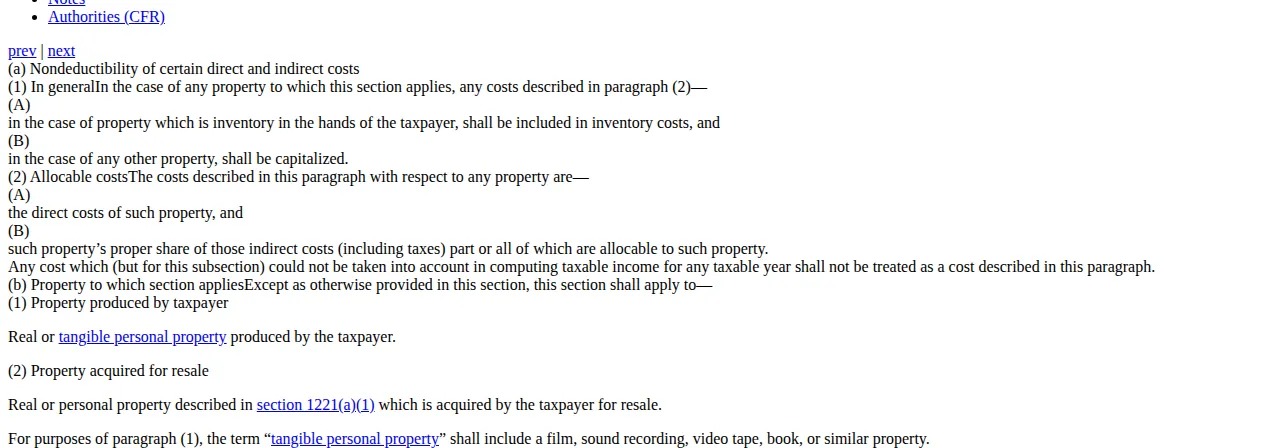
Section 263A(a) is short enough to quote. For any property to which the section applies, the direct costs of the property, and its proper share of indirect costs including taxes, are included in inventory costs if the property is inventory, and capitalized in any other case. Any cost that could not be taken into account in computing taxable income at all is excluded — the section moves deductions in time, it does not create them. The section applies to two kinds of property: real or tangible personal property produced by the taxpayer, and real or personal property described in section 1221(a)(1) acquired for resale. Produce means construct, build, install, manufacture, develop, or improve — and property produced for you under a contract counts as produced by you to the extent you pay for it. Hiring a factory does not hire away the rule.
Step 2: The cost map — what capitalizes and what stays deductible
Direct costs — materials and labor that go into the property — always capitalize. Indirect costs split: capitalizable service costs directly benefit production or resale; deductible service costs do not, and stay deductible.
| Cost | Treatment | Authority |
|---|---|---|
| Direct materials and direct labor | Capitalize | § 263A(a)(2)(A) |
| Factory overhead: rent, utilities, depreciation, insurance, supervision, QC, rework | Capitalize | Reg. § 1.263A-1(e)(3)–(4) |
| Purchasing, handling, storage (resellers) | Capitalize | Reg. § 1.263A-3(c) |
| Marketing, selling, advertising, distribution, overall management | Deduct now | Reg. § 1.263A-1(e)(4) |
| Research and experimental under § 174 | Deduct now (excluded) | § 263A(c)(2) |
| Interest (unless the § 263A(f) gate is met) | Deduct now | § 263A(f)(1) |
| Personal-use property, long-term contracts, timber | Outside the section | § 263A(c) |
Two lines do the most damage when missed. Selling and distribution costs are deductible — the sales team's salaries and the ad spend never enter inventory, however large they are. And research and experimental costs deductible under section 174 are outside section 263A by statute; the section-174-software-capitalization-guide runs the R&D side. The trap is the middle bucket: the accounting, personnel, and data-processing departments. Those are mixed service departments, and Step 5 is how they are split.
Step 3: Worked example — the simplified production method
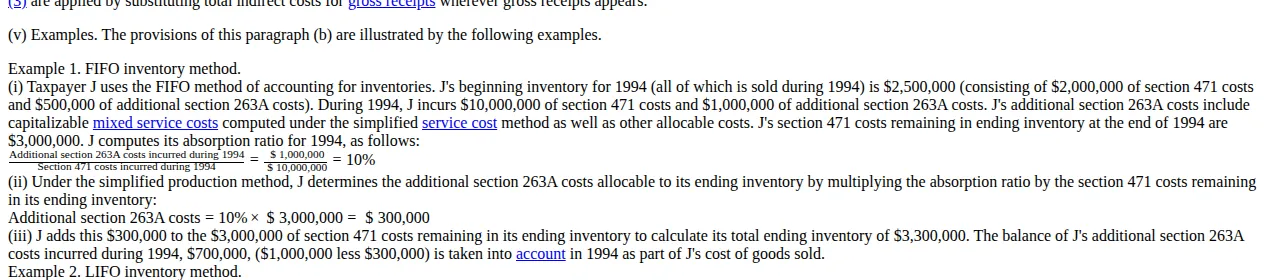
Most producers never trace indirect costs unit by unit. The regulation gives them the simplified production method: one ratio, applied to ending inventory. The absorption ratio is the additional section 263A costs incurred during the year divided by the section 471 costs incurred during the year. Section 471 costs are the costs that would be in inventory without section 263A; additional section 263A costs are everything else the section requires you to capitalize. Multiply the ratio by the section 471 costs in ending inventory, and that product joins ending inventory.
Example: a stated manufacturer incurs $8,400,000 of section 471 costs and $1,176,000 of additional section 263A costs, and holds $2,100,000 of section 471 costs in ending inventory.
The remaining $882,000 flows to COGS this year with the goods that sold. At the 21% corporate rate, capitalizing $294,000 defers $61,740 of deduction into the year the goods sell. The regulation's Taxpayer J runs the same formula: $10,000,000 of section 471 costs, $1,000,000 of additional costs, $3,000,000 in ending inventory — a 10% ratio, $300,000 capitalized, ending inventory $3,300,000, $700,000 to COGS. A LIFO taxpayer runs the same ratio against the current-year increment only.
Step 4: Worked example — the simplified resale method
A reseller has no factory, but a purchasing department, a warehouse, and a delivery fleet. The simplified resale method splits the ratio in two. The storage and handling ratio is the current year's storage and handling costs divided by beginning inventory plus current year's purchases. The purchasing ratio is the current year's purchasing costs divided by current year's purchases. Add the two, and multiply the combined ratio by the section 471 costs in ending inventory.
Example: a stated reseller holds $600,000 of beginning inventory, buys $4,800,000 of goods during the year, spends $270,000 on storage and handling, and $144,000 on purchasing, and holds $900,000 of section 471 costs in ending inventory.
Ending inventory at section 263A cost is $972,000, and at the 21% rate the $72,000 capitalization defers $15,120 of deduction. The method is available only to a trade or business exclusively engaged in resale, with two narrow doors for de minimis production and contract production incident to resale. A producer-reseller that makes a material share of what it sells cannot elect the resale method at all. The section-179-vs-bonus-depreciation-tech-startups playbook runs the depreciation side of that warehouse and equipment.
Step 5: Service costs — the mixed departments and the 90% rule
The hardest costs to allocate serve both production and everything else. The regulation calls them mixed service costs and gives two shortcuts. The first is the 90% de minimis rule: if 90% or more of a mixed service department's costs are deductible service costs, you may elect to allocate none of the department's costs to production or resale; if 90% or more are capitalizable, you must allocate 100% of the department's costs. The election applies to all mixed service departments at once — it cannot be picked department by department.
The second shortcut is the simplified service cost method, which replaces tracing with a single ratio. A producer picks the labor-based ratio or the production cost allocation ratio; a reseller using the simplified resale method must use the labor-based ratio. The regulation's own examples both land on $500 of capitalizable mixed service costs.
Example: a stated manufacturer has $240,000 of total mixed service costs, $1,800,000 of section 263A labor costs, and $3,000,000 of total labor costs.
The remaining $96,000 stays deductible. Labor costs inside mixed service costs are excluded from both sides, so the ratio measures production labor against total labor.
Step 6: Interest and the carve-outs
Interest is the one indirect cost with its own gate. Section 263A(f) capitalizes interest only when it is paid or incurred during the production period and the property meets one of three tests: a long useful life — real property, or property with a class life of 20 years or more; an estimated production period exceeding 2 years; or an estimated production period exceeding 1 year and a cost exceeding $1,000,000. Three stated builds show the gate: a $1,400,000 build with an 18-month period passes the third test — over a year and over $1,000,000 — so its interest is capitalized; an $800,000 build with the same period fails the cost test and its interest stays deductible; a build of any cost with a 3-year period passes the second test. Beer, wine, and spirits aging does not count toward the production period, and qualified residence interest is excepted outright.
Two groups sit outside the section. Freelance authors, photographers, and artists are exempt under section 263A(h) for qualified creative expenses — the exemption is personal to the creator, not the publisher. Section 263A(d) keeps farmers out for animals and plants with a preproductive period of 2 years or less, and a farmer may elect out for all plants, at the price of alternative depreciation while the election is in effect.
Step 7: The small-business exemption — the $32,000,000 line
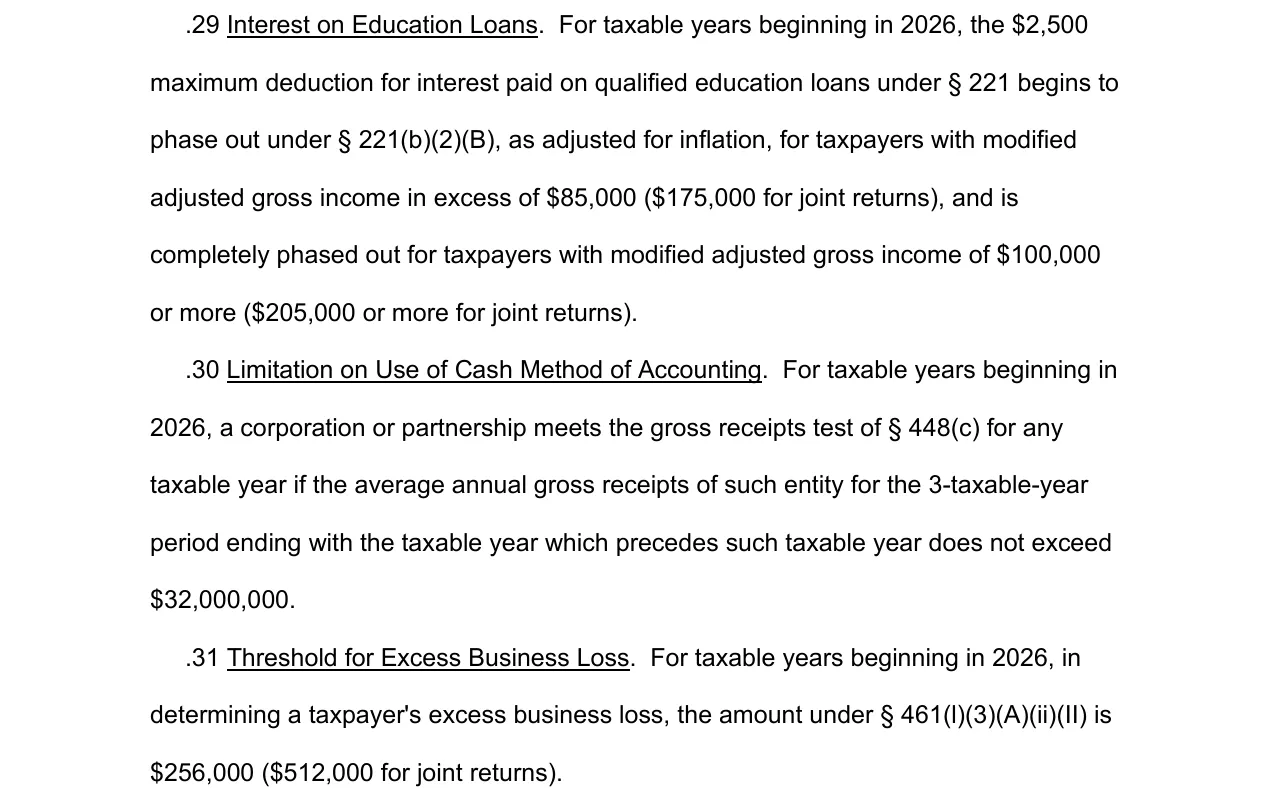
Section 263A(i) exempts a taxpayer — other than a tax shelter barred from the cash method under section 448(a)(3) — that meets the section 448(c) gross receipts test for the taxable year. The test is a 3-taxable-year average, and for 2026 the line is $32,000,000: Rev. Proc. 2025-32 states that a corporation or partnership meets the test if its average annual gross receipts for the 3-taxable-year period ending with the preceding taxable year do not exceed $32,000,000.
Example: an individual runs two Schedule C trades averaging $18,000,000 and $12,000,000. The test combines all of the individual's trades, so the figure is $30,000,000 — under the line, and section 263A does not apply that year. The same individual at $20,000,000 and $15,000,000 combines to $35,000,000, fails, and must capitalize in both trades. The regulation's own examples teach the trap: Taxpayer A, with businesses at $5 million and $35 million, fails at $40 million against the 2020 line of $26 million; Taxpayer B, with three businesses at $15 million, $6 million, and $12 million, fails at $33 million. Splitting receipts across Schedule Cs does not split the test.
The decision
| Situation | Method | Authority |
|---|---|---|
| Producer, any size | Simplified production method | Reg. § 1.263A-2(b)(3) |
| Reseller only | Simplified resale method | Reg. § 1.263A-3(d)(3) |
| Mixed service departments | Simplified service cost method | Reg. § 1.263A-1(h) |
| 3-year average receipts ≤ $32,000,000 (2026) | Exempt under § 263A(i) | § 263A(i); Rev. Proc. 2025-32 § 3.30 |
| Freelance writer, photographer, artist | Exempt under § 263A(h) | § 263A(h) |
| Farmer, animals or ≤2-year plants | Outside the section | § 263A(d)(1) |
| Production >2 years, or >1 year and >$1M | Capitalize interest | § 263A(f)(1)(B) |
The build operation, start to finish
- Test the small-business exemption first: 3-year average gross receipts against $32,000,000 for 2026, aggregated across all trades or businesses. If exempt, document the test and re-test every year; if not, pick the method — simplified production for producers, simplified resale for resellers.
- Tag every general-ledger account as capitalize, deduct, or mixed before the year starts, using the Step 2 cost map, and run the mixed service departments through the 90% rule and the simplified service cost method.
- Compute the absorption ratio from the year's actual section 471 costs and additional section 263A costs, and apply it to ending inventory.
- Test the interest gate on every build: production period and cost against the three section 263A(f) tests.
- File the method properly. Adopting or leaving UNICAP is a change in method of accounting under section 446, filed on Form 3115 with the section 481(a) adjustment spread over four years for a positive adjustment and taken in the year of change for a negative one. The form carries the taxpayer's identifying number — the EIN for an entity, the SSN for an individual sole proprietor, the ITIN where one applies instead — and the entity type, whether S-Corp, C-Corp, or LLC, and a CPA should tie the adjustment to the Schedule C or the corporate return and confirm the number against the books kept under GAAP. Run the capitalized amount through the break-even-calculator before setting next year's prices: the cost that moved into inventory changes the margin on every unit still on the shelf.
- Keep the workpapers — the ratio computation, the cost map, the exemption test — because the examiner's first question is how the number was built.
- [x] Test the $32,000,000 exemption every year, aggregated across all trades.
- [x] Tag every ledger account as capitalize, deduct, or mixed in January.
- [x] Compute the absorption ratio from the year's actual costs and apply it to ending inventory.
- [x] Test the interest gate on every build before the first draw.
- [x] File Form 3115 for any method change, with the section 481(a) adjustment.
- [x] Keep the ratio computation, cost map, and exemption test.
Founder & CEO Insight — Enow A. Jovial