Section 197 Amortization of Intangibles: The Complete Playbook
When you buy a business, most of the price is rarely the desks and the delivery van. The price sits in the customer list, the trade name, the trained team, and the seller's promise not to open a rival shop across the street. Before 1993, buyers and the IRS fought over every one of those items. Congress ended the fight with a blunt instrument. Section 197 gives every acquired intangible the same treatment — a ratable deduction over 15 years, starting in the month of acquisition. One clock, 180 months — but only for qualifying intangibles, acquired the right way, with an honest allocation.
Founder & CEO Insight — Enow A. Jovial
The 15-year rule in one page
Section 197(a) gives the rule in two sentences: a taxpayer may amortize any amortizable section 197 intangible ratably over the 15-year period beginning with the month it was acquired. Section 197(b) then bars every other deduction for the same asset. Three features drive every planning decision. The period is fixed at 15 years regardless of useful life: a customer list that churns in three years and a trade name that lasts fifty both amortize over 180 months. The deduction is ratable, the same amount every month, and the clock starts in the month of acquisition, not first use: buy on July 15 and you deduct six months in year one.
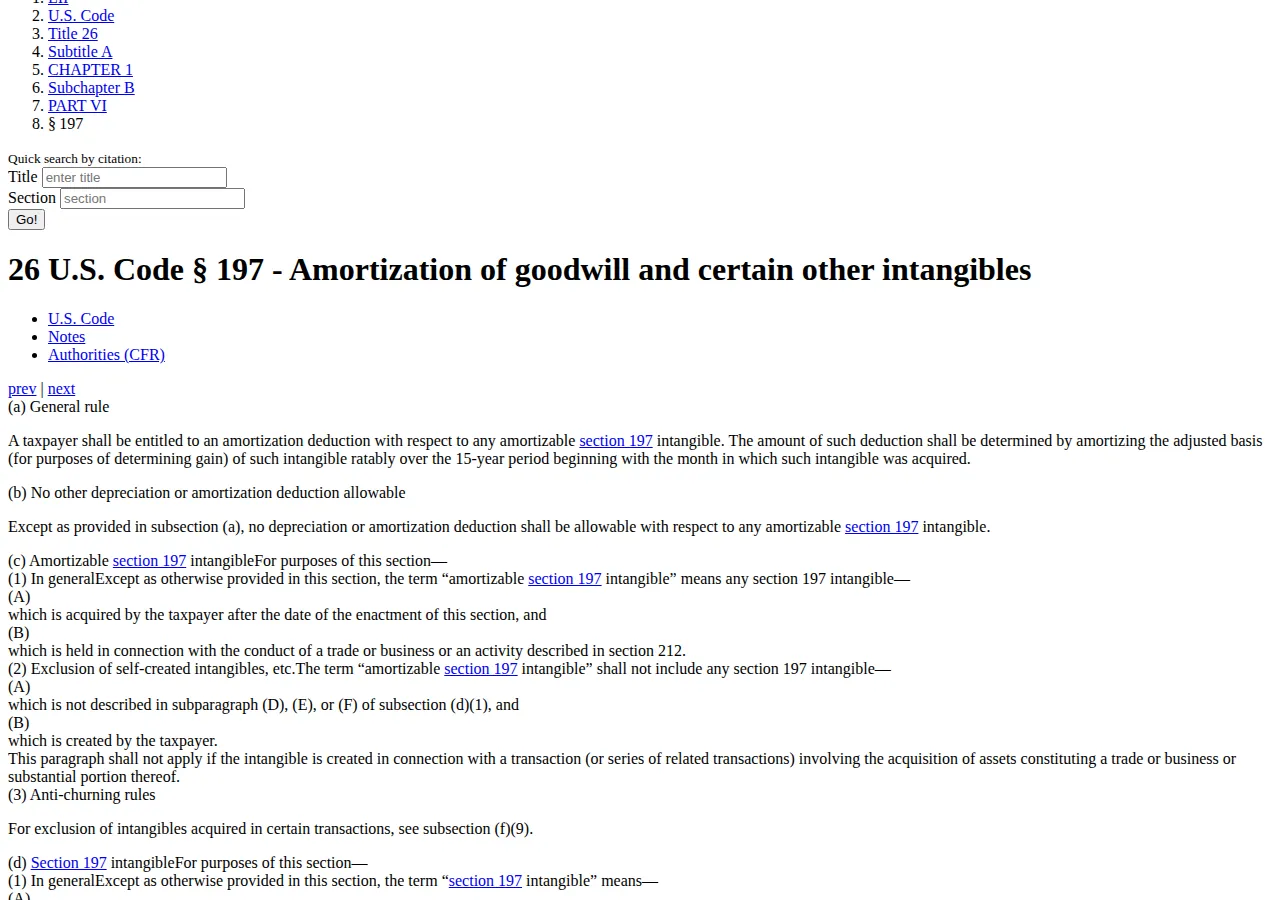
Section 197(c)(1) limits the benefit to intangibles acquired after August 10, 1993, the enactment date, and held in connection with a trade or business or an activity described in Section 212. Section 197(c)(2) excludes self-created intangibles, except for government licenses, covenants not to compete, and franchises, trademarks, and trade names, and except for intangibles created when acquiring a trade or business.
What counts as a section 197 intangible
Section 197(d)(1) covers goodwill, workforce in place, customer-based intangibles, covenants not to compete, and franchises, trademarks, and trade names.
| Intangible | Section 197 treatment | Authority |
|---|---|---|
| Goodwill and going concern value | 15-year amortization | 26 U.S.C. § 197(d)(1)(A)–(B) |
| Workforce in place | 15-year amortization | 26 U.S.C. § 197(d)(1)(C)(i) |
| Customer-based intangible | 15-year amortization | 26 U.S.C. § 197(d)(2) |
| Covenant not to compete | 15-year amortization; amounts chargeable to capital | 26 U.S.C. § 197(d)(1)(E), (f)(3) |
| Franchise, trademark, trade name | 15-year amortization | 26 U.S.C. § 197(d)(1)(F) |
| Government license or permit | 15-year amortization | 26 U.S.C. § 197(d)(1)(D) |
| Self-created intangible | Not amortizable | 26 U.S.C. § 197(c)(2) |
| Interest in land | Excluded from Section 197 | 26 U.S.C. § 197(e)(2) |
| Separately acquired patent or copyright | Excluded from Section 197 | 26 U.S.C. § 197(e)(4)(C) |
Two questions decide every item: is it on the Section 197(d) list, and does a Section 197(e) exclusion pull it back out? The exclusions include financial interests, interests in land, certain computer software, separately acquired interests in films, books, patents, and copyrights, and interests under leases of tangible property. A patent bought alone is not a Section 197 intangible; the same patent bought as part of acquiring a trade or business is.
The math: what you deduct each year
Monthly deduction equals adjusted basis divided by 180. For a partial first year, multiply it by the months from the acquisition month through December.
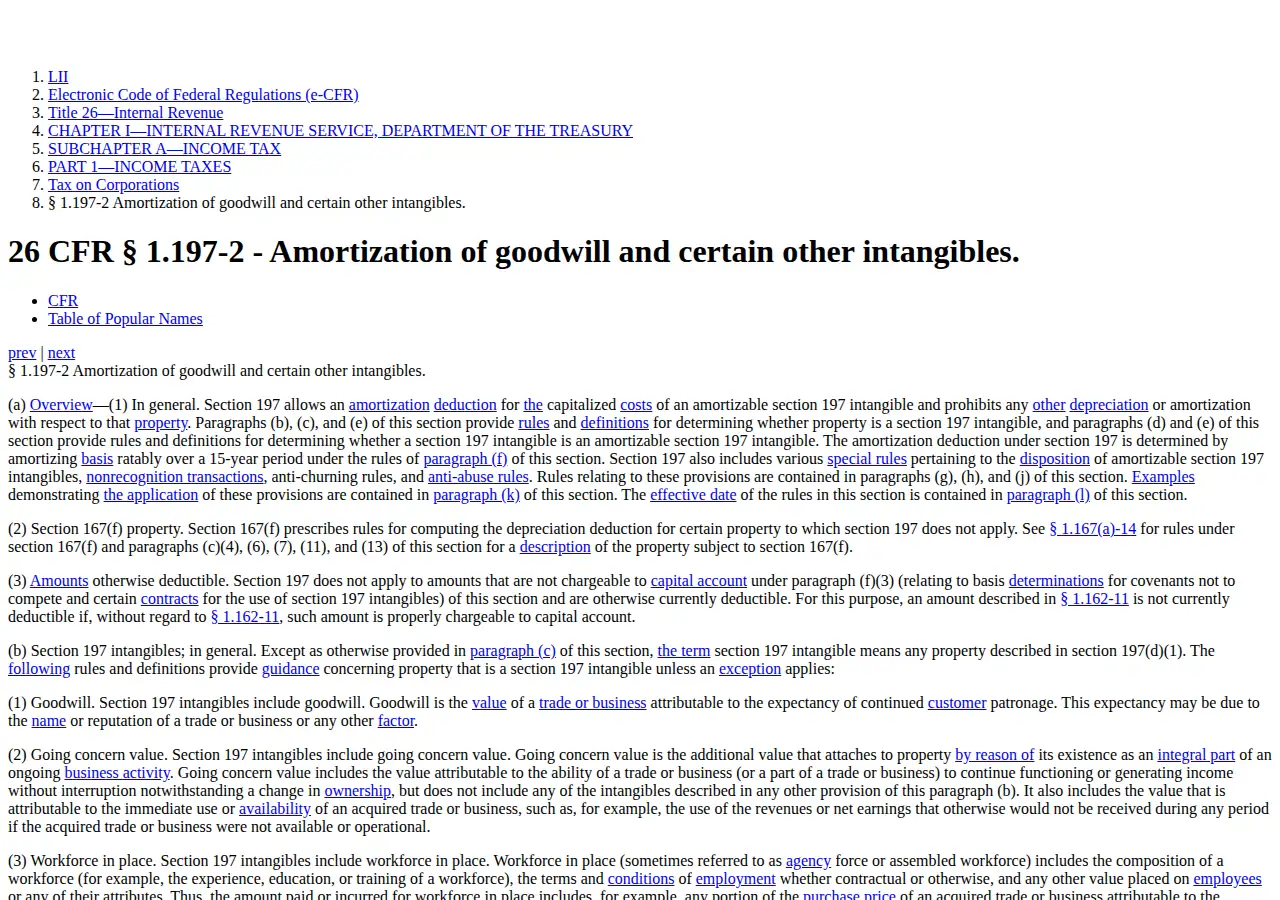
Treas. Reg. § 1.197-2(f) adds two rules for late amounts: a contingent amount added to basis during the 15-year period is amortized ratably over the remainder of the period, starting on the first day of the month of the increase, and an amount not fixed until after the period ends is amortized in full immediately when it enters basis.
Worked example: buying a 3,000,000 dollar business
A buyer acquires a small distribution business for 3,000,000 dollars, allocated under the Section 1060 residual method: tangible assets 600,000; covenant not to compete 300,000; customer list 450,000; trade name 150,000; goodwill, the residual, 1,500,000 dollars. The three Class VI intangibles total 900,000, so Section 197 intangibles total 2,400,000 — and 600,000 plus 900,000 plus 1,500,000 equals 3,000,000.
Each intangible amortizes over the same 15 years: covenant 300,000 divided by 15 is 20,000 dollars a year; customer list 450,000 divided by 15 is 30,000; trade name 150,000 divided by 15 is 10,000; goodwill 1,500,000 divided by 15 is 100,000. The four amounts sum to 160,000 dollars, matching 2,400,000 divided by 15.
If the acquisition closes in July, the first year holds six months: 13,333.33 times 6 equals 80,000 dollars. The middle years run at 160,000 dollars a year, and the final year holds the remaining six months, another 80,000 dollars. Over 180 months the buyer deducts exactly the 2,400,000 dollars of basis.
At the 21 percent corporate rate in Section 11(b), the annual tax saving is 160,000 times 0.21, or 33,600 dollars a year, and the 15-year total is 504,000 dollars. Every 150,000 dollars shifted from tangible assets to Section 197 intangibles adds 10,000 dollars a year in deductions, worth 2,100 dollars a year in tax at 21 percent. The seller wants price assigned to assets that produce capital gain; the buyer wants price assigned to amortizable intangibles. Run your own numbers through the tax estimator and check them against the calculation above.
Section 1060 and Form 8594: the allocation is the audit trail
Section 197 tells you the rate. Section 1060 tells you the basis. When assets constituting a trade or business change hands and the buyer's basis is determined wholly by reference to the price paid, Section 1060(a) requires allocation under the residual method of Section 338(b)(5). Both buyer and seller report the allocation on Form 8594, including the amount allocated to Section 197 intangibles under Section 1060(b)(1).
The Instructions for Form 8594 set out seven asset classes, filled in order: Class I cash; Class II actively traded personal property; Class III accounts receivable; Class IV inventory; Class V other tangible assets; Class VI Section 197 intangibles except goodwill and going concern value — covenant, customer list, trade name, workforce; Class VII goodwill and going concern value, which takes whatever is left. Within each class, consideration is allocated in proportion to fair market value, and no asset other than a Class VII asset can exceed its fair market value.
Both sides file Form 8594: the buyer attaches it to the return for the year of the acquisition — Form 1120 for a C-Corp buyer, Form 1120-S for an S-Corp, Form 1065 for a partnership or an LLC taxed as one, Schedule C for a sole proprietor — and the seller files the same form with its own return. Each filer is identified by its EIN; an individual seller uses an SSN, or an ITIN where no SSN exists. Have a CPA review the allocation before either side signs: the IRS compares the two copies, and a mismatch is the fastest way to an examination. Note the book-tax gap: under GAAP, goodwill is tested for impairment rather than amortized, so the 15-year tax deduction and the book expense will differ every year.
The residual method makes goodwill the plug figure: the price minus everything else. That is also what makes the allocation the most disputed part of the deal. Section 1060(a) provides that if buyer and seller agree in writing on the allocation or on the fair market value of any asset, the agreement binds both unless the Secretary determines the allocation or value is not appropriate. A written allocation carries real weight, but it is not a shield for an inflated value: the IRS can still challenge a customer list valued at twice its supportable worth. Appraisals and the income the intangible produces are the evidence that holds an allocation up.
Anti-churning: the rule that kills the deduction
Section 197(f)(9) blocks the obvious move: sell goodwill you already own to a related party and buy it back as a brand-new amortizable asset. An intangible does not qualify as amortizable if it is goodwill or going concern value, or an intangible that would not have been depreciable or amortizable without Section 197, and it was held or used between July 25, 1991 and August 10, 1993 — the enactment date — by the taxpayer or a related person; or it was acquired from a person who held it then and the user does not change; or the taxpayer grants the right to use it to a person who held or used it then.
The related-person definition is wider than most buyers expect. Section 197(f)(9)(C) applies Sections 267(b) and 707(b)(1) with 20 percent substituted for 50 percent, so a 20 percent owner counts as related, and it adds persons under common control within Section 41(f)(1), tested immediately before or immediately after the acquisition. Treas. Reg. § 1.197-2(h)(1)(ii) states the purpose: no amortization without a significant change in ownership or use. The applicable date is July 25, 1991 with a valid retroactive election, and August 10, 1993 otherwise.
Two escape routes exist. Under Section 197(f)(9)(B), the seller may elect to recognize gain and pay tax on it at the highest applicable rate; the anti-churning rule then applies only to the extent the buyer's basis exceeds the gain recognized. With basis of 500,000 dollars and gain recognized of 300,000 dollars, 200,000 dollars of basis stays non-amortizable and 300,000 dollars becomes amortizable.
Section 197(f)(9)(D) provides the second escape: the rules do not apply to property acquired from a decedent, where basis is determined under Section 1014(a). Section 197(f)(9)(F) adds an anti-abuse rule for deals built to avoid the anti-churning rules.
Covenants and dispositions
First, Section 197(f)(3) provides that any amount paid under a covenant not to compete is chargeable to capital account. The covenant is not deductible when paid; it is a capital asset amortized over 15 years like every other Section 197 intangible.
Second, Section 197(f)(1) governs dispositions. If you sell one amortizable Section 197 intangible from a transaction and retain others from the same transaction, no loss is recognized, and the retained intangibles take basis adjustments for the unrecognized loss. Section 197(f)(1)(B) adds a timing rule for covenants: a covenant is never treated as disposed of, or as becoming worthless, before the disposition of the entire interest it protected.
Who this playbook is for, and who should step aside
This playbook is for buyers of operating businesses — asset purchases where goodwill, customer relationships, and covenants carry a real share of the price — and for owners planning an exit who want to understand why the buyer cares about the allocation. It also fits buyers of professional practices, where the covenant often carries the largest allocation.
It is not a guide to research costs or tangible equipment. Research spending follows Section 174, covered in the section 174 software capitalization guide, and the choice between Section 179 expensing and bonus depreciation is covered in the section 179 versus bonus depreciation guide. Section 197 covers acquired intangibles only: one treatment per asset, chosen by what it is and how it was acquired.
The risk layer sits in three places: an unsupported allocation invites a Section 1060 challenge; a related-party deal without a genuine change in ownership or use can leave the buyer with basis that never amortizes; and basis assigned to land, separately acquired patents, or off-the-shelf software produces no deduction at all. A written allocation supported by an appraisal, a related-party check before signing, and a review of the Section 197(e) exclusions avoids each one. For the pass-through side of a deal, see the Section 199A qualified business income deduction playbook.
Execution checklist
- List every intangible in the deal and classify it under Section 197(d) or Section 197(e) before drafting the purchase agreement.
- Appraise the customer list, covenant, trade name, and every other Class VI asset.
- Put a written Section 1060 allocation in the purchase agreement, signed by both parties.
- Run the anti-churning check under Section 197(f)(9): who held the goodwill in the 1991 to 1993 window, and does the user change?
- Set the clock from the acquisition month: basis divided by 180 is the monthly deduction; the first year is prorated.
- File Form 8594 with both returns.
- Capitalize covenant payments under Section 197(f)(3); do not expense them.
- Track earn-outs so amounts added to basis amortize over the remainder of the period under Treas. Reg. § 1.197-2(f)(2).