A founder spends $41,000 before the business opens: market research, legal fees, branding, supplier travel, pre-opening training. The doors open in July. The tax question is not whether that money was real — it was — but when the deduction arrives. Under 26 U.S.C. § 195(a), the default answer is never as an ordinary expense: start-up expenditures are not deductible when paid. They sit in a capital account until the taxpayer elects the recovery in § 195(b): up to $5,000 in the year the business begins, and the rest ratably over 180 months. The election is the whole game, and most of it happens automatically.
The statute in one paragraph
Section 195(a) states the default rule plainly: no deduction is allowed for start-up expenditures. Subsection (b)(1) is the exception, and it has two parts. In the taxable year the active trade or business begins, the taxpayer deducts the lesser of the total start-up expenditures or $5,000 reduced (but not below zero) by the amount by which those expenditures exceed $50,000. The remainder is deducted ratably over the 180-month period beginning with the month the business begins.
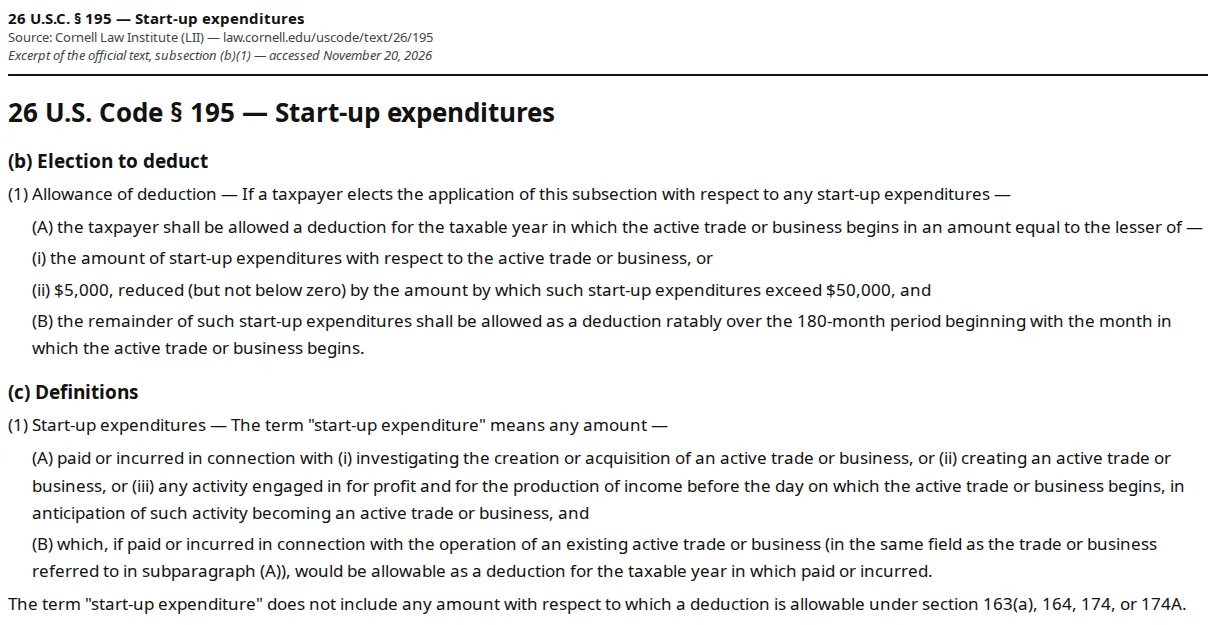
The phase-out is one-for-one, which makes the $50,000-to-$55,000 band the most expensive $5,000 a founder ever spends: every additional dollar of start-up cost in that band removes a dollar of immediate deduction and pushes it into a 15-year trickle. Past $55,000 there is no immediate deduction at all.
| Total start-up expenditures | Immediate deduction (year business begins) | Remainder amortized over 180 months | Monthly amortization | Authority |
|---|---|---|---|---|
| $3,000 | $3,000 | $0 | $0 | § 195(b)(1); Reg. § 1.195-1(c), Ex. 1 |
| $41,000 | $5,000 | $36,000 | $200.00 | § 195(b)(1); Reg. § 1.195-1(c), Ex. 2 |
| $54,500 | $500 | $54,000 | $300.00 | § 195(b)(1); Reg. § 1.195-1(c), Ex. 5 |
| $450,000 | $0 | $450,000 | $2,500.00 | § 195(b)(1); Reg. § 1.195-1(c), Ex. 6 |
The regulation's own worked examples
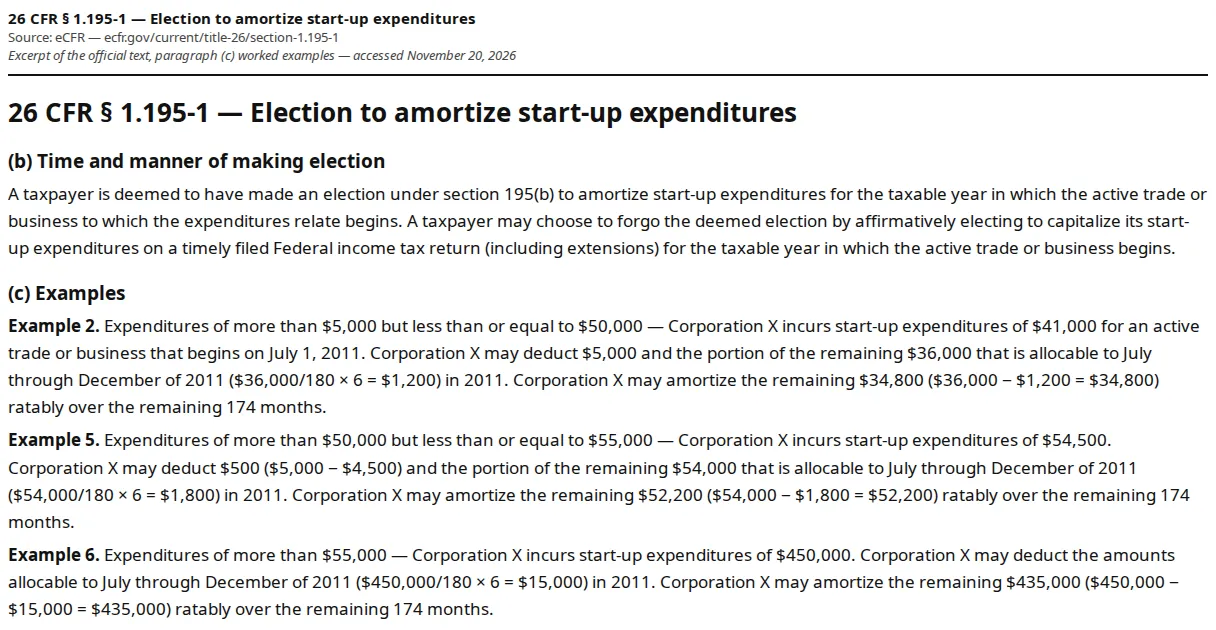
Treasury Regulation § 1.195-1(c) does the arithmetic for the taxpayer, and its three examples bracket every real case. Example 2: Corporation X spends $41,000 on start-up costs and begins business on July 1. It deducts $5,000 plus the July-through-December portion of the remaining $36,000 — $36,000 divided by 180 months times 6 months equals $1,200 — for a first-year deduction of $6,200, and amortizes the remaining $34,800 over the following 174 months. Example 5 ($54,500) shows the phase-out biting: the immediate deduction falls to $500, plus $1,800 of amortization, for $2,300 in year one. Example 6 ($450,000) shows the cliff passed: no immediate deduction, $15,000 in year one, $435,000 left to amortize.
Two founder scenarios extend the same math. A consultancy spends $48,000 before opening on January 1: the immediate deduction is the full $5,000, and the remaining $43,000 amortizes at $238.89 a month, so the first-year deduction is $5,000 plus $2,866.67, or $7,866.67. A software company spends $82,000 before opening on September 1: the immediate deduction is zero, the monthly amortization is $455.56, and the first-year deduction — four months, September through December — is $1,822.22. The same $82,000 spent after the business opens would be an ordinary § 162 expense, deductible in full the year it is paid. The calendar, not the amount, decides the treatment.
What counts as a start-up expenditure
Section 195(c)(1) defines the term by two tests. The amount must be paid or incurred in connection with investigating the creation or acquisition of an active trade or business, creating one, or any for-profit activity carried on before the business begins in anticipation of it becoming an active trade or business. And it must be an amount that would have been deductible if paid in connection with operating an existing active trade or business in the same field.
The definition also carries an exclusion list that decides most disputes before they start. A start-up expenditure does not include any amount deductible under § 163(a) (interest), § 164 (taxes), or § 174 or § 174A (research and experimental expenditures). The § 174A exclusion arrived with the One Big Beautiful Bill Act, P.L. 119-21, for taxable years beginning after December 31, 2024: domestic research is deductible under § 174A, foreign research is capitalized over 15 years, and neither runs through § 195.
| Cost | Treatment | Authority |
|---|---|---|
| Market research, pre-opening advertising, supplier travel, training | Start-up expenditure — § 195(b) recovery | § 195(c)(1) |
| Interest on pre-opening borrowing | Excluded from § 195 — § 163(a) | § 195(c)(1) |
| State and local taxes paid before opening | Excluded from § 195 — § 164 | § 195(c)(1) |
| Research and experimental spending | Excluded from § 195 — § 174/§ 174A | § 195(c)(1); P.L. 119-21 |
| Equipment, machinery, office furniture | Capital asset — § 167/§ 168 or § 179, not § 195 | § 195(c)(1); Pub. 583 |
| Incorporation fees, bylaws, organizational meetings (corporation) | Organizational expenditure — § 248, same frame | § 248(a) |
| Partnership agreement, organization fees (partnership) | Organizational expense — § 709(b), same frame | § 709(b)(1) |
| Cost of selling partnership interests (syndication) | Never deductible, never amortizable | § 709(a) |
Book treatment differs from tax treatment, and the gap is where founders get confused. Under GAAP, start-up costs are expensed as incurred (ASC 720-15), so the financial statements show the loss in year one while the tax return amortizes the same costs over 180 months. The difference creates a deferred tax asset and, where the business has no income yet, a net operating loss (NOL) carried forward. The EIN on the return is the same EIN the payroll filings use, and pre-opening wages still incur FICA withholding even though the business has not begun.
Three buckets, three statutes, one frame
The Code gives the same $5,000, $50,000 and 180-month frame to three different buckets, and IRS Publication 583 (December 2024) states the point founders miss: the $5,000 immediate deduction for start-up costs and the $5,000 immediate deduction for organizational costs are separate. A corporation that spends $40,000 investigating the business and $30,000 organizing it deducts $5,000 of each in the first year — $10,000 total — and amortizes $35,000 plus $25,000 over 180 months.
Section 248 covers corporations: organizational expenditures are amounts incident to the creation of the corporation, chargeable to capital account, and of a character amortizable over a limited life — articles of incorporation, bylaws, legal fees for organization, the first board meeting. Section 709(b) covers partnerships on the same frame, and § 709(a) states the trap: no deduction is allowed for amounts paid to organize a partnership or to promote the sale of an interest in it, except under subsection (b). Syndication costs — broker commissions, printing the offering memorandum, legal fees for selling the interests — are capitalized and never recovered.
The election is already made
Treasury Regulation § 1.195-1(b) reverses the usual election logic. A taxpayer is deemed to have made the § 195(b) election for the taxable year the active trade or business begins. There is no separate election statement to file and no box to check: claiming the deduction on the return for that year is the election. The only affirmative act available is the opposite one — electing to capitalize the start-up expenditures instead, by stating so on a timely filed return, including extensions, for the year the business begins. That capitalization election is irrevocable and applies to all start-up expenditures related to that business.
The amortization itself is claimed on Form 4562, Part VI, the amortization schedule; the election timing in § 195(d) follows the return deadline including extensions, and the same deemed-election structure applies to § 248 corporations and § 709(b) partnerships. Two regulation examples show what goes wrong when the facts move: in Example 3, Corporation X discovers in 2013 that it deducted a $10,000 start-up expenditure under § 162 in 2011, and the correction is a change in method of accounting under §§ 446 and 481(a), not a free re-filing; in Example 4, the business actually began in 2012, not 2011 as claimed, and the fix is again a method change. The begin date is a factual determination the taxpayer owns, and getting it wrong compounds for years.
When the business begins, and when it ends
The beginning of the trade or business is the month the 180-month clock starts, and it is the single most litigated fact in this section. The regulation leaves the determination to the facts — when the business is open, staffed, and transacting. A business that signs its first customer, takes its first payment, or opens its doors to the public has begun; a business still raising money, still negotiating a lease, or still building the product has not. Document it: the lease start date, the first invoice, the first payroll run, the launch announcement, kept together in the file that supports the Form 4562 amortization schedule. If the trade or business is completely disposed of before the 180 months run out, § 195(b)(2) lets the taxpayer deduct the unamortized balance to the extent allowable under § 165 — the loss provision — and the same rule applies to a partnership liquidated before its § 709(b) amortization ends.
The first-year filing sequence
- Separate the buckets before the return is drafted. Tag every pre-opening cost as start-up (§ 195), organizational (§ 248 or § 709(b)), syndication (nondeductible), capital asset (§ 167/§ 168/§ 179), or post-opening § 162 expense.
- Fix the begin date in writing. Record the month the active trade or business began, with the lease, first invoice, or first payroll run as evidence — that month starts the 180-month period.
- Run the $5,000/$50,000 test per bucket. Apply the phase-out separately to start-up costs and to organizational costs; do not net the buckets against each other.
- Claim the deduction on the return for the begin year. The deemed election under Reg. § 1.195-1(b) is made by claiming it; no separate statement is required unless the taxpayer affirmatively elects to capitalize instead.
- List the amortization on Form 4562, Part VI. Carry the monthly amount forward each year; the schedule is the audit trail for the remaining 174 months.
- Keep the file for the life of the amortization. Retain the cost ledger, the begin-date evidence, and the Form 4562 schedule until the 180 months expire or the business is disposed of and the § 165 deduction is claimed.
- [x] Bucket the costs: every pre-opening dollar tagged § 195, § 248/§ 709(b), syndication, capital asset, or post-opening § 162.
- [x] Begin date documented: lease, first invoice, or first payroll run in the file.
- [x] Phase-out run per bucket: $5,000 reduced dollar-for-dollar above $50,000, zero at $55,000.
- [x] Form 4562, Part VI completed: monthly amortization listed, schedule retained.
- [x] Syndication costs isolated: partnership offering costs kept out of the organizational bucket entirely.
Founder & CEO Insight — Enow A. Jovial
Who should not use this
A business with no income for years gains little from the immediate $5,000, and the deemed election still starts the 180-month clock in the begin year whether or not the deduction is usable — the amortization does not wait for profits. A founder who expects the business to be sold within two or three years should weigh the § 165 disposition deduction against capitalizing and recovering the costs in the sale. And a taxpayer who has already deducted pre-opening costs as § 162 expenses for two or more years cannot re-label them; the correction is a method change, needing a CPA and, in most cases, a Form 3115.
Related reading on this site: the Section 174 software capitalization guide for the § 174A regime § 195(c)(1) now excludes; the Section 179 vs bonus depreciation playbook for the equipment bought after opening; and the LLC dissolution and tax clearance playbook for the wind-up order behind a § 165 disposition deduction. Run the first-year numbers through the Self-Employed Tax & Quarterly Estimator before the return is filed, so the deduction lands in the year the business actually began.