Schedule SE is the form every self-employed filer meets, but the form is not the law. The law is 26 U.S.C. Section 1402, and it does four things the form never explains: it defines net earnings from self-employment, builds in the 92.35% factor, sets the $400 floor, and draws the boundary between income that is taxed and income that is not. A sole proprietor, a partner, a minister, a church employee, and a farmer all file the same form, but Section 1402 treats each differently.
What Section 1402 actually says
Section 1402(a) defines net earnings from self-employment as gross income from any trade or business carried on by the individual, minus attributable Section 162 deductions. In practice that is Schedule C line 31, Schedule F line 34, or a partner share from Schedule K-1, box 14, code A. The statute then carves out seventeen categories. The ones that change real returns are rentals from real estate, unless the taxpayer is a real estate dealer; dividends and interest, unless the taxpayer is a dealer in stocks or securities; capital gains and losses; retirement payments to a retired partner under a written plan; and the distributive share of a limited partner. Notary income is also excluded.
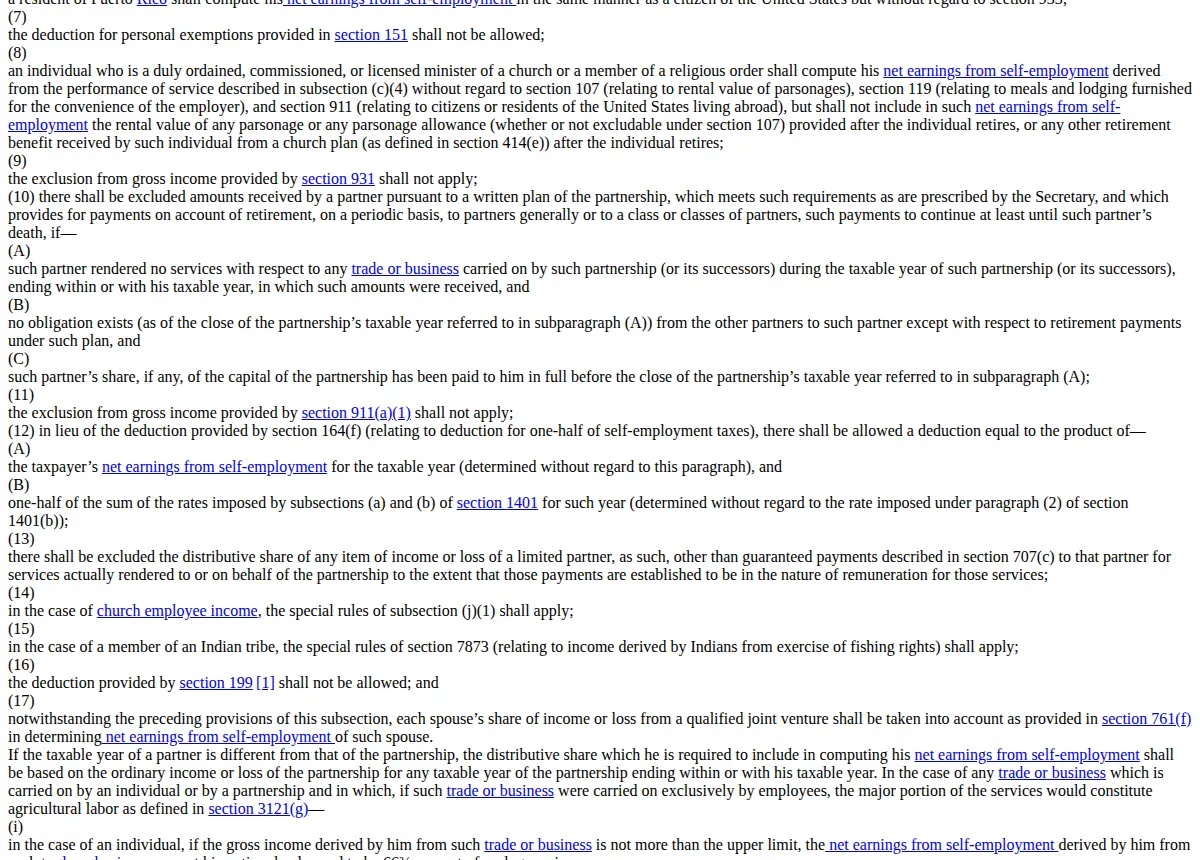
Section 1402(b) defines self-employment income, with two limits. First, the Social Security portion stops at the contribution and benefit base minus wages already paid in the year — $184,500 for 2026, printed on line 7 of the form itself. Second, net earnings under $400 are excluded entirely. Section 1402(c) defines trade or business by reference to Section 162, but excludes services performed as an employee and the functions of a public office — which is why a W-2 salary never enters Schedule SE.
The 92.35% factor, derived from the statute
The factor on line 4a comes from Section 1402(a)(12), which allows a deduction equal to net earnings multiplied by one-half of the sum of the Section 1401 rates — 12.4% for Social Security and 2.9% for Medicare. Half of 15.3% is 7.65%, and one minus 7.65% is 92.35%. The paragraph expressly excludes the 0.9% Additional Medicare rate in Section 1401(b)(2), so the factor stays 92.35% even for high earners. Publication 334 states it in one sentence: multiply self-employment earnings by 92.35%.
The 7.65% haircut is not a gift. It mirrors the employer half of FICA: an employee pays 7.65% and the employer pays 7.65%, while the self-employed person pays both halves on 92.35% of profit. The one-half deduction on Schedule SE line 13 — line 12 times 50%, carried to Schedule 1, line 15 — lowers income tax only, never the SE tax itself.
The decision table: who pays, on what, under which authority
| Situation | SE tax applies? | What is taxed | Authority |
|---|---|---|---|
| Sole proprietor, Schedule C profit | Yes | 92.35% of profit at 15.3% | §1402(a), §1401 |
| General partner, distributive share | Yes | 92.35% of share at 15.3% | §1402(a), K-1 box 14 code A |
| Limited partner, distributive share | No, except guaranteed payments for services | §707(c) guaranteed payments only | §1402(a)(13) |
| S-corp shareholder, distribution | No | Only reasonable-compensation wages, via FICA | §1402(a); IRS S-corp compensation page |
| C-Corp owner, salary | No SE tax; FICA on wages | Wages only | §1402(c) employee exclusion |
| Church employee, W-2 church wages | Yes, at $108.28 of wages | 92.35% of wages at 15.3% | §1402(j), Schedule SE line 5b |
| Minister who filed Form 4361 | No, on ministerial earnings | Only $400+ of other net earnings | §1402(e), Schedule SE box A |
| Farmer, optional method | Yes, on the elected amount | Two-thirds of gross farm income, capped | §1402(a), Schedule SE Part II |
| Net earnings under $400 | No | Nothing; do not file Schedule SE | §1402(b)(2), Schedule SE line 4c |
Worked examples: A1 to A8, every step shown
— Example A1: sole proprietor, Schedule C net profit $120,000, no W-2 wages. Net earnings are $110,820.00: Social Security $13,741.68 and Medicare $3,213.78. Total SE tax is $16,955.46, and the one-half deduction is $8,477.73 on Schedule 1.
— Example A2: W-2 wages $150,000 plus Schedule C profit $200,000, single filer. Net earnings are $184,700.00. The wage base leaves $34,500 of Social Security room, so that portion is $4,278.00. Medicare has no cap: $5,356.30. SE tax before Additional Medicare is $9,634.30. Combined income is $334,700 against a $200,000 single-filer threshold, so the tax on the $134,700 excess is $1,212.30. Total: $10,846.60.
— Example A3: the $400 edge. A Schedule C profit of $434 gives net earnings of $400.80, so SE tax applies: $49.70 of Social Security and $11.62 of Medicare, $61.32 in total. A profit of $433 gives $399.88, so no SE tax and no Schedule SE. A $5,000 profit gives net earnings of $4,617.50 and SE tax of $706.48.
— Example A4: church employee with $10,000 of W-2 church wages not subject to FICA. Net earnings are $9,235.00. The floor is $100 of net earnings, and $100 divided by 0.9235 is $108.28 of wages. SE tax is $1,412.96: $1,145.14 of Social Security and $267.82 of Medicare.
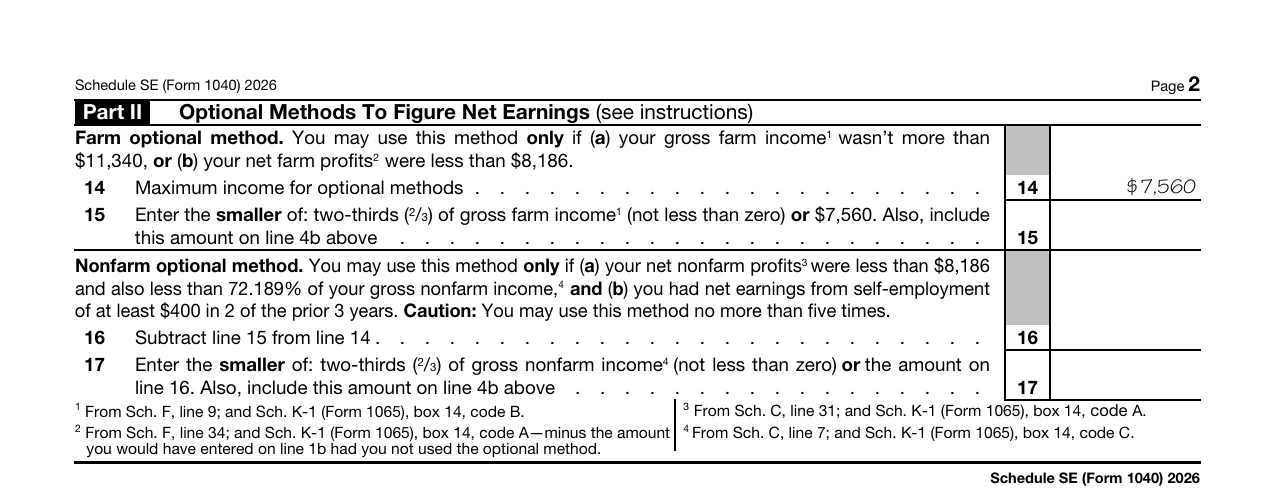
— Example A5: farm optional method on a loss year. Gross farm income is $11,000, under the $11,340 ceiling, and actual net farm profit is negative $2,000. Line 15 is the smaller of two-thirds of $11,000 and $7,560, which is $7,333.33. It goes to line 4b and straight to line 4c — the 92.35% factor is not applied again. SE tax is $1,122.00. The regular method would give zero SE tax and zero credits; the optional method buys the credits for $1,122.00.
— Example A6: nonfarm optional method. Gross nonfarm income is $9,000 and actual net profit is $1,000. The tests pass: $1,000 is under $8,186 and under 72.189% of $9,000, which is $6,497.01. Line 17 is the smaller of two-thirds of $9,000 and $7,560, which is $6,000. SE tax is $918.00. The regular method would give $141.30, so the operator pays $776.70 extra for the credits and any earned income credit the higher earnings unlock.
— Example A7: the S-corp comparison on the same $120,000 profit as A1. As a sole proprietor the SE tax is $16,955.46. As an S corporation paying a $70,000 reasonable salary, FICA is $10,710.00 and the $50,000 distribution carries no SE tax. The saving is $6,245.46. It is not free: the employer half of FICA, $5,355.00, is deductible, the distribution is still subject to income tax, and the $70,000 salary must be defensible as reasonable compensation. A zero salary is the fact pattern the IRS audits.
— Example A8: the wage base already exhausted. W-2 wages are $184,500 and Schedule C profit is $54,144, single filer. Net earnings are $50,001.98. The Social Security portion is zero because line 9 is zero. Medicare is $1,450.06. Combined income is $234,501.98, the excess over the $200,000 threshold is $34,501.98, and the Additional Medicare Tax is $310.52. Total: $1,760.58. A filer who only reads the 15.3% headline overpays here: the 12.4% piece is already spent.
The optional methods: buying Social Security credits on a thin year
The optional methods exist for one reason: a loss year or a thin year still earns Social Security coverage. The farm method applies when gross farm income is $11,340 or less, or net farm profits under $8,186. The nonfarm method applies when net nonfarm profits are under $8,186 and under 72.189% of gross nonfarm income, and the operator was regularly self-employed — net earnings of $400 or more in two of the three preceding years. It can be used no more than five times. Both methods report two-thirds of gross income, capped at $7,560 combined, and both can raise or lower reported net earnings. The instructions warn the methods may also increase SE tax — A6 shows how: $918.00 instead of $141.30. A method can be changed by amending with Form 1040-X.
Church employees, ministers, and the $108.28 figure
Church employee income is a category of its own under Section 1402(j). It covers wages for services for a church or qualified church-controlled organisation not covered by FICA, and the $400 floor applies to that income separately, with $100 substituted for $400. Schedule SE line 5b multiplies the wages by 92.35% and enters zero if the result is under $100 — which is where the $108.28 figure comes from: $100 divided by 0.9235. Ministers, members of religious orders, and Christian Science practitioners have a different route: Section 1402(e) exempts ministerial earnings on filing Form 4361, on a statement of conscientious or religious opposition to public insurance. The exemption covers only ministerial earnings; a minister who filed Form 4361 but has $400 or more of other net earnings checks box A and completes Part I on the other income. The parsonage allowance is excluded under Section 1402(a)(8), whether or not the minister filed Form 4361.
SE tax versus FICA: the S-corp boundary
A self-employed person pays SE tax under the Self-Employment Contributions Act, SECA. An employee pays FICA and the employer pays the matching half. The rates are the same, 15.3% in total, but the base and the paperwork are not. FICA applies to wages, reported on Form W-2 and filed quarterly on Form 941. SE tax applies to net earnings from a trade or business carried on by the individual, reported on Schedule SE and paid with the individual return, usually through estimated tax on Form 1040-ES. The boundary matters most for an LLC that elects S corporation treatment. The election does not change the business; it changes whose trade or business the income belongs to. The corporation trade or business is not the shareholder trade or business, so the distribution is not net earnings under Section 1402(a). What the IRS polices instead is the salary: the S corporation must pay reasonable compensation to a shareholder-employee before non-wage distributions are made.
The wage base and the Additional Medicare Tax
For 2026 the first $184,500 of combined wages, tips, and net earnings is subject to the Social Security portion of SE tax. Wages use the base first; only the remainder is available to net earnings. Medicare has no cap, and the 0.9% Additional Medicare Tax sits on top: single filers above $200,000, married filing jointly above $250,000, married filing separately above $125,000. The threshold applies to the combined total, reduced for the SE portion by wages already subject to the additional tax. Form 8959 figures the tax. A fiscal-year taxpayer uses the rate and wage base in effect at the beginning of the tax year, even if either changes mid-year.
Execution checklist
- [x] Start from Schedule C line 31 or Schedule F line 34; confirm the EIN, SSN or ITIN.
- [x] Multiply by 0.9235; stop if net earnings are under $400 — no Schedule SE is due.
- [x] Subtract W-2 Social Security wages from the $184,500 base before the 12.4% rate.
- [x] Apply 2.9% Medicare to all net earnings, then test the Additional Medicare thresholds.
- [x] On a loss year or thin year, run both optional methods and compare tax and credits before electing.
- [x] For church employee income, use the $108.28 wage figure and line 5b.
- [x] For an S corporation, document the reasonable-compensation salary before any distribution.
- [x] Carry line 12 to Schedule 2, line 4, and line 13 to Schedule 1, line 15; keep the working papers.
Who this playbook is not for
A C corporation owner with no other trade or business does not need this playbook: salary is FICA wages and dividends are not net earnings. A limited partner whose only partnership income is a distributive share with no guaranteed payments for services does not need it either — Section 1402(a)(13) excludes the share, so confirm the K-1 coding. A nonresident alien without a Section 233 totalisation agreement is outside Section 1402(b) altogether. A filer whose only income is W-2 wages should not file Schedule SE for a hobby: the $400 test applies to net earnings from a trade or business, and a hobby belongs on Schedule 1. Under GAAP, SE tax is a personal tax of the owner, not a business expense, so it never appears on the business books.
Related reading: the filing companion is IRS Form 1040 Schedule SE Self-Employment Tax Playbook, the S corporation analysis is S-Corp Election Tax Savings Threshold, and the QBI interaction is Section 199A QBI Deduction SSTB Phaseout Playbook.
Founder & CEO Insight — Enow A. Jovial