Section 1256 Mark-to-Market Futures & Options Tax Playbook
Section 1256 Mark-to-Market Futures & Options Tax Playbook
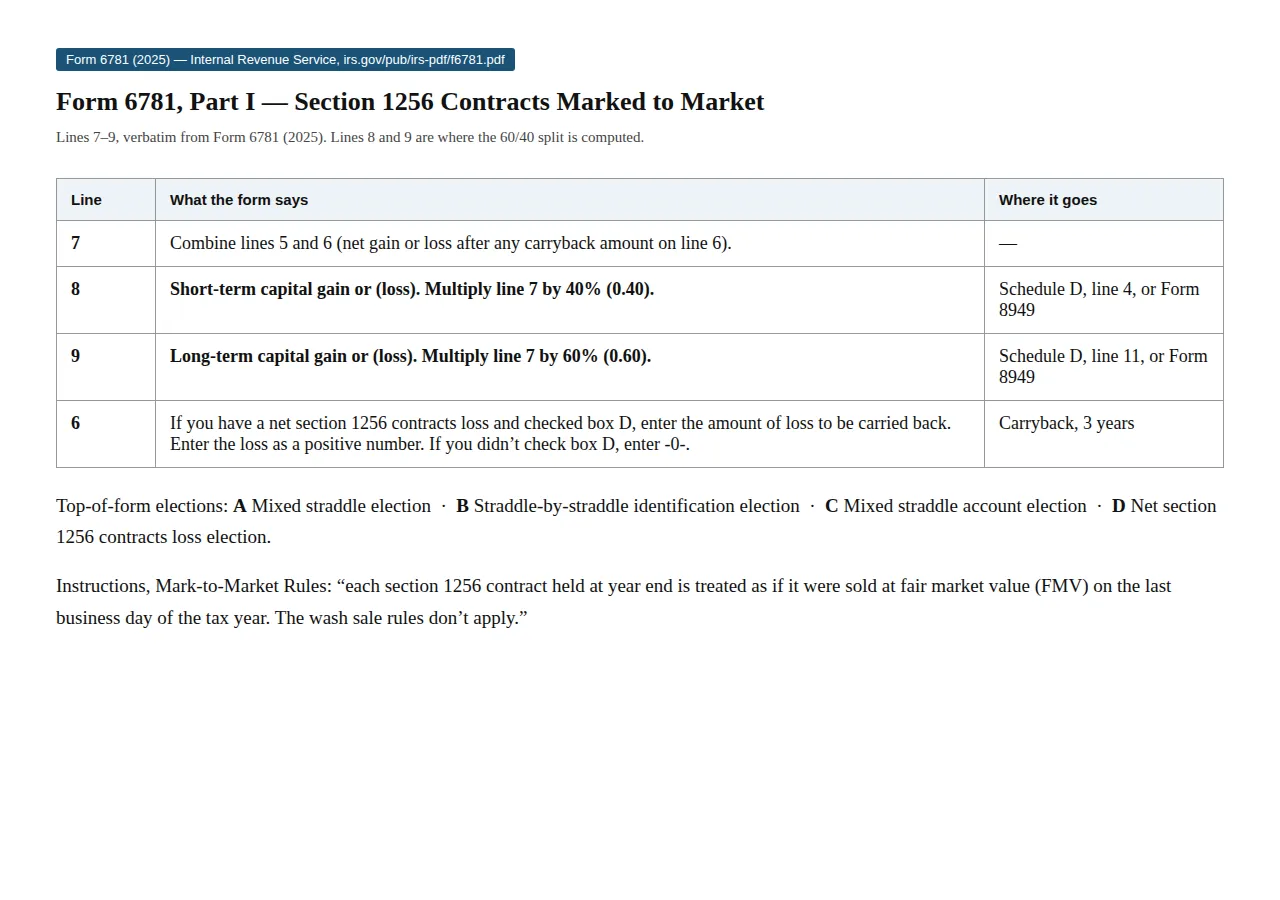
A trader holds an E-mini S&P 500 futures contract open on December 31, eleven days after buying it. Nothing has been sold. The return still reports a gain. Section 1256 treats every regulated futures contract, foreign currency contract, and nonequity option held at year-end as sold for its fair market value on the last business day of the year — 60% of the gain long-term, 40% short-term, regardless of holding period. On a stated $120,000 net gain, the split cuts the tax to $28,560 at assumed 15% long-term and 37% ordinary rates, against $44,400 if the whole gain were short-term. The section 475 election — marking an entire securities business to market — is a different mechanism, covered in the section-475-mark-to-market-trader-tax-playbook.
Step 1: The rule in one paragraph
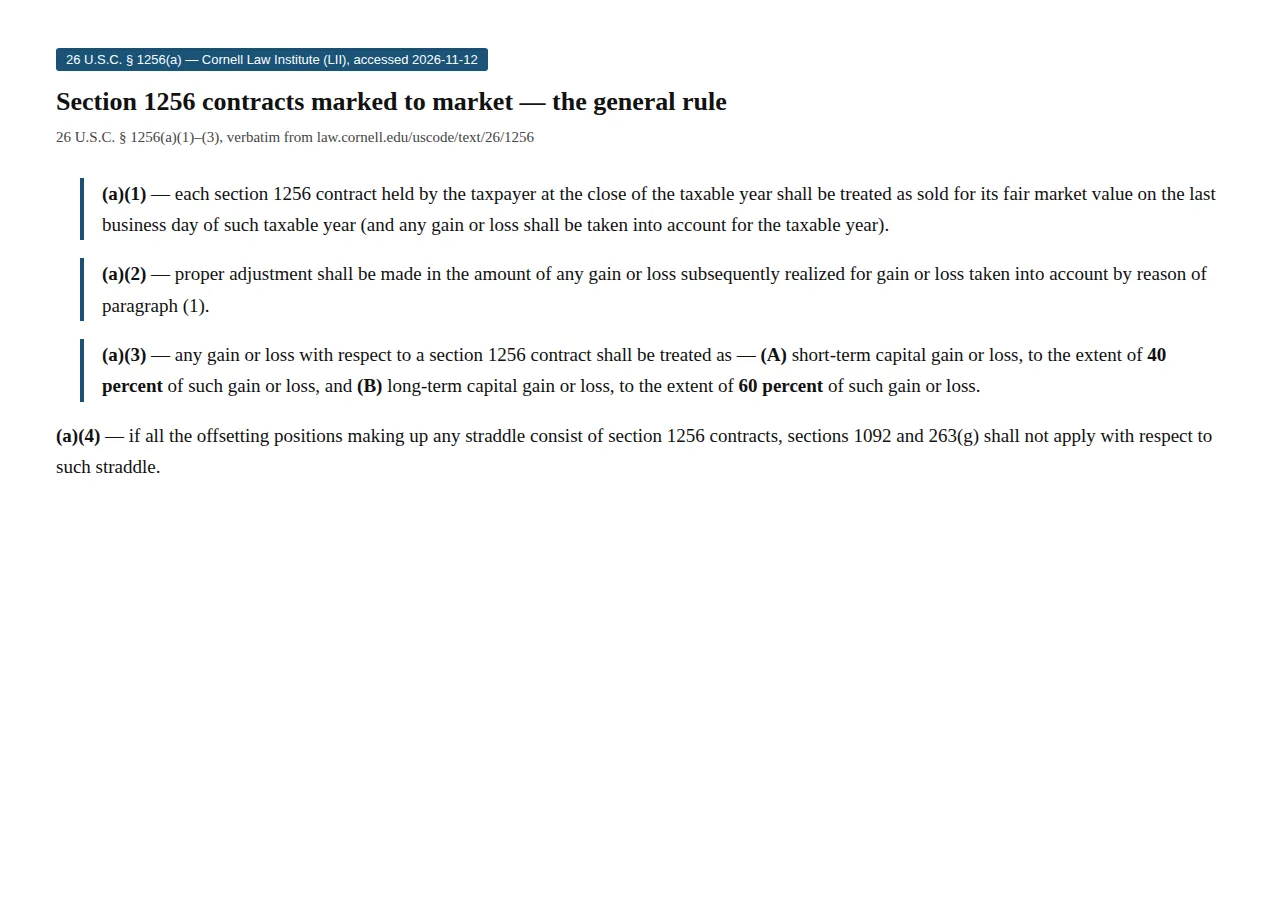
Section 1256(a) does three things. First, each section 1256 contract held at the close of the taxable year is treated as sold for its fair market value on the last business day of that year. Second, the basis is adjusted when the contract is later sold, so the same dollars are never taxed twice. Third, any gain or loss is treated as 40% short-term and 60% long-term. The holding period is irrelevant. A fourth paragraph switches off sections 1092 and 263(g) for straddles made entirely of section 1256 contracts.
Step 2: Which contracts qualify — the five, and the exclusions
Section 1256(b)(1) names five kinds of contract; section 1256(b)(2) carves out the swaps.
| Contract | Test | Authority |
|---|---|---|
| Regulated futures contract | Traded on a qualified board or exchange; margin marked to market daily | § 1256(g)(1) |
| Foreign currency contract | Delivery of, or settlement by reference to, a currency also traded through regulated futures; interbank market | § 1256(g)(2) |
| Nonequity option | Listed option that is not an equity option: debt, commodity futures, currency, broad-based index | § 1256(g)(3) |
| Dealer equity option | Listed equity option bought or granted by a dealer in the normal course of dealing | § 1256(g)(4) |
| Dealer securities futures contract | Securities futures contract entered into by a dealer | § 1256(g)(9) |
| Any swap, cap, floor, or similar agreement; non-dealer securities futures contract | Excluded | § 1256(b)(2) |
Three boundaries do the most work. A listed option on a single stock or a narrow-based index is an equity option, and an equity option is a section 1256 contract only in a dealer's hands — retail single-stock options are not, but broad-based index options are. A longer-maturity bank forward still qualifies if it meets the three-part test (Pub. 550). A swap is never a section 1256 contract. The 60/40 rule does not apply to dealer equity options or dealer securities futures allocable to limited partners or limited entrepreneurs; those are short-term.
Step 3: Worked example — the IRS's own numbers
Publication 550 runs the whole machine on one contract. On June 3, 2024, you bought a regulated futures contract for $50,000. On December 31, 2024 — the last business day of the year — its fair market value was $57,000: a $7,000 gain on your 2024 return, 60% long-term, 40% short-term.
On February 3, 2025, you sold the contract for $56,000. The basis going into 2025 is the $57,000 year-end value — the section 1256(a)(2) adjustment, since the $7,000 was already recognized. The 2025 loss is $1,000, again split 60/40: $600 long-term, $400 short-term. Across the two years the net is a $6,000 gain — $56,000 minus $50,000. The rule changes when the gain is taxed, not how much. The trap is timing: the $7,000 was taxable in 2024 with no sale, and a trader who spends it in January pays the 2024 tax out of 2025 cash.
Terminations. The rule does not wait for year-end when a contract ends early. Section 1256(c) applies the same treatment when a section 1256 contract is terminated by offsetting, delivery, exercise, assignment, or lapse, at the fair market value at termination. If two or more section 1256 contracts form a straddle and the taxpayer takes delivery or exercises one, section 1256(c)(2) treats each of the others as terminated that same day. The gain or loss is still split 60/40.
Step 4: Worked example — what the 60/40 split is worth
The long-term portion is taxed at the section 1(h) rates — 0%, 15%, or 20% by taxable income; the short-term portion at ordinary rates. The blended rate is 60% of the long-term rate plus 40% of the ordinary rate.
Example: a stated individual trader has a net section 1256 gain of $120,000, at assumed rates of 15% long-term and 37% ordinary — not the reader's rates.
The same $120,000 as short-term gain would cost $44,400 at 37% — the split saves $15,840. At the assumed 37% ordinary rate, the blended tax on a stated $100,000 gain is $14,800 at a 0% long-term rate, $23,800 at 15%, and $26,800 at 20%.
Two limits sit on top. The bands turn on taxable income under section 1(h); this playbook prints no 2026 threshold — none was verified from a primary source; use the Schedule D Tax Worksheet. A 3.8% net investment income tax under section 1411 may also apply above $250,000 for a joint return and $200,000 otherwise; the examples above do not include it.
Step 5: The hedging exception — identify it the same day or lose it
Section 1256(e) switches the whole section off for a hedging transaction — one entered into in the normal course of business primarily to manage price, currency, or interest-rate risk — if the taxpayer clearly identifies it as a hedge before the close of the day entered into. Miss the deadline and the contract is marked to market like any other.
A properly identified hedge escapes mark-to-market entirely, and its gain or loss follows the character of the hedged item — gain from selling identified personal property is ordinary income, not capital gain. The exception never applies to a syndicate.
Step 6: Mixed straddles and section 1092 — where the deferral lives
A straddle is offsetting positions in personal property: holding one substantially diminishes the risk of loss from holding the other. Section 1092(a) defers the loss — it counts only above the unrecognized gain on the offsetting positions, and the rest is treated as sustained in the succeeding year. But section 1256(a)(4) switches sections 1092 and 263(g) off entirely when every offsetting position is a section 1256 contract. The deferral lives in the mixed straddle — at least one, but not all, of the positions is a section 1256 contract.
Example: a stated trader closes one leg of a mixed straddle and realizes a $20,000 loss, while the offsetting position still held carries $14,000 of unrecognized gain. Only $6,000 is deductible this year; the $14,000 waits. With an all-section 1256 straddle the full $20,000 would be recognized this year, because section 1092 would not apply at all.
Section 1256(d) gives three elections for mixed straddles, all on Form 6781.
| Election | What it does | Authority |
|---|---|---|
| Box A — Mixed straddle election | Section 1256 does not apply; report the component in Part II. Identify each position before the close of the day the first section 1256 contract is acquired | § 1256(d) |
| Box B — Straddle-by-straddle identification election | Identifies the straddle position by position; positions held the day before are deemed sold at FMV. Identify by the close of the day the straddle is established | Temp. Reg. § 1.1092(b)-3T(d) |
| Box C — Mixed straddle account election | Mixed straddle accounts; annual net gain or loss in Part II. Establish by the prior year's return due date (no extensions) | Temp. Reg. § 1.1092(b)-4T(f) |
Step 7: The loss carryback — three years back, individuals only
Under section 1212(c), a taxpayer other than a corporation with a net section 1256 contracts loss may elect to carry it back to each of the three preceding years. In each carryback year, 40% is treated as a short-term capital loss and 60% as a long-term capital loss. Check Box D on Form 6781, enter the amount on line 6, and claim the refund on Form 1040-X or 1045 with an amended Form 6781 and Schedule D.
Two caps bind it: the earliest year absorbs first, no year absorbs more than its net section 1256 gain, and the carryback cannot create or increase a net operating loss. Corporations, estates, and trusts are not eligible.
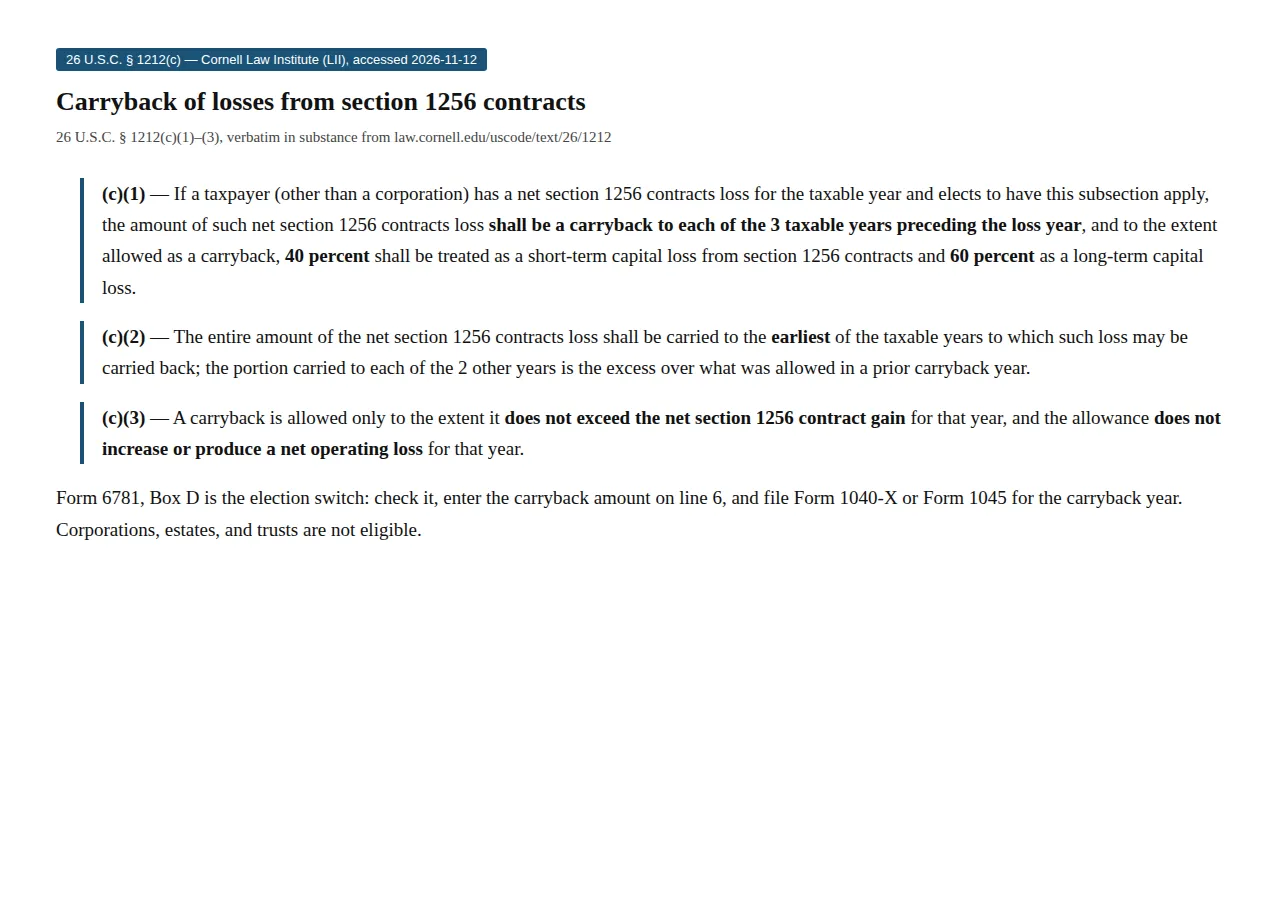
Example: a stated $90,000 net section 1256 loss in 2026, with prior-year gains of $40,000 (2023), $25,000 (2024), and $35,000 (2025), is fully absorbed earliest-first — $40,000, $25,000, $25,000 — each split 60/40. Nothing is left; any remainder carries forward under the ordinary capital loss rules.
A trader operating through an LLC, S-Corp, or C-Corp files under the entity's EIN, and the §1256 contracts the entity holds are still marked to market — the entity changes who reports, not whether §1256 applies. A CPA reconciles the broker's CSV before filing.
The decision
| Situation | Treatment | Authority |
|---|---|---|
| Section 1256 contract held at year-end | Mark to market; 60% LT, 40% ST | § 1256(a) |
| Retail equity option | Not a section 1256 contract; holding period controls | § 1256(b), (g)(3) |
| Swap, cap, floor, or credit default swap | Excluded — not a section 1256 contract | § 1256(b)(2)(B) |
| Hedge identified before the close of the entry day | Section 1256 does not apply; gain can be ordinary | § 1256(e) |
| All-section 1256 straddle | Sections 1092, 263(g) off; full loss recognized | § 1256(a)(4) |
| Mixed straddle, no election | 1256 leg marked to market; 1092 defers loss to unrecognized gain | § 1256(a); § 1092(a) |
| Individual with a net section 1256 loss | Elect 3-year carryback (Box D); capped at yearly gain | § 1212(c) |
The build operation, start to finish
- List every open derivatives position at December 31 and test each against section 1256(b).
- Take the fair market value of each section 1256 contract on the last business day of the year and compute the gain or loss against cost basis.
- Identify any hedge in writing before the close of the entry day, naming the contract, the hedged item, and the risk.
- Test every pair of offsetting positions for a straddle. If all legs are section 1256 contracts, sections 1092 and 263(g) are off; if mixed, choose the election first.
- Complete Form 6781, Part I: line 7 × 40% is line 8 (Schedule D, line 4); line 7 × 60% is line 9 (Schedule D, line 11). The irs-form-1040-schedule-d-capital-gains-playbook runs the Tax Worksheet for the 0%, 15%, and 20% bands.
- On a net section 1256 loss year, compare the carryback with the carryforward: total the prior three years' gains, check the net operating loss cap, and file Form 1040-X or 1045 if the carryback wins.
- Run the after-tax return through the ROI calculator at the blended rate from Step 4 — 23.8% at the assumed rates — before sizing next year's positions.
- Keep the workpapers — valuations, identifications, and the carryback computation — because the examiner's first question is how the number was built.
- [x] Test every open position against section 1256(b) before year-end.
- [x] Value each section 1256 contract at year-end FMV.
- [x] Identify every hedge in writing the day it is entered into.
- [x] Decide the mixed-straddle election before the first section 1256 contract.
- [x] Complete Form 6781, Part I; carry lines 8 and 9 to Schedule D.
- [x] Compare the 3-year carryback with the carryforward on a net section 1256 loss year.
- [x] Keep the valuations, identifications, and carryback computation.
Founder & CEO Insight — Enow A. Jovial