Depreciation is a loan from the Treasury, not a gift. Each deduction cuts your basis by the same amount. Sell that property for more than its reduced basis, and the code asks how much of your gain is just the depreciation coming back. That is depreciation recapture: a seller expecting a 15% capital-gains rate can watch a large slice of the gain taxed as ordinary income instead.
This playbook covers the recapture operation itself: section 1245 for personal property, section 1250 for real property, section 1231 netting, where the numbers land on Form 4797, and the traps that fire even without a sale — a business-use drop, an installment sale, and a former home turned rental. It is not a Form 4562 filing guide or a section 179 vs bonus choice. For claiming depreciation, start with the Form 4562 playbook.
What section 1245 actually does
Section 1245 applies to depreciable personal property: machinery, equipment, vehicles, computers, and furniture — tangible property that is not a building or its structural components. Under 26 U.S.C. § 1245(a)(1), when section 1245 property is disposed of, the amount by which the lower of the recomputed basis or the amount realized exceeds the adjusted basis "shall be treated as ordinary income." Recomputed basis adds all depreciation back, so the ordinary-income slice is the lesser of the depreciation you took or the gain you realized.
The depreciation that counts is broad. Publication 544 lists ordinary MACRS deductions, any special depreciation allowance — bonus depreciation — amortization of section 197 intangibles, and the section 179 deduction, because section 1245(a)(2)(C) treats a section 179 deduction "as if it were a deduction allowable for amortization." So $60,000 of bonus depreciation and a $60,000 section 179 election both come back as ordinary income on sale. The only escape is a disposition the statute excuses: a gift and a transfer at death are excepted under section 1245(b)(1) and (b)(2).
The statute's formula:
Note the phrase "allowed or allowable": you are recaptured on the greater of what you actually deducted and what you could have deducted, so skipping a depreciation year does not shrink the bill. Keep permanent records of acquisition date, cost, depreciation, and every basis adjustment.
Worked example: the CNC machine
Example: in February 2023, a manufacturer buys a CNC machine for $60,000, places it in service for 100% business use as 7-year property, claims no section 179 or bonus depreciation, and sells it in June 2025 for $70,000. MACRS under the half-year convention is $8,574 in 2023 ($60,000 × 14.29%), $14,694 in 2024 ($60,000 × 24.49%), and $5,247 in 2025 ($60,000 × 17.49% × ½) — $28,515 in total. Adjusted basis is $60,000 − $28,515 = $31,485, and gain realized is $70,000 − $31,485 = $38,515. The section 1245 slice is the lesser of $28,515 and $38,515, which is $28,515; the remaining $10,000 is section 1231 gain. Had the machine sold for $40,000, the gain would have been $8,515 and every dollar of it ordinary. Price the sale first with the profit calculator.
What section 1250 does differently
Section 1250 covers depreciable real property: buildings, land improvements that are realty, and leaseholds. Under 26 U.S.C. § 1250(a)(1), gain is ordinary income only to the extent of "additional depreciation" — depreciation in excess of straight-line — at the 100% applicable percentage for most property. Publication 544 states the consequence plainly: "You will not have additional depreciation if ... you figured depreciation for the property using the straight-line method." Because MACRS requires straight-line depreciation for real property placed in service after 1986, additional depreciation is usually zero, and section 1250 ordinary recapture is usually zero with it.
The part of a long-term capital gain on section 1250 property that is "due to depreciation" is called unrecaptured section 1250 gain, and IRS Topic 409 states that "the portion of any unrecaptured section 1250 gain from selling section 1250 real property is taxed at a maximum 25% rate." Publication 544 adds the limits: unrecaptured section 1250 gain "cannot be more than the net section 1231 gain or include any gain otherwise treated as ordinary income." The depreciation slice is therefore carved out and taxed at up to 25%, not at 0%, 15%, or 20%.
The modern-case formula:
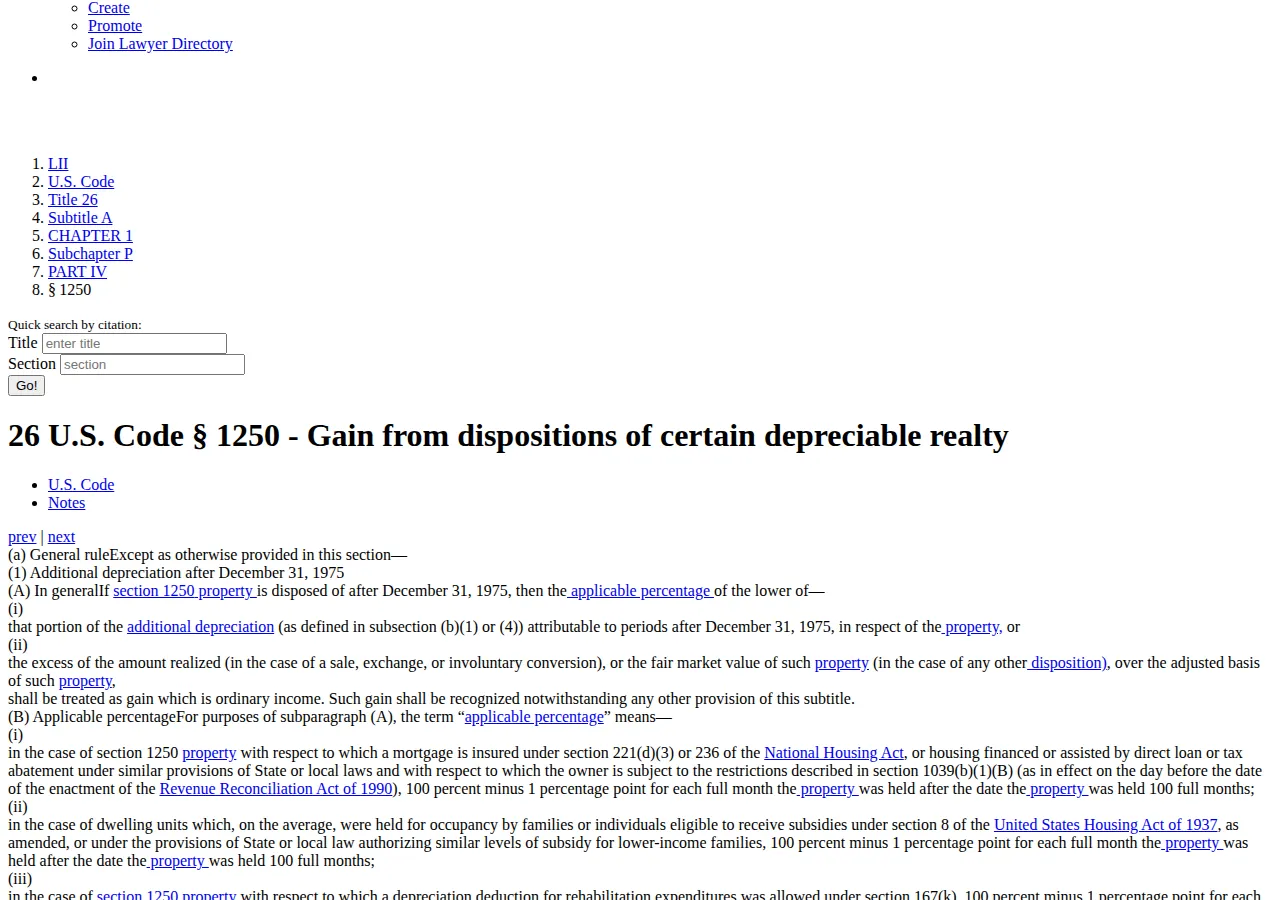
26 U.S.C. § 1250(a)(1): ordinary recapture reaches only "additional depreciation."
Worked example: the rental building
Worked example: an investor buys a residential rental in 2015 for $400,000 — $80,000 for land and $320,000 for the building — and sells it in 2025 for $520,000. Annual straight-line depreciation is $320,000 ÷ 27.5 = $11,636.36 — $116,364 over ten full years. Adjusted basis is $400,000 − $116,364 = $283,636. Gain realized is $520,000 − $283,636 = $236,364. Additional depreciation is $0, so section 1250 ordinary recapture is $0. But the unrecaptured section 1250 gain is $116,364 — the whole depreciation slice — taxed at a maximum 25%. The remaining $120,000 is long-term capital gain at 0%, 15%, or 20%. Check: $116,364 + $120,000 = $236,364. Topic 409 puts the 2025 0% threshold at $48,350 of taxable income for a single filer, 15% up to $533,400, and 20% above that. Full rental-sale mechanics are in the Schedule E rental income playbook.
Section 1245 vs section 1250 vs section 1231
| Rule | Property | Test | Rate | Authority |
|---|---|---|---|---|
| § 1245 | Depreciable personal property | Lesser of depreciation or gain | Ordinary rates | 26 U.S.C. § 1245(a)(1); Pub. 544 ch. 3 |
| § 1250 | Depreciable real property | Additional depreciation above straight-line | Ordinary rates | 26 U.S.C. § 1250(a)(1); Pub. 544 ch. 3 |
| § 1250 unrecaptured gain | Depreciable real property | Depreciation slice, capped at net § 1231 gain | Max 25% | 26 U.S.C. § 1(h); IRS Topic 409 |
| § 1231 | Business property held over 1 year | Net all § 1231 gains and losses; ordinary up to 5-year nonrecaptured losses | Capital rates on remainder | 26 U.S.C. § 1231; Pub. 544 ch. 3 |
The property type chooses the statute, and the statute chooses the rate. A cost-segregation study that moves building components into 5-year and 7-year personal property makes those components section 1245 property — a trade worth making only if it is priced first.
Section 1231 netting: the last filter
Recapture is computed asset by asset; only the remainder enters section 1231, where all gains and losses for the year are netted. Publication 544 gives the result in one paragraph: "If you have a net section 1231 loss, it is ordinary loss. If you have a net section 1231 gain, it is ordinary income up to the amount of your nonrecaptured section 1231 losses from previous years. The rest, if any, is long-term capital gain." Nonrecaptured losses are net section 1231 losses from the previous five years, applied earliest first.
Example: take the CNC machine's $10,000 section 1231 gain. Suppose the same taxpayer had a $4,000 net section 1231 loss in 2023. Then $4,000 of the $10,000 is ordinary income, and only the remaining $6,000 is long-term capital gain. The $28,515 of section 1245 recapture never enters this netting.
Section 179 and bonus recapture when business use drops
Recapture does not wait for a sale. Section 179(d)(10) directs the Treasury to write regulations "for recapturing the benefit under any deduction allowable under subsection (a) with respect to any property which is not used predominantly in a trade or business at any time." The Instructions for Form 4797 give the trigger: "If you took a section 179 expense deduction for property placed in service after 1986 ... and the business use of the property decreased to 50% or less this year, complete column (a) of lines 33 through 35 to figure the recapture amount."
Worked example: in 2025, an S-Corp buys a packaging line for $120,000, uses it 100% in the business, and elects section 179 for the full $120,000 — inside the 2025 limit of $2,500,000. In 2026 business use falls to 45%, so recapture is triggered. Without section 179, the 2025 MACRS deduction on 7-year property would have been $120,000 × 14.29% = $17,148. The recapture on Form 4797 is $120,000 − $17,148 = $102,852 of ordinary income in 2026. Bonus depreciation follows the same logic: 100% bonus is restored under section 168(k)(1)(A) for property acquired after January 19, 2025. The expensing choice and its recapture consequence are compared in the section 179 vs bonus playbook.
Installment sales: recapture is due in year one
Section 453(i)(1) is blunt: in an installment sale, "any recapture income shall be recognized in the year of the disposition," and only "any gain in excess of the recapture income shall be taken into account under the installment method." Publication 544 adds: recapture "is taxable as ordinary income in the year of sale. This applies even if no payments are received in that year." A seller who finances the purchase over five years will instead owe tax on the entire recapture slice in year one, with no cash in hand to pay it. For the CNC machine, the $28,515 of section 1245 income is due in the sale year even if the buyer pays nothing until year two.
The former residence: section 121 does not shelter depreciation
A home that becomes a rental carries its depreciation into the sale; section 121 cannot wash it out. Section 121(b)(1) caps the principal-residence exclusion at $250,000 ($500,000 for certain joint returns), and section 121(d)(6) adds the decisive limit: the exclusion "shall not apply to so much of the gain from the sale of any property as does not exceed the portion of the depreciation adjustments ... attributable to periods after May 6, 1997."
Worked example: a single filer buys a home in 2010 for $300,000, lives in it until 2020, rents it from 2020 to 2025, claims $60,000 of depreciation, and sells in 2025 for $620,000. Adjusted basis is $300,000 − $60,000 = $240,000, and gain is $620,000 − $240,000 = $380,000. The $60,000 depreciation slice cannot be excluded under section 121(d)(6) and is unrecaptured section 1250 gain taxed at a maximum 25%. The $250,000 exclusion then covers the remaining $320,000, leaving $70,000 of taxable long-term gain. Check: $60,000 + $250,000 + $70,000 = $380,000. A 1099-S will be filed carrying the seller's SSN or ITIN, so the IRS will match the reported gain.
The five-step filing workflow
File the result on Form 4797, Sales of Business Property. Part I holds section 1231 transactions, Part II holds ordinary gains and losses, and Part III computes recapture — lines 20–26 for section 1245 property, the following lines for section 1250. No IRS API computes recapture for you; the form is the computation.
- Rebuild the fixed-asset register. Pull every depreciable asset sold this year, with cost, placed-in-service date, depreciation taken, and adjusted basis. Confirm the EIN matches the 1099-S.
- Classify each asset before you compute anything. Personal property takes the section 1245 test, real property the section 1250 test, and property held one year or less gets no section 1231 treatment.
- Compute recapture asset by asset in Part III. For each section 1245 asset, take the lesser of depreciation allowed or allowable and gain realized. For each section 1250 asset, compute additional depreciation above straight-line and complete the Unrecaptured Section 1250 Gain Worksheet.
- Net what is left under section 1231 in Part I. Carry only the gain above recapture into Part I, then apply the five-year lookback.
- Report the section 179 and installment exceptions on their own lines. Business-use drops go on Form 4797 lines 33 through 35 in the year use falls to 50% or less; installment-sale recapture is recognized in the year of disposition on Form 6252.
- [x] Register rebuilt and reconciled
- [x] Assets classified § 1245 / § 1250
- [x] Lesser-of test run per asset
- [x] § 1250 worksheet completed
- [x] Five-year § 1231 lookback applied
- [x] § 179 recapture checked for assets held
- [x] Installment recapture recognized in year of sale
- [x] § 121 slice excluded from residence exclusion
Who this is for — and who should stop here
This playbook is for owners who sell business property: an LLC selling equipment, an S-Corp disposing of a plant line, a C-Corp selling a warehouse, a landlord selling a rental, and a sole proprietor selling the tools of the trade. It is also for the CPA who prepares the return. It is not for personal-use property: losses on personal-use assets are not deductible, and a home sold without ever being rented or used in business has no depreciation to recapture. States do not all follow federal recapture. Finally, recapture is income tax, not payroll tax. It is not FICA wages and does not run through payroll; whether any slice touches the SECA net-earnings computation depends on the property, so confirm that with your CPA. Only tax depreciation drives recapture, never the GAAP number.
Founder & CEO Insight — Enow A. Jovial
Recapture rewards the seller who plans the exit at the same time as the purchase. Know which statute owns each asset, run the lesser-of test before you agree a price, and file the result through Form 4797.