IRC Section 1244: Small Business Stock Loss Playbook
A founder pays $120,000 cash for common stock in a domestic C-Corp. Three years later the company liquidates and the stock is worth nothing. The tax question is what kind of loss it is. A capital loss is rationed: section 1211(b) lets an individual deduct net capital losses only against capital gains plus $3,000 a year. An ordinary loss is not rationed — it offsets wages and business income in the year it is recognized. Section 1244 converts that loss into ordinary loss, up to $50,000 a year single or $100,000 joint. The relief is narrow, tested at issuance, and lost permanently if the paperwork was never kept.
Why the capital-loss limit makes section 1244 worth real money
Start with the trap. A $110,000 capital loss with no capital gains is deductible at $3,000 a year under section 1211(b) — $1,500 if married filing separately — the balance carried forward year after year. Publication 550 and IRS Topic 409 state the rule: the loss deductible against other income is the lesser of $3,000 or the total net loss, claimed on line 7a of Form 1040, the remainder carried forward. At $3,000 a year, a $110,000 loss takes 37 tax years to absorb. Section 1244 changes the character of the first $100,000 on a joint return. Publication 550 works the exact example: a $110,000 loss on a joint return, with the spouse holding no loss, yields a $100,000 ordinary loss and a $10,000 capital loss.
The saving is timing, not exemption — an ordinary loss in the year of a failed investment offsets that year's salary and business income. Run your own numbers through the profit calculator first.
The three qualification tests
Section 1244(c)(1) defines section 1244 stock with three conditions, all of which must hold. The QSBS gain-exclusion playbook covers the gain side of the same bargain — section 1202 exempts the gain, section 1244 cushions the loss — and qualifying under one never guarantees the other.
| Test | What the statute requires | Authority |
|---|---|---|
| Small business corporation | Money and property received for stock, capital contributions, and paid-in surplus ≤ $1,000,000 at issuance, including all prior stock | IRC § 1244(c)(3)(A) |
| Issued for money or property | Issued for money or other property, other than stock and securities; stock for services fails | IRC § 1244(c)(1)(B) |
| Operating receipts | Over 50% of aggregate gross receipts in the 5 most recent taxable years before the loss from operating sources, not passive income or securities sales | IRC § 1244(c)(1)(C) |
The corporation must be domestic, the stock must be issued to the person taking the loss, and stock issued after July 18, 1984 may be common or preferred. Trusts, estates, and corporations cannot use section 1244 — section 1244(d)(4) excludes trusts and estates, and section 1211(a) limits corporate capital losses to capital gains.
Section 1244(c)(2) refines the test: a corporation younger than five years is tested over the years it has existed; securities sales count only to the extent of gains; and the test does not apply if the corporation's deductions — other than the net operating loss and dividends-received deductions — exceeded its gross income.
The $1,000,000 aggregate capital test, worked
Section 1244(c)(3)(B) sets the valuation rule: property counts at its adjusted basis to the corporation, reduced by any liability assumed, measured when received; cash counts at face value. The test is cumulative — each issuance is tested against everything received before it.
Take a founder capitalizing a new C-Corp: stock issued for $600,000 cash, equipment with a $300,000 adjusted basis subject to a $50,000 loan the corporation assumes, and $100,000 paid-in surplus. The equipment counts at $250,000 — $300,000 basis less the $50,000 liability — and the aggregate is $950,000, inside the limit:
If the corporation issues another $100,000, the aggregate becomes $1,050,000 and that stock is not section 1244 stock, though the first founder's stock still qualifies. A corporation past $1,000,000 can never issue section 1244 stock again. Keep a running ledger of every dollar and property contribution from the first issuance, with basis and liability figures — the corporation's records are the only proof the test was met.
The two basis haircuts
Even qualifying stock does not always produce a full ordinary loss. Section 1244(d)(1) imposes two reductions, both triggered by later property or cash contributions.
The first haircut applies to stock received for property with basis above fair market value: section 1244(d)(1)(A) reduces the stock's basis, for the section 1244 loss only, by that excess. Publication 550 works the numbers: property with a $1,000 basis and a $250 fair market value is exchanged for section 1244 stock. The stock's basis is $1,000 for every other purpose, but $250 for the ordinary loss. Sell it later for $200 and the $800 loss splits into $50 ordinary and $750 capital:
The second haircut applies to later contributions to capital: section 1244(d)(1)(B) treats any increase in the stock's basis through contributions to capital as allocable to stock that is not section 1244 stock. Publication 550 supplies the arithmetic: 100 shares bought for $10,000, then a $2,000 contribution raises the basis to $12,000. Sell for $9,000 and the $3,000 loss is ordinary only in the proportion $10,000 bears to $12,000 — $2,500 ordinary, $500 capital:
Every dollar contributed after the original purchase dilutes the ordinary-loss fraction. The Section 83(b) election playbook covers a different issuance-time decision — the tax timing of restricted stock — and the same discipline applies: tax character is fixed at issuance, not by what the founder wishes at the loss.
Worked example: the stock goes to zero
Assume a single filer with no capital gains in the loss year, a $120,000 cash purchase of common stock in a domestic C-Corp that had taken in $900,000 of aggregate capital at issuance, and gross receipts 80 percent operating. The corporation fails in year three and the stock becomes worthless. Section 165(g) treats a worthless security as sold on the last day of the year — the baseline character section 1244 then overrides, up to the cap. The stock qualifies on every test.
The single-filer cap is $50,000: $50,000 of the loss is ordinary in year three, $70,000 is capital, $3,000 of it deductible that year and $67,000 carried forward:
Filing jointly, the founder takes $100,000 as ordinary loss in year three, leaving $20,000 of capital loss — $3,000 deductible that year, $17,000 carried forward and absorbed in under six years. At an assumed 24 percent marginal rate, for illustration only, the single filer's $50,000 ordinary loss shelters $12,000 of tax in year three against $720 a year from the drip; the joint filer's $100,000 shelters $24,000. The actual saving follows the taxpayer's real bracket.
How section 1244 sits beside section 1202 and section 165(g)
Section 1244 and section 1202 are the two halves of the small-business bargain, pointing in opposite directions: section 1202 excludes gain on qualified small business stock — up to 100 percent for stock acquired after September 27, 2010 — while section 1244 converts loss into ordinary loss. The tests differ: section 1202 requires a $50,000,000 gross-assets test, a five-year holding period, and an active-business test over substantially all of the holding period; section 1244 requires a $1,000,000 capital test at issuance and a 50 percent receipts test over the five years before the loss. Stock can qualify under one and fail the other.
Section 165(g) supplies the loss event: a worthless security is treated as sold on the last day of the taxable year, fixing the year of the loss. The ordinary portion goes on Form 4797; the capital remainder flows to Schedule D, nets against gains, and is subject to the $3,000 limit. Section 1244(d)(3) adds one more consequence: for the section 172 net operating loss deduction, a section 1244 ordinary loss counts as attributable to a trade or business of the taxpayer.
The partnership channel works the same way: section 1244(a) extends ordinary-loss treatment to stock issued to a partnership. Per Publication 550, the partner must have been a partner when the stock was issued and have remained one until the loss, and adds the distributive share of the partnership loss to any individual section 1244 loss before applying the cap — per taxpayer per year, not per stock or per entity. If the partnership distributes the stock to the partner, the later loss on that stock is not ordinary; the chain breaks at distribution.
Where it lands on the return
The Instructions for Form 4797 (2025) state the rule directly: individuals report ordinary losses from the sale or exchange, including worthlessness, of section 1244 stock on line 10, in Part II.
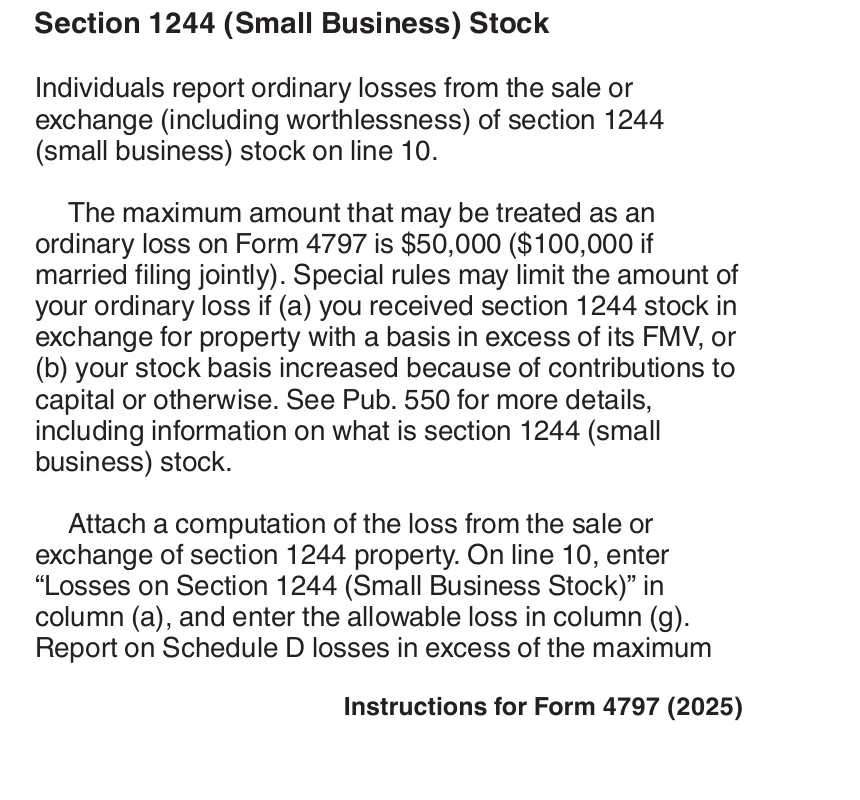 The maximum treated as ordinary is $50,000, or $100,000 if married filing jointly. Enter "Losses on Section 1244 (Small Business Stock)" in column (a) and the allowable loss in column (g), attaches a computation, and reports the excess on Schedule D. The instructions add a recordkeeping command: keep records that distinguish section 1244 stock from other stock in the corporation. Publication 550 repeats it: a founder who cannot tell the shares apart has no provable ordinary loss.
The capital remainder follows the ordinary machinery: Form 8949, summarized on Schedule D, netted against gains, limited to $3,000 a year under section 1211(b), the excess carried forward. The Section 704(b) capital account playbook shows the same basis discipline on the partnership side — separate lots, separate records, contemporaneous notes — and that instinct is what makes either position survive an examination.
Operator Boundaries
This playbook is for an individual founder or angel investor who buys stock directly from a small domestic C-Corp for cash or property and holds it until sale or worthlessness, where the $1,000,000 capital figure at issuance can be documented. It is not for trusts or estates, excluded by section 1244(d)(4); not for corporations, which cannot take ordinary losses on stock; not for stock bought on the secondary market, received for services, or issued after the corporation had already taken in more than $1,000,000; and not for S-Corp stock, where losses already flow through under subchapter S. Your CPA will want the EIN, the stock certificate, and the GAAP books behind the $1,000,000 figure — both tests turn on the corporation's books. Small business investment company stock under section 1242 is a separate provision, also on Form 4797 line 10 — do not confuse the two.
Founder & CEO Insight — Enow A. Jovial
Run the loss: execution checklist
- Confirm original-owner status before the loss year. Stock certificate, subscription agreement, and payment record proving issuance to you.
- Reconstruct the $1,000,000 capital figure at issuance. Cash, property at basis less assumed liabilities, capital contributions, and paid-in surplus, cumulative since the first issuance.
- Run the 50 percent gross-receipts test. Five most recent taxable years before the loss, operating receipts against passive receipts and securities sales.
- Separate the lots. Keep section 1244 shares identifiable from any other stock in the same corporation, in the records and the cap table.
- Apply the basis haircuts. Reduce the ordinary-loss basis for property contributed above fair market value; allocate later capital contributions to non-section 1244 stock.
- Document worthlessness. Cessation of operations, liquidation, final distributions, date of worthlessness.
- File Form 4797, Part II, line 10. "Losses on Section 1244 (Small Business Stock)" in column (a), allowable loss in column (g), computation attached.
- Carry the capital remainder to Schedule D. Net against gains, deduct $3,000 a year, track the carryforward on the Capital Loss Carryover Worksheet.
The decision in advance
Verify the $1,000,000 figure before buying, keep the shares in a separate lot, and calendar the five-year receipts test while records exist. The ordinary loss is capped and the excess is rationed — but for a founder who buys right, the difference between $50,000 of ordinary loss in year one and a $3,000 annual drip is the difference between a deduction that matters and one that does not.