A lender forgives $60,000 of your debt and the IRS sends you a bill for it. That is not a mistake. Under 26 U.S.C. § 61(a), gross income includes income from the discharge of indebtedness, and a forgiven loan is income unless a specific exclusion removes it. Section 108 is the only statute that removes it, through five narrow doors, in a fixed order, at a price: every dollar you exclude comes back as a dollar of tax attributes you lose.
Most debtors discover § 108 after the Form 1099-C arrives. The insolvency exclusion is capped at the exact dollar amount by which you were insolvent the day before the discharge. The principal-residence exclusion — the one millions of homeowners used after 2008 — expired for new discharges on January 1, 2026, and only a written arrangement signed before that date keeps it alive.
The statute: five doors, one order
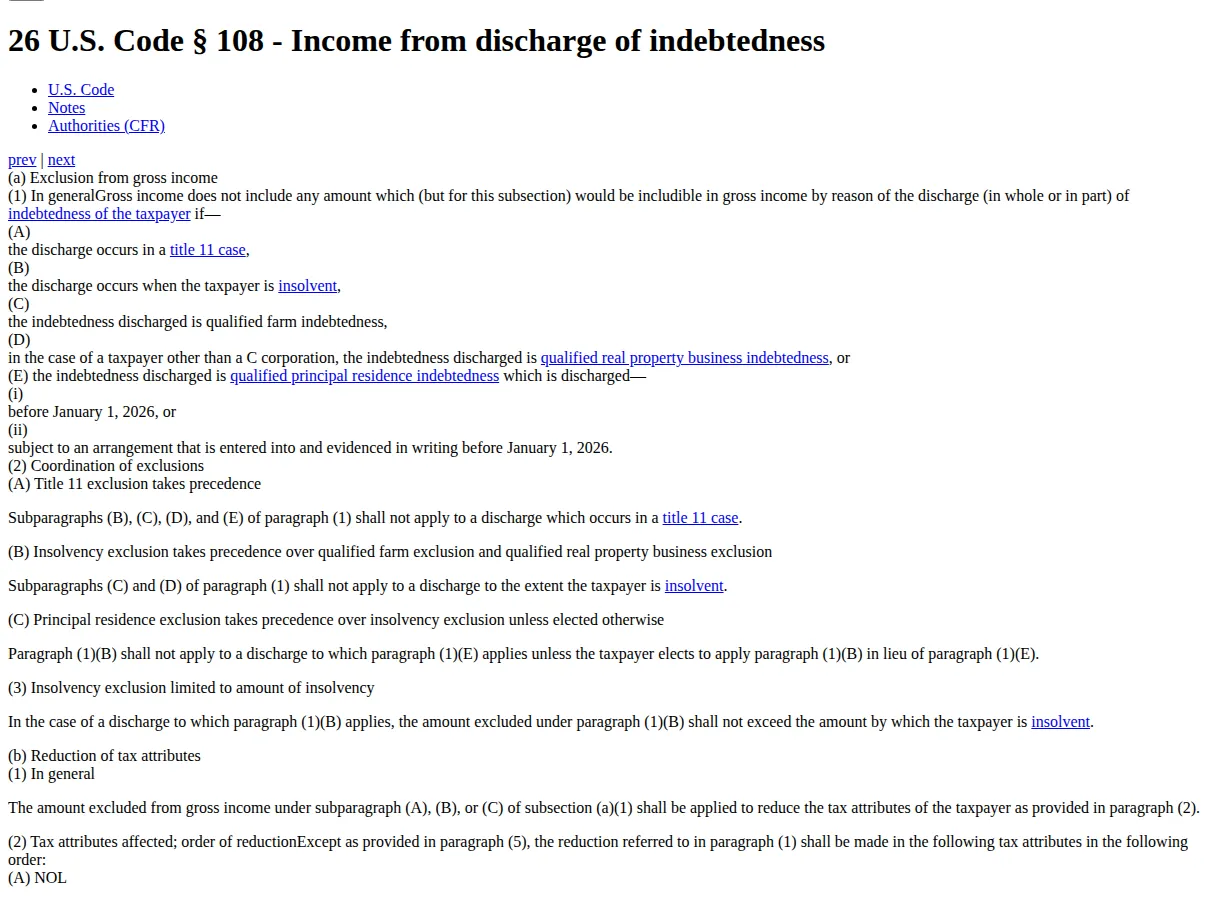
Section 108(a)(1) lists the five exclusions. Gross income does not include discharged debt if the discharge occurs in a title 11 bankruptcy case, if it occurs while the taxpayer is insolvent, if the debt is qualified farm indebtedness, if it is qualified real property business indebtedness of a taxpayer other than a C corporation, or if it is qualified principal residence indebtedness discharged before January 1, 2026, or under an arrangement entered into and evidenced in writing before that date.
| Exclusion | Cap | Authority |
|---|---|---|
| Title 11 case | None — the full discharge | § 108(a)(1)(A) |
| Insolvency | Amount of insolvency, day before | § 108(a)(1)(B), (a)(3) |
| Qualified farm indebtedness | Tax attributes plus business and investment assets | § 108(a)(1)(C), (g) |
| Qualified real property business indebtedness | Qualified acquisition debt, election required | § 108(a)(1)(D), (h) |
| Qualified principal residence indebtedness | $750,000 ($375,000 married filing separately) | § 108(a)(1)(E) |
The order matters because § 108(a)(2) imposes a precedence ladder. A discharge in a title 11 case takes only the bankruptcy exclusion — the other four do not apply at all. An insolvent taxpayer takes the insolvency exclusion before the farm and real-property-business exclusions, which do not apply to the extent of insolvency. And the principal-residence exclusion takes precedence over insolvency unless the taxpayer elects otherwise. The election exists because insolvency is sometimes the better door: no $750,000 cap, no January 1, 2026 expiry.
Two definitions control everything that follows. Under § 108(d)(3), a taxpayer is insolvent to the extent liabilities exceed the fair market value of assets, measured immediately before the discharge. Under § 108(d)(1), indebtedness means any debt for which the taxpayer is liable or subject to which the taxpayer holds property — so a nonrecourse mortgage counts, and so does a debt secured by property you hold even if you never signed the note.
The insolvency math: a worked example
The insolvency exclusion is the door most individuals and small businesses actually walk through, because it needs no bankruptcy filing and no election. The math is three lines, and the IRS expects you to keep the worksheet that proves them. Publication 4681, Canceled Debts, Foreclosures, Repossessions, and Abandonments (2025), publishes the Insolvency Worksheet the IRS wants to see.
Take a founder who personally guaranteed a business line of credit. The day before the bank settles, her liabilities are $140,000 — the $120,000 line, $14,000 of credit-card balances, and a $6,000 personal loan. Her assets at fair market value are $95,000: an $18,000 car, $52,000 of retirement accounts, $10,000 of household goods, and $15,000 of business equipment. She is insolvent by $45,000. The bank accepts $60,000 in settlement of the $120,000 line, cancelling $60,000 of debt. The exclusion covers $45,000 of it. The remaining $15,000 is ordinary income — at 22%, a $3,300 bill on money she never received.
Publication 4681 states the same rule in miniature: you owed $1,000, paid $400 in full satisfaction, and have $600 of cancelled debt. The cancelled amount is the debt minus what you paid, and the exclusion is that amount minus what insolvency covers.
The asset list is where returns go wrong. The worksheet counts everything at fair market value, not GAAP book value: retirement accounts, life-insurance cash value, household goods at garage-sale value, and jointly owned property. There is no exemption list — § 108 insolvency is a balance-sheet test, not a bankruptcy test.
The price: attribute reduction under § 108(b)
The exclusion is not a gift. Section 108(b)(1) requires the excluded amount to reduce the taxpayer's tax attributes, in the order § 108(b)(2) prescribes. The reduction is dollar for dollar, except that the three credits reduce at 33 and one-third cents per dollar excluded — the split the Instructions for Form 982 state on their face.
| Order | Tax attribute reduced | Rate |
|---|---|---|
| 1 | Net operating loss, current year and carryovers | $1 per $1 |
| 2 | General business credit carryovers | 33 and one-third cents per $1 |
| 3 | Minimum tax credit under § 53(b) | 33 and one-third cents per $1 |
| 4 | Capital loss carryovers | $1 per $1 |
| 5 | Basis of property, under § 1017 | $1 per $1 |
| 6 | Passive activity loss and credit carryovers under § 469(b) | $1 per $1 |
| 7 | Foreign tax credit carryovers under § 27 | 33 and one-third cents per $1 |
Return to the founder: she excluded $45,000. Suppose she carries a $30,000 net operating loss from the failed business and $20,000 of general business credit carryover. The NOL is wiped first — $30,000 of the $45,000. The remaining $15,000 hits the credit at 33 and one-third cents, reducing it by $5,000 to $15,000. The exclusion saved her tax on $45,000 of income this year and cost her $30,000 of NOL and $5,000 of credit she would have used later. That is the trade, and it is why a founder with large NOLs should model the exclusion before claiming it. Our § 382 NOL limitation playbook covers how ownership changes cap those same losses from the other side, and the two rules stack.
The basis reduction deserves its own warning. When the reduction reaches the basis of property, it lowers the basis of depreciable property first, which means smaller depreciation deductions for years and a larger gain when the property is sold. Form 982 lets the taxpayer elect, on lines 10a and 10b, to reduce depreciable-property basis first. The reduction is recaptured on a later sale, so the bill is deferred, not forgiven.
The other three doors
Qualified farm indebtedness is the narrowest door. Under § 108(g)(2), the debt must have been incurred directly in connection with farming, and 50 percent or more of the taxpayer's aggregate gross receipts for the three taxable years preceding the discharge must be attributable to farming. The exclusion cannot exceed the taxpayer's adjusted tax attributes plus the adjusted basis of qualified property.
Qualified real property business indebtedness is the door for landlords and developers. Under § 108(h), the debt must have been incurred or assumed in connection with real property used in a trade or business and secured by that property, and — for debt incurred on or after January 1, 1993 — it must be qualified acquisition indebtedness, debt incurred to acquire, construct, or substantially improve the property. The taxpayer must elect to apply the paragraph. A C corporation cannot use it at all, while an S-Corp landlord can elect — the exclusion is not available to C corporations, and it excludes qualified farm indebtedness by definition.
Student loans have their own door under § 108(f): a discharge is excluded when the loan terms forgive the balance because the borrower worked for a certain period in certain professions for a broad class of employers. Public-service loan forgiveness is the familiar example.
The purchase-money rule in § 108(e)(5) is not an exclusion at all, and it is the one most often misread. When the seller of property reduces the buyer's purchase-money debt, the reduction is treated as a purchase price adjustment, not as discharge income — but only when the buyer is not in a title 11 case, the buyer is insolvent, and the reduction would otherwise be income. The price drops, the basis drops with it, and there is no Form 982 to file.
The principal-residence door is closing
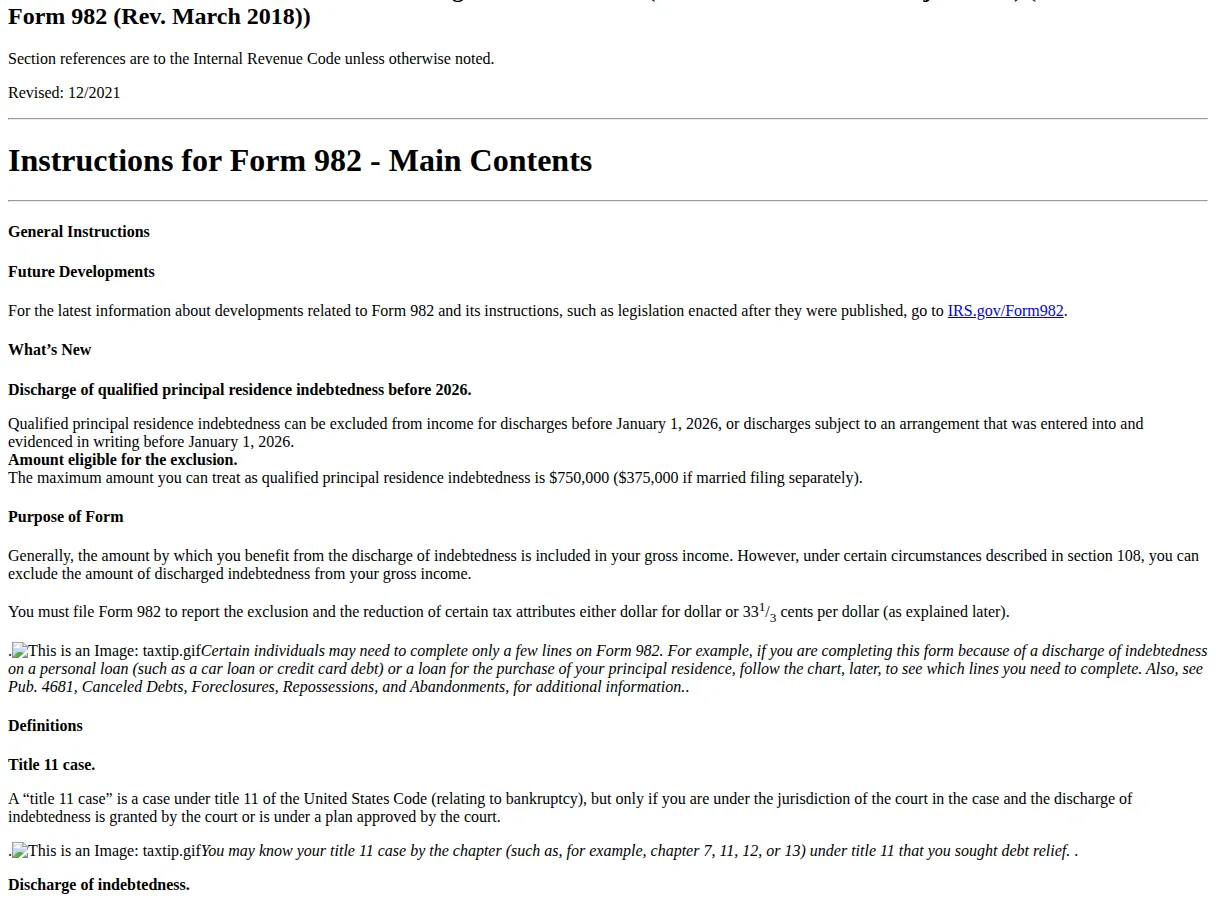
The qualified principal residence exclusion is the deadline in this article. Section 108(a)(1)(E) covers qualified principal residence indebtedness discharged before January 1, 2026, or discharged under an arrangement entered into and evidenced in writing before January 1, 2026. The Instructions for Form 982 (12/2021) state it plainly in their What's New section, and cap the amount at $750,000 — $375,000 if married filing separately.
As of this writing, that date has passed. A homeowner whose lender forgives mortgage debt in 2026 with no written arrangement predating January 1, 2026 cannot use this door at all. The remaining route is insolvency, which is uncapped but requires the balance-sheet test, or bankruptcy. The wind-down of a business raises the same question on the entity side: our LLC dissolution and tax clearance playbook covers the final returns and clearances that accompany a wind-up in which debt is settled.
Filing it: the Form 982 sequence
Form 982, Reduction of Tax Attributes Due to Discharge of Indebtedness, is where the exclusion is claimed and the attribute reduction is reported. The form is short; the preparation behind it is not.
- Collect the 1099-C and the settlement agreement. Confirm the cancelled amount, the identifiable event date in Box 6, and whether the debt was recourse or nonrecourse.
- Build the insolvency worksheet the day before the discharge. List every liability and every asset at fair market value. Keep bank statements, appraisals, and retirement account statements with that date.
- Apply the precedence ladder. If the discharge is in a title 11 case, claim only the bankruptcy exclusion. Otherwise apply insolvency first, then farm or real property business, then principal residence — unless you elect insolvency instead.
- Check the box on Form 982, line 1. Line 1a is the title 11 case, 1b insolvency, 1c qualified farm, 1d qualified real property business, 1e principal residence. Lines 1b through 1e do not apply in a title 11 case.
- Enter the excluded amount on line 2 and complete Part II, which reports the attribute reduction in the § 108(b) order. Consider the lines 10a and 10b election to reduce depreciable-property basis first.
- Attach Form 982 to the return and keep the worksheet. The IRS matches the 1099-C against the return; the worksheet is what survives the notice. Run the final numbers through our tax estimator and have a CPA review the attribute reduction — the exclusion changes the marginal rate on everything else in the return.
Execution checklist
- [x] Confirm the 1099-C amount against the settlement agreement: the cancelled debt is the balance minus what you paid, interest included.
- [x] Date the insolvency worksheet the day before the discharge: assets and liabilities after the discharge are irrelevant to the test.
- [x] List every asset at fair market value: retirement accounts, life-insurance cash value, jointly owned property, and business equipment.
- [x] Apply the precedence ladder before choosing: bankruptcy first, insolvency second, farm and real property business third, principal residence last unless elected.
- [x] Model the attribute reduction before claiming it: a $30,000 NOL burned to exclude $30,000 of income is a wash in a zero-income year.
- [x] File Form 982 with the return, not after it: an exclusion without the form is an audit notice waiting for the 1099-C match.
- [x] Keep the worksheet for three years after filing: the IRS has that long to ask for it.
Who should not use this
Do not claim the insolvency exclusion if you were solvent the day before the discharge — the cap is zero. Do not claim the principal-residence exclusion for a 2026 discharge without a pre-2026 written arrangement; the door is closed. Do not use the farm exclusion for a hobby farm, and do not elect the real property business exclusion for a personal residence — the statute requires a trade or business, and the election is a statement under penalties of perjury. Do not treat a Form 1099-C as optional income because the lender wrote off the debt: the income is yours, and the IRS receives the same form you do.
Founder & CEO Insight — Enow A. Jovial