The classification question is worth $8,477.73 a year
One taxpayer, $60,000 of net income, two forms. A consultant reports $60,000 of net profit on Schedule C; a landlord reports $60,000 of net rental income on Schedule E. Both pay income tax on the $60,000. Only the consultant pays self-employment tax: $8,477.73.
The two schedules, side by side
| Dimension | Schedule C (Form 1040) | Schedule E (Form 1040) | Authority |
|---|---|---|---|
| What it reports | Profit or loss from a sole proprietorship | Rental real estate, royalties, partnerships, S corps, estates, trusts, REMICs | Sch. C / E Instructions |
| Self-employment tax | Yes, via Schedule SE at 15.3% | No, for ordinary rental income | 26 U.S.C. §§ 1401, 1402(b) |
| Loss treatment | Offsets other income same year, subject to basis and at-risk limits | Passive; suspended until passive income or disposition | 26 U.S.C. § 469(a), (c)(2) |
| $25,000 rental allowance | Not available | $25,000 of rental losses against nonpassive income, phased out $100,000-$150,000 | 26 U.S.C. § 469(i) |
| Material participation | Assumed | Irrelevant: passive even with material participation | 26 U.S.C. § 469(c)(2), (c)(4) |
| QBI deduction | Yes, if a qualified trade or business under § 199A | Only if the rental is a § 162 trade or business | 26 U.S.C. § 199A |
| Net investment income tax | No: active income excluded | Yes, 3.8% on passive rental income | 26 U.S.C. § 1411 |
What Schedule C actually taxes
Schedule C is for income from a business you operated or a profession you practiced as a sole proprietor, with a primary purpose of income or profit and involvement with continuity and regularity. Schedule C profit is measured under tax rules, not GAAP. Hobbies and sporadic activities do not qualify. A single-member domestic LLC that has not elected corporate treatment files Schedule C by default, though it uses the LLC's EIN for employment tax returns.
The expensive tax on Schedule C is self-employment tax. Section 1401 imposes 12.4% for old-age, survivors, and disability insurance and 2.9% for hospital insurance, a combined 15.3%. Section 1402 defines the base, net earnings from self-employment, and caps the 12.4% portion at the contribution and benefit base minus wages paid during the year. For 2025 that base is $176,100, printed on line 7 of the 2025 Schedule SE form ($184,500 for 2026); the 2.9% portion has no cap. Section 1402(b)(2) adds a floor: no self-employment tax when net earnings are less than $400, also the Schedule SE filing threshold.
Line 4a of the 2025 Schedule SE supplies the multiplier: line 3 times 92.35%, recognizing that an employer pays half the payroll tax. On a single filer with $60,000 of net profit and no W-2 wages:
Line 13 deducts one-half of the self-employment tax above the line, the mirror of the employer's FICA share: $4,238.87 here. Schedule E produces none of this.
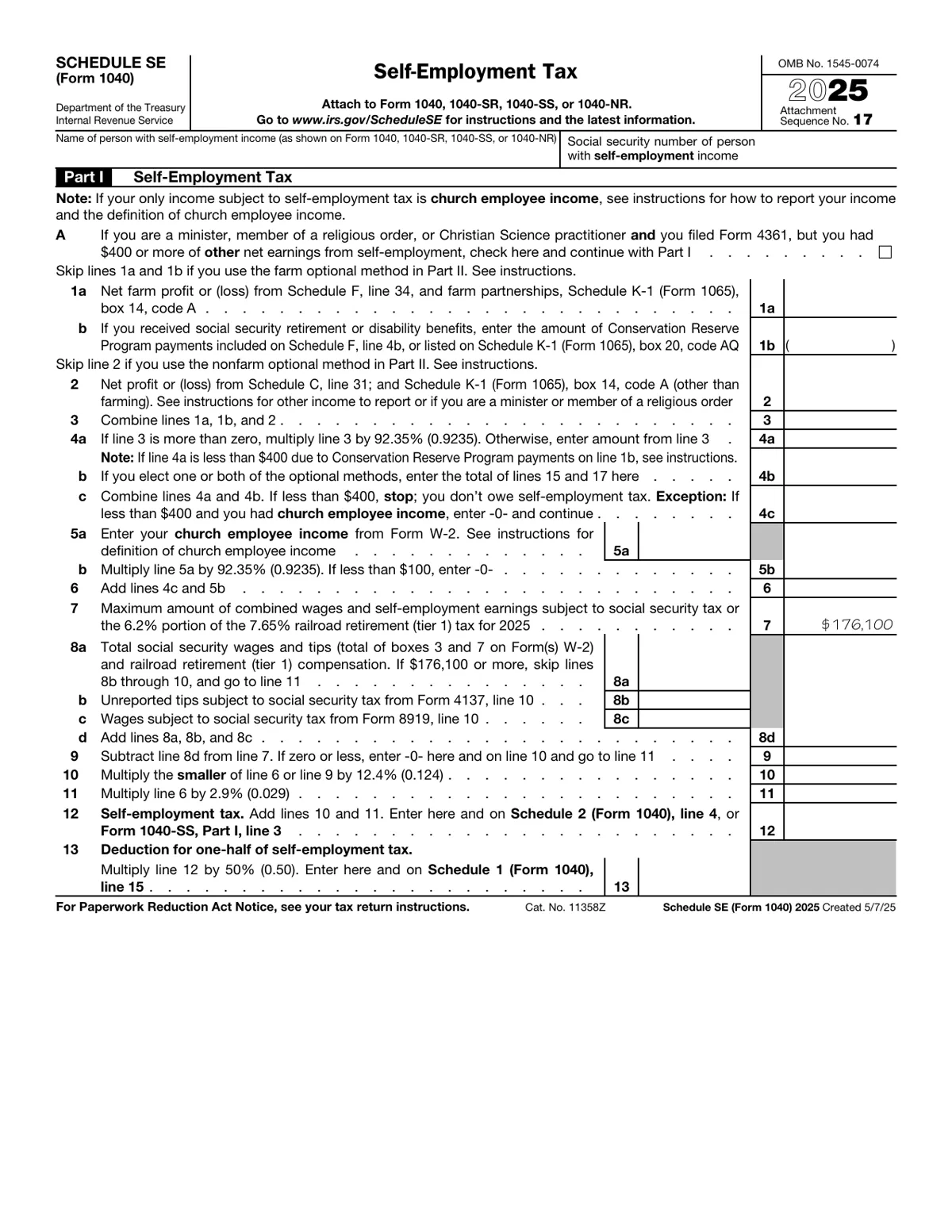
The wage-base cap lowers the rate: at $200,000 of net profit, net earnings are $184,700, the 12.4% portion applies only up to $176,100, and the total is $27,192.70, or 13.60%. The 0.9% Additional Medicare Tax applies above $200,000 single, $250,000 joint, and $125,000 married filing separately. Price both classifications on the tax estimator.
What Schedule E actually shelters
Schedule E reports income or loss from rental real estate, royalties, partnerships, S corporations, estates, trusts, and REMICs. Section 469(c)(1) defines a passive activity as a trade or business without material participation. Section 469(c)(2) then overrides that definition for rentals: except for real estate professionals, the term passive activity includes any rental activity. Section 469(c)(4) applies the rental rule without regard to material participation. A landlord spending 600 hours a year managing a long-term rental still holds a passive activity.
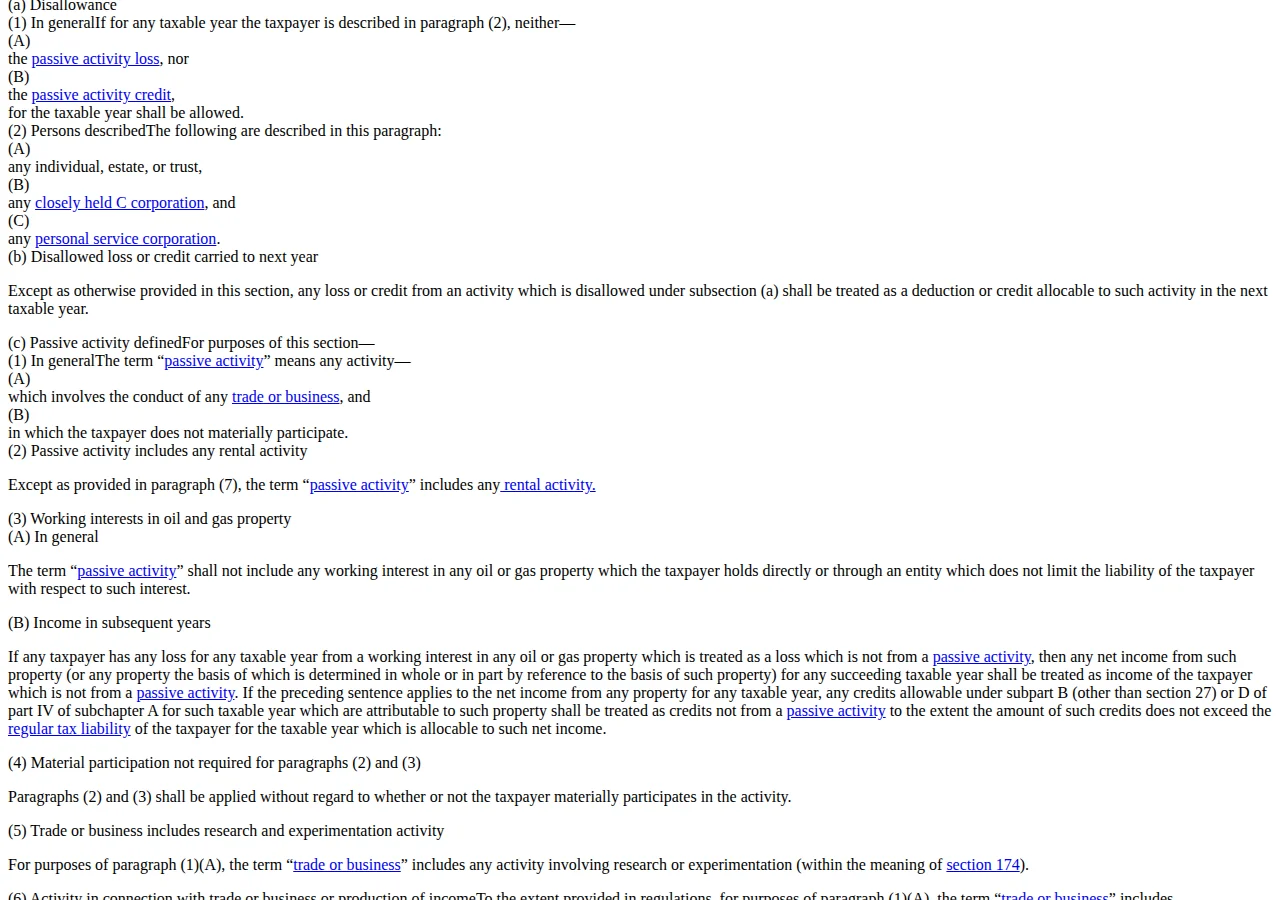
Passive treatment has a price. Section 469(a) disallows passive losses against nonpassive income: a $20,000 rental loss does not reduce wages or Schedule C profit in the year it occurs. It is suspended until the taxpayer has passive income to absorb it or disposes of the entire interest. The one relief valve is the $25,000 offset in § 469(i) for a taxpayer who actively participates in rental real estate. It narrows fast: reduced by 50% of AGI above $100,000, so at $120,000 of AGI the allowance is $15,000, and at $150,000 it is zero. Publication 925 works the same example for 2025: a single taxpayer with $120,000 of salary and a $31,000 rental loss deducts only $15,000 and carries the remaining $16,000 forward to 2026. Publication 925's second example makes the same point at small scale: Stacey, with $42,300 of salary and a $4,000 rental loss, offsets the entire $4,000 because she actively participated. Married filing separately cuts the figures in half.
Topic No. 414 confirms that cash or fair market value received for the use of real estate is rental income. Topic No. 415 adds the dwelling-unit rule: a home you also use personally counts as a residence when personal use exceeds the greater of 14 days or 10% of the days rented at fair rental value.
The five borderline cases that decide the form
| Borderline case | The test | The form it points to | Authority |
|---|---|---|---|
| Short-term rental, average stay 7 days or less | Average period of customer use: total rental days divided by number of rentals | Schedule C, if a § 162 business | Pub. 925 |
| Short-term rental, 30 days or less with significant personal services | Significant services by individuals, judged on frequency, labor, and value relative to the charge | Schedule C, if a § 162 trade or business | Pub. 925 |
| Hotel, boarding house, parking lot | Payments for rooms or space plus substantial services | Schedule C and Schedule SE | Sch. SE |
| Real estate dealer | Property held primarily for sale to customers | Schedule C; the rental exclusion does not apply | 26 U.S.C. § 1402(a) |
| Rental to your own business (self-rental) | Rent paid by a business in which you materially participate | Schedule E, but recharacterized as nonpassive income | Sch. E Instructions; Pub. 925 |
IRS Publication 925 states that an activity is not a rental activity when the average period of customer use is 7 days or less, or 30 days or less with significant personal services. A property rented for 120 nights in stays averaging 3 nights has an average period of customer use of 3 days, so it is not a rental activity at all; if the operation rises to a § 162 trade or business, the income belongs on Schedule C and carries self-employment tax.
Material participation: the seven tests
Material participation makes a trade or business activity nonpassive. For a rental activity, it does not, because § 469(c)(2) and (c)(4) override it. The seven tests in IRS Publication 925 decide whether a non-rental business is passive, and whether a real estate professional's rental is nonpassive.
| Test | What it requires |
|---|---|
| 1. More than 500 hours | You participated for more than 500 hours in the year |
| 2. Substantially all | Yours was substantially all participation |
| 3. More than 100 hours, most of all | More than 100 hours, and at least as much as any other individual |
| 4. Significant participation combined | Significant participation activities combined over 500 hours |
| 5. Five of the last ten years | Material participation in any 5 of the prior 10 years |
| 6. Personal service activity, three years | Personal service activity, material participation in any 3 prior years |
| 7. Facts and circumstances | Regular, continuous, and substantial participation; management alone does not count if someone else managed more |
A spouse's participation counts as yours; investor work does not.
Real estate professional status
Section 469(c)(7) is the only statutory exit from passive rental treatment, and it has two gates. More than one-half of the personal services the taxpayer performs in trades or businesses during the year must be performed in real property trades or businesses in which the taxpayer materially participates, and the taxpayer must perform more than 750 hours of services in those businesses. On a joint return, either spouse may qualify separately; their hours do not combine. Personal services performed as an employee do not count unless the taxpayer is a 5% owner of the employer.
The arithmetic is unforgiving for anyone with a full-time job elsewhere: a taxpayer who works 2,000 hours a year as a salaried engineer must perform more than 1,000 hours of real property services to clear the more-than-one-half test. A qualifying real estate professional reports income and losses from rental real estate activities in which they materially participated as nonpassive, completing line 43 of Schedule E. The losses then offset wages and Schedule C profit that year. The cost is the log: 750 hours, about 15 a week.
QBI: the deduction that follows the trade or business
Section 199A allows a deduction of 20% of qualified business income with respect to a qualified trade or business, and that phrase does the classification work. Schedule C income from a sole proprietorship is qualified business income in the ordinary case; Schedule E rental income qualifies only if the rental is a § 162 trade or business. A triple-net lease with no services, no employees, and no regular activity is investment income, not a trade or business, and it produces no QBI deduction.
Revenue Procedure 2024-40 sets the 2025 thresholds at $197,300, and $394,600 for joint returns, with phase-in ranges to $247,300 and $494,600. Below the threshold the 20% deduction applies in full. The classification question does not change the QBI rate; it changes whether the income qualifies at all. A consultant with $60,000 of Schedule C profit claims a $12,000 QBI deduction and pays $8,477.73 of self-employment tax; a landlord with $60,000 of triple-net rental income pays no self-employment tax and claims none.
The second tax on Schedule E income
Schedule E income escapes self-employment tax but not every tax. Section 1411 imposes a 3.8% tax on the lesser of net investment income or the amount by which modified adjusted gross income exceeds a threshold: $250,000 joint, $125,000 married filing separately, $200,000 for everyone else. Net investment income includes income from a passive activity under § 469 — exactly what a long-term rental is. A single filer with $260,000 of modified AGI and $40,000 of net passive rental income owes 3.8% on the lesser of $40,000 and the $60,000 excess:
The surcharge does not apply to income from a business in which the taxpayer materially participates.
Reclassification cost: what the wrong form costs
A service business that reported $60,000 a year on Schedule E for three years underpaid $25,433.19 in total; a rental wrongly reported on Schedule C overpaid the same amount, recoverable by amending the returns.
The second layer is penalties. Section 6651(a)(2) adds 0.5% of the unpaid tax for each month the failure to pay continues, capped at 25%. Twelve months of nonpayment on one year's $8,477.73 shortfall adds 6%, or $508.66, before interest. Section 6662 adds a 20% accuracy-related penalty on the underpayment: $1,695.55 on the same year's shortfall. Interest accrues on top of both.
Founder & CEO Insight — Enow A. Jovial
Who should not use this playbook
This playbook is for operators deciding between two schedules for income they already earn, not for moving income to chase a lower rate. Relabeling service income as rent without changing the activity is misreporting, and § 6662 prices it at 20% of the underpayment. Partnerships, S corporations, and C corporations do not file Schedule C or Schedule E for their own operating income; partners and shareholders use the entity-level rules and K-1 reporting instead, and an S-Corp election moves a sole proprietorship off Schedule C entirely. Take the borderline table to a CPA for a short-term rental, a dealer inventory, or self-rental. The companion filing playbooks carry the line-by-line mechanics: the Schedule C playbook, the Schedule E playbook, and the Schedule SE playbook.
Execution checklist
- [x] Step 1: Name the activity. Operating a business for profit with continuity and regularity points to Schedule C; payment for the use of property points to Schedule E.
- [x] Step 2: Apply the rental exceptions. Average customer use of 7 days or less, or 30 days or less with significant personal services, ends rental treatment.
- [x] Step 3: Test the dealer rule. Property held for sale to customers is dealer inventory.
- [x] Step 4: Run the Schedule SE math. Multiply net profit by 92.35%, apply 12.4% up to the $176,100 wage base, and apply 2.9% uncapped.
- [x] Step 5: Price the Schedule E side. Apply the § 469 loss rules, the $25,000 allowance phaseout, and the 3.8% tax above § 1411 thresholds.
- [x] Step 6: Test real estate professional status. More than one-half of personal services and more than 750 hours in real property.
- [x] Step 7: Test QBI. Confirm a § 162 trade or business, then apply the 20% deduction.
- [x] Step 8: File the decision, not the preference. Record the statute and test result.