A $25,000 gap in a small business has three doors, and the doors do not charge the same price for the same money. The SBA microloan program lends through nonprofit intermediaries at 8 to 13 percent over as long as seven years. A CDFI term loan from a lender like Accion Opportunity Fund starts near 9.99 percent APR and runs 18 to 36 months. An online term loan from OnDeck averaged 53.2 percent APR on loans originated in the first half of 2026. Same $25,000, same business, three totals: $32,241, $29,036, and $41,117. The cheapest door is not always the right one: the SBA door is slow, the CDFI door is hand-underwritten, and the online door charges daily.
Who this guide is for, and who should stop here
This guide is for an operating, for-profit small business in the United States — whether it is organized as an LLC, an S-Corp, or a C-Corp — that needs $50,000 or less for working capital, inventory, supplies, furniture, fixtures, machinery, or equipment. It is not for a business that needs to refinance existing debt or buy real estate — the SBA microloan program forbids both uses, and no intermediary can waive that rule. It is not for a startup with no operating history that needs money this week: the CDFI door wants 12 to 24 months in business, and the online door wants $100,000 of annual revenue.
Door one: the SBA microloan program
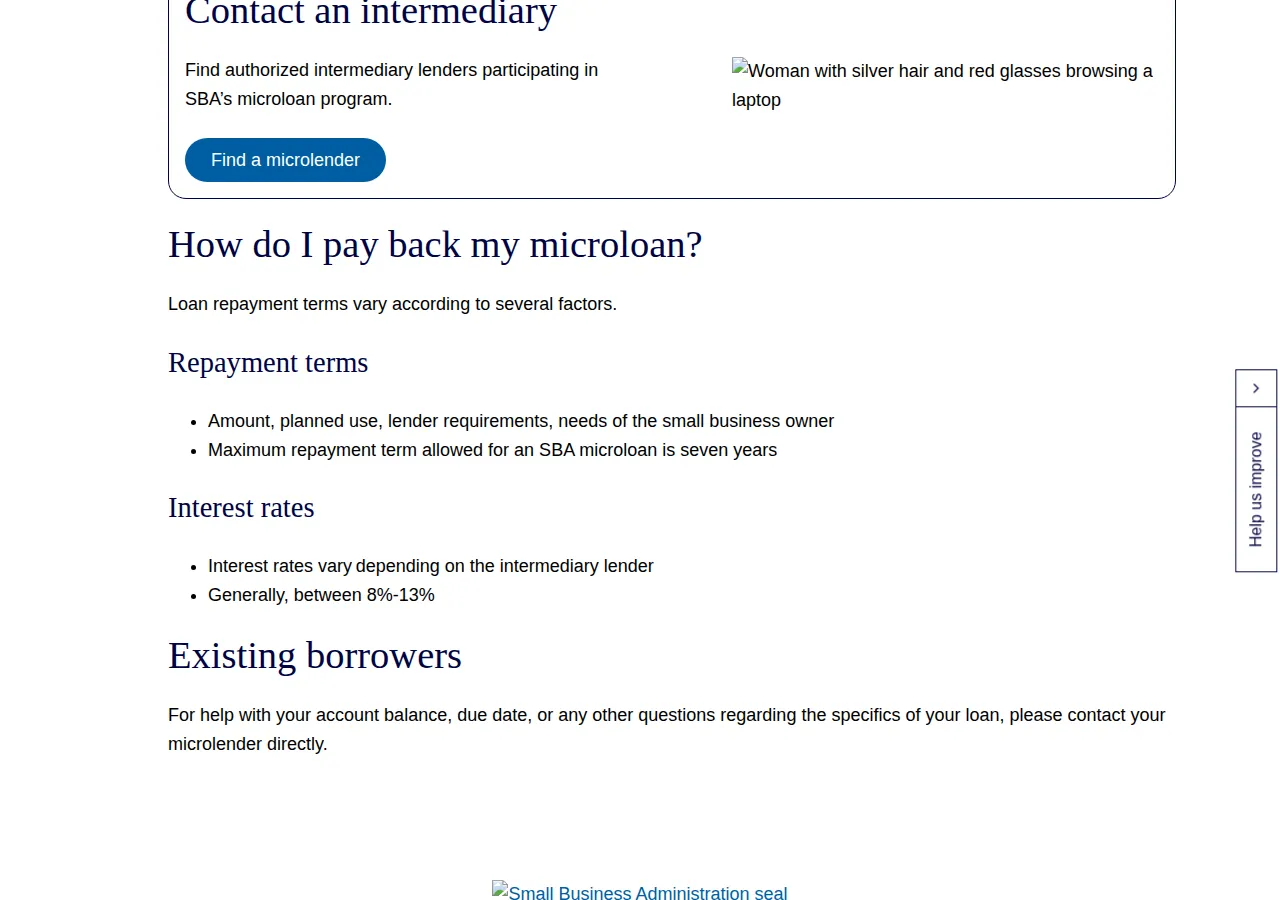
The SBA does not lend microloans directly. It funds specially designated intermediary lenders — nonprofit, community-based organizations with lending and technical-assistance experience — and those intermediaries make every credit decision and set every term. Terms vary by intermediary, and coaching comes attached with the loan.
The program's numbers come from the SBA's own microloan page, read for this guide on November 18, 2026. Loans go up to $50,000. The average microloan is about $13,000. The maximum repayment term is seven years. Interest rates vary by intermediary and generally run between 8 and 13 percent. Certain not-for-profit childcare centers are also eligible. The program rules sit in 13 CFR Part 120, Subpart H, published on eCFR.
The use-of-proceeds rule is the program's sharp edge. Proceeds can be used for working capital, inventory, supplies, furniture, fixtures, machinery, and equipment. Proceeds cannot be used to pay existing debts or to purchase real estate. A borrower who takes a microloan to retire a credit-card balance has misused federal program funds. It is the most common reason a microloan application gets restructured or declined: the owner describes a debt problem, and the program only funds an operating need.
| Program fact | SBA microloan | Authority |
|---|---|---|
| Maximum loan | $50,000 | SBA microloan program page |
| Maximum term | 7 years (84 months) | SBA microloan program page |
| Interest rate | Generally 8%–13%, set by intermediary | SBA microloan program page |
| Lender | Nonprofit intermediary, not the SBA | SBA microloan program page |
Door two: the CDFI term loan
A Community Development Financial Institution is a private financial institution certified by the Treasury Department's CDFI Fund, created by the Riegle Community Development and Regulatory Improvement Act of 1994 to expand economic opportunity for underserved people and communities. The CDFI Fund has awarded more than $8 billion to CDFIs and community development organizations since 1994. The certification tells the borrower what the lender is for: a CDFI exists to lend where conventional banks do not, and it underwrites the business and the owner, not a credit-score cutoff alone.
Accion Opportunity Fund is the largest nonprofit CDFI small-business lender in the country and the worked example in this guide. Its standard term loan runs $5,000 to $250,000, with terms of 18 to 36 months and no prepayment penalty. NerdWallet's 2026 review puts the APR range at 9.99 to 28.95 percent, with a minimum credit score of 620, at least 24 months in business, and at least $300,000 in annual revenue. Other 2026 reviews put the floor lower — a 600 score and 12 months in business — which is itself a useful fact: CDFI underwriting is manual, and two reviewers reading the same lender in the same year get different thresholds because the lender prices the borrower, not a rate card. The origination fee runs 3 to 5.99 percent and is deducted from the proceeds, so a $25,000 approval at a 3 percent fee puts $24,250 in the borrower's account. AOF also lends in most states but not Montana, North Dakota, South Dakota, Tennessee, or Vermont, and files a UCC lien on loans above $50,000.
The CDFI door's real price is time. Funding takes two to four weeks from application, and the application asks for the business's financials, not just a bank connection. The borrower who cannot produce a profit-and-loss statement or a tax return will stall here. The borrower who can will get the cheapest priced money in this guide at the floor rate, plus free one-on-one business coaching in English and Spanish.
Door three: the online term loan
OnDeck is the worked example for the online door: a direct online lender owned by Enova, selling term loans and lines of credit to established small businesses. Its own figures, for loans originated in the half year ending June 30, 2026, put the average APR at 53.2 percent on term loans and 59.8 percent on lines of credit. The estimated APR range NerdWallet reports for the term loan is 35 to 99 percent, including origination fees. The term loan runs $5,000 to $400,000 with terms up to 24 months, an origination fee of 0 to 4 percent, and fixed daily or weekly ACH debits. Minimums are a 625 personal FICO score, 12 months in business, $100,000 in annual revenue, and a business checking account. Funding can arrive the same day for loans up to $250,000 completed before 10:30 a.m. Eastern.
The daily debit is the feature that decides whether this door is usable. A $25,000 loan at the 53.2 percent average over 24 months costs $1,713.22 a month, which the lender collects as roughly $57 a day, every business day, before the owner has sold anything. The prepayment clause adds a second trap: without the 100 percent prepayment benefit option, early payoff still leaves 75 percent of the remaining unpaid interest owed, so the borrower cannot escape the cost by repaying early. A personal guarantee and a lien are required, and OnDeck is not an SBA lender.
The same $25,000 through all three doors
Every figure below uses the same amortizing-loan formula, with the monthly rate equal to the annual rate divided by 12:
where $M$ is the monthly payment, $P$ is the principal, $r$ is the monthly rate, and $n$ is the number of monthly payments. Total paid is $M \times n$; total interest is total paid minus principal.
| Door | Principal | Rate | Term | Monthly payment | Total paid | Total interest |
|---|---|---|---|---|---|---|
| SBA microloan (midpoint 10.5%) | $25,000 | 10.5% | 60 months | $537.35 | $32,240.85 | $7,240.85 |
| CDFI term loan, AOF floor 9.99% | $25,000 | 9.99% | 36 months | $806.56 | $29,036.24 | $4,036.24 |
| Online term loan, OnDeck average 53.2% | $25,000 | 53.2% | 24 months | $1,713.22 | $41,117.27 | $16,117.27 |
Three facts fall out of the table. First, the CDFI loan is the cheapest total cost at the floor rate on a short term — $4,036 of interest — but it demands the highest monthly payment, $806.56. Second, the SBA microloan is the cheapest monthly payment, $537.35, on a seven-year term; at the 8 percent floor the payment on the average $13,000 microloan over 84 months is $202.62, and at the 13 percent ceiling it is $236.50. Third, the online loan costs $12,081 more than the CDFI loan and $8,876 more than the SBA loan for the same $25,000.
The origination fee changes the cash in hand, not the payment. At a 3 percent fee, the CDFI borrower receives $24,250 on a $25,000 approval; at OnDeck's 4 percent maximum, $24,000 — with payments computed on the full $25,000. Run the numbers through the business loan calculator before signing anything, and insist the lender state the fee as a dollar amount deducted from proceeds, not as a percentage buried in the agreement.
The fourth door: Kiva, at zero percent
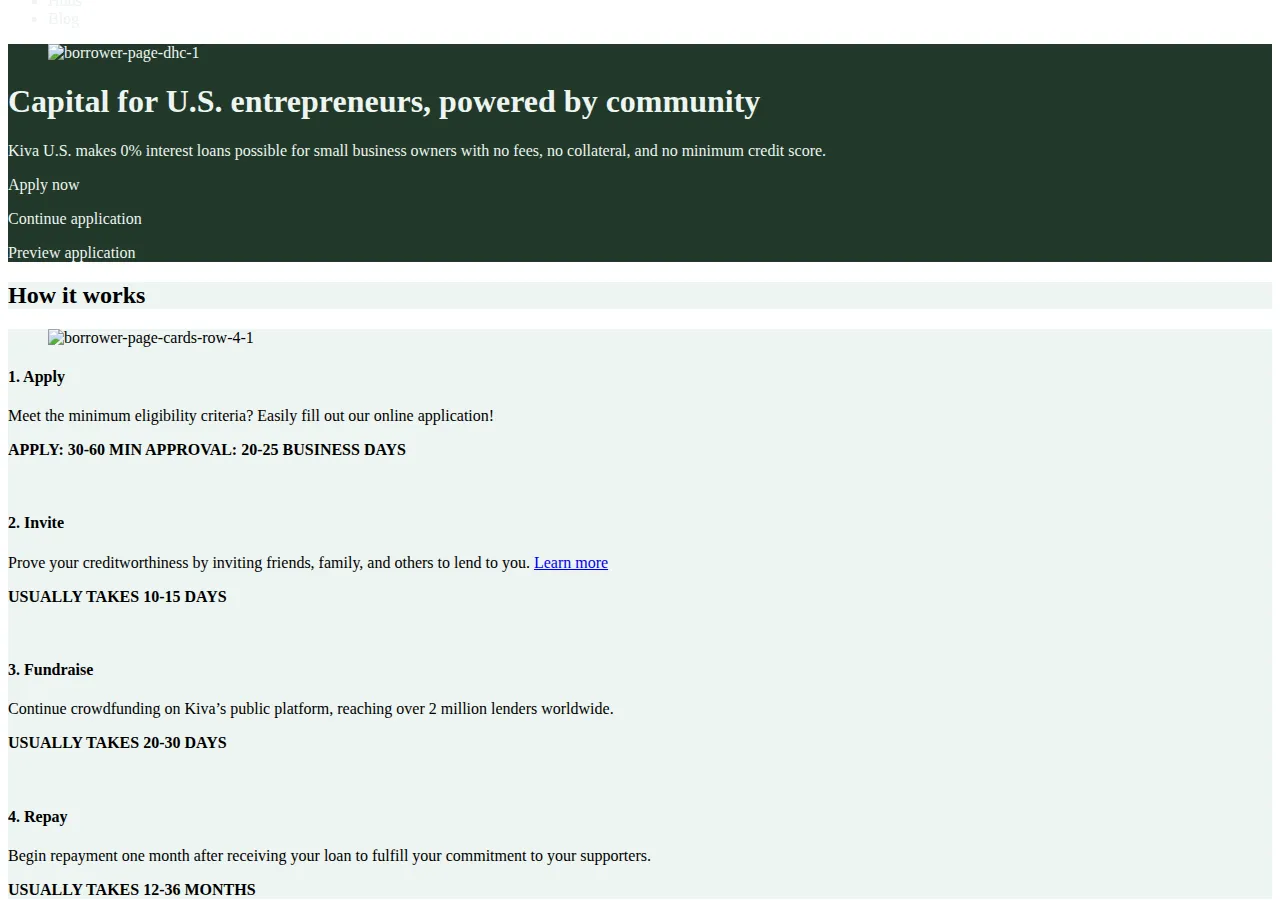
For needs under $15,000, a fourth door beats all three priced doors. Kiva U.S. makes crowdfunded microloans of $1,000 to $15,000 at 0 percent interest, with no borrower fees, no collateral, and no minimum credit score. The borrower applies in 30 to 60 minutes, waits 20 to 25 business days for approval, then invites 5 to 40 people from their own network to lend first — 10 to 15 days of private fundraising — before the loan goes public for 20 to 30 days. Repayment runs 12 to 36 months and starts one month after funding. At $15,000 over 36 months the payment is $416.67, and the total paid is $15,000. The price is effort and time, not interest: 30 to 90 days from application to money, and no lending to businesses registered or primarily operating in Nevada or North Dakota.
The decision table
| Borrower situation | Door | Why | Authority |
|---|---|---|---|
| Needs $15,000 or less, can wait 30–90 days | Kiva | 0% interest, no fees, $416.67/mo on $15,000 over 36 months | Kiva U.S. borrower page |
| Needs $25,000, can wait 2–4 weeks, 24 months in business | CDFI term loan (AOF) | Cheapest total cost, $4,036 interest at the 9.99% floor | NerdWallet AOF review 2026 |
| Needs $25,000, thin monthly cash flow, can wait weeks | SBA microloan | Lowest payment, $537.35/mo at 10.5% over 60 months | SBA microloan program page |
| Needs money today, $100,000+ revenue, 625+ FICO | Online term loan (OnDeck) | Same-day funding; average 53.2% APR, $1,713.22/mo | OnDeck published averages |
The crossover is a calendar, not a rate: the online door is open today, the CDFI door in two to four weeks, the SBA door in weeks, the Kiva door in 30 to 90 days. Apply to the slow doors first and the fast door last.
Founder & CEO Insight — Enow A. Jovial
The application sequence
Each door's clock starts at application, not at approval. Apply in this order, and do not sign anything until all three answers are in hand.
- [x] Step 1: Size the need exactly. Write the use down in one sentence with a dollar figure, and strike any portion that repays debt or buys real estate. If the need is $15,000 or less, start the Kiva application first; its 30-to-90-day clock is the longest.
- [x] Step 2: Find the intermediary. Use the SBA's intermediary search to find an SBA-approved microloan intermediary in the borrower's area, ask for the current rate and the maximum term offered, and have the business EIN ready before submitting anything.
- [x] Step 3: Apply to the CDFI. Submit the Accion Opportunity Fund application with 12 to 24 months of financials, sign the IRS Form 4506-C consent if the lender asks for it so it can pull tax transcripts directly from the IRS, and ask in writing for the APR and the origination fee as a dollar amount.
- [x] Step 4: Price the online door last. Get the OnDeck quote only after the slow doors are in motion, and demand the full repayment amount, the ACH debit schedule, the payment frequency, and the prepayment clause in writing.
- [x] Step 5: Compare on total paid, not on the monthly payment. A low payment over a long term can cost more in total interest than a higher payment over a short term — the CDFI loan proves it, at $4,036 of interest against the SBA loan's $7,241.
- [x] Step 6: Verify the use of proceeds before signing. Confirm in the loan agreement that the stated use is permitted, and that no dollar is allocated to existing debt or real estate, and have a CPA review the agreement before signing.
For the larger SBA programs, the SBA 7(a) vs SBA 504 loan playbook prices term loans above the microloan cap, and the business line of credit vs term loan vs invoice factoring playbook runs the same total-cost comparison on the credit products next to these loans. The borrower who can wait should wait, whether the business is an LLC or a sole proprietorship; the borrower who cannot should know, to the dollar, what waiting would have saved.