The asset decides the program, not the lender
A founder walks into a bank with two needs: 500,000 dollars for cash flow and a 1,000,000 dollar building. The 7(a) program lends against the business and its cash flow; the 504 program lends against a fixed asset and the jobs it creates.
> [!KEY TAKEAWAY]
> Match the money to the asset. Working capital, inventory, payroll gaps, and debt refinancing belong to 7(a). A building, land, or equipment with a useful life of ten years or more belongs to 504. Rates, fees, maturities, and the job test all follow from that one split.
Two programs, two machines
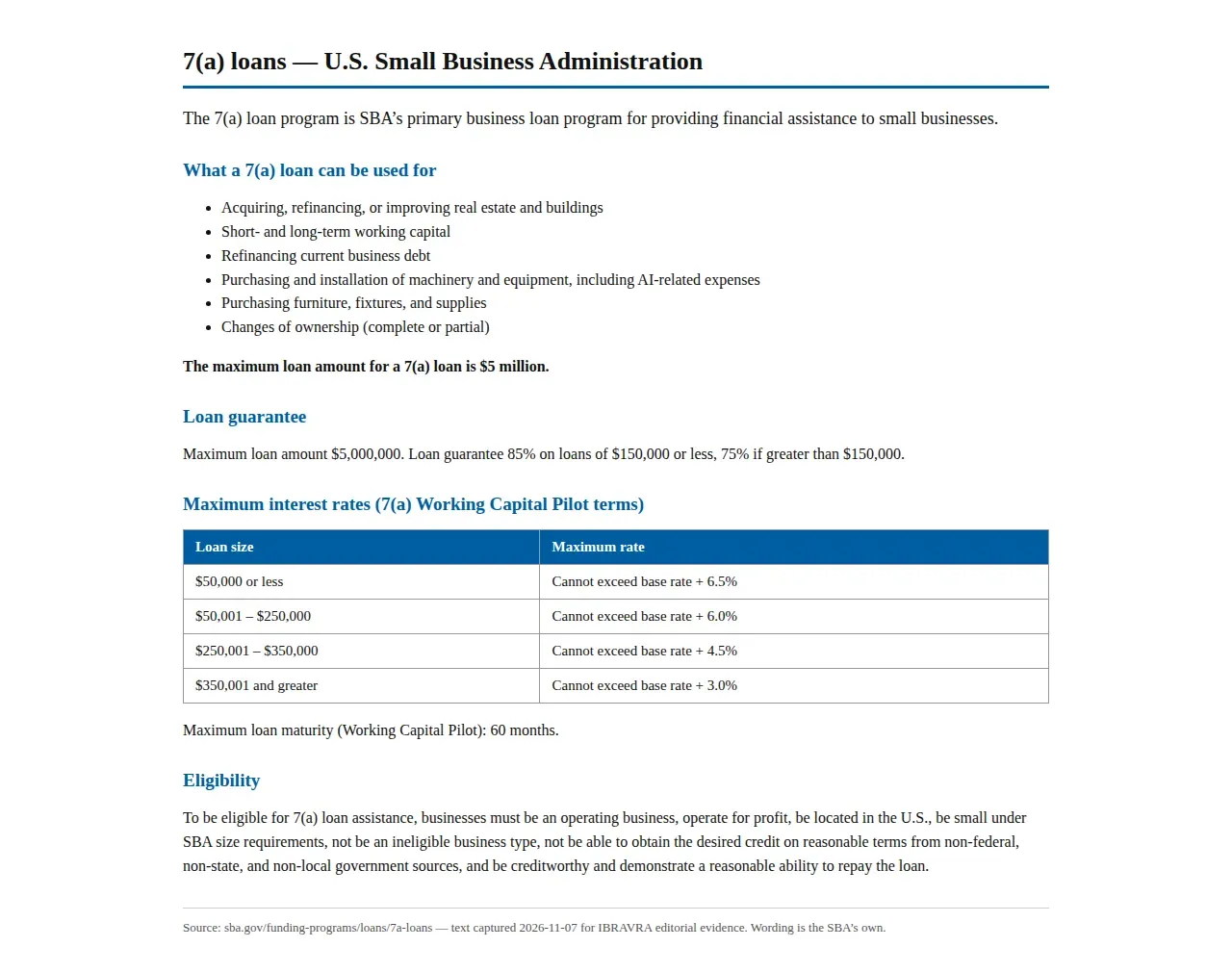
The 7(a) program is the SBA's primary business loan program: a guarantee that lets lenders finance small businesses. The maximum loan is 5,000,000 dollars; the guarantee is 85 percent up to 150,000 dollars and 75 percent above, under 15 U.S.C. section 636. The credit-elsewhere test applies.
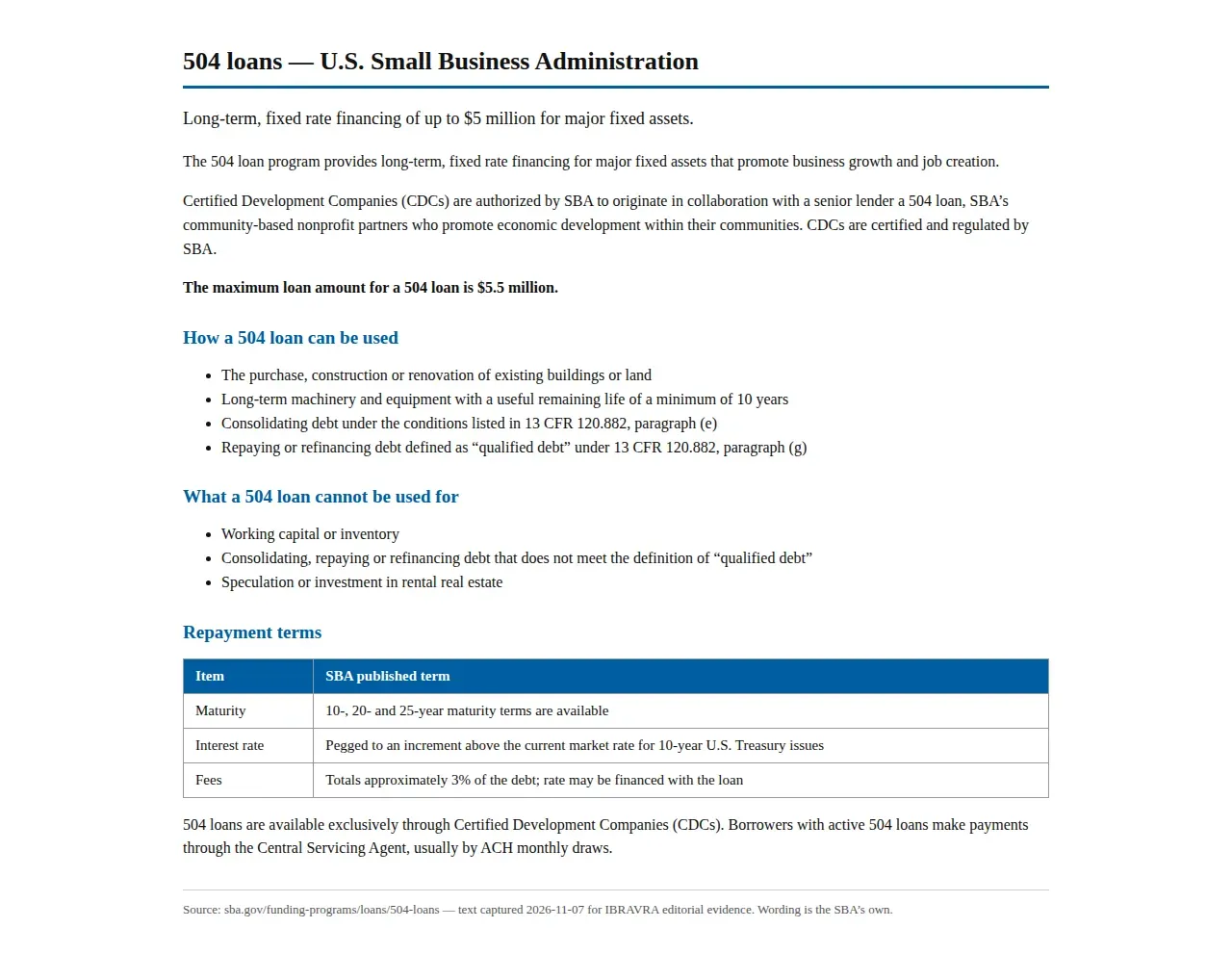
The 504 program finances major fixed assets through Certified Development Companies (CDCs), up to 5,500,000 dollars. The structure is fixed: the senior lender funds about 50 percent and takes a first lien, the CDC funds up to 40 percent through an SBA-guaranteed debenture and takes a second lien, the borrower contributes at least 10 percent.
| Feature | SBA 7(a) | SBA 504 | Authority |
| :--- | :--- | :--- | :--- |
| Structure | One loan, one lender, SBA guarantee | Bank 50%, CDC 40%, borrower 10% | SBA pages; 13 CFR 120.910 |
| Maximum loan | 5,000,000 dollars | 5,500,000 dollars | SBA pages |
| SBA guarantee | 85% to 150,000 dollars; 75% above | 100% of the CDC debenture | 15 U.S.C. § 636 |
| Rate basis | Prime plus a capped spread | Monthly debenture sale | 13 CFR 120.214; 120.932 |
| Maturity | 10 years, or 25 for real estate | 10, 20, or 25 years | 13 CFR 120.212 |
| Job test | None | One job per 95,000 dollars | FR notice SBA-2025-0135 |
Both require an operating, for-profit U.S. business. The alternative size test, in 13 CFR 121.301, is tangible net worth of not more than 20,000,000 dollars and average net income after federal income taxes of not more than 6,500,000 dollars for two fiscal years, including affiliates.
!SBA 7(a) terms: 5,000,000 dollar maximum, 85 and 75 percent guarantees, rate caps by loan size
Use of proceeds: where each program is allowed to spend
The 7(a) list is broad: real estate, working capital, debt refinancing, equipment, ownership changes.
The 504 list is narrow: buildings or land, equipment with a useful life of at least ten years, refinancing of qualified debt (13 CFR 120.882). It cannot fund working capital, inventory, non-qualified debt, rental real estate.
| Use | 7(a) | 504 | Authority |
| :--- | :--- | :--- | :--- |
| Working capital / inventory | Yes | No — prohibited | SBA pages |
| Owner-occupied real estate | Yes | Yes — the core use | SBA pages |
| Equipment, life 10+ years | Yes | Yes | SBA 504 page |
| Equipment, short life | Yes | No — 10-year minimum | SBA 504 page |
| Refinance business debt | Yes | Only qualified debt | 13 CFR 120.882 |
The business line of credit versus term loan versus invoice factoring playbook prices the short-term instruments for the cash-flow half.
Rates and fees: what each program actually charges
A 7(a) loan is usually variable: prime or the SBA peg rate (13 CFR 120.214), plus a capped spread: 6.5 percent over base up to 50,000 dollars, 6.0 percent to 250,000 dollars, 4.5 percent to 350,000 dollars, and 3.0 percent above. Prime has stood at 7.00 percent since September 17, 2026, so the maximum on a 500,000 dollar 7(a) loan is 10.00 percent.
The 504 rate is fixed at the monthly debenture sale (13 CFR 120.932). The effective rate — debenture rate plus CDC, SBA, and central servicing fees — printed at 6.58 percent on the 20-year and 6.57 percent on the 25-year at the November 2026 sale, per NADCO. The bank's 50 percent portion is priced separately at typically 7 to 9 percent.
On a 7(a) loan the lender pays the SBA a guaranty fee, capped at 2 percent of the guaranteed portion to 150,000 dollars, 3 percent to 700,000 dollars, and 3.5 percent above, plus 0.25 percent above 1,000,000 dollars (13 CFR 120.220). On a 504 loan the SBA states total fees run approximately 3 percent of the debt.
The math: a 500,000 dollar 7(a) against a 1,000,000 dollar 504 project
Every comparison below uses one formula:
$
\text{Monthly Payment} = P \times \frac{r \times (1 + r)^n}{(1 + r)^n - 1}
$
Worked rates: 7(a) 10.00 percent; 504 CDC 6.58 percent; bank 8.00 percent assumed.
Total cost means loan payments made plus balances still owed plus the borrower's cash injection:
$
\text{Total Cost} = \text{Payments Made} + \text{Balances Still Owed} + \text{Cash Injection}
$
A 500,000 dollar 7(a) loan at 10.00 percent over 10 years costs 6,607.54 dollars a month, repaying 792,904.42 dollars, of which 292,904.42 dollars is interest. The guaranty fee is capped at 11,250 dollars (3 percent of the 375,000 dollar guarantee).
The 504 project splits a 1,000,000 dollar purchase: bank 500,000 dollars, CDC 400,000 dollars, borrower 100,000 dollars cash. The CDC portion at 6.58 percent over 20 years costs 3,001.16 dollars a month, 720,278.81 dollars, of which 320,278.81 dollars is interest. The bank portion at 8.00 percent costs 4,182.20 dollars a month, 1,003,728.08 dollars, of which 503,728.08 dollars is interest. Combined: 7,183.36 dollars a month, 1,724,006.89 dollars over twenty years.
| Measure | 7(a) 1,000,000 dollars, 10.00%, 10 years | 504 1,000,000 dollar project, 20 years | Authority |
| :--- | :--- | :--- | :--- |
| Monthly payment | 13,215.07 dollars | 7,183.36 dollars | Formula |
| Total repaid | 1,585,808.84 dollars | 1,724,006.89 dollars | Formula |
| Total interest | 585,808.84 dollars | 824,006.89 dollars | Formula |
| Total cash out | 1,585,808.84 dollars | 1,824,006.89 dollars including the 100,000 dollar injection | Formula |
The 504 payment is 6,031.71 dollars a month lower. But its total interest is 238,198.05 dollars more than the 7(a) on the same project. The injection offsets the smaller loan, so the gap equals the interest gap. Counted on total cash, the 504 stays cheaper until about month 125, roughly 10.4 years. At month 120 it is still cheaper by 15,739.52 dollars. Sell or refinance before then and the 504 wins; hold to full term and the 7(a) wins by 238,198.05 dollars. Check your own numbers in our business loan calculator.
The job test: the 504 requirement most applicants miss
For 504 loans approved on or after October 1, 2025, a project must create or retain one job per 95,000 dollars guaranteed; one per 150,000 dollars for a small manufacturer or energy-goal project. Those figures are from the SBA Federal Register notice, Docket SBA-2025-0135. In 2024, 77 percent of small businesses reported rising costs, per the Federal Reserve Small Business Credit Survey cited in the notice.
The debenture is 400,000 dollars. Divide by 95,000 dollars: 4.21, rounded up to 5 jobs within two years of project completion. A small manufacturer divides the same debenture by 150,000 dollars, gets 2.67, and needs 3 jobs.
A project that cannot show the jobs at application faces denial of the 504 portion — the count is verified before the debenture funds, not after.
What a real 504 looks like: Phenix Trucks
Phenix Truck Bodies and Van Equipment, a commercial-truck-body manufacturer in Pomona, California, bought its second facility with an SBA 504 loan — a nearly 184,000-square-foot plant on 13 acres at 1301-1345 E. Lexington Avenue. The acquisition totaled 24,400,000 dollars with a 10 percent down payment, through CDC TMC Financing and Enterprise Bank & Trust; owner Rick Albertini chose the 504 a second time because the low injection let him keep capital for equipment, machinery, and staff instead of tying it up in a down payment — conventional commercial mortgages typically require 30 to 40 percent. The project added site and facility improvements and is expected to add 60 to 70 employees, about 50 of them manufacturing jobs, and lift capacity by about 60 to 70 percent. The 504 job test is not abstract: this is what it funds.
Who must not use each program
The 7(a) program is the wrong tool for a borrower who needs more than 5,000,000 dollars, for a business that can borrow on reasonable terms, for passive ventures. It is also wrong for working capital on a twenty-five-year clock (13 CFR 120.212 caps it at 10 years).
The 504 program is the wrong tool for anyone needing working capital, inventory, or a payroll bridge. It is wrong for a business under two years old that cannot fund a 15 percent injection — 20 percent for a new business buying single-purpose property. It is wrong for a project that cannot show the jobs or needs money in weeks.
> [!FOUNDER]
> "Before any SBA conversation I ask what the money buys and how long the buyer keeps it. A building you will occupy for twenty years wants the 504 and its low payment; a gap you will close in eighteen months wants the 7(a) and its speed. Founders who pick by rate alone end up paying for the wrong machine."
> — Enow A. Jovial, Founder & Chief Executive Officer
> [!WARNING]
> Do not dress working capital as a fixed-asset purchase to reach the 504 program. A project that cannot show the asset, the ten-year useful life, and the jobs will be restructured or declined after months of work.
The execution checklist
#### Phase 1: Qualify
#### Phase 2: Price
#### Phase 3: Close
> [!TIP]
> Ask the CDC for the most recent monthly debenture rate before you lock the budget. The November 2026 sale printed 6.58 percent on the 20-year debenture after 6.97 percent in October — a 0.39 point swing on a 400,000 dollar debenture is about 93 dollars a month for twenty years.
Two programs, one decision, and the decision is the asset. The 7(a) buys flexibility; the 504 buys time. Price both and let the crossover, not the payment, make the call.