Same Day ACH: Cutoff Windows, Settlement Timing, and Funds Availability
Same Day ACH moves money within hours instead of overnight. A credit or debit submitted before the right deadline settles the same business day; one minute late, it waits for the next window — or the next business day. The operation is a clock, a dollar limit, and a set of availability deadlines. The rails themselves are compared in the ACH vs FedNow vs wire vs RTP playbook; this article is the operation that runs on them.
The three windows: the only clock that matters
The ACH Network has two operators, the Federal Reserve's FedACH service and The Clearing House's Electronic Payments Network. Nacha writes the rules; the operators publish the schedules. On the FedACH schedule, three same-day windows run every business day, all in Eastern Time:
| Window | File deadline (ET) | Target distribution (ET) | Interbank settlement (ET) | Credit available by |
|---|---|---|---|---|
| First | 10:30 a.m. | 12:00 noon | 1:00 p.m. | 1:30 p.m. local |
| Second | 2:45 p.m. | 4:00 p.m. | 5:00 p.m. | 5:00 p.m. local |
| Third | 4:45 p.m. | 5:30 p.m. | 6:00 p.m. | End of RDFI processing day |
The third window opened March 19, 2021. Nacha reports 1.4 billion Same Day ACH payments worth $3.9 trillion in 2025, up 16.7% in volume on 2024.
These are the operator's deadlines — the moment the originating bank's file must reach FedACH or EPN. They are not your deadline: your bank sets its own customer cutoff earlier, often by 30 to 60 minutes, to allow time for validation and fraud screening. Treat the operator times as the outer boundary and your bank's published cutoff as the real one.
Settlement is not availability
Settlement and availability are two different events. Settlement is the interbank movement: at 1:00, 5:00, or 6:00 p.m. Eastern, the money moves between the sending and receiving banks through the Federal Reserve's National Settlement Service. Availability is when the receiver can withdraw it.
The availability rule, effective September 20, 2019, sits in Article Three, Subsection 3.3.1.2 of the Nacha Operating Rules: first-window credits by 1:30 p.m. in the RDFI's local time, second-window credits by 5:00 p.m., third-window credits by the end of the RDFI's processing day.
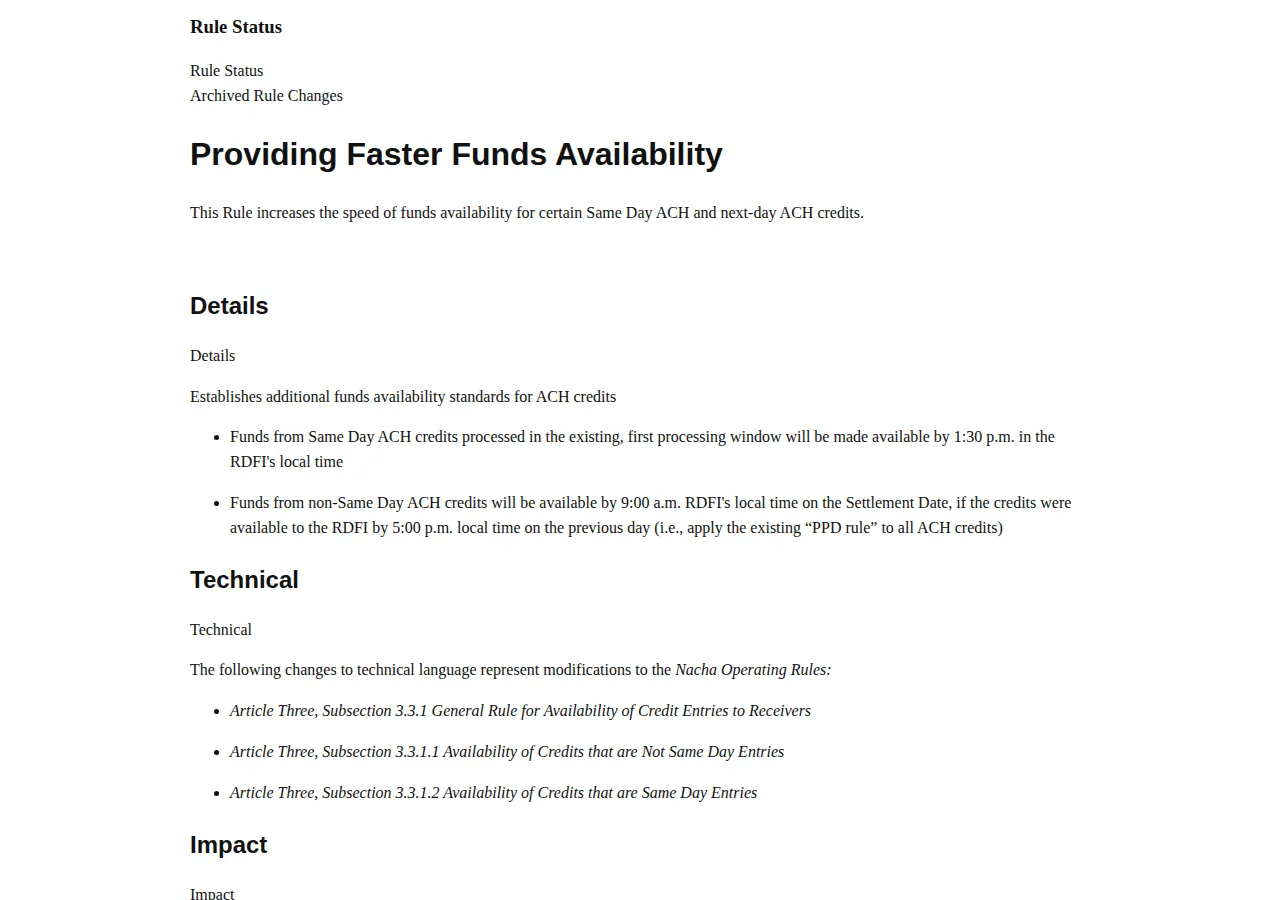 The deadlines bind the RDFI — but the originator chooses the window, and the window chooses the availability time.
Under the same 2019 rule, a non-Same Day ACH credit must be available by 9:00 a.m. local time on the settlement date, if the credit was available to the RDFI by 5:00 p.m. local time on the previous day. A window-one credit is spendable by early afternoon; a standard credit is not spendable until the next morning.
Debits work differently. A Same Day ACH debit settles the same day, so the money leaves the receiver's account the same day — but the originator does not hold final funds until the return windows close, and consumer unauthorized debits can come back up to 60 calendar days after settlement. The codes and reinitiation limits are covered in the ACH return codes R01–R29 and NOC correction playbook.
The $1 million limit — and the $10 million date
Every Same Day ACH payment is capped at $1 million per entry: $25,000 at launch in 2016, $100,000 from March 20, 2020, and $1 million from March 18, 2022. The next step is approved: a rise to $10 million, effective September 17, 2027, after a request for comment drew 117 responses, 87% of which supported raising the limit. Until that date, $1 million is the cap.
The limit applies per entry, to all eligible Standard Entry Class codes, to credits and debits, to consumer and business payments, and in all three windows. Two carve-outs survive: international ACH transactions (IAT entries) remain ineligible for same-day processing, and the separate, lower dollar limits for ARC, BOC, POP, RCK, and XCK entries still apply.
Two behaviors around the limit matter. First, a payment above the limit is not rejected — it settles as a next-day entry instead. A $1.4 million same-day credit is a next-day credit, with no error message to explain why. Second, splitting a single payment into several entries to fit under the cap is prohibited. Three separate $800,000 invoices may each travel as a same-day entry; one $2.4 million invoice cut into three pieces may not.
A $4.7 million cash concentration needs five same-day entries today:
What it costs: the 5.2-cent entry fee
Same Day ACH carries a network fee that standard ACH does not. The originating bank — the ODFI — pays the receiving bank 5.2 cents per forward Same Day ACH transaction, not counting returns or notifications of change. It is a network fee between banks, not a customer price.
Nacha reviewed the fee in March 2026, eight years after the Phase 3 rules took effect, and left it unchanged: 6.109 billion actual payments from April 2018 through March 2026 against 8.933 billion projected. Across the network in 2025, the fee totalled:
That is what originating banks paid receiving banks for same-day entries in 2025, on our arithmetic from Nacha's published volume. The fee is never the reason to avoid Same Day ACH; the return risk on debits is.
Funds availability under Regulation CC: the other half of the clock
Same Day ACH availability is governed by the Nacha rules. Everything else a bank holds — checks, cash, wires — is governed by Regulation CC, 12 CFR Part 229, whose baseline is next-day availability for electronic payments: Section 229.10(b) requires a bank to make funds received by an electronic payment — including an ACH credit and a wire transfer received — available for withdrawal not later than the business day after the banking day the payment is received. Cash deposited in person to an employee gets the same treatment under Section 229.10(a)(1).
Everything else runs on the second-day schedule: Section 229.12(b) requires all other checks to be available by the second business day after the banking day of deposit, and deposits at an ATM the institution does not own get the fifth business day under Section 229.12(f). The first slice of any check deposit is accelerated: the lesser of $275 or the day's total of checks not already entitled to next-day availability must be available the next business day, under Section 229.10(c)(1)(vii). That $275 figure is current as of July 1, 2025, when the Federal Reserve and the Consumer Financial Protection Bureau raised it from $225 under the five-year inflation adjustment in 12 CFR 229.11, published at 89 FR 43737; the next adjustment is due July 1, 2030.
A check deposited on a Friday gives the depositor $275 on Monday and the rest on Tuesday. A Same Day ACH credit submitted by 10:30 a.m. Eastern on that same Friday is available by 1:30 p.m. local time — the same day, hours earlier, in full.
| Item | Availability | Authority |
|---|---|---|
| SDA credit, window 1 | 1:30 p.m. local, same day | Nacha Rules §3.3.1.2 |
| SDA credit, window 2 | 5:00 p.m. local, same day | Nacha Rules §3.3.1.2 |
| SDA credit, window 3 | End of RDFI processing day | Nacha Rules §3.3.1.2 |
| Standard ACH credit | 9:00 a.m. local, settlement date | Nacha Rules §3.3.1.1 |
| Electronic payment | Next business day | 12 CFR 229.10(b) |
| First $275 of a check deposit | Next business day | 12 CFR 229.10(c)(1)(vii) |
| Remainder of a check deposit | Second business day | 12 CFR 229.12(b) |
| Non-proprietary ATM deposit | Fifth business day | 12 CFR 229.12(f) |
Section 229.13 allows longer holds for new accounts, large deposits over $6,725 in one banking day, redeposited checks, repeatedly overdrawn accounts, reasonable cause to doubt collectibility, and emergency conditions. None of these exceptions applies to a Same Day ACH credit, which follows the Nacha availability deadlines instead.
The federal corner: 31 CFR Part 210
Title 31 CFR Part 210 governs federal participation in ACH, incorporates the Nacha Operating Rules by reference in Section 210.3(b), and makes each Federal Reserve Bank the Treasury's fiscal agent under Section 210.7. The overlay bites hardest after a beneficiary dies: under Sections 210.9 through 210.11, an agency that learns of a recipient's death or incapacity must start a reclamation within 120 calendar days, and may not reclaim any payment made more than six years before the notice. The receiving bank is liable for benefit payments received after the death or incapacity, and proper use of return codes R14 or R15 counts as notice of the death.
The cost of missing a window
A missed cutoff is not a delay of minutes; it is a delay of a business day. Scenario: a $250,000 payroll funding debit misses the third window on a Friday afternoon and settles Monday instead. The money is three calendar days late, and at a 5.00% annual cost of funds the float cost is:
One hundred and three dollars is not the damage. The damage is the payroll that lands Monday instead of Friday and the vendor's late fee. Run the same arithmetic on your own largest recurring payment, put the result next to your bank's cutoff, and run the margin impact through our Business Profit Margin Calculator.
Decide before you send
| Situation | Use Same Day ACH? | Authority |
|---|---|---|
| Payroll funding debit, due today | Yes — window 1 or 2 | Nacha SDA schedules |
| Vendor invoice under $1M, due today | Yes — any window that fits your bank cutoff | Nacha $1M limit, eff. Mar 18, 2022 |
| Single payment over $1M due today | No — use a wire; splitting is prohibited | Nacha limit rule; no-split prohibition |
| International payment (IAT) | No — IAT entries are ineligible | Nacha eligibility; Phase 3 rule |
| Consumer debit you cannot afford to see returned | No — returns run 60 days | Nacha return windows |
| Cash concentration between your own accounts | Yes — debits and credits both eligible | Nacha $10M rule page |
| Payment after 4:45 p.m. ET on a Friday | No — next business day | FedACH schedule |
Who should not use Same Day ACH
Same Day ACH is the wrong tool in four situations. First, any payment over $1 million that must settle today belongs on a wire. Second, any international payment belongs on a wire or a correspondent channel, because IAT entries cannot use same-day settlement. Third, any debit whose return would hurt more than the delay — a first payment from a new customer, a debit against an account with no history — belongs on standard ACH, because the 60-day unauthorized return window outlives the same-day speed by weeks. Fourth, any business without the discipline to hit a clock: Same Day ACH charges same-day prices for next-day settlement.
This article is for whoever owns an originator's ACH operation: the payments manager, the controller, the operations lead, or the developer building the submission queue. The reconciliation work that follows any same-day settlement is covered in the automated bank reconciliation playbook, and the reserve and holdback mechanics that follow a risk event are covered in the merchant account reserve and holdback playbook. For the cost math, run the numbers through the cost of goods sold calculation playbook before you commit to a same-day price.
Founder & CEO Insight — Enow A. Jovial
Run the same-day desk: execution checklist
- Get your bank's cutoffs in writing. Operator deadlines, customer cutoffs, holiday calendar.
- Set internal deadlines 30 minutes ahead of the bank's cutoff.
- Convert every deadline to the sender's time zone. Print Eastern deadlines in Pacific hours.
- Check the dollar limit before you build the file. Any entry over $1 million settles next day; splitting one obligation to fit is prohibited.
- Confirm eligibility before you submit. No IAT entries; ARC, BOC, POP, RCK, and XCK keep their lower limits.
- Tell the receiver the availability time, not the settlement time.
- Reconcile the same day. Match settled entries to the ledger, and hold same-day debits out of the collected-cash forecast until the return window closes.
- Refresh the numbers every July. Regulation CC amounts move every five years — $275 today, next change July 1, 2030 — and the Same Day ACH limit rises to $10 million on September 17, 2027.
The decision in advance
Same Day ACH is not a faster version of ACH. It is a different operation: three clocks a day, a dollar limit per entry, availability measured in hours, and a fee of 5.2 cents. Treat the cutoff as a promise, the limit as a wall, and the availability time as the only time the receiver cares about.