Merchant-Account Rolling Reserves and Holdbacks: The Release Playbook
A subscription business processes $100,000 a month. The acquirer imposes a 10% rolling reserve held 180 days. Sales keep coming, and the bank balance is $60,000 lighter than the revenue line says. That $60,000 is not a fee, not a fine, and not lost. It is held, and the hold has a schedule, a release trigger, and a negotiation path — worked here with the arithmetic shown.
What a reserve is, and what it is not
Stripe defines a reserve as a temporary hold on a portion of a business's funds for a set period, covering potential losses such as disputes and refunds; funds release once the term ends, minus amounts used for disputes or refunds. PayPal defines an account reserve the same way: money held against payment reversals like chargebacks and claims.
Three facts decide the treatment. First, the money is held against future losses, not taken as a cost; a reserve that releases in full cost nothing except the use of the money. Second, refunds and disputes draw from the reserve before touching the operating balance. Third, a reserve does not stop the business taking payments: Stripe states reserves do not affect the ability to accept payments. The constraint is liquidity, not revenue.
The four ways your money gets held
Acquirers hold funds in four shapes.
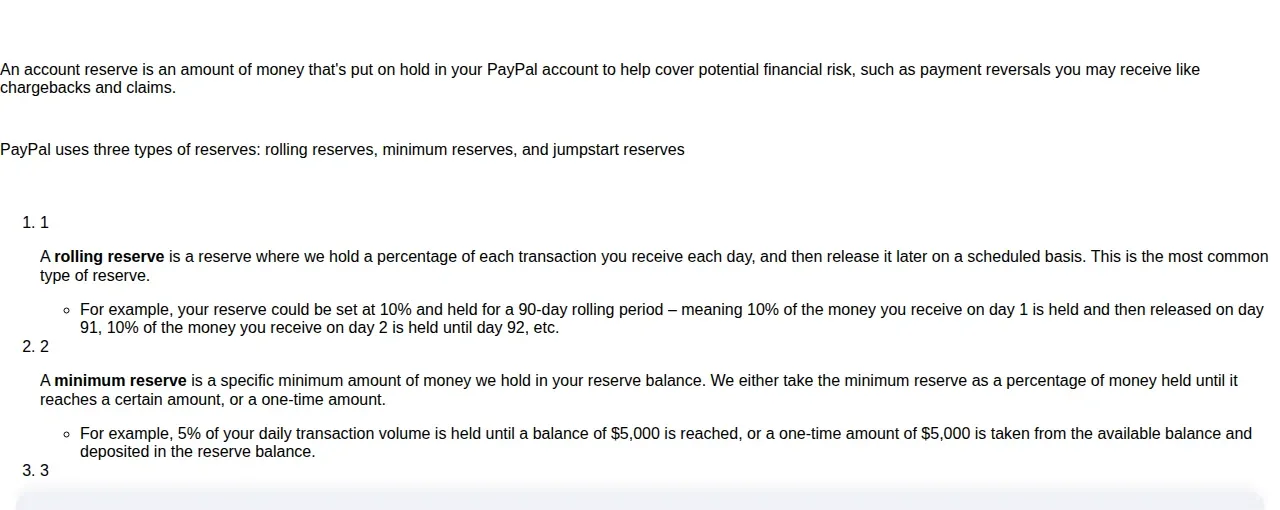 A rolling reserve withholds a percentage of each transaction, releasing each day's slice on its own date. A fixed reserve withholds a percentage until one release date. A minimum reserve is a fixed floor, built from sales or deposited at once. A jumpstart reserve moves a lump sum out of the available balance on day one.
| Hold type | What is withheld | When it releases | Authority |
|---|---|---|---|
| Rolling reserve | Percentage of each transaction, usually 5%–15% | Each day's slice on its own date (day 91 for a 90-day hold) | Stripe, "What is a rolling reserve?"; PayPal, "Account Reserves" |
| Fixed reserve | Percentage of each new transaction | All of it on one specified release date | Stripe Support, "Reserves" |
| Minimum reserve | Fixed floor (e.g. $5,000), built from sales or deposited at once | Stays in place; reviewed every 180 days | PayPal, "Account Reserves" |
| Jumpstart reserve | Lump sum from available balance (e.g. $10,000) | Per the agreement | PayPal, "Account Reserves" |
| Payment hold | One specific payment | Generally up to 21 days | PayPal User Agreement |
Stripe's table makes the choice concrete: a fixed reserve holds a set amount regardless of volume, while a rolling reserve fluctuates with sales. Fixed reserves suit new businesses with limited history; rolling reserves suit higher-risk businesses and those with a history of chargebacks. The types can stack: PayPal may combine reserve types on one account, and Stripe notes a reserve may include a transfer of part of the existing balance.
Worked math 1: the steady-state held balance
Take the opening business: $100,000 monthly volume, 10% reserve, 180-day hold. The monthly hold is $10,000 and six monthly holds are outstanding at once after ramp-up.
In general, the same arithmetic scales to any volume, rate, and hold period.
In month one, only $10,000 is held; by month six, $60,000. From month seven, each month's $10,000 release matches the new hold, and the $60,000 never comes home while the reserve runs. Stripe's illustration uses the same mechanics at small scale: a $100 sale with a 10% reserve held 90 days has $10 withheld, returned after 90 days if no chargebacks occur.
Worked math 2: the reserve is taken on net, not gross
The base changes the answer: Stripe's examples show it is the net remainder after fees. In the Stripe Support example, a 25% reserve on a 30-day rolling window takes a $100 sale netting $80 after fees — $20 held, $60 available in two business days, the $20 released on day 31.
At $100,000 a month, keeping Stripe's fee ratio, gross becomes net $80,000, the reserve holds $20,000 a month, and $60,000 is available. Modelling 25% of gross would give $25,000 held and $55,000 available — wrong by $5,000 a month in both directions. Read the agreement for the base before modelling anything, and run the monthly cost through the Business Profit Margin Calculator before deciding whether the reserve or the pricing is the problem.
Worked math 3: what the hold costs, and the growth trap
Held money has a price even when it comes back in full: the cost of the capital that replaces it — a credit line covering payroll while $60,000 sits in reserve, or the return on the inventory and advertising it would otherwise have funded. At an 8% annual cost of capital, a $60,000 steady-state hold costs:
That $4,800 is the true annual cost of a 10% 180-day reserve on $100,000 a month, assuming every dollar comes back. It never appears as a fee on the statement, which is why operators miss it. The cost scales with rate and period, not disputes: a 360-day hold doubles the balance to $120,000 and the cost to $9,600, even with zero chargebacks.
Growth makes it worse before it makes it better. If volume doubles to $200,000 a month, the steady-state hold doubles to $120,000, funded out of the growth itself. A minimum reserve fills differently: PayPal's example holds 5% of daily volume until a $5,000 balance is reached. At $100,000 a month, daily volume is about $3,333, so 5% is about $167 a day and the floor fills in about 30 days.
Reserve, holdback, security deposit, payment hold: the terms, settled
Four words, four different holds — confusing them is how merchants agree to the wrong one. A holdback is the generic word for the withheld percentage itself: the 10% that never reaches the payout. A reserve is the mechanism that holds it, with a schedule and a release rule. A security deposit, which Stripe calls an up-front reserve, is a lump sum posted before processing starts: Stripe's example is a business expecting $100,000 a month posting $10,000. A payment hold freezes one transaction while the processor checks it; PayPal says risk-based holds generally last up to 21 days. A reserve runs for its term; a hold runs for its investigation. The representment fight that follows a dispute is a separate operation: see the chargeback defence and representment playbook.
Why the acquirer imposes it
The acquirer holds funds because it carries the loss when a merchant cannot: when a customer disputes a charge and the merchant's balance cannot cover it, the processor pays the card network anyway. The reserve is the collateral for that exposure. PayPal weighs processing history, the industry's chargeback likelihood, the number of claims and disputes, business and personal credit history, preselling, and delivery time frames. Stripe weighs the same shape of risk — industry conditions, payment activity, dispute rate, refund rate, financial stability — and names the longer-hold industries: travel, adult entertainment, gambling, telemarketing, subscriptions, and dispute-prone goods such as electronics, luxury goods, and online courses.
The hold period follows the dispute window: card-network chargeback time frames typically run 45 to 120 days, so low-risk sectors see 30 to 90 day reserves and higher-risk sectors see 180 days or more. A reserve shorter than the dispute window leaves the acquirer exposed; a reserve longer than it is the merchant's money doing nothing. That is the whole negotiation in one sentence: the strongest lever is a shorter dispute window, not a louder complaint. For the underwriting decision that usually precedes a reserve, see the high-risk merchant account guide.
Release triggers: the five ways money comes back
Money leaves a reserve on a trigger, never on a request alone:
- Scheduled release. Under a rolling reserve, each day's slice releases on its own date — day 1 money on day 91 for a 90-day hold. Under a fixed reserve, everything releases on the specified date.
- Dispute or refund draw. Refunds and disputed funds are taken first from the reserved amounts for that transaction, so a refund or dispute equal to or larger than a hold releases it early.
- Periodic review. PayPal reviews reserves within every 180 days and may adjust or remove them as the business improves; Stripe reviews a few days before term end and may remove, lower, or raise the reserve.
- Term end. At the end of the term, the remaining balance releases to the available balance, minus anything used for disputes or refunds.
- Account closure. The processor holds the reserve until the dispute window closes, then releases what remains; Stripe's Connect reserves API will not hold funds longer than 180 days.
The dispute-ratio program that often triggers a reserve has its own thresholds: see the Visa VAMP dispute-ratio defence playbook.
Negotiation levers that actually move the number
Reserves are underwriting terms, and underwriting moves on evidence. The levers, in order:
- Cut the dispute rate first. Every lever below is weaker while disputes rise: tighten fulfilment, ship with tracking, answer refund requests before they become disputes.
- Bring the complaint rate under 1%. PayPal's guidance: keep buyer complaints below 1% of sales with prompt shipping, valid tracking, and fast refunds.
- Shorten the delivery window. Extended delivery is a named reserve factor at PayPal: a 30-day window justifies a longer hold than a 3-day one, so prove the shorter window with tracking data.
- Ask for a cap. A capped reserve holds the same percentage but stops at a dollar ceiling — Stripe's example is 10% with a $5,000 cap — turning an open-ended hold into a known number.
- Ask for a step-down in writing: 10% for 90 days, then 5% for 90 days, then removal, conditional on the dispute rate staying under an agreed threshold.
- Offer a smaller hold for longer, or a larger hold for shorter. Stripe's Connect documentation works the trade openly: for 70% coverage on a 30-day refund window, hold 30% for 30 days, 20% for 45 days, or 40% for 10 days. Pick the shape that fits the cash plan.
- Bring financials to the review. PayPal reviews within every 180 days: arrive with six months of statements and the dispute and refund rates, and ask in writing for a reduction or removal.
Founder & CEO Insight — Enow A. Jovial
Who this is for, and who should walk away
This playbook is for the operator who already processes card volume and has just received a reserve notice, or who is choosing between acquirers and wants the hold priced before signing. It fits a formed business with an EIN and a trading entity — an LLC, a C-Corp, or an S-Corp — whose CPA can carry the held balance under GAAP as restricted cash rather than as an expense. It fits a SaaS business billing subscriptions through an API, a B2B seller taking card payments against invoices, and merchants paying suppliers by ACH while card receipts lag. It is not for a business that has not started processing: nothing to hold yet, and no evidence behind the negotiation. And it is not for an operator who needs every dollar of this month's sales to fund this month's orders — a rolling reserve strands working capital first and releases it last, so that business should negotiate a capped reserve or a different acquirer before the first sale, not after the first hold.
Run the operation
- Read the reserve notice line by line: percentage, base, hold type, hold period, release date, balance-transfer clause.
- Model the steady-state hold at current and forecast volume.
- Price the hold at your cost of capital; enter the annual figure in the cash forecast.
- Separate the holds: reserve, payment hold, and security deposit each release on a different trigger.
- Fix the drivers: dispute rate, refund speed, delivery window, and complaint rate below 1%.
- File the review request at the 180-day mark with six months of statements and dispute and refund rates attached.
The release checklist
- [x] Reserve notice read: percentage, base, type, period, release date, transfer clause
- [x] Steady-state hold modelled at current and forecast volume
- [x] Annual hold cost priced and entered in the forecast
- [x] Reserve, payment hold, deposit separated by release trigger
- [x] Dispute rate, refund speed, delivery window, complaint rate under 1% tracked monthly
- [x] Review date calendared, evidence file ready two weeks early
The decision in advance
A reserve is priced risk, and priced risk can be repriced. Model the hold before signing, read the base, calendar the review, arrive with the file that proves the risk has fallen.