The SaaS Rule of 40 Playbook: Growth vs. Profit, Burn Multiple, and the NRR Input That Moves the Score
A founder with $6 million in annual recurring revenue has two plans. Plan A spends $2.4 million on sales and marketing to grow 70% and ends the year burning cash. Plan B holds spend flat, grows 25%, and ends the year cash-flow positive. The argument is usually fought with adjectives instead of arithmetic. The Rule of 40 replaces it with a number.
The rule in one paragraph, and where it came from
The rule reached a wide audience in February 2015, when venture investor Brad Feld wrote about a heuristic he had heard from a late-stage investor at a board meeting: a healthy software company's growth rate plus its profit should add up to 40%. Fred Wilson, who sat in the same meeting, wrote it down the same month as a plain equation: annual revenue growth rate plus operating margin should equal 40%.
Wilson's ladder: growing 100% a year, a company can lose money at 60% of revenue and still satisfy the rule; growing 40%, it should break even; growing 20%, it needs 20% margins; not growing at all, it needs 40%; shrinking 10%, it needs 50%.
One detail still matters: Feld measured growth on monthly recurring revenue, year over year — a revenue growth rate, not bookings or billings — and the rule was framed for companies with at least $50 million in revenue. It was built for businesses with scale.
Which margin goes in the formula
Two candidates circulate for the margin leg: EBITDA margin, the most common and comparable choice across stages, and free cash flow margin, the strictest test and the one late-stage investors prefer. Bessemer Venture Partners, the firm most associated with popularising the rule, defines the profitability leg as either, and says EBITDA is the more common choice. Use one measure consistently and state which one you used every time you quote the score.
Gross margin must never go in. It stops at the cost of delivering the software — hosting, support, infrastructure — and ignores sales, marketing, research, and administration. Swap it in for EBITDA margin and a typical SaaS score jumps 20 to 30 points, because the cost of acquiring and building the product has been deleted.
Under ASC 606, the revenue standard issued by the Financial Accounting Standards Board as Accounting Standards Update 2014-09, a company recognises revenue to depict the transfer of promised goods or services to customers, in the amount of consideration it expects to receive — applying its five-step model: identify the contract and its performance obligations, determine and allocate the transaction price, and recognise revenue when or as each obligation is satisfied. A multi-year contract paid up front does not become growth in the month the cash arrives; it becomes recognised revenue month by month as the service is delivered. Measure the growth leg on recognised revenue, not on bookings or cash collected. The deferred revenue SaaS balance sheet recognition playbook works through the balance-sheet mechanics, and the ASC 606 revenue recognition SaaS contracts guide covers the five-step model contract by contract.
Two worked examples, with the arithmetic exposed
The two companies below are illustrative worked examples with stated inputs. Neither is real.
Company A — fast growth, controlled burn. Beginning ARR $4.0 million, ending ARR $6.4 million. Revenue for the year $6.4 million. EBITDA negative $0.8 million.
Company A passes with room to spare: 60% growth buys a lot of burn.
Company B — moderate growth, real profit. Beginning ARR $20.0 million, ending ARR $23.0 million. Revenue $23.0 million. EBITDA $4.14 million.
Company B is profitable and growing, and it still fails. At 15% growth it needs a 25% margin — another 7 points, or $1.61 million of additional EBITDA on $23 million of revenue. That is the number the board should argue about: the specific $1.61 million, and whether it comes from price, retention, or cutting spend that is not producing growth. The flat-line case is the trap the rule was built to catch: at zero growth a company needs 40% margins, so a profitable business at 30% margins that has stopped growing fails.
What the market actually scores
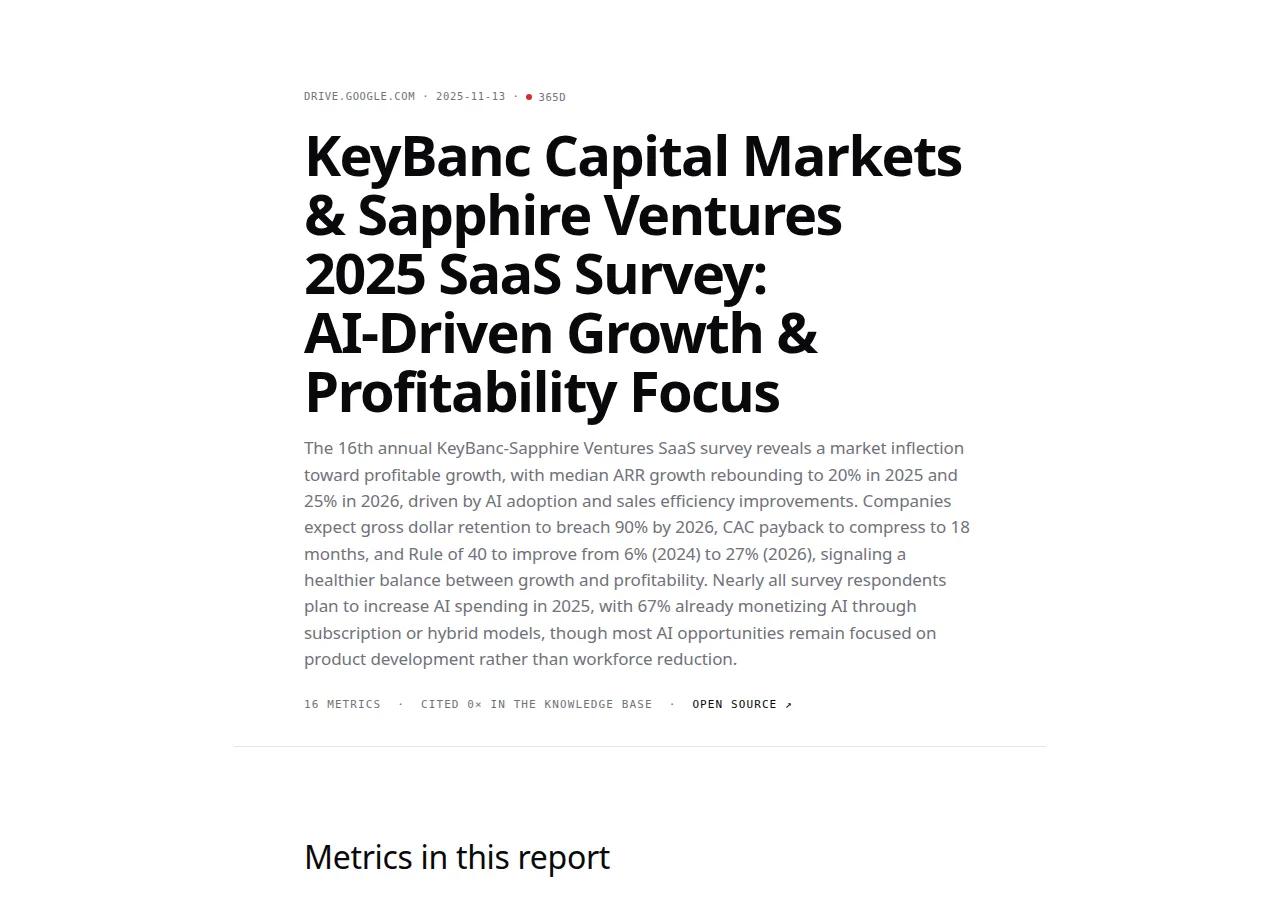
The 16th annual KeyBanc Capital Markets and Sapphire Ventures SaaS survey, published in 2025, puts the median private SaaS company's Rule of 40 score at 6% for 2024, expected to reach 13% in 2025 and 27% in 2026. The medians explain why: ARR growth of 15% in 2024 against an EBITDA margin of negative 12%.
| KeyBanc–Sapphire 2025 SaaS Survey median | 2024 | 2025 expected | 2026 expected |
|---|---|---|---|
| ARR growth | 15% | 20% | 25% |
| EBITDA margin | -12% | -4% | 1% |
| Rule of 40 score | 6% | 13% | 27% |
| Net dollar retention | 101% | 102% | 104% |
Bessemer reports the average BVP Cloud Index company scored about 31% on the Rule of 40 as of late 2023, and only the top decile of public cloud companies averaged about 48%. McKinsey's 2021 analysis of more than 200 software companies from 2011 to 2021, as summarised in published benchmark reviews, found companies cleared the bar only about 16% of the time.
Burn multiple: the companion metric for companies too young for the rule
Below roughly $5 million in ARR, the Rule of 40 is the wrong first question: the margin leg is dominated by deliberate investment, not operating performance. Bessemer's guidance says so — for early-stage companies, focus on burn multiples and the path to free cash flow positivity. The burn multiple answers the question the Rule of 40 cannot answer at that stage: how much cash did each dollar of new recurring revenue cost?
Bessemer describes a burn multiple of about 1x to 1.5x as attractive for an early-stage business. Burning $3.0 million in a year and adding $2.0 million of net new ARR scores 1.5x — $1.50 of cash per dollar of new ARR. Burning $4.5 million and adding $1.5 million scores 3.0x — $3.00 per dollar, twice as much, for slower growth. The second company is not "investing in growth". It is buying revenue at a price the first company would refuse.
Run both numbers every quarter. A company growing 150% with a burn multiple of 3.0x can outgrow its inefficiency for a while; the same multiple at 20% growth is a countdown to a down round.
Bessemer's Rule of X: growth is worth more than margin
In February 2024, Bessemer's Byron Deeter and Sam Bondy challenged the rule they had helped popularise. Their argument is arithmetic: a margin increase has a linear impact on value, while a growth rate increase compounds. Backtesting the BVP Cloud Index, they found a 1% increase in growth had about 2.3 times the valuation impact of a 1% increase in free cash flow margin, with the weighting settling at 2x to 3x over the long term.
A business growing 30% with a 15% free cash flow margin scores 45% under the Rule of 40 — and 75% under the Rule of X with a 2x multiplier (30% × 2 + 15%). A business growing 15% with a 30% margin scores the same 45% under the Rule of 40, but only 60% under the Rule of X (15% × 2 + 30%). Same Rule of 40, different Rule of X — and, Bessemer argues, different value. The correlation supports the weighting: the Rule of 40 explained about 50% of the variation in forward revenue multiples (R² 0.50), the Rule of X about 62% (R² 0.62).
Use the Rule of X when the company is late-stage or public and approaching free cash flow positivity, where the equal weighting of the Rule of 40 does its damage. Bessemer is explicit that it is less relevant for early-stage companies growing above 125% and burning above 75%, and warns it is a guide more than a rule. Snowflake is the extreme case they cite: it burned more than $1 billion before turning free cash flow profitable in fiscal 2022, and closed its first day public at about a $70 billion market capitalisation. Burn with compounding growth behind it is an investment; burn without it is a cost.
The decision: spend into growth or harvest margin
The score is a diagnostic; the decision is what to do with it. Price is the lever founders reach for last and should reach for first: a price or packaging change lifts margin without touching the growth engine, which is why the SaaS pricing tiers packaging playbook belongs in this conversation before any headcount decision.
| Situation | Score shape | The move | Authority |
|---|---|---|---|
| Growth above 60%, burn multiple under 1.5x | High growth, negative margin, pass | Spend into growth; protect the engine | Bessemer, "The Rule of X" (2024) |
| Growth 30–60%, score 30–39 | Near pass, both legs short | Price and packaging first, then targeted spend | KeyBanc–Sapphire 2025 survey medians |
| Growth under 20%, margin under 10% | Low growth, thin margin, fail | Cut spend that is not producing growth; fix retention before buying growth | Feld / Wilson, "The 40% Rule" (2015) |
| Declining revenue, any margin | Negative growth | No margin target saves this; fix the product or the market | Rule of 40 ladder (Feld, 2015) |
The most expensive mistake in this table is the third row: a slow-growing company buying growth with acquisition spend while retention leaks. Every dollar of new ARR bought above a 2x burn multiple while existing customers churn is a dollar spent filling a bucket with a hole in it. Fix retention first. The SaaS unit economics CAC payback LTV NRR formulas guide carries the full derivation of that math, which this article deliberately does not repeat.
Who the rule misleads
The rule is a heuristic for a specific kind of company; outside that shape it misleads.
Pre-revenue and pre-scale companies. Below about $1 million in monthly recurring revenue, the margin leg measures how much the founders chose to invest, not operating health. A seed-stage company scoring negative 80% is not failing; it is spending.
Acquired growth and concentration. Growth bought through acquisition is not the same as organic growth, and the rule does not distinguish them. A company growing 80% on one customer worth half its revenue has a growth leg that can reverse in a single quarter. Quote organic growth alongside the headline number.
Net revenue retention: one input, not the whole answer
Net revenue retention enters this decision in one place: it is the part of the growth leg that costs no new acquisition spend. A company with net dollar retention above 100% — the KeyBanc–Sapphire median was 101% for 2024, expected to reach 104% by 2026 — grows its existing base every year before sales closes a new logo. That growth feeds the score at the lowest possible cost.
That is the full extent of retention's role here. The definitions, formulas, and worked derivation of net revenue retention, customer acquisition cost payback, and lifetime value belong to the SaaS unit economics CAC payback LTV NRR formulas guide; repeating them would duplicate that guide. Before spending on the next growth lever, check the arithmetic with the break-even calculator.
Founder & CEO Insight — Enow A. Jovial
Execution checklist: the quarterly Rule of 40 review
- [x] Pull recognised revenue, not bookings: close the quarter under ASC 606.
- [x] Fix one margin definition: EBITDA or free cash flow margin.
- [x] Compute the burn multiple alongside it: net burn divided by net new ARR.
- [x] Write the decision down: spend, harvest, or fix retention.
Run the review in order:
- Score the quarter: growth plus margin on recognised revenue, one margin.
- Price the trade: the burn multiple prices each point of growth.
- Set the trigger: write the decision down before the quarter starts.
The decision in advance
The Rule of 40 forces one question: is this company buying growth at a price the growth is worth? At 60% growth with a 12.5% negative margin, yes. At 15% growth with an 18% margin, not yet — the company needs 7 more points, worth $1.61 million on $23 million of revenue, and must say where they come from. Run the number honestly, on recognised revenue, with one margin, over four rolling quarters — then decide, in writing, the next quarter's move.