A SaaS Master Services Agreement is the one document that governs a relationship for years, and almost nobody reads it until something breaks. The sales call covers price, seats, and features. The MSA covers what happens when the service goes down for a day, when the vendor is breached, when the price doubles on renewal, and when the customer wants out. It is signed once and forgotten — until the outage, the breach, or the renewal invoice arrives, when the terms are already fixed. This playbook reads the clauses that move money, from the agreements vendors really sign: Salesforce's Main Services Agreement, Stripe's Services Agreement, the AWS EC2 SLA, and the Atlassian SLA.
The anatomy: eight clauses, one hierarchy
A SaaS MSA is built from the same eight clauses in nearly every vendor's paper. Knowing the map lets you read any vendor's version in twenty minutes instead of two days.
| Clause | What it decides | Where it lives in the agreements read |
|---|---|---|
| Scope and order forms | What you bought; each order form is a separate purchase under the MSA | Salesforce MSA preamble; Stripe SSA § 1 |
| Fees and payment | Price, invoicing, taxes, late payment, prepaid fees on termination | Salesforce MSA § 11.4; Stripe SSA § 4 |
| Service level (SLA) | The uptime commitment and the credits for missing it | AWS EC2 SLA; Atlassian SLA |
| Liability cap | The maximum either party can ever recover | Salesforce MSA § 10.1; Stripe SSA § 8 |
| Indemnification | Who defends whom against third-party IP claims | Salesforce MSA § 9; Stripe SSA § 7 |
| IP and data | Who owns what, and what happens to your data on exit | Salesforce MSA §§ 6–7 |
| Term and termination | Renewal, termination for cause and convenience, refunds | Salesforce MSA § 11; Stripe SSA § 10.1 |
| Order of precedence | Which document wins | Salesforce MSA § 12.3 |
The hierarchy matters more than any single clause. The MSA governs; the order form states the commercial terms for one purchase; the SLA and any data-processing addendum sit alongside them; and your purchase order, in Salesforce's words, is void as a source of terms. "Net 60, no auto-renewal" on a purchase order changes nothing. The same words on the order form change the deal.
The liability cap: the number that bounds every dispute
Salesforce's MSA § 10.1 is the industry-standard formulation: in no event shall the aggregate liability of each party, together with all of its affiliates, arising out of or related to the agreement exceed the total amount paid by the customer and its affiliates for the services giving rise to the liability in the twelve months preceding the first incident out of which the liability arose. The cap applies whether the action is in contract or tort, even if a limited remedy fails of its essential purpose. Section 10.2 excludes consequential damages entirely: no liability for lost profits, revenues, goodwill, or indirect, special, incidental, consequential, cover, business-interruption, or punitive damages, even if a party was advised of the possibility.
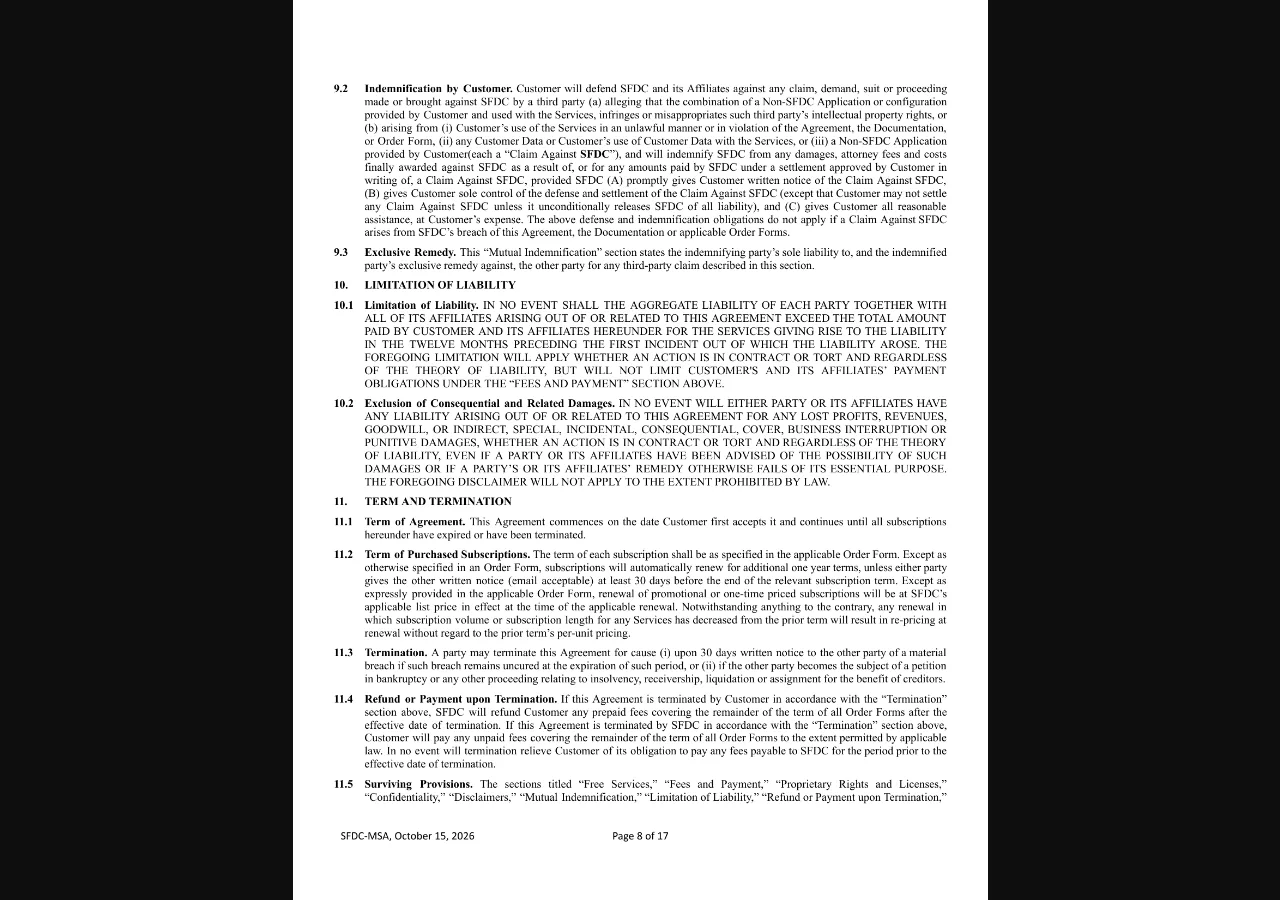
The cap is a multiplication, so work it before you sign:
Example 1 — a mid-market CRM. $15,000 a month for Sales Cloud across 50 seats. Twelve months of fees is $180,000. That is the cap. If an outage corrupts a quarter of pipeline data and the business loses $900,000 of deals, the recoverable amount is $180,000 before the consequential-damages exclusion — and the $900,000 of lost deals is consequential damage, excluded by § 10.2 in any case. The real exposure is the gap between the cap and the loss, and that gap is the customer's to carry, insure, or mitigate with backups.
Example 2 — a small Stripe account. Stripe's Services Agreement caps Preview Services liability at the lesser of the total fees paid in the 12 months before the first event and USD $1,000. A business paying $400 a month in Stripe fees has a $1,000 cap on preview-service losses — not $4,800. Where a vendor writes "lesser of," the cap is the smaller number, and for a small account the smaller number is the fixed dollar figure, not the fee total.
Three things to check in every cap clause: the look-back period (12 months is standard; a 6-month look-back halves the cap); whether the cap is per-incident or aggregate (Salesforce's is aggregate — all incidents share one cap); and the carve-outs. Salesforce's MSA has an "Unlimited Liability" section carving certain liabilities out of the cap, and § 10.1 does not limit the customer's payment obligations. Ask in writing which liabilities are carved out — IP indemnity, data-breach costs, and wilful misconduct are the usual candidates.
The SLA: uptime percentages are downtime budgets
An SLA commitment is a downtime budget stated as a percentage:
A 30-day month has 43,200 minutes. Atlassian Premium commits to 99.9% monthly uptime — 43.2 minutes of allowed downtime a month. Enterprise commits to 99.95% — 21.6 minutes. AWS EC2's region-level commitment is 99.99% — 4.32 minutes. A vendor that promises "99.9% uptime" is promising up to 43 minutes of outage a month, every month, without owing you anything. The percentage sounds like perfection; the minutes are the truth.
The remedy for missing the commitment is a service credit — a percentage of the monthly fee for the affected service:
| Vendor | Commitment | Credit ladder (monthly fee for the affected service) |
|---|---|---|
| Atlassian Premium | 99.9% | 10% at 99.0–99.9%; 25% at 95.0–99.0%; 50% below 95.0% |
| Atlassian Enterprise | 99.95% | 5% at 99.9–99.95%; 10% at 99.0–99.9%; 25% at 95.0–99.0%; 50% below 95.0% |
| AWS EC2 (region) | 99.99% | 10% at 99.0–99.99%; 30% at 95.0–99.0%; 100% below 95.0% |
| AWS EC2 (single instance) | 99.5% | Separate instance-level ladder |
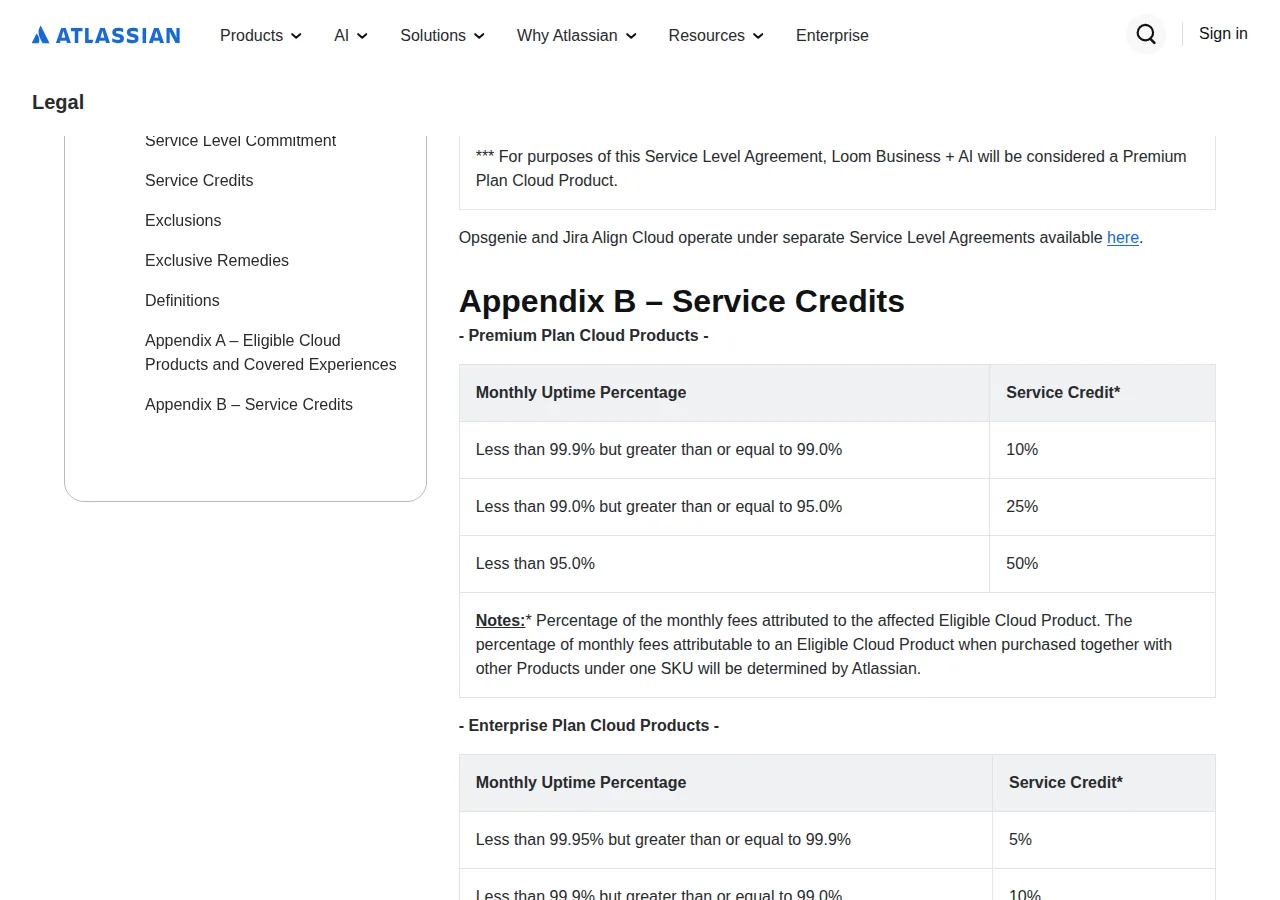
Work the credit on a real number. A team pays $10,000 a month for Atlassian Premium and suffers a month at 98.5% uptime — roughly 11 hours down — so the credit band is 25%:
ext{Service Credit} = $10{,}000 imes 25% = $2{,}500
Two hard limits apply. First, the credit is the exclusive remedy for missed uptime in most MSAs: the customer cannot also claim the outage as a breach entitling it to damages. Second, the credit must be claimed — Atlassian requires a ticket with all fields completed within 15 days after the end of the calendar month. Miss the window and the credit is gone, however bad the month was. The fix is a calendar entry: on the first of every month, check last month's uptime against the commitment and file the claim inside the window. Price the downtime itself through the ROI calculator — a $2,500 credit against an 11-hour outage is a refund, not compensation.
Term, renewal, and the exit
Salesforce's MSA § 11.2 is the auto-renewal clause every buyer should memorise: subscriptions automatically renew for additional one-year terms unless either party gives written notice (email acceptable) at least 30 days before the end of the term, at the vendor's applicable list price in effect at renewal — except that a renewal in which volume decreased is re-priced at the prior term's per-unit price. If you do nothing, you renew for a year at whatever the list price is then, and the only price protection is the one negotiated into the order form. The defence is a date: put the non-renewal notice deadline in the calendar at signing, 45 days before the term ends, with the vendor's notice address attached.
Termination has two doors. Termination for cause — Salesforce § 11.3 — is available where the other party is in material breach and the breach remains uncured 30 days after written notice (or immediately for insolvency events). Stripe's Services Agreement § 10.1 gives the customer termination for cause immediately on notice where Stripe materially breaches and does not cure within 10 days. Termination for convenience is rarer and usually one-sided: Stripe lets the customer terminate at any time by closing its Stripe account via the dashboard. Salesforce's paid subscriptions have no general termination-for-convenience right — the term is the term, and the exit is the non-renewal notice. On termination, Salesforce § 11.4 refunds prepaid fees covering the remainder of the term where the customer terminates for cause. The refund is pro-rata on the remainder, not a return of the whole term — a customer that prepays annually and terminates for cause in month 4 recovers roughly two-thirds of the annual fee, not the full amount.
Indemnity, IP, and data: who owns what when it ends
Salesforce's MSA § 9 is mutual indemnification: Salesforce defends the customer against third-party claims that a purchased service infringes or misappropriates intellectual property, and the customer defends Salesforce against claims arising from its data, its use of the services in violation of the agreement, or its non-Salesforce applications. The indemnity is conditioned on prompt notice, sole control of the defence by the indemnifying party, and reasonable assistance — and § 9.3 makes it the indemnified party's sole liability and exclusive remedy for the claims it describes. Indemnity is not insurance: it covers IP infringement claims, not the customer's own losses, and it is capped by the liability cap unless carved out.
Data ownership and return are where SaaS MSAs diverge most from the on-premise contracts founders remember. The customer owns its data; the vendor owns the service, the platform, and the vendor's IP; and the right to export data before termination — Salesforce states it expressly for free services, where the customer is solely responsible for exporting its data before termination of access — must be exercised before access ends, not after. Write the exit checklist at signing: export format, export deadline, data-deletion certification, and the transition-assistance clause, if any — an MSA without a transition clause has no obligation to help you leave.
Choosing the CRM the MSA will govern is a separate decision, made on price and capability before the contract is signed: our HubSpot vs Salesforce vs Pipedrive CRM pricing and automation comparison runs the per-seat ladders at 5, 25, and 100 seats. The signature workflow matters too — our DocuSign vs HelloSign vs PandaDoc e-signature pricing comparison prices the tools that execute the agreement. Security exhibits are the fourth document in the stack: our ISO 27001 vs SOC 2 Type 2 procurement guide explains which certification answers the MSA's security schedule.
Founder & CEO Insight — Enow A. Jovial
The signing sequence
- Price the cap: multiply 12 months of fees and write the number on the order form — that is the maximum recovery, and the gap to your real exposure is your insurance decision.
- Convert the SLA to minutes: 99.9% is 43.2 minutes a month; 99.99% is 4.32 — and the credit ladder (10/25/50 at Atlassian, 10/30/100 at AWS) is the only remedy.
- Calendar the claim window: file SLA credit claims within 15 days after month-end (Atlassian) or the credit is gone.
- Calendar the renewal notice: 30 days before term end (Salesforce) — set the reminder 45 days out, with the notice address and the price lock attached.
- Check the precedence ladder: order form beats MSA on commercial terms; purchase-order terms are void — never rely on a PO to change the deal.
- Write the exit at signing: data export format and deadline, deletion certification, and transition assistance — before access ends, not after.
Operator checklist
- [x] Cap priced at 12 months of fees, written on the order form.
- [x] SLA converted to minutes and the credit ladder noted.
- [x] Claim window calendared (15 days after month-end).
- [x] Renewal notice calendared 45 days before term end.
- [x] Precedence ladder checked — order form over MSA, PO terms void.
- [x] Exit written at signing — export, deletion, transition.
An MSA is signed once and lived with for years. Vendors write it to bound their liability, guarantee their renewal, and limit their remedy to a credit. A buyer who reads the four numbers before signing negotiates from the same document the vendor is reading.