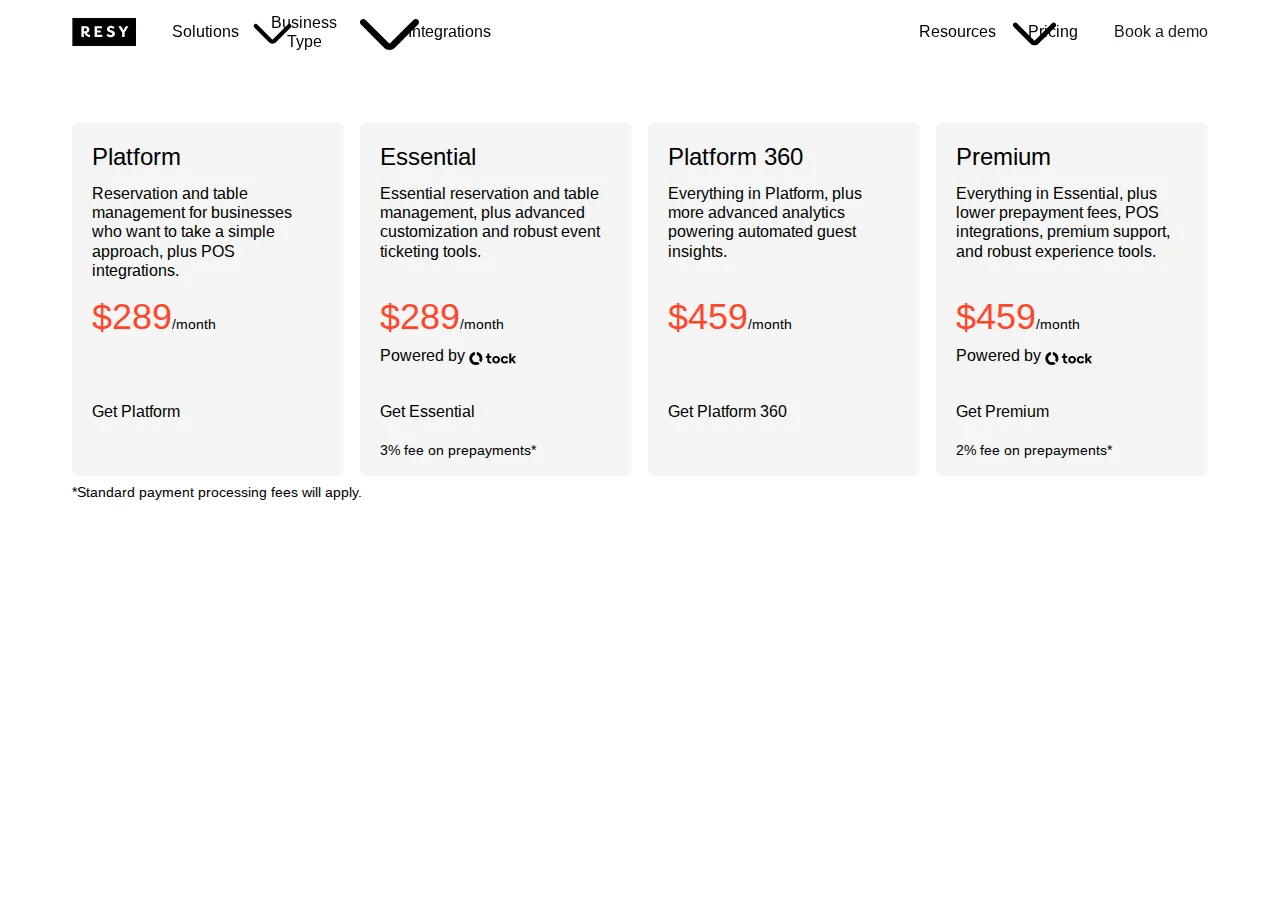
OpenTable charges you every time a diner sits down. Resy charges you the same amount whether you seat 10 covers or 10,000. At 94 network covers a month, Resy Platform at $289 ties OpenTable Basic at $149 plus $1.50 a cover; above 94, Resy wins by $1.50 with every additional cover. Against OpenTable Core at $299, Resy Platform wins at any volume — its $289 flat fee is already below Core's subscription before the first cover fee lands. Tock no longer publishes its own pricing: its plans live on Resy's page as Tock-powered tiers. The honest comparison is between OpenTable's meter, Resy's flat fee, and Tock's percentage on prepaid tickets.
The ladder, read November 2026
All three vendors publish their prices except Tock, which publishes through Resy. Figures are US dollars, read from each vendor's own pricing page on November 18, 2026 — OpenTable's plans page and Resy's plans page, both read directly — with Tock's standalone page returning a 404 and its "Use Tock at your business" link redirecting to Resy's get-started page. OpenTable's prices are per location, month to month, with no long-term contract; Resy states no contract term on its pricing page, so none is claimed here. OpenTable Basic is available in the US only.
| Plan | Monthly fee | Per-cover fee | Website covers | Prepayment fee | Authority |
|---|---|---|---|---|---|
| OpenTable Basic | $149 | $1.50 per network cover (free first 30 days) | $0.25 per cover, or $49/mo flat | 2% service fee on prepaid experiences | OpenTable plans page, Nov 18, 2026 |
| OpenTable Core | $299 | $1.00 per network cover | Free | 2% on prepaid experiences and ticketing | OpenTable plans page, Nov 18, 2026 |
| OpenTable Pro | $499 | $1.00 per network cover | Free | 2% on prepaid experiences and ticketing | OpenTable plans page, Nov 18, 2026 |
| Resy Platform | $289 | None | Free | None — prepayment not included | Resy plans page, Nov 18, 2026 |
| Resy Platform 360 | $459 | None | Free | None — prepayment not included | Resy plans page, Nov 18, 2026 |
| Tock Essential | $289 | None | Free | 3% on prepayments | Resy plans page (Tock-powered), Nov 18, 2026 |
| Tock Premium | $459 | None | Free | 2% on prepayments | Resy plans page (Tock-powered), Nov 18, 2026 |
Resy sells two products under one roof. Platform and Platform 360 are the reservation system: flat fee, no per-cover charge, no prepayment machinery. Essential and Premium are the Tock-powered track: the same flat fees, plus deposits, ticketing, and prepaid experiences at 3% or 2%. A restaurant that never sells a prepaid ticket should never pay for Essential or Premium — Platform buys the same system for the same $289. And OpenTable's cheapest plan is only cheap at low volume: Basic looks like a $149 plan and behaves like a $1,649 plan at 1,000 network covers.
The per-cover math, worked in full
On OpenTable the monthly bill is a subscription plus a meter. On Resy it is a subscription, full stop:
At 1,000 network covers a month — a 60-seat restaurant turning twice a night, six nights a week, with most bookings arriving through the network — the bills are:
Resy Platform saves $1,360 a month against OpenTable Basic at this volume — $16,320 a year — and $1,010 a month against Core. The break-even against Basic sits low:
Ninety-four network covers a month is the tie — a restaurant doing 30 covers a night, six nights a week, crosses it in the first week if half its bookings come through the network. Against Core there is no break-even to solve: $289 is below $299 before the first cover fee, so Resy Platform is cheaper at any volume, and the gap widens $1.00 per cover from there. The only OpenTable plan that can ever beat Resy Platform on price is Basic, and only below 94 network covers a month. At 500 network covers the bills are Basic $899, Core $799, Resy Platform $289. At 2,000 they are Basic $3,149, Core $2,299, Resy Platform $289.
Tock is no longer a separate price
Tock pioneered the prepaid ticket: the guest pays for the meal like a concert ticket, the restaurant banks the money before service, and a no-show costs nothing because the revenue is already in. American Express agreed to acquire Tock from Squarespace for $400 million in June 2024, and on February 24, 2026 Resy's chief executive announced the unification — Tock venues moving onto Resy, "all on Resy," in summer 2026. By November 2026 the unification is visible on the pricing page: exploretock.com/pricing says the page does not exist, the business link sends you to Resy's get-started page, and Tock's plans appear on Resy's page marked "Powered by Tock." There is no standalone Tock price to compare anymore, and any article still printing one — $199 a month plus 2%, or $249 a month — is printing a stale pre-merger price. What remains is the comparison between Resy's two tracks: the flat reservation system, and the Tock-powered track that takes a percentage of prepaid revenue.
The prepayment percentage, worked in full
On the Tock-powered track, the choice is Essential at $289 plus 3% of prepaid revenue against Premium at $459 plus 2%. The break-even is where the percentage saving covers the $170 subscription gap:
At $17,000 a month in prepaid tickets, deposits, and events, both plans cost $799. Below it Essential wins; above it Premium wins, the gap growing $1 for every $100 past the line. At $30,000 a month — a tasting-menu restaurant selling 150 tickets at $200 — Essential costs $289 plus $900, or $1,189 a month; Premium costs $459 plus $600, or $1,059. At $50,000 a month, Essential costs $1,789 and Premium $1,459. If your prepaid volume is under $17,000 a month, Premium's extra features — chargeback protection up to $25,000 a year in aggregate, priority phone support — are the only reason to pay for it, and they are not worth $170 a month on their own. Standard card processing applies on top, and the percentage is charged on the prepaid amount, not the food cost — a distinction that matters when the ticket is $200 and the plate cost is a fraction of it. Your CPA books the subscription as a SaaS operating expense and the percentage as a cost of sale against the prepaid revenue it attaches to; keep the two lines separate, because the subscription is fixed and the percentage scales with the revenue it taxes. An LLC and a C-Corp deduct the subscription identically; the percentage is a cost of sale either way, and the VAT treatment follows the invoice, not the plan. A restaurant running a POS terminal at the bar and a prepaid ticket book in the dining room is the concrete case: two different cost lines, and only one grows when you sell more.
No-shows: what the numbers actually say
The Resos No-Show Index 2026 recorded a 2.33% no-show rate across 3.77 million advance reservations. For a restaurant seating 100 covers a night, 30 nights a month, that is 3,000 covers and about 70 no-shows. At a $75 average check, roughly $5,250 a month of revenue is at risk — an illustrative figure, because the rate is an industry average. OpenTable charges nothing for a no-show: you only pay for seated diners. Resy takes the same position on its flat plans and adds the machinery to do something about it — credit-card holds and cancellation fees are included on all four plans, so the restaurant sets its own charge and collects it, and deposits are included on Essential and Premium. A $25 per-person fee collected on half of 70 no-shows recovers $875 a month. The hold is also where the friction lives — a guest who has to leave a card to book may book elsewhere. A neighborhood restaurant with empty tables on Tuesdays should not copy the cancellation policy of a restaurant with a three-week waitlist.
Founder & CEO Insight — Enow A. Jovial
Who each one is actually for
OpenTable is for the restaurant that wants the largest diner network in the United States — reported at roughly 31% of the online reservation market, over 60 million seated diners a month — and will pay a per-cover toll for discovery it cannot buy elsewhere. It is not for the high-volume restaurant whose covers mostly arrive through the network: at 1,000 network covers a month, Core costs $15,588 a year against Resy's $3,468, and the discovery is not worth $12,120 a year once your own reputation fills the room. Core is the rational OpenTable pick over Basic — free website covers, table management, a waitlist, POS integration. Pro's $200 a month over Core buys relationship management only a group will use.
Resy is for the restaurant that already has demand — the hard-to-book room, the neighborhood favorite, the tasting-menu counter. Its flat fee means the bill is the same in July and in January. Platform 360 at $459 adds advanced analytics over Platform at $289; buy it only if someone on staff will read the analytics every week — an unread dashboard is a $170-a-month subscription to nothing. Resy is not for the restaurant outside a major metro: its network is concentrated in big cities. American Express has owned Resy since 2019, and the Amex audience spends heavily on dining — a real advantage for a high-check restaurant.
Tock is for the prepaid room: the tasting menu, the chef's counter, the winery experience — anywhere an empty seat is $150 gone and the guest would rather bank the money upfront. Essential and Premium are the only way to sell a ticket, take a deposit, and run an event through this trio; the 2% or 3% is the price of eliminating the no-show entirely. Tock is not for the à la carte restaurant: a prepaid ticket on a walk-in dinner is friction without a benefit. The Square vs Toast vs Clover restaurant POS pricing playbook is the companion read, because the reservation system and the point of sale are the two subscriptions every restaurant pays, and the POS decision changes what the reservation system can do. For bookings by phone and calendar rather than a marketplace, the Calendly vs Acuity scheduling software pricing comparison prices the lighter alternative.
| Decision | OpenTable | Resy | Tock | Authority |
|---|---|---|---|---|
| Entry monthly fee | $149 (Basic) | $289 (Platform) | $289 (Essential, Tock-powered) | Vendor pricing pages, Nov 18, 2026 |
| Cost at 1,000 network covers/mo | $1,649 (Basic) / $1,299 (Core) | $289 (Platform) | $289 + prepay % (Essential) | Formula above |
| Per-cover fee | $1.00–$1.50 | None | None | Vendor pricing pages, Nov 18, 2026 |
| Prepayment fee | 2% on prepaid experiences | None on Platform/360 | 3% Essential / 2% Premium | Vendor pricing pages, Nov 18, 2026 |
| No-show charge by vendor | None — seated diners only | None — restaurant sets its own hold | None — prepaid ticket banks the revenue | Vendor pricing pages, Nov 18, 2026 |
Buy it in this order
- [x] Count last month's covers by channel. Network, website, phone, walk-in. The network count decides OpenTable's bill; prepaid revenue decides Essential against Premium.
- [x] Price OpenTable Basic only below 94 network covers. Above that, Resy Platform is cheaper. Do not let the $149 sticker decide.
- [x] Take the $49 flat website fee on Basic from day one if you do more than 197 website covers a month. At $0.25 a cover, 197 covers cost $49.25.
- [x] Never buy Essential or Premium for reservations alone. Platform at the same $289 or $459 buys the same reservation system. Pay the percentage only when you sell prepaid tickets, deposits, or events.
- [x] Set the cancellation hold to match your demand, not your fear. A $25 per-person hold on a room with a waitlist recovers real money; on a quiet Tuesday it drives bookings elsewhere.
- [x] Re-price when the book changes. A restaurant that grows from 90 network covers to 900 has crossed the line where OpenTable Basic stops being cheap.