Square vs Toast vs Clover Restaurant POS Pricing Playbook: Rates, Hardware, and Break-Even Math
A restaurant POS pitch always starts with the monthly software price. That number is the smallest line on the bill: on a $50,000 month of card sales, processing runs $1,300 to $1,700 while software runs $0 to $150. Square publishes everything on its own pages. Toast prints its card rates only in its online shop, for new single-location restaurants, and quotes everyone else. Clover publishes everything on Clover.com, then lets thousands of banks and resellers sell the same hardware at whatever rates they choose.
Who this playbook is for, and who should not run it
This playbook is for a single-location restaurant owner choosing between Square for Restaurants, Toast, and Clover for one counter station and one or two handhelds. A multi-location group gets a custom quote from all three vendors, and the shop rates here do not apply to it.
Founder & CEO Insight — Enow A. Jovial
The published rates, side by side
Rates below are in-person, tap, dip, or swipe, unless stated otherwise. Taxes and shipping are extra on every vendor.
| Item | Square | Toast | Clover (direct, Clover.com) |
|---|---|---|---|
| Software, entry | Free $0/mo per location | Starter Kit $0/mo, 1 location, up to 2 terminals | Restaurant Growth $89.95/mo, first device |
| Software, mid | Plus $49/mo per location | Point of Sale $69/mo per location | $109.90/mo, two devices |
| Software, top | Premium $149/mo per location | Build Your Own, custom quote | $129.85/mo, three devices |
| In-person card rate | Free 2.6%, Plus 2.5%, Premium 2.4%, all + 15 cents | Traditional 2.49% + 15 cents most cards; Pay-as-you-Go Basic 3.09% + 15 cents | 2.3% + 10 cents, every card incl. American Express |
| Amex / keyed-in | Keyed-in 3.5% + 15 cents, all plans; no Amex surcharge | Amex and card-not-present 3.50% + 15 cents | Keyed-in 3.5% + 10 cents; no Amex surcharge |
| Contract | Month to month, cancel anytime | 2-year software agreement, both plans | Purchase: no fixed term; bundle: 36 or 48 months, non-cancelable |
Sources: Square pricing page; Toast pricing page and online shop, read via RestOps November 12, 2026; Clover.com, read via RestOps November 12, 2026. Square's online rate is 3.3% + 30 cents on Free and 2.9% + 30 cents on Plus and Premium; Clover publishes no online rate. Toast charges $50 a month per added terminal and Clover $19.95, while Square charges no per-device software fee except its KDS and Kiosk apps.
Three facts decide most choices. Clover has the lowest published in-person rate, 2.3% + 10 cents, and the only rate that treats American Express like every other card. Square is the only vendor with no contract and no per-device software fee, which makes it the cheapest system to leave. Toast charges American Express at 3.50% + 15 cents, a full point above its headline rate.
Monthly cost math at three volumes
Transactions per month equal monthly card volume divided by the average check.
The worked examples below use a $45 average check, the benchmark for a 40-seat neighborhood room, and one terminal. Run your own numbers through the break-even calculator with your real average ticket before you sign.
| Monthly card volume | Square Free | Square Plus | Square Premium | Toast Traditional | Toast Pay-as-you-Go Basic | Clover Restaurant Growth |
|---|---|---|---|---|---|---|
| $20,000 | $586.67 | $615.67 | $695.67 | $633.67 | $684.67 | $594.39 |
| $50,000 | $1,466.67 | $1,465.67 | $1,515.67 | $1,480.67 | $1,711.67 | $1,351.06 |
| $100,000 | $2,933.33 | $2,882.33 | $2,882.33 | $2,892.33 | $3,423.33 | $2,612.17 |
At $20,000 a month, Square Free is cheapest at $586.67. At $50,000, Clover leads at $1,351.06, about $116 a month under Square Free, while Toast Pay-as-you-Go is the loser at $1,711.67. At $100,000, Clover leads by more than $270 a month over every rival, Square Plus and Premium tie at $2,882.33, and Pay-as-you-Go at $3,423.33 is $811 a month over Clover.
What one card payment costs you
| System and plan | Rate | Fee on a $45 check |
|---|---|---|
| Clover Restaurant Growth | 2.3% + 10 cents | $1.14 |
| Square Premium | 2.4% + 15 cents | $1.23 |
| Toast Traditional, most cards | 2.49% + 15 cents | $1.27 |
| Square Plus | 2.5% + 15 cents | $1.28 |
| Square Free | 2.6% + 15 cents | $1.32 |
| Toast Pay-as-you-Go Basic | 3.09% + 15 cents | $1.54 |
| Toast Traditional, Amex / card-not-present | 3.50% + 15 cents | $1.73 |
The per-transaction fee punishes small tickets: a coffee shop at a $12 average check pays the 15-cent fee on every small sale. At $50,000 a month with 10% of volume on Amex, Toast Traditional adds about $50.50 a month over its headline rate: 10% of $50,000 times the 1.01 point gap between 3.50% and 2.49%.
Break-even points worth writing down
Each paid plan only earns its fee above a volume threshold. The thresholds below assume one terminal and a $45 average check, software and processing only.
Square Plus beats Free above $49,000 a month in card volume: the $49 fee divided by the 0.1 point rate saving. Square Premium beats Plus above $100,000 a month, and beats Free above $74,500 a month. Toast Traditional beats Pay-as-you-Go Basic above $11,500 a month: the $69 fee divided by the 0.6 point saving. At $50,000 a month, Traditional saves $231 a month after its fee, so the $1,153 Countertop Starter Kit pays for itself in about 5 months. Clover beats Square Free above about $21,900 a month, and beats Toast Traditional above about $7,000 a month.
Hardware: what the counter actually costs
Software is monthly. Hardware is once, and it is where the three vendors differ most. Prices below are outright purchase prices, before tax and shipping. Square hardware is yours outright and resells if you switch; Toast hardware runs only on Toast.
| Device | Square | Toast | Clover |
|---|---|---|---|
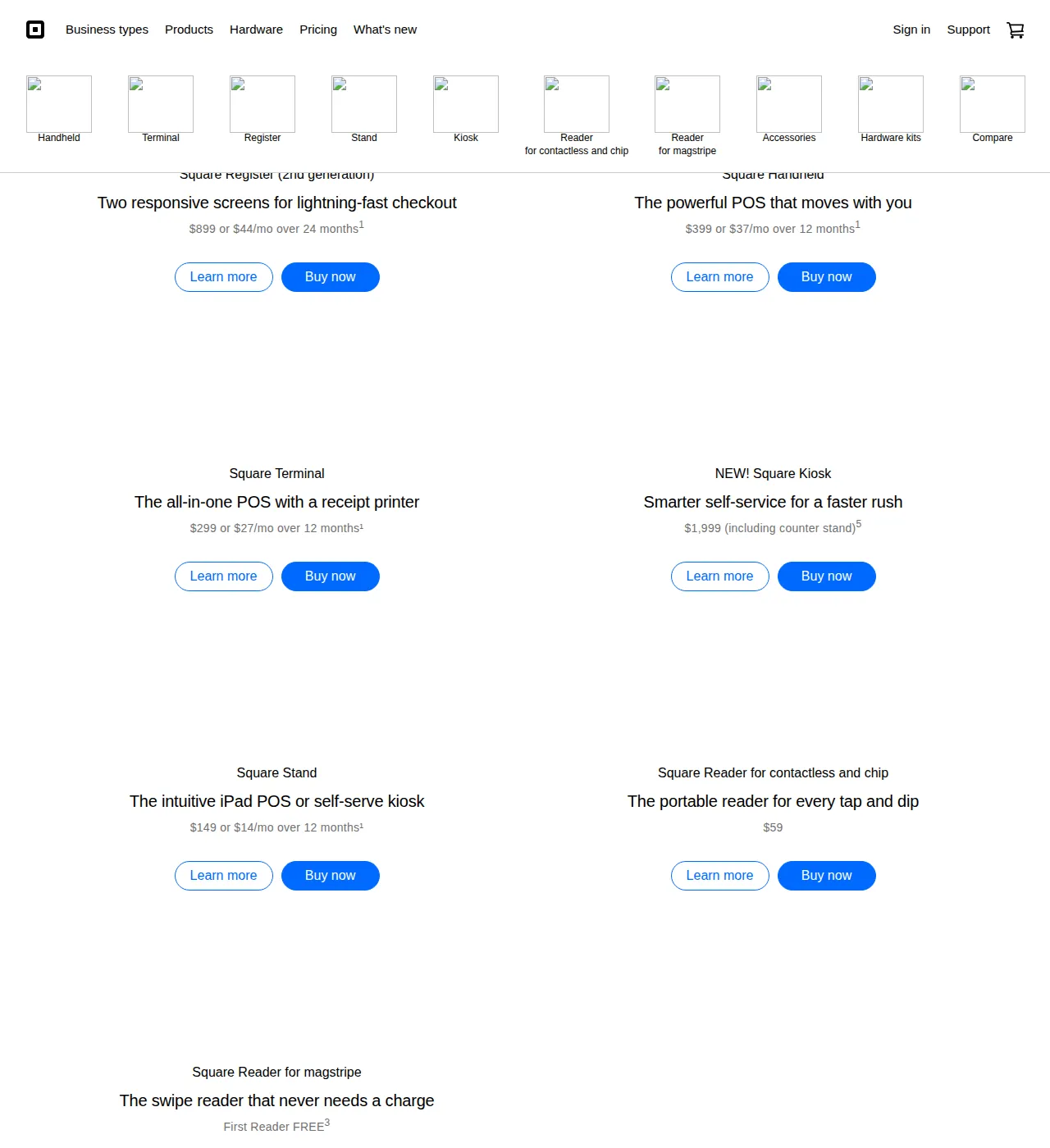
| Countertop terminal | Register (2nd gen) $899 | Countertop Starter Kit $1,153 (Flex, Tap reader, router) | Station Solo $1,799; Station Duo $1,899 |
| Handheld | Handheld $399 | Toast Go 3 $599 | Flex $749; Flex Pocket $699 |
| Receipt printer | Register Kit $1,189 adds drawer and printer | Receipt Printer $329 | Included with Station Solo and Flex |
| Kitchen printer | Impact Printer $379 | Kitchen Printer $339 | Kitchen printer $359 |
Two hardware facts change the budget. Neither Toast starter kit includes a printer, while the Station Solo and the Flex print receipts, so a Toast room must add $329 for a receipt printer and $339 for a kitchen printer. And the Clover Station Solo cannot accept tap-to-pay or mobile wallets, a limit from Clover's own comparison table, so the cheapest Clover counter cannot take the payment method most guests now reach for.
A one-counter, one-handheld room, hardware bought outright: Square Plus is Register $899 plus Handheld $399, or $1,298 once, plus $49 a month, before printers. Toast Traditional is Countertop Starter Kit $1,153 plus Toast Go 3 $599, or $1,752 once, plus $119 a month for two devices, before printers. Clover is Station Solo $1,799 plus two Flex handhelds at $749 each, or $3,297 once, plus $129.85 a month for three devices, with receipt printing included. Clover also sells the same room as a monthly bundle, full-service Starter $179, Standard $239, Advanced $354 a month for 36 months. The bundle hides the hardware price inside a non-cancelable subscription, so compare the total of 36 payments against the outright price before choosing it.
Contracts, lock-in, and the exit cost
The contract is the second decision, after the rate, because it decides what happens when the system disappoints you.
| Item | Square | Toast | Clover |
|---|---|---|---|
| Term | Month to month, cancel anytime | 2-year software agreement, both plans | Purchase: no fixed term; bundle: 36 or 48 months, non-cancelable |
| Early exit | None | Termination fee set by your agreement | Bundle: remaining payments; purchase: none |
| Support | Weekday phone on Free and Plus; 24/7 phone on Premium | Toast Care 24/7/365 on every plan | 24/7/365; quality depends on who sold you the account |
| Offline mode | Queued payments expire after 24 hours offline | Full offline mode on every plan | Not advertised on Clover.com pricing pages |
Toast's 2-year term is the hard edge: the rate is quoted for new single-location restaurants, the early-termination fee is set by the agreement rather than published, and the agreement can change card processing rates on 30 days' written notice. Get the rate, the term, and the termination fee in writing before signing.
The features behind the paywalls
The rate table hides the feature gates, and the gates decide whether the cheap plan is usable. On Square, tableside ordering is not included on Free, so a handheld that takes orders at the table needs Plus or Premium. The KDS app costs $30 a month per device on Plus and $20 on Premium, and is not available on Free. Coursing and 24/7 phone support sit behind Premium, while Square Online ordering is included on every plan at the online rate. On Toast, Traditional pricing charges Basic at $69 a month, Core at $219 a month for online ordering and delivery integrations, and Growth at $578 a month; on Pay-as-you-Go the same packs are priced in the card rate instead, 3.09% on Basic, 3.39% on Core, 3.69% on Growth. On Clover, online ordering is included with Restaurant Growth at no extra fee.
The decision
| Your room | Pick | Why |
|---|---|---|
| Under $20,000 a month in card volume, counter service | Square Free | $0 software, 2.6% + 15 cents, no contract; cheapest total at $586.67 |
| $20,000 to $50,000 a month, full service, one handheld | Square Plus or Toast Traditional | Plus at $49 a month with tableside ordering; Toast Traditional at $69 a month with native KDS |
| Over $50,000 a month, full service, Amex-heavy guests | Clover direct from Clover.com | 2.3% + 10 cents on every card, $1,351.06 a month at $50,000 volume |
| Full-service room that needs coursing, KDS, and offline mode on day one | Toast Traditional | Native KDS, coursing, and full offline mode; pay the 2-year term and the Amex rate with open eyes |
The processing comparison underneath this decision is covered in the Stripe vs Square vs PayPal payment processing fees playbook, and the rails the money moves on are in the ACH vs FedNow vs Wire vs RTP payment rails guide.
Run the decision
- Pull three months of card volume and your average check: count the Amex share separately.
- Run the monthly math at your volume: volume times rate, plus transactions times the per-transaction fee, plus software, or use the break-even calculator.
- Price the hardware basket, printers included: Toast kits ship without a printer; Clover Solo cannot take tap; Square Register needs the $1,189 kit for a printer and drawer.
- Read the contract term and the termination fee: Toast is 2 years, Clover bundles are 36 or 48 months non-cancelable, Square is month to month.
- Get the rate in writing, and test the exit: Toast quotes larger restaurants and Clover resellers set their own rates.
Failure modes: how good POS choices still go wrong
Most POS failures are arithmetic errors with a contract attached. Buying the free kit at real volume: a room doing $50,000 a month pays $1,711.67 on Toast Pay-as-you-Go against $1,351.06 on Clover, a $360 monthly penalty for a $0 sticker. Pricing the teaser tier: the Clover Starter bundle has no tap-to-pay and no tableside ordering, so the room upgrades to Standard in month two and the budget breaks. Signing the reseller rate: the bank rep's Clover quote carries a different rate than Clover.com, and the 2.3% figure in this playbook never applied to it.
The decision in advance
The restaurant POS decision is a rate decision with a contract attached. Price the card rate at your volume and your average check, price the hardware basket with printers, read the term and the termination fee, and get the rate in writing. Square wins on flexibility and on small volume. Toast wins on full-service depth and pays for it with a 2-year term and an American Express rate. Clover wins on published cost above $21,900 a month, if you buy it direct from Clover.com.