A cloud IDE comparison written in November 2026 has a problem the 2025 version did not: one of the three products no longer exists as something you can buy. Gitpod renamed itself Ona in September 2025, retired Gitpod Classic on October 15, 2025, joined OpenAI in a transaction that closed on August 10, 2026, and wound Ona Cloud down on October 31, 2026. New signups closed, new Core subscriptions stopped selling, and the pricing page that once listed plans is now a sales-contact form — verified on November 16, 2026. So this is a two-way pricing comparison with a third chair kept in the room on purpose: the Gitpod story is the most expensive lesson in this market. Figures as read on November 16, 2026, from GitHub's billing documentation, Ona's own announcement, Replit's billing documentation, and the two most recent independent pricing captures.
What each product actually is
The three products never sold the same thing, and the pricing only makes sense once that is clear. Replit sells an AI agent with an editor attached: you describe the app, the Agent builds it, and the subscription buys a dollar wallet of credits the Agent spends. GitHub Codespaces sells a metered virtual machine with VS Code attached: you pick a machine size, the meter runs while the machine exists, and the bill is core-hours plus storage. Gitpod sold a prebuilt ephemeral workspace — a container spun up from a repository in seconds, with the environment defined in code — and Ona sold the same idea plus AI agents, priced in Ona Compute Units. One model is a subscription, one is a utility meter, and one is a credit system.
| Attribute | Replit | GitHub Codespaces | Gitpod / Ona | Authority |
|---|---|---|---|---|
| What you buy | Subscription + credit wallet for Agent work | Metered VM: core-hours + GB-months | Was: subscription + OCUs | GitHub; Replit; Ona pricing |
| Entry price | Core $18/mo annual ($20 monthly) | 2-core $0.18/hr; Free tier 120 hrs/mo | Core was from $20/mo — no longer sold | UsagePricing Nov 2, 2026; GitHub billing docs |
| Included allowance | $20 credits/mo (Core); $100 (Pro) | Free: 120 hrs + 15 GB-month; Pro: 180 hrs + 20 GB-month | Was 80–2,200 OCUs/mo | GitHub billing docs; Tech Insider |
| Rollover | Core credits expire monthly; Pro rolls 1 month | Included hours do not roll over | Subscription credits expired monthly | Replit; GitHub billing docs |
| Top tier | Pro $90/mo annual, up to 15 builders | 32-core $2.88/hr, org billing | Enterprise custom — no longer sold | UsagePricing; GitHub billing docs |
| Buyable today | Yes | Yes | No — cloud wound down Oct 31, 2026 | Ona pricing page, Nov 16 |
The meters, side by side
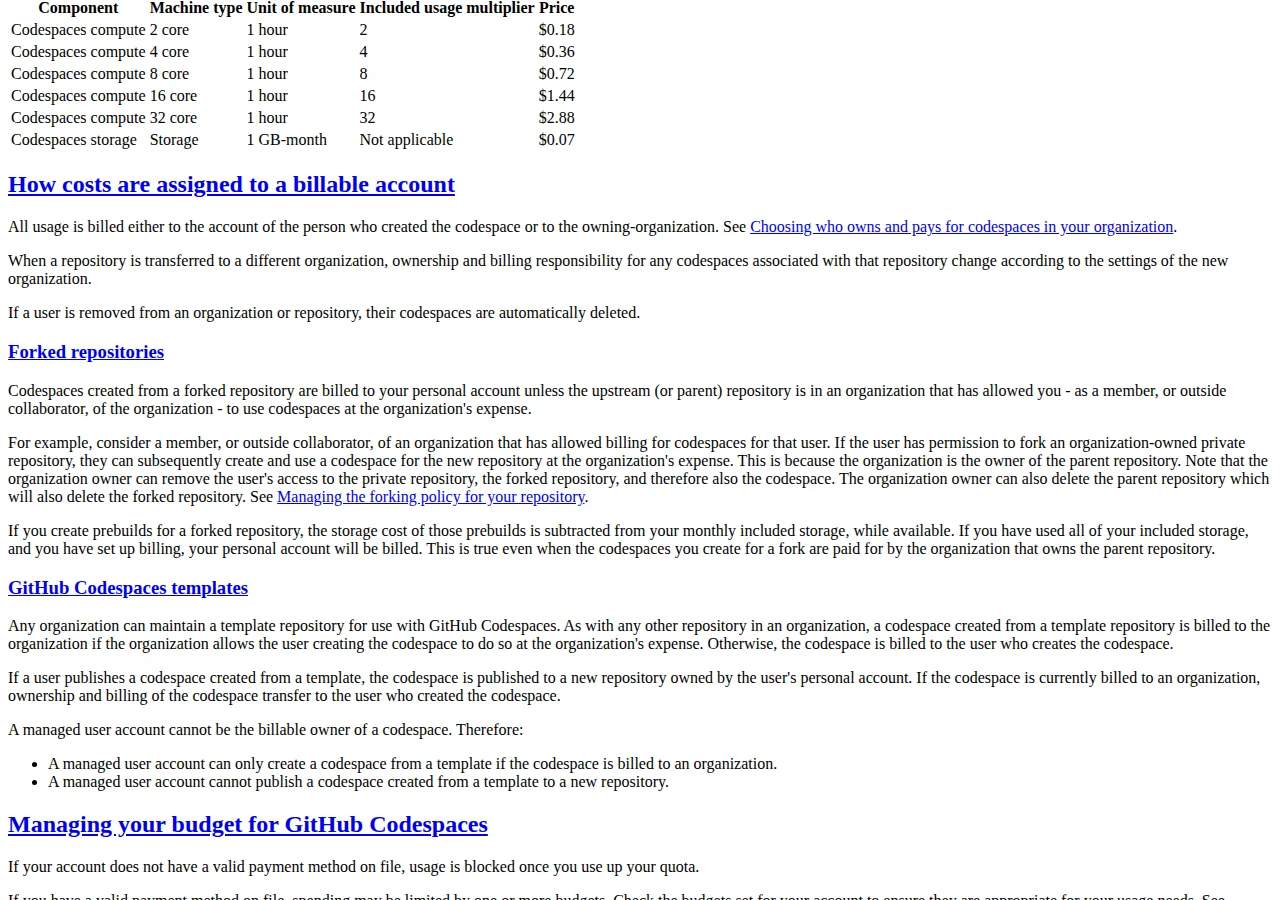
Codespaces publishes the cleanest meter in developer tooling. Every machine size is exactly double the price of the one below it, because the price is per core-hour and the multiplier is the core count. Storage is $0.07 per GB-month, billed on the space a codespace or prebuild occupies while it exists, and the included allowance for personal accounts is 120 hours of compute and 15 GB-month of storage a month on Free, 180 hours and 20 GB-month on Pro. Without a valid payment method, usage stops when the included quota is used; with one on file, spending can be capped with budgets, and GitHub emails at 90 and 100 percent of included usage.
Replit's meter is a wallet, not a clock. The subscription fee buys a monthly credit allotment — $20 on Core, $100 on Pro — and every Agent action, deployment, database operation, and storage charge draws from it. The documentation states the credits are included in the subscription fee and reset on the monthly renewal date, and a spend threshold can grow to $250 with account standing. What the documentation does not publish is a fixed price per Agent task, because Agent 4 is billed by effort: a checkpoint costs what the work costs, and a failed operation still consumes credits. That is why no exact Replit monthly total can be computed in advance — only a floor (the subscription) and a ceiling (the subscription plus whatever packs you buy).
Three workloads, three bills
The only fair way to compare a meter and a wallet is to run the same workload through both and show the arithmetic. The workloads below are illustrative, built from the published rates. A developer hour means one hour of an active environment; a stopped codespace does not bill compute, though its storage keeps billing.
Workload 1 — one solo developer, 160 hours a month, 4-core machine, 30 GB stored. On Codespaces the compute is 160 × $0.36 = $57.60, storage is 30 × $0.07 = $2.10, and the total is $59.70 a month. On a Free personal account the first 120 hours and 15 GB-month are included, so the first bill is closer to 40 × $0.36 + 15 × $0.07 = $15.45. On Replit Core the same developer pays $20 a month and holds $20 of credits; whether the month costs $20 or $60 depends entirely on how much Agent work the credits absorb, and a heavy build month with 500-plus Agent checkpoints is documented by users at $150 to $220 on Core. The Codespaces bill is $59.70 and knowable; the Replit bill is $20 plus unknown.
Workload 2 — five developers, same 160-hour month, 4-core machines, 30 GB each. Codespaces: 5 × 160 × $0.36 = $288.00 in compute, plus 5 × 30 × $0.07 = $10.50 in storage, for $298.50 a month — $59.70 per developer, exactly five times the solo bill, because the meter is linear. Replit Pro: $100 a month for the team, including $100 of pooled credits and up to 15 builders. If the team's Agent usage fits inside $100 of credits, the month costs $100 — a third of the Codespaces figure. If it does not, the team buys credit packs: 250 credits for $215, 500 for $425, 1,000 for $825 on annual billing. The break-even is where the team's Agent usage crosses $298.50 of credits, and that point cannot be read off a price list — it has to be measured from the team's own first month.
Workload 3 — twenty-five developers. Codespaces: 25 × 160 × $0.36 = $1,440.00, plus 25 × 30 × $0.07 = $52.50, for $1,492.50 a month — $59.70 per developer, still exactly linear. Replit Pro at this size is sold in credit packs up to 2,500 credits for $2,000 a month, and the subscription itself is $100. A team that burns 2,500 credits of Agent work pays $2,000 plus the subscription; a team that burns 500 pays $425. The spread between the cheapest and the most expensive Replit month at this headcount is roughly fivefold, while the Codespaces spread is zero. That spread is the real price difference, and it is invisible on the pricing page. Before committing a team to either meter, run the numbers through the pricing calculator with your own hours and first-month credit burn, not the vendor's example.
The Gitpod lesson: vendor continuity is a price
Gitpod was not a bad product. It created the mainstream expectation that a development environment could be a URL, and it grew to two million developers on that idea. The failure was not technical; it was commercial, and it arrived in four dated steps. In September 2025 the company rebranded as Ona and pivoted toward AI agent orchestration. On October 15, 2025, Gitpod Classic — the pay-as-you-go browser workspace most tutorials and README badges still reference — shut down. On June 11, 2026, Ona announced an agreement to join OpenAI as part of the Codex team; on August 10, 2026, the transaction closed. On October 31, 2026, Ona Cloud was wound down: new signups closed, new Core subscriptions stopped selling, and users were told to save their code and data.
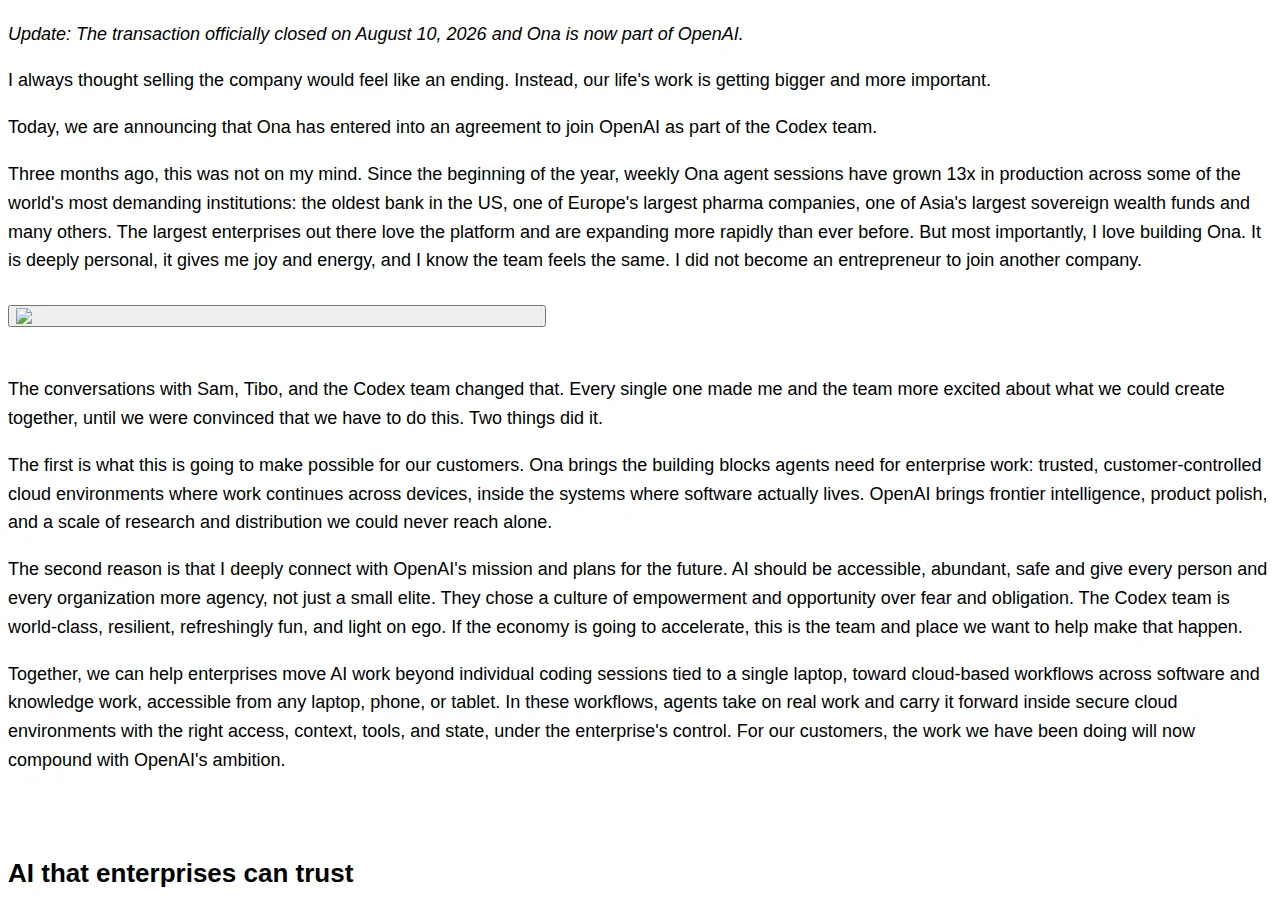
The last published Ona pricing shows what the product cost while it lasted: Core from $20 a month, 80 to 2,200 Ona Compute Units a month depending on tier, up to 100 team members, pooled credits, no per-seat fee, additional OCUs at $10 per 40 units, and Enterprise custom-priced with VPC deployment, SSO, and audit trails. The OCU was the warning sign: a 4 vCPU, 16 GB environment cost 1 OCU per hour, a new web app about 4, a feature in a medium codebase about 8 — but the unit never mapped to a published dollar-per-vCPU-hour rate, so a team could not compute its exact monthly bill the way it can with Codespaces. Our serverless pricing playbook runs the same meter-versus-wallet comparison for compute, and the AI coding assistant comparison prices the local-editor alternative, where the code never leaves your machine.
Founder & CEO Insight — Enow A. Jovial
Who should not pick each
Replit is the wrong pick for a team that needs a fixed monthly number for finance to approve, because effort-based credits cannot produce one — the subscription is a floor, not a total, and spending caps are disabled by default. Codespaces is the wrong pick for a developer who wants the AI to build the app rather than a machine to run it in: it is an environment, not an agent, and it bills for the hours the machine exists, typing or thinking. Gitpod, now Ona, is the wrong pick for anyone starting today, because there is nothing to buy — and any tutorial, badge, or README still pointing at it is a stale link that should be replaced, not followed. A team with strict data-residency or air-gap requirements should pick neither and self-host instead; our self-hosting guide prices that route, including the Hetzner hardware it runs on.
Execution checklist
- [x] Step 1: Define the environment in code. Put the devcontainer configuration, the toolchain versions, and the setup scripts in the repository before choosing a vendor.
- [x] Step 2: Measure one real month. Run the team's actual workload on Codespaces for one month and record the core-hours and GB-months; run the same workload on Replit and record the credit burn per feature. The two numbers are the comparison — the pricing pages are not.
- [x] Step 3: Set the caps before the first build. Enable Codespaces budgets with email alerts at 90 percent, and set a Replit spend cap and a monthly credit-pack ceiling in the billing settings.
- [x] Step 4: Price the storage nobody budgets. A codespace that exists but is stopped still bills $0.07 per GB-month; delete prebuilds and stopped machines at the end of each sprint.
- [x] Step 5: Audit every Gitpod link in your docs. Replace "Open in Gitpod" badges and tutorial links with the surviving product, and export any remaining Ona Cloud data now — the cloud is gone.
- [x] Step 6: Re-price quarterly. Replit has changed its pricing structure three times in eighteen months, and Codespaces rates are list prices GitHub can revise. Re-run the three-workload math every quarter and move the team if the meter flips.
A note on the Replit figures
Replit's own pricing page would not load from this network on November 16, 2026 — it returns a Cloudflare challenge — so the Replit figures here are the two most recent independent captures, which agree: UsagePricing's capture of November 2, 2026, and Appy Pie's read of September 28, 2026, both put Core at $18 a month billed annually ($20 month-to-month) with $20 of monthly credits, and Pro at $90 billed annually ($100 month-to-month) with $100 of credits and up to 15 builders. Older sources still show the retired Teams plan at $40 per user a month and Core at $25 — those figures are stale. Confirm the live rate card before you buy — this vendor reprices often and the captures are already two weeks old.