Cursor vs Windsurf vs Claude Code: Pricing Compared
Three AI coding assistants dominate the 2026 conversation, and all three charge $20 a month for their entry-level paid seat. That coincidence is where the similarity ends. Cursor sells a usage pool priced against frontier-model API rates. Windsurf no longer exists under its own name: Cognition bought what remained in July 2025, renamed the editor Devin Desktop on June 2, 2026, and now bills through Devin plans. Claude Code is not a separate subscription — it rides inside Anthropic's Claude Pro, Max, and Ultra plans.
This guide compares per-seat price at 1, 5, and 25 seats, what the usage allowance buys, which models each tier unlocks, and what happens when a developer burns through the included allowance. Every price below was read from the vendor's own pricing page on November 7, 2026, except Cursor's, whose pricing page no longer lists editor plans — that exception is explained in the sourcing note at the end.
> [!FOUNDER]
> "The $20 sticker price is the least informative number on any of these pages. What matters is what $20 buys after the first heavy week: a usage pool, a quota, or a meter that never stops."
> — Enow A. Jovial, Founder & Chief Executive Officer
> [!KEY TAKEAWAY]
> At monthly billing, one seat costs $20 on all three. The divergence starts at five seats — Cursor Teams $200, Devin Desktop Teams $280, Claude Team Standard $125 — and widens to $455 a month at 25 seats.
What each product actually is
Cursor is an AI-first code editor built on a Visual Studio Code foundation, from Anysphere. Tiers are Hobby (free), Pro $20 a month, Pro+ $60, Ultra $200, and Teams $40 per user a month, with Enterprise priced on application. Since June 2025, Cursor has sold a usage pool, not a fixed request count: Pro's $20 buys roughly $20 of frontier-model usage at API list price, with anything beyond the pool billed at those same rates. The allowance refreshes weekly.
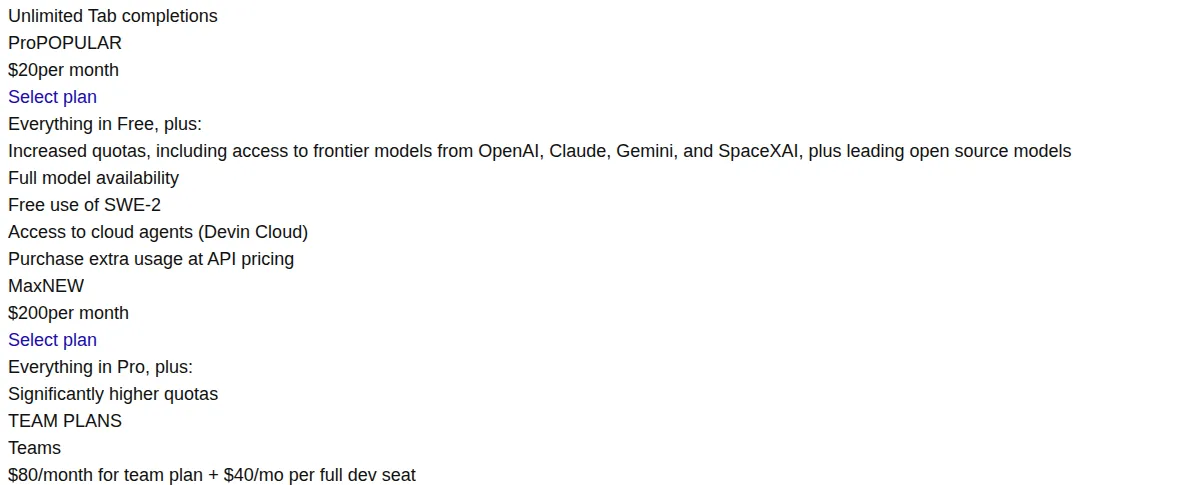
Windsurf began as Codeium's editor. OpenAI's reported $3 billion acquisition collapsed in July 2025; Google paid about $2.4 billion to license the technology and hire its chief executive and a co-founder; Cognition, maker of the Devin agent, acquired what remained and renamed the editor Devin Desktop on June 2, 2026. It now lists Free at $0, Pro at $20 a month, Max at $200 a month, and Teams at $80 a month plus $40 per full developer seat. Pro rose from $15 to $20 in March 2026, when monthly credits gave way to daily and weekly quotas.
Claude Code is Anthropic's agentic coding tool, run from the terminal and inside the editor, included in the Claude subscription. Pro costs $20 a month, or $17 a month billed annually at $200 up front, and includes Claude Code. Max costs $100 a month with five times the Pro usage and $100 a month in API credits; Ultra costs $200 a month with ten times the usage, $200 in credits, and no five-hour limit for verified accounts. Team Standard is $20 per seat a month annual ($25 monthly); Premium is $100 ($125 monthly) with five times the usage. Enterprise is $20 per seat a month annual with a 20-seat minimum, plus usage at API rates.
Individual plans: the $20 tie and where it breaks
| Plan | Cursor | Windsurf / Devin Desktop | Claude Code (via Claude) | Authority |
| :--- | :--- | :--- | :--- | :--- |
| Free | $0, limited agent requests | $0, light quota, unlimited Tab | $0, limited usage every 5 hours | Vendor pages, Nov 7, 2026 |
| Entry paid | Pro $20/mo | Pro $20/mo | Pro $20/mo ($17 annual) | Vendor pages; Cursor corroborated |
| Mid tier | Pro+ $60/mo | — (no mid tier) | Max $100/mo | Vendor pages; Cursor corroborated |
| Top tier | Ultra $200/mo | Max $200/mo | Ultra $200/mo | Vendor pages; Cursor corroborated |
| Usage model | Pool ≈ $20 of API usage, weekly refresh | Daily + weekly token quota | 5-hour and weekly limits; Max 5×, Ultra 10× | Vendor pages |
The table hides the real difference: what the allowance measures. Cursor measures money: the pool is a dollar amount of model usage, so cheap-model work stretches far and a week of Opus-class sessions drains it fast. Windsurf measures tokens against daily and weekly quotas and publishes no request count — heavy frontier-model sessions consume the quota fastest, and overage bills at API rates. Claude measures usage against time-boxed limits — a five-hour window and a weekly window — with the multiple (1×, 5×, 10×) as the only published scale. None of the three publishes a request count any longer.
Model access is the second fault line. Cursor's Pro includes frontier models from Anthropic, OpenAI, and Google, billed against the pool at API list price. Devin Desktop Pro includes OpenAI, Claude, Gemini, SpaceXAI, and leading open-source models, plus free use of Cognition's SWE-2 model and Devin Cloud access. Claude Code's menu is Anthropic-only: Opus, Sonnet, and Haiku, with context up to 1M tokens. A team that wants GPT or Gemini inside the same assistant cannot get it from Claude Code at any price.
Team and enterprise plans: where the bill actually lands
| Team feature | Cursor Teams | Devin Desktop Teams | Claude Team | Authority |
| :--- | :--- | :--- | :--- | :--- |
| Price | $40/user/mo (~$32 annual) | $80/mo + $40/full seat | Standard $20/seat/mo annual ($25 monthly); Premium $100 annual ($125 monthly) | Vendor pages; Cursor corroborated |
| Central billing + admin | Yes | Yes, admin dashboard + analytics | Yes | Vendor pages |
| SSO / SAML | SAML/OIDC SSO | SAML/OIDC SSO (Enterprise) | SSO (Team); SCIM (Enterprise) | Vendor pages |
| Spend controls | Admin usage metrics | Group spend limits (Enterprise) | User + org spend limits (Enterprise) | Vendor pages |
| Audit logs | Enterprise only | Enterprise only | Enterprise only | Vendor pages |
Two facts decide most team purchases. First, Claude's Team Standard seat is half the price of Cursor Teams and Devin Desktop's per-seat rate at annual billing — $20 against $40 — including the full Claude product, not only the coding tool. Second, Devin Desktop Teams carries an $80 monthly base fee on top of the per-seat rate, which makes it exactly $80 a month more expensive than Cursor Teams at every team size.
The math: monthly cost at 1, 5, and 25 seats
The reproducible model is a base fee plus a per-seat rate, with overage added on top:
$
\text{Team cost} = \text{Base fee} + n \times \text{Seat rate} + \text{Overage}
$
| Seats | Cursor Teams ($40/seat) | Devin Desktop Teams ($80 + $40/seat) | Claude Team Standard ($25/mo; $20 annual) |
| :--- | :--- | :--- | :--- |
| 1 | Pro $20 (individual) | Pro $20 (individual) | Pro $20 monthly ($17 annual) |
| 5 | $200/mo; $2,400/yr | $280/mo; $3,360/yr | $125/mo monthly; $100/mo annual; $1,200/yr |
| 25 | $1,000/mo; $12,000/yr | $1,080/mo; $12,960/yr | $625/mo monthly; $500/mo annual; $6,000/yr |
Three conclusions follow. First, a 25-seat team on Claude Team Standard at annual billing pays $6,000 a year, against $12,000 for Cursor Teams on monthly billing — or $3,600 less than Cursor's own annual rate of $32 per seat ($9,600 a year). Second, Devin Desktop Teams costs $960 a year more than Cursor Teams at any seat count — the $80 base fee is the only difference. Third, the single-seat tie at $20 is narrow: Claude's annual Pro at $17 a month undercuts both rivals by $36 a year.
Overage math: what a heavy session actually costs
Overage is where budgets break: all three vendors bill excess usage at API rates. Anthropic publishes the token rates behind Claude Code overage and much of Cursor's pool arithmetic: Sonnet 5.5 at $2 input and $10 output per million tokens; Fable 5.1, Anthropic's top model, at $10 and $50; Haiku 5.5 at $0.10 and $0.50 for prompts up to 100,000 tokens. A heavy session — 10 million input tokens and 2 million output tokens — prices out as:
$
\text{Session cost} = \text{Input} \times \text{Input rate} + \text{Output} \times \text{Output rate}
$
On Sonnet 5.5: 10 × $2 + 2 × $10 = $40. On Fable 5.1: 10 × $10 + 2 × $50 = $200. On Haiku 5.5: 10 × $0.10 + 2 × $0.50 = $2. The same work varies 100-fold by model — the model picker is a budget control, not a preference setting. For a deeper treatment of token pricing across providers, see the OpenAI vs Anthropic vs Google LLM API pricing playbook.
Cursor's break-even is a clean threshold: Pro costs $20 plus overage past the $20 pool; Pro+ costs $60 flat with roughly three times the usage. Pro+ becomes cheaper the moment monthly usage passes $60 of API value:
$
\text{Pro} = \$20 + \max(0, U - \$20) \quad \text{vs} \quad \text{Pro+} = \$60
$
At $100 of monthly usage value, Pro costs $100 and Pro+ costs $60 — a $40 monthly saving, or $480 a year. At $40 of usage value, Pro costs $40 and Pro+ costs $60, so Pro wins by $20.
Max at $100 includes $100 a month in API credits; Pro ($20) plus $100 of credits separately costs $120, so Max saves $20 a month before its five-times usage allowance. Ultra at $200 includes $200 of credits against $220 bought separately, saving $20 a month before its ten-times allowance and the removal of the five-hour limit. Credits only save money if the team would have bought them anyway.
Worked example: a five-person agency and a 25-person product team
Take a five-person agency on paid seats, monthly billing, no overage in month one: Cursor Teams 5 × $40 = $200 a month; Devin Desktop Teams $80 + (5 × $40) = $280; Claude Team Standard 5 × $25 = $125, or 5 × $20 = $100 a month on annual billing. The agency saves $75 to $100 a month against Cursor, and $155 to $180 against Devin Desktop — $900 to $2,160 a year — before any usage difference.
Now take a 25-person team: 20 standard developers and 5 leads who need the heaviest allowance. On Cursor Teams at the annual rate: 25 × $32 = $800 a month, or $9,600 a year. On Devin Desktop Teams: $80 + (25 × $40) = $1,080 a month, or $12,960 a year. On Claude, a mixed seat map costs (20 × $20) + (5 × $100) = $900 a month annual, or $10,800 a year — the only tier that lets a team mix heavy and light seats on one bill. Run these seat maps against your own headcount with the pricing calculator before committing to an annual term.
The five-step selection workflow
1. Measure current usage for two weeks. Pull token or spend data from your current tool, or run all three free tiers in parallel on real tickets, recording input tokens, output tokens, and the model used.
2. Trial the free tier on real work, not a demo. All three free tiers cap usage; the point is to learn which cap you hit first — requests, tokens, or the five-hour window — because that cap predicts your overage bill.
3. Price the seat map, not the seat. Model 1, 5, and 25 seats with your actual mix of heavy and light users. Claude's mixed seats beat flat per-seat pricing once more than a fifth of the team needs heavy usage; flat pricing wins when usage is uniform.
4. Set spend controls before rollout. Enable usage caps, weekly allowance alerts, and admin dashboards on day one. All three expose admin usage views; only enterprise tiers expose granular spend limits and audit logs.
5. Review after 30 days against the baseline. Compare actual spend per developer against the baseline. If overage exceeds 25% of the seat bill, move heavy users up a tier or restrict the top model; if usage sits below half the allowance, drop a tier.
Who should not use each one
Cursor is the wrong purchase for a team that needs predictable monthly billing: the usage pool makes the bill variable by design, and a heavy month can double it. Windsurf, now Devin Desktop, is the wrong purchase for a team that needs a stable vendor story: the product has changed owner, name, and pricing model inside 18 months, and its pricing page redirects to another company's domain. Claude Code is the wrong purchase for a team that needs GPT or Gemini models, or that wants a standalone coding subscription without the rest of the Claude product.
> [!WARNING]
> All three vendors changed pricing inside the last 18 months — Cursor moved to usage pools in June 2025, Windsurf replaced credits with quotas in March 2026 and changed owners and names, and Anthropic restructured Claude tiers twice. Treat every figure in this guide as a November 7, 2026 snapshot: re-check the vendor page before signing an annual term.
The back office decides whether any of this is deductible. These subscriptions are SaaS spend, usually a B2B operating expense; a CPA will generally book them against the same cost center as the editor licences and the SDK tooling they replace, with the monthly CSV export as the audit trail. An LLC or S-Corp founder pays from the business account and keeps seat receipts with the EIN on file; a C-Corp routes the spend through procurement with FICA-bearing payroll kept separate from contractor tooling. The API overage line deserves its own ledger entry: it can triple without a new seat being added. For the code-review side of the same workflow, see the AI code review automation guide, and for the CI tooling that usually sits beside these editors, see the GitHub Actions vs GitLab CI vs CircleCI pricing comparison.
> [!TIP]
> Start every developer on the monthly rate for the first 30 days, even when the annual discount looks tempting: a single wrong tier choice costs more than the 15–20% discount saves.
> [!NOTE]
> Sourcing note: when this guide was researched on November 7, 2026, cursor.com/pricing returned the X subscription page (Plus $8, Premium $30, Super $100, Ultra $200), not Cursor editor plans. Cursor's editor figures above are therefore corroborated-secondary, drawn from three independent 2026 pricing guides that agree on Hobby $0, Pro $20, Pro+ $60, Ultra $200, and Teams $40 per user. Windsurf and Claude figures are vendor-page figures. Re-verify Cursor before purchase.