The agent is the address the law actually serves
Every Delaware corporation must maintain a registered office in the state, defined as the address of the registered agent appointed to accept service of process. That is 8 Del. C. § 131, and it is the sentence that makes the whole operation matter: lawsuits and state notices are legally delivered when they reach the agent, not when a founder reads them. An agent that has moved, stopped answering, or resigned without a successor does not pause the law. It creates a gap in which a default judgment can be entered against a company that never saw the complaint.
Section 132 sets the qualifications. The agent may be the corporation itself, an individual resident in Delaware, or a domestic or foreign entity authorized to do business there. The agent must maintain a business office generally open during business hours, or be generally present at a designated location, to accept service of process and forward it, and must also forward the § 502 annual report. Two details catch founders by surprise. First, an agent may not perform its duties solely through a virtual office or a mail forwarding service. Second, an agent serving more than 50 entities is a commercial registered agent, must hold a Delaware business license, and must keep a natural person generally present during business hours. The corporation must also keep a current communications contact on file with the agent — a natural person authorized to receive the agent’s communications — and if it fails to, the agent may resign under § 136.
The LLC rule is the same shape: under 6 Del. C. § 18-104, each Delaware LLC must maintain a registered office and a registered agent. The pattern repeats across states because the function is identical: the state needs one reliable address for service on every entity it charters, and the entity needs one reliable recipient that will forward it.
Change it by board resolution and a certificate
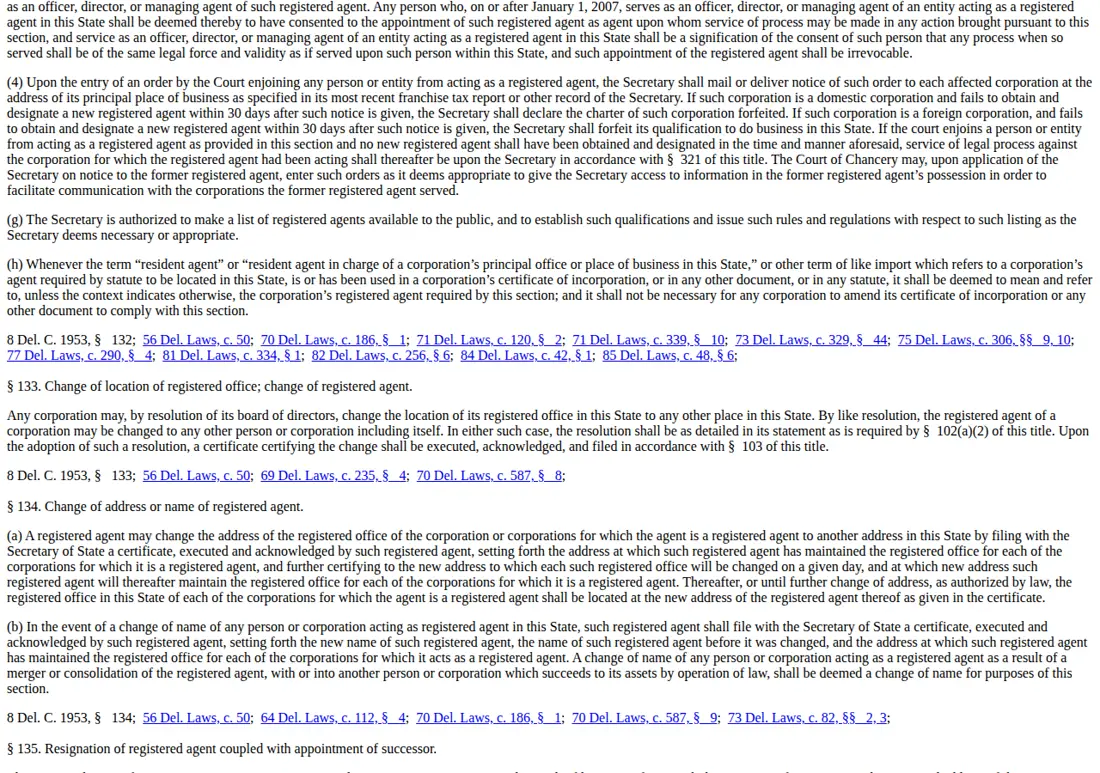
For a Delaware corporation, the change is made under 8 Del. C. § 133. The board of directors adopts a resolution changing the location of the registered office, or changing the registered agent to any other person or corporation, including the corporation itself. Once adopted, a certificate certifying the change is executed, acknowledged, and filed in accordance with § 103. The Division publishes the form as the Certificate of Change of Registered Agent and/or Registered Office. It asks for the corporation name exactly as it appears in the state records, the new agent name and address, and the signature of an authorized officer under § 103, with the name printed legibly beneath.
Delaware distinguishes three different filings that founders constantly confuse. Section 133 is the company changing its own agent or office by board resolution. Section 134 is the agent changing the address of the offices it serves, or changing its own name, by filing its own certificate. Section 135 is a resignation coupled with the appointment of a successor: the agent files a certificate naming the successor, and each affected corporation attaches a statement ratifying and approving the change. The signer and the consent differ in each case — under § 133 the company signs, under § 134 the agent signs, under § 135 the agent files and every affected corporation ratifies — and filing the wrong certificate with the wrong signer is the most common reason a change is returned unfiled.
For a Delaware LLC, the instrument is a certificate of amendment under 6 Del. C. § 18-202, and its caption decides the fee. Section 18-1105(a)(11) sets the fee for receiving and filing any certificate at $200 — except that an instrument that only changes the registered office or registered agent, and is specifically captioned as a certificate of amendment changing only the registered office or registered agent, costs $50, with no additional fee under § 18-206(e). The same $50 change-only rule applies to limited partnerships under § 17-1107(a)(11), where the general filing fee is $100. The caption is the trigger for the lower fee: a certificate captioned as a general amendment pays the general price.
What each state charges to record the change
The state fee is small in every state that matters, and the spread between states is a rounding error next to the cost of a missed lawsuit. The table below uses the figures on the states’ own forms and fee statutes as read on November 21, 2026.
| State | Entity | Form | State fee | Authority |
|---|---|---|---|---|
| Delaware | Corporation | Certificate of Change of Registered Agent/Office | $50 ($5 non-profit) | 8 Del. C. § 133 |
| Delaware | LLC | Certificate of amendment changing only the registered office or registered agent | $50 | 6 Del. C. § 18-1105(a)(11) |
| Delaware | Limited partnership | Certificate/statement of amendment changing only the registered office or registered agent | $50 | 6 Del. C. § 17-1107(a)(11) |
| Wyoming | LLC or corporation | Appointment of New Registered Agent and Office | $5 | Wyoming SOS form |
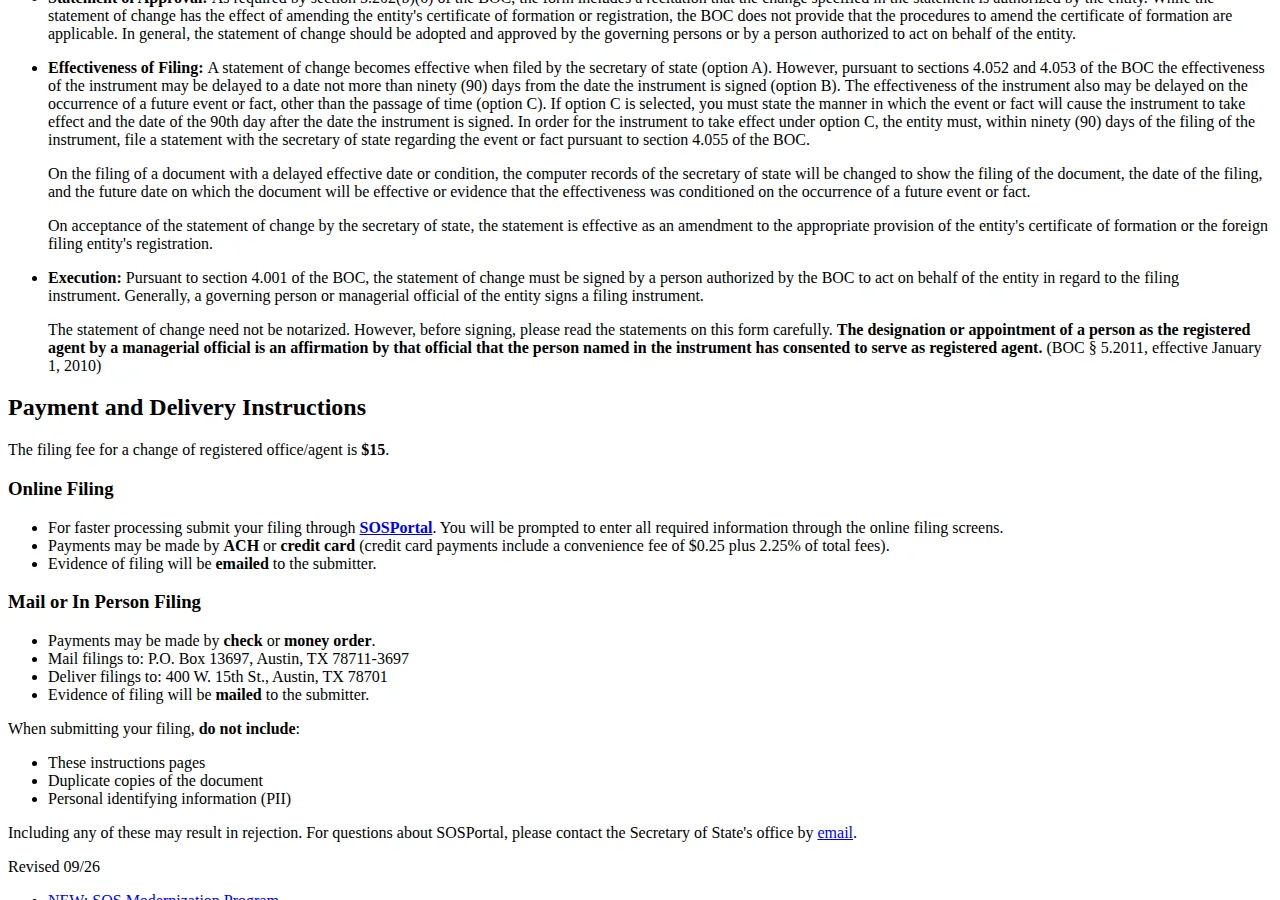
| Texas | Any filing entity | Form 401, Statement of Change of Registered Office/Agent | $15 ($5 non-profit/co-op) | Tex. Bus. Orgs. Code § 5.202 |
Three arithmetic facts follow from that table. First, the three-entity portfolio — a Delaware C-Corp, a Delaware LLC, and a Wyoming LLC — costs $105 in state fees to move in full. Second, the Delaware LLC trap is a $150 overpayment hiding in a caption: a general certificate of amendment costs $200; the change-only certificate costs $50. Third, Texas charges one $15 fee whether the filing changes the agent, the office, or both. None of these fees is the price of the agent service itself: the state fee buys the record; the service fee buys someone present to accept process.
The resignation clock is the real deadline
The filing fee is the cheap part. The expensive part is the clock that starts when an agent resigns. Delaware gives the corporation two 30-day periods, and they run back to back. Under 8 Del. C. § 136(a), an agent may resign without a successor by filing a certificate of resignation, effective 30 days after filing, which must state that written notice was given to the corporation at least 30 days before the filing. Under § 136(b), the corporation must then obtain and designate a new registered agent as a § 133 change, and if it fails to do so before the expiration of 30 days after the agent filed the certificate of resignation, the Secretary of State declares the charter forfeited for a domestic corporation, or forfeits the authority to do business for a foreign corporation. Service then falls on the Secretary of State under § 321.
Sixty days from notice to forfeiture is the whole exposure window, and the corporation spends the first thirty with an agent that has already decided to leave. Wyoming runs the same structure: the agent must notify the entity at least 30 days before resigning, the entity then has 30 days to file a change under W.S. 17-28-103, and the state’s own guide states the consequence plainly — failure to maintain a registered agent results in dissolution or revocation. Reinstating a Wyoming LLC dissolved for having no agent costs $350 — seventy times the $5 change fee. Section 132(f)(4) adds a second forfeiture route: if the Court of Chancery enjoins an agent, and the corporation fails to obtain a new agent within 30 days after notice, the Secretary declares the charter forfeited.
A worked example: three entities, one bad month
Take a founder with a Delaware C-Corp running the business, a Delaware LLC holding the brand IP, and a Wyoming LLC holding one rental property. The commercial agent serving all three gives notice that it will resign in 30 days. The move is three filings, because each entity is a separate record in a separate state. The C-Corp files the Certificate of Change under § 133: $50. The LLC files the change-only certificate: $50. The Wyoming LLC files the Appointment of New Registered Agent and Office: $5. Total state fees: $105. File the Delaware LLC change as a general certificate of amendment instead, and the LLC filing costs $200 — the portfolio total rises to $255 for nothing. Miss the Wyoming 30-day window, and the LLC faces dissolution and a $350 reinstatement, taking the total to $455. File in week one: $105. File in week nine: $455 and an explanation to the bank.
Who should not change agents this way
Do not use a routine change to fix a deeper problem. If the company is already in litigation and the registered agent is the address on the court’s service list, change the agent only with counsel confirming the new address is on the record before the next hearing date — a filing that is mailed but not yet recorded does not redirect service. If the company is foreign-qualified in five states, a Delaware change fixes Delaware only; each qualification state needs its own filing, fee, and consent. If the current agent holds unforwarded mail, settle that first: the new agent inherits forwarding from the appointment date and has no record of what the old agent never sent. And if the agent has stopped responding, treat it as a resignation: start the new appointment immediately, confirm it on the record, and only then cancel the old service. The order is appointment, confirmation, cancellation. Reversing it creates the gap the statute punishes.
Run the change
- Name the new agent and get its consent: confirm the agent’s physical street address, its business hours, and its written consent. Wyoming requires the signed Consent to Appointment as part of the packet.
- Adopt the authorizing act: board resolution for a Delaware corporation under § 133; manager or member approval for an LLC amendment under § 18-202.
- Complete the state form: corporation name exactly as it appears in the state records, current agent name and address, new agent name and address. In Wyoming the former agent’s name and address must match the Secretary of State’s records exactly or the form is returned.
- Caption the Delaware LLC instrument correctly: a certificate of amendment changing only the registered office or registered agent, so the $50 fee applies instead of the $200 general fee.
- Pay the state fee: Delaware corporation $50 ($5 non-profit, $9 per extra page); Delaware LLC $50; Wyoming $5 by check or money order; Texas $15 by ACH or card through SOSPortal, or by check with a mailed Form 401.
- File by the state’s route: Delaware by mail, fax, or in person; Wyoming by mail only — the form cannot be accepted by email, and processing takes up to 15 business days; Texas online through SOSPortal or by mail in duplicate to P.O. Box 13697, Austin, TX 78711-3697.
- Confirm the change on the state record: verify the new agent’s name and address on the Secretary of State’s site before cancelling the old service.
- Update every downstream record: IRS Form 8822-B, the bank’s entity file, the annual report contact, and every foreign qualification state.
- [x] New agent’s written consent in hand before filing.
- [x] Board resolution or LLC approval adopted.
- [x] Delaware LLC instrument captioned as a change-only certificate.
- [x] Fee paid, with a receipt kept.
- [x] New agent confirmed on the record before the old service is cancelled.
- [x] IRS, bank, and foreign qualification records updated.
Failure modes
Most registered agent failures are timing failures. Filing the change after cancelling the old service: the gap between cancellation and recording is a period with no agent, and service during that period goes to the Secretary of State. A name that does not match the state record: Wyoming returns the form when the former agent’s name or address differs by a single character, and the clock restarts on re-filing. The general-amendment caption: a Delaware LLC that files a general certificate of amendment pays $200 for a $50 change. The mailed Wyoming form: it cannot be accepted by email, it takes up to 15 business days, and mailing it in week four of a 30-day window leaves no margin. The foreign qualification gap: changing the domestic state and forgetting the qualification states leaves the company unserved where it actually operates. The unforwarded mail: the old agent’s unforwarded notices do not transfer to the new agent, and a franchise tax bill sitting in the old agent’s office still accrues penalties.
Founder & CEO Insight — Enow A. Jovial
The operation is a sequence: pick the new agent, get its consent, adopt the authorizing act, file the certificate with the correct caption, pay the fee, confirm the change on the record, and only then cancel the old service. The compliance calendar that keeps the agent current is in our foreign qualification playbook, the good-standing certificate that proves the record is clean is in our Delaware good standing playbook, and the dissolution filing that closes an entity properly is in our LLC dissolution playbook. Before the next filing, run the numbers through our pricing calculator to confirm the fee covers the change across every entity you hold.