Ramp vs Brex vs Mercury: Spend Management Pricing, Cashback, and the Real Monthly Cost
A corporate card moves every dollar your company spends, and the platform around it decides how much comes back, how much leaks out in fees, and how many hours finance spends chasing receipts. Ramp, Brex, and Mercury sell the same promise — cards, controls, bill pay, and accounting sync — but price it differently: Ramp charges per user and pays flat cashback, Brex charges per user and pays category points, and Mercury charges a flat monthly fee and pays flat cashback on a card whose limit follows your bank balance.
This comparison answers one question with numbers you can check: at a stated spend level and team size, what does each platform cost, what does it return, and what is left over. Every price comes from the vendor pricing page as published on November 6, 2026, or from a named secondary source where the vendor page prints no figure.
> [!KEY TAKEAWAY]
> Under 200,000 dollars a month in domestic spend, the free tiers decide it: Ramp Free and Mercury both return 1.5 percent cashback with no platform fee, while Brex Essentials returns points worth roughly 1 percent on uncategorised spend. Paid tiers only pay when your team is large, your spend is categorised, or your operations need what they unlock.
How this comparison was built
Three ground rules keep the numbers honest. First, subscription cost and rewards are counted separately, then netted. Second, Brex points are valued at one cent per point, the statement-credit value. Third, every scenario states its spend mix, because Brex pays for categories while Ramp and Mercury pay for volume. All three issue charge cards, paid in full each statement period, with no personal guarantee, and require an incorporated business. Sole proprietors cannot apply.
The three platforms at a glance
| | Ramp | Brex | Mercury |
|---|---|---|---|
| Free tier | Free, 0 dollars per user per month | Essentials, 0 dollars per user per month | Mercury, 0 dollars per month |
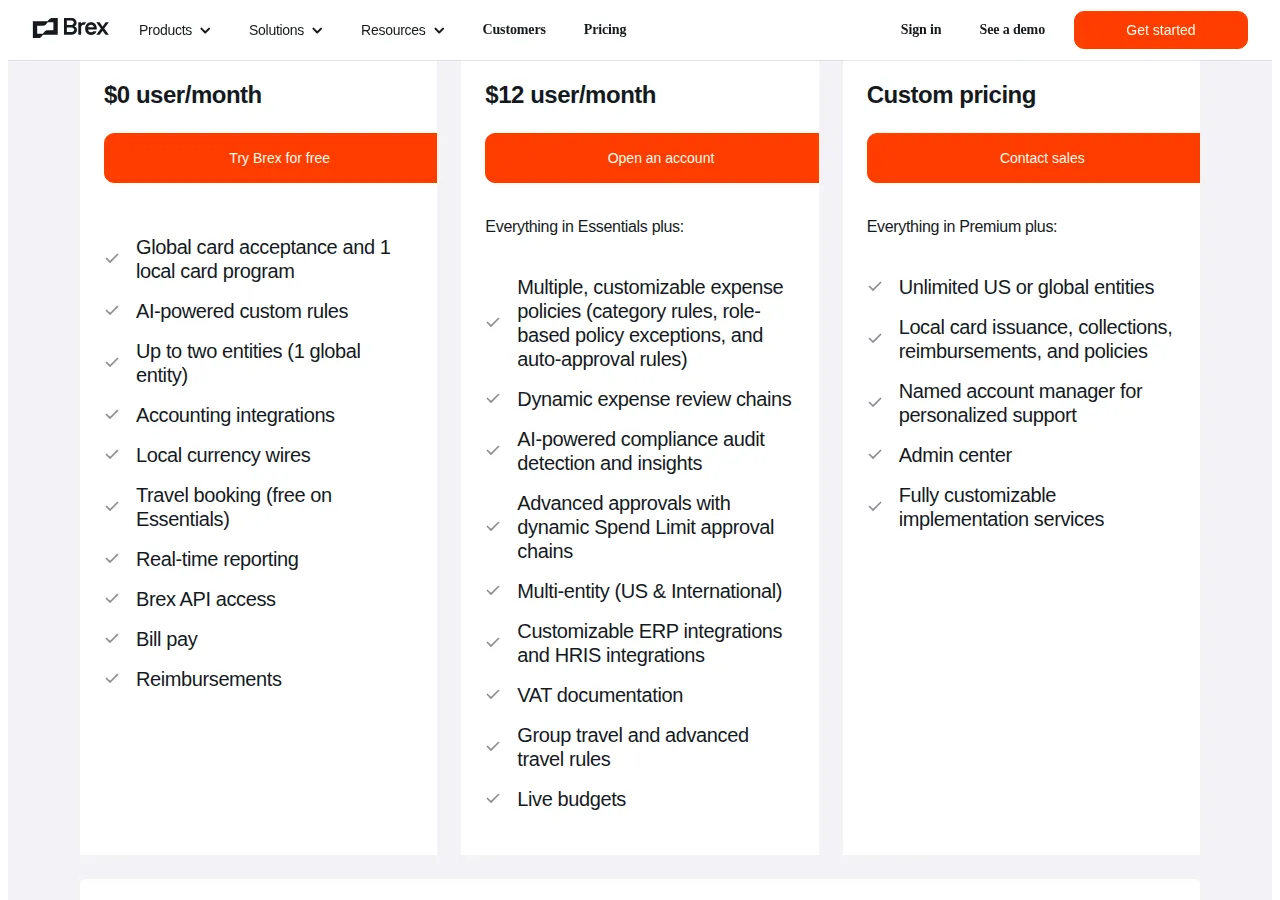
| Paid tier | Plus, 15 dollars per user per month plus a platform fee set by team size | Premium, 12 dollars per user per month | Plus, 29.90 dollars per month; Pro, 299 dollars per month |
| Card reward | Up to 1.5 percent cashback; the exact rate is set by Ramp and varies by customer | Points: 7x rideshare, 4x Brex Travel, 3x restaurants, 2x software, 1x everything else | 1.5 percent cashback on the IO card, unlimited |
| Foreign-exchange charge | Margin of up to 3 percent on non-USD transactions | No foreign transaction fee; exchange-rate markup of up to 3 percent | 3 percent on non-USD card transactions |
Pricing: what you actually pay
Ramp: free to start, 15 dollars per user to scale
Ramp Free costs 0 dollars per user per month and includes unlimited cards, expense management, accounts payable, bill pay by ACH, card, check, and wire, and accounting sync with QuickBooks Online and Xero. Plus costs 15 dollars per user per month plus a platform fee based on team size, with 20 percent off annual billing and a 30-day free trial; it adds AI expense reviews, automated batch payments, procurement, NetSuite and Sage Intacct integrations, and multi-entity support. Enterprise is custom annual pricing. Two costs deserve attention: the Plus platform fee is not printed, so a 10-person team pays at least 150 dollars a month and an unknown amount more; and 1099 filing costs 0.65 dollars per IRS filing, state filing free — 65 dollars a year at 100 contractors.
Brex: free Essentials, 12 dollars per user for Premium
Brex Essentials costs 0 dollars per user per month and includes unlimited corporate cards, expense management, business banking, automated bill pay, travel booking, and real-time reporting; travel booking is free on Essentials. Premium costs 12 dollars per user per month. Enterprise is custom pricing. Brex charges no annual card fee and no foreign transaction fee; its card is a 30-day charge card on the Mastercard network. The pricing page publishes no per-invoice bill-pay fee. New accounts earn 10,000 points for spending 3,000 dollars within the first three months, per NerdWallet and FinanceBuzz — about 100 dollars at one cent per point.
Mercury: flat monthly pricing, no per-user meter
Mercury prices its platform as a flat monthly fee, not a per-user fee. The base plan costs 0 dollars per month and includes checking and savings, corporate cards, expense management, invoicing, bill pay, and accounting connections. Plus costs 29.90 dollars per month on annual pricing — independent 2026 guides describe the standard rate as 35 dollars a month — and adds recurring invoicing, expanded workflows, and priority support. Pro costs 299 dollars per month and adds a dedicated relationship manager and deeper NetSuite features. Bill Pay is free and unlimited; ACH payments, domestic wires, and international wires sent in USD are free. The pricing table lists a 1 dollar charge per ACH debit transaction on the free tier and 0 dollars on paid tiers. One independent 2026 guide reports a 1 percent conversion fee on wires converted to non-USD; that figure comes from a secondary source.
> [!FOUNDER]
> Enow A. Jovial, Founder & CEO: "A corporate card platform is a cost center wearing a rewards costume. Write down your monthly spend, cardholder count, and foreign-currency share — then run the net math. The platform that wins on a headline rate and loses on your numbers is the most expensive choice you can make."
Cards and rewards: the monthly cost math
The scenarios below assume all spend is domestic and in USD; foreign-currency spend is handled separately.
Scenario A: 50,000 dollars a month, 10 cardholders
Ramp Free and Mercury each return 1.5 percent of 50,000 dollars — 750 dollars a month — against zero subscription. Brex Essentials returns 50,000 points at the 1x base rate, worth about 500 dollars.
$
Ramp Free = 0.015 \times 50{,}000 - 0 = 750
$
$
Ramp Plus = 0.015 \times 50{,}000 - (10 \times 15) = 750 - 150 = 600
$
$
Brex Essentials = 50{,}000 \times 1 \times 0.01 - 0 = 500
$
$
Brex Premium = 500 - (10 \times 12) = 500 - 120 = 380
$
$
Mercury Plus = 0.015 \times 50{,}000 - 29.90 = 750 - 29.90 = 720.10
$
$
Mercury Pro = 750 - 299 = 451
$
At 50,000 dollars a month, Ramp Free and Mercury tie at 750 dollars net; every paid tier makes the result worse.
Scenario B: 200,000 dollars a month, 25 cardholders
Assume a realistic mix: 10 percent rideshare, 10 percent travel booked through Brex, 10 percent dining, 20 percent software, 50 percent everything else. Brex points total 460,000, worth about 4,600 dollars. Ramp and Mercury each return a flat 1.5 percent of 200,000 dollars: 3,000 dollars.
$
\text{Brex points} = 140{,}000 + 80{,}000 + 60{,}000 + 80{,}000 + 100{,}000 = 460{,}000 \text{ points} \approx 4{,}600
$
$
Ramp Free = 0.015 \times 200{,}000 - 0 = 3{,}000
$
$
Ramp Plus = 3{,}000 - (25 \times 15) = 3{,}000 - 375 = 2{,}625
$
$
Brex Essentials = 4{,}600 - 0 = 4{,}600
$
$
Brex Premium = 4{,}600 - (25 \times 12) = 4{,}600 - 300 = 4{,}300
$
$
Mercury Plus = 3{,}000 - 29.90 = 2{,}970.10
$
$
Mercury Pro = 3{,}000 - 299 = 2{,}701
$
With this mix, Brex Essentials wins by 1,600 dollars a month — but only if the multipliers apply. The 7x, 4x, 3x, and 2x rates are Brex Exclusive rates, requiring the Brex card to be the company's primary corporate card. Split spend across two cards and you fall back toward 1x; entirely uncategorised, Brex loses to both rivals by 1,000 dollars a month.
Scenario C: 1,000,000 dollars a month, 50 cardholders
At one million dollars a month the same mix scales linearly: Ramp and Mercury each return 15,000 dollars; Brex returns 2,300,000 points, worth about 23,000 dollars. Subscriptions become rounding errors.
$
Ramp Plus = 0.015 \times 1{,}000{,}000 - (50 \times 15) = 15{,}000 - 750 = 14{,}250
$
$
Brex Premium = 2{,}300{,}000 \times 0.01 - (50 \times 12) = 23{,}000 - 600 = 22{,}400
$
$
Mercury Pro = 15{,}000 - 299 = 14{,}701
$
A travel-heavy, rideshare-heavy, software-heavy company earns roughly 8,000 dollars a month more on Brex; a company whose million dollars is mostly undifferentiated vendor payments earns the same 15,000 dollars on Ramp or Mercury. Caution: Ramp states its rate as up to 1.5 percent, set per customer — confirm your assigned rate in writing.
> [!TIP]
> Run Scenario B with your own mix: replace the percentages with your last three months of card statements, apply each platform's rates, and subtract the subscription.
Bill pay and AP automation
Ramp includes AP on every tier: OCR invoice extraction, approval workflows, and payment by ACH, card, check, and wire. Plus adds auto-coded line items, automated batch payments, and payment-release approval. The per-unit cost is the 1099 fee: 0.65 dollars per IRS filing, state filing free — 65 dollars a year at 100 contractors.
$
\text{Ramp 1099 cost} = 100 \times 0.65 = 65 \text{ per year}
$
Mercury Bill Pay is free and unlimited on every plan, with automatic invoice extraction and accounting sync. The cost edge is the ACH debit charge: 1 dollar per transaction on the free tier, 0 dollars on paid tiers — 30 ACH debits a month already costs more than the 29.90-dollar Plus subscription.
$
ACH debit breakeven = 29.90 \div 1 = 29.9 \text{ debits per month}
$
Brex includes automated bill pay in all three tiers, and the pricing page publishes no per-invoice fee.
Foreign exchange and international spend
All three charge for conversion, even when they advertise no foreign transaction fee. Take a 20,000-dollar month of non-USD card purchases. Ramp applies a margin of up to 3 percent, per independent 2026 guides. Mercury charges a 3 percent fee, printed on its pricing page. Brex charges no foreign transaction fee, but NerdWallet reports an exchange-rate markup of up to 3 percent — the fee is zero, the conversion is not.
$
Ramp net FX = (20{,}000 \times 0.03) - (20{,}000 \times 0.015) = 600 - 300 = 300
$
$
Mercury net FX = (20{,}000 \times 0.03) - (20{,}000 \times 0.015) = 600 - 300 = 300
$
$
Brex net FX = (20{,}000 \times 0.03) - (20{,}000 \times 0.01) = 600 - 200 = 400
$
Brex issues local-currency cards in more than 50 countries, so teams with employees abroad can skip conversion entirely. Ramp Enterprise adds local-currency issuing in more than 30 countries, but only on the custom-priced tier. Mercury is weakest for card spend but strongest for wires: international wires sent in USD are free.
> [!WARNING]
> Do not choose a card on the words "no foreign transaction fee" alone. Brex charges no such fee and can still cost up to 3 percent on conversion through its exchange-rate markup. Ask each vendor for the markup on your currencies, in writing, before you sign.
Travel and eligibility
Brex Travel is included on Essentials with free booking, and the 4x rate on flights and prepaid hotels booked through Brex drives much of Scenario B: 20,000 dollars of monthly travel earns 80,000 points, about 800 dollars at one cent per point. Mercury has no travel platform of comparable depth. Brex underwrites against funding or revenue — independent 2026 guides report roughly 50,000 dollars in the bank for funded startups, or around 1 million dollars or more in revenue for self-funded companies. Mercury IO sets its limit from account balances, and 30-day terms require at least 15,000 dollars deposited; below that the card autopays daily, per independent guides citing Mercury's credit page.
The decision table
| Your situation | Pick | Authority |
|---|---|---|
| Under 50,000 dollars a month, domestic spend, small team | Ramp Free or Mercury, tied at 1.5 percent with no fee | Ramp pricing page; Mercury pricing page |
| 200,000 dollars a month with heavy rideshare, travel, dining, and software | Brex Essentials, about 4,600 dollars a month in points at the stated mix | NerdWallet Brex review; Brex pricing page |
| 200,000 dollars a month, mostly undifferentiated vendor payments | Ramp Free or Mercury, 3,000 dollars flat | Ramp pricing page; Mercury pricing page |
| Heavy international card spend | Brex, with local-currency cards in 50-plus countries | Nav Brex review; NerdWallet Brex review |
Operator boundaries: who each platform is not for
Ramp is not for a team that needs its Plus total cost printed before committing — the platform fee is unpublished — or for a company whose spend is mostly foreign-currency. Brex is not for a team splitting spend across two cards, because the multipliers require it to be the primary card; nor for a team that wants cash rather than points. Mercury is not for a team needing a travel platform, deep procurement, or local-currency cards at scale — and its IO limit follows the account balance.
For the banking half, read our Mercury vs Relay vs Brex on FDIC sweep and international underwriting; for the acceptance side, our Stripe vs Square vs PayPal payment processing fees playbook; for funding a gap, the business line of credit vs term loan vs invoice factoring playbook. Before committing, run your numbers through the profit calculator.
Execution checklist
1. Pull three months of card statements; split spend into rideshare, travel, dining, software, and other.
2. Count cardholders.
3. Run Scenario B with your mix and headcount.
4. Price your foreign-currency share with the 20,000-dollar test; get markups in writing.
5. Confirm Ramp's cashback rate and Plus platform fee in writing.
6. Confirm Brex Exclusive multipliers apply and Brex will be your primary card.
7. Apply to one platform; issue virtual cards first; run one full cycle before migrating the team.
8. Reconcile the first statement against the forecast; if the gap exceeds 10 percent, find the cause before cycle two.