Purchase Price Allocation (ASC 805) Playbook
Purchase Price Allocation (ASC 805) Playbook
A purchase price allocation — PPA — is the accounting that happens on the day a deal closes. The buyer paid one price for a whole company; the allocation breaks that price into pieces, each measured at acquisition-date fair value, and whatever is left over becomes goodwill. This playbook runs the operation on one stated deal — a $12,000,000 cash acquisition — from classification to Form 8594. The impairment testing that follows a PPA lives in the goodwill-impairment-testing-asc-350-playbook; the deferred-revenue piece is worked in the deferred-revenue-saas-balance-sheet-recognition-playbook.
Step 1: Is it a business combination or an asset acquisition?
The first question is not how to allocate — it is whether ASC 805 applies at all. A business combination is an acquirer obtaining control of a business; an asset acquisition is a purchase of assets that do not amount to a business. The screen test in ASC 805-10-55-5A, narrowed by ASU 2017-01, decides: if substantially all of the fair value of the gross assets acquired is concentrated in a single identifiable asset or a group of similar identifiable assets, the set is not a business.
In a business combination, identifiable assets and liabilities are measured at acquisition-date fair value and the residual is goodwill (ASC 805-30-30-1). In an asset acquisition, cost is allocated on relative fair value and no goodwill is recognised (ASC 805-50-30-3). The measurement period in Step 8 exists only for business combinations.
Step 2: The acquisition method, in four moves
ASC 805 requires the acquisition method for every business combination; pooling-of-interests accounting is no longer permitted. The four moves: identify the acquirer; determine the acquisition date, when control legally passes; recognise and measure the identifiable assets acquired, the liabilities assumed, and any noncontrolling interest (NCI), generally at acquisition-date fair value (ASC 805-20-30-1); and recognise and measure goodwill or a bargain purchase gain — the residual after identifiable net assets are netted against the consideration transferred plus NCI plus any previously held equity interest.
Deferred taxes follow ASC 740, not fair value (Step 9). Everything else is fair-valued, including intangibles the target never recognised.
Step 3: Find the intangibles the target never recorded
The most valuable part of most deals is invisible on the target's balance sheet. ASC 805 requires the acquirer to recognise, separately from goodwill, every identifiable intangible that meets the contractual-legal criterion or the separability criterion: it arises from a contract or legal right, or it can be separated from the business and sold, transferred, licensed, rented, or exchanged. Customer relationships, trade names, patents, and non-compete agreements are the usual finds; the assembled workforce itself stays inside goodwill.
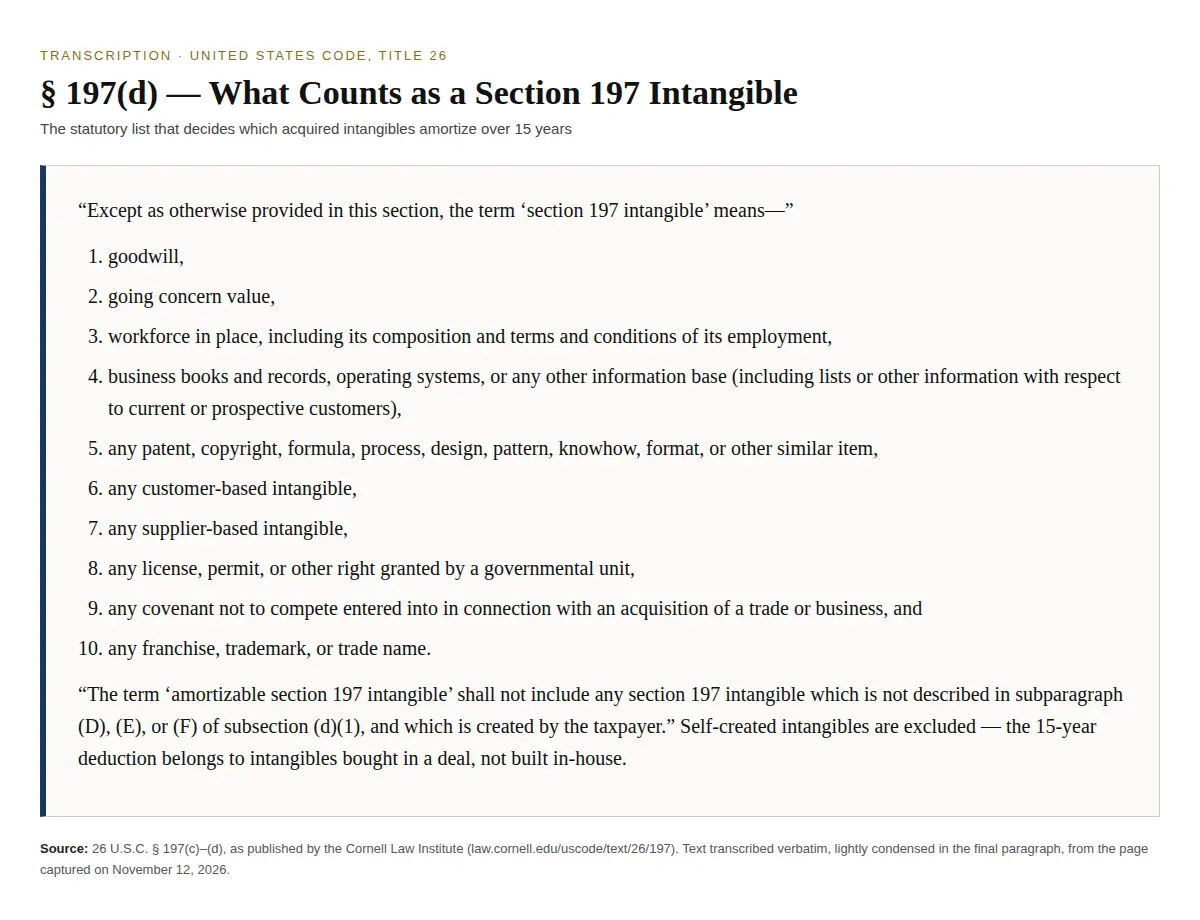
Section 197(d)(1) defines a section 197 intangible as goodwill, going concern value, workforce in place, business books and records, patents and similar items, customer-based and supplier-based intangibles, government licenses, covenants not to compete, and franchises, trademarks, and trade names.
Step 4: Worked example — allocating $12,000,000
The deal, stated as assumptions: Acquirer Co., a C-Corp, buys 100 percent of Target Co. for $12,000,000 in cash on July 1, 2026. The target's book net assets are $4,100,000. Valuations put them at the fair values below. Cash consideration is $12,000,000; for § 1060 purposes the total consideration is $14,800,000, because liabilities assumed count as consideration.
| Identifiable asset / liability | Fair value | § 1060 class |
|---|---|---|
| Cash | $400,000 | Class I |
| Accounts receivable | $900,000 | Class III |
| Inventory | $1,500,000 | Class IV |
| Property, plant, and equipment | $3,200,000 | Class V |
| Customer relationships | $1,800,000 | Class VI |
| Trade name | $700,000 | Class VI |
| Covenant not to compete | $300,000 | Class VI |
| Patent | $500,000 | Class VI |
| Total identifiable assets | $9,300,000 | |
| Accounts payable | ($800,000) | — |
| Deferred revenue | ($350,000) | — |
| Debt assumed | ($1,650,000) | — |
| Total liabilities assumed | ($2,800,000) | |
| Identifiable net assets | $6,500,000 |
Goodwill is the residual — consideration less identifiable net assets:
Under ASC 350, goodwill is not amortized; it is tested for impairment at least annually at the reporting-unit level, and the goodwill-impairment-testing-asc-350-playbook runs that test. The cautionary case is AOL Time Warner: in 2002 the merged company reported a $98.7 billion net loss — then the largest annual corporate loss in US history — after a $54 billion first-quarter goodwill write-down under FAS 142 and a further $45.5 billion charge in the fourth quarter. Overstated goodwill does not stay hidden; the impairment test collects it.
Step 5: The tax allocation — the § 1060 residual method
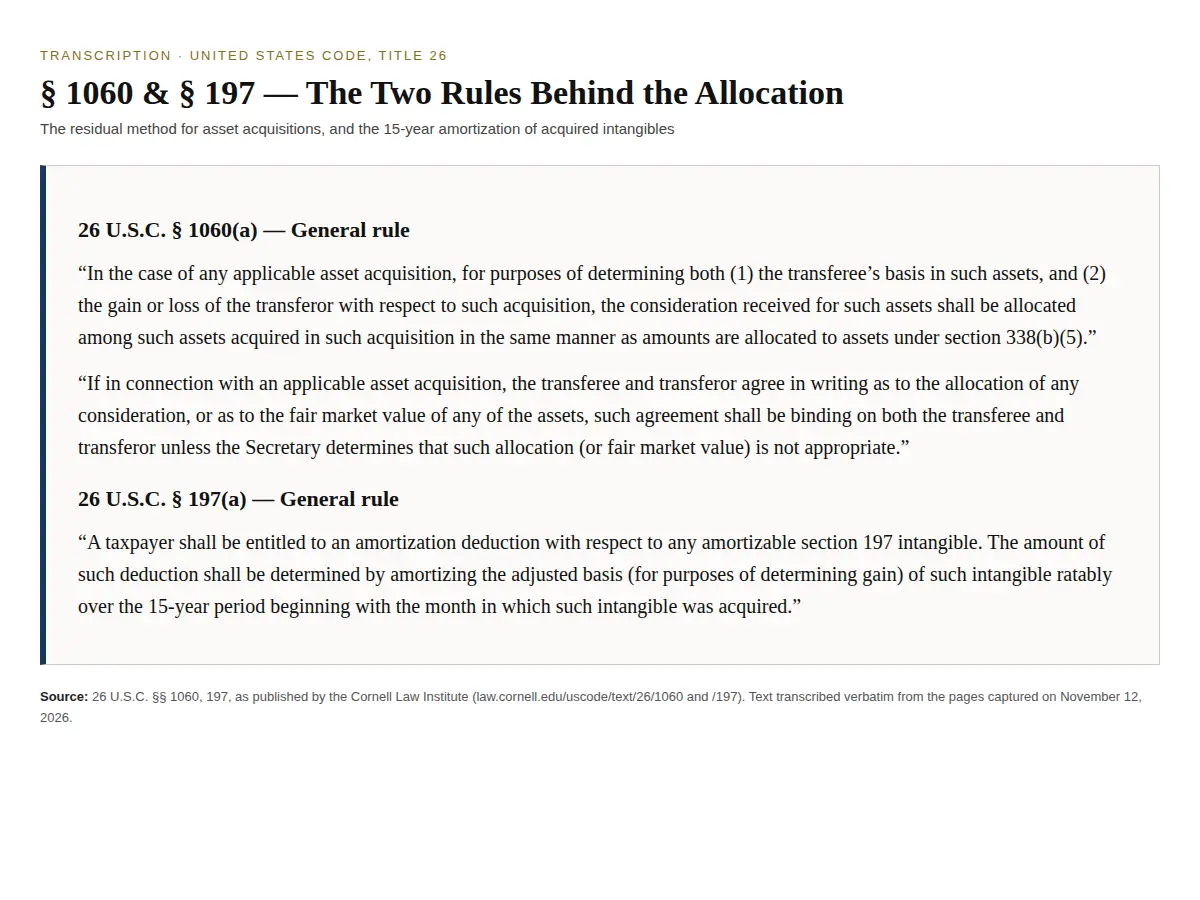
Section 1060(a) requires that, in an applicable asset acquisition, the consideration "shall be allocated among such assets acquired in such acquisition in the same manner as amounts are allocated to assets under section 338(b)(5)." The mechanism is the residual method in the Instructions for Form 8594:
| Class | What it holds | Tax treatment | Authority |
|---|---|---|---|
| Class I | Cash and general deposit accounts | Allocated first, dollar for dollar | § 1060(a); Form 8594 |
| Class II | Actively traded personal property; certificates of deposit; foreign currency | Fair value, in class order | Reg. § 1.338-6 |
| Class III | Assets marked to market annually; debt instruments including accounts receivable | Fair value, in class order | Reg. § 1.338-6 |
| Class IV | Stock in trade / inventory; property held primarily for sale to customers | Fair value, in class order | Reg. § 1.338-6 |
| Class V | All other assets — furniture, fixtures, buildings, land, vehicles, equipment | Fair value, in class order | Reg. § 1.338-6 |
| Class VI | § 197 intangibles except goodwill and going concern value | Fair value, in class order | § 197(d); Reg. § 1.338-6 |
| Class VII | Goodwill and going concern value | The residual — whatever is left | § 1060(a); Reg. § 1.338-6 |
Reduce the consideration by Class I, allocate to Classes II through VI in that order, each asset in proportion to its fair value, and only then allocate what remains to Class VII goodwill. No asset other than Class VII may be allocated more than its fair market value on the purchase date.
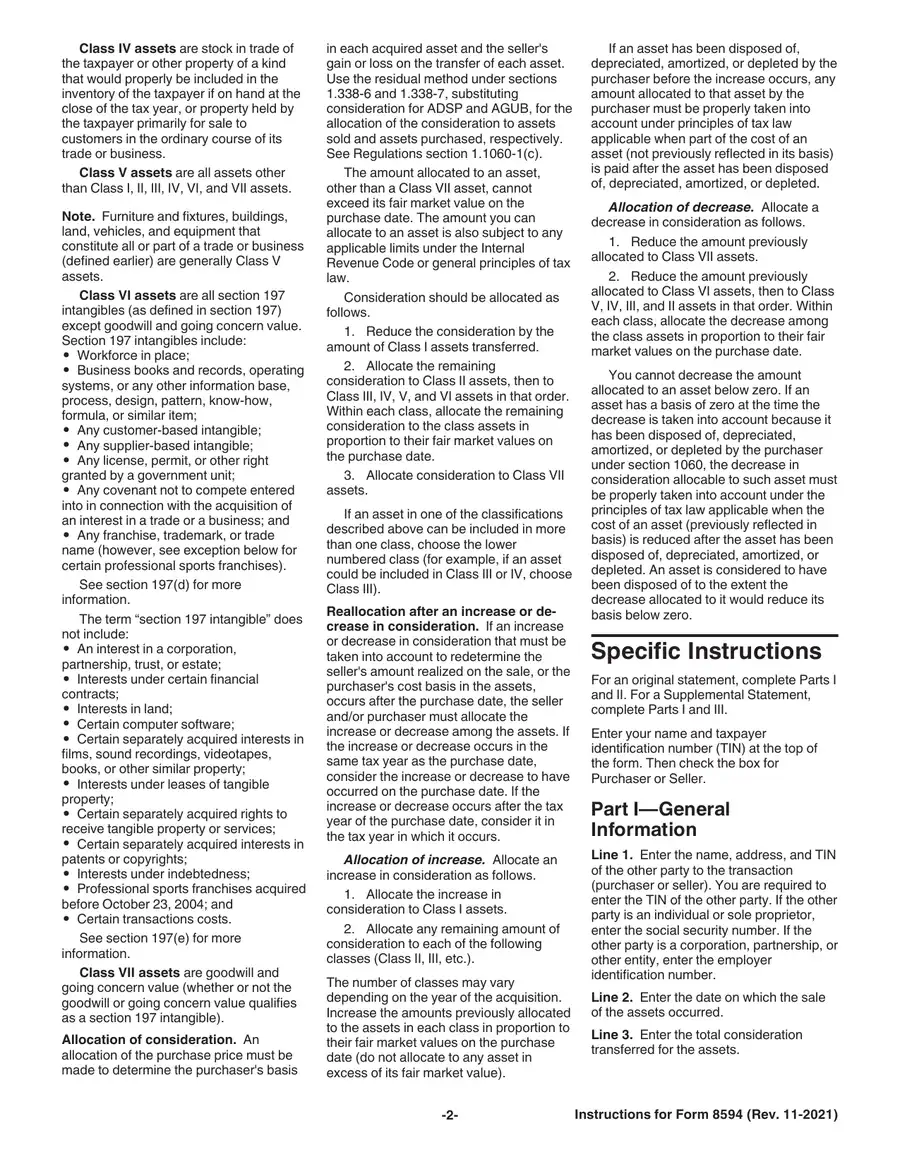
Both buyer and seller file Form 8594 with their return for the year of the acquisition — the buyer completes Parts I and II, the seller Parts I and III. The exceptions are narrow: a like-kind exchange under § 1031, or a partnership-interest transfer. A missed or incorrect Form 8594 draws penalties under §§ 6721 through 6724; the research-credit interaction for acquired R&D is worked in the irc-section-41-research-credit-asc-vs-regular-method.
Step 6: The § 197 clock — 15 years, ratably, from the month of acquisition
Section 197(a) is one sentence and it decides the tax value of the entire intangible schedule: "A taxpayer shall be entitled to an amortization deduction with respect to any amortizable section 197 intangible. The amount of such deduction shall be determined by amortizing the adjusted basis (for purposes of determining gain) of such intangible ratably over the 15-year period beginning with the month in which such intangible was acquired." Our deal's amortizable § 197 base is $3,300,000 of Class VI intangibles plus $5,500,000 of goodwill — $8,800,000 in total:
Per asset: $120,000 on customer relationships, $46,666.67 on the trade name, $20,000 on the non-compete, $33,333.33 on the patent, $366,666.67 on goodwill. Because the deal closes July 1, the first-year deduction covers six months, $293,333.33, and the clock runs 180 months from July 2026. Two limits: self-created intangibles are excluded (§ 197(c)(2)), and the anti-churning rules in § 197(f)(9) block deductions on intangibles shuffled between related parties.
Step 7: When the price is less than the net assets — bargain purchase
Not every deal produces goodwill. If the fair value of the identifiable net assets exceeds the consideration transferred plus NCI, the formula goes negative and the acquirer has made a bargain purchase. The rule is to reassess first: ASC 805 requires the acquirer to re-examine whether all identifiable assets and liabilities have been recognised and correctly measured before recognising any gain — a bargain purchase is usually a missed intangible, not a free lunch. If the gain survives, it is recognised in earnings on the acquisition date.
On our deal's numbers, the same $6,500,000 of identifiable net assets bought for $5,900,000 instead of $12,000,000 would produce a $600,000 bargain purchase gain ($6,500,000 − $5,900,000), recognised immediately in earnings.
Step 8: The measurement period — one year to finish the job
Fair values are rarely final on the day a deal closes. ASC 805 gives the acquirer a measurement period of up to one year from the acquisition date to finish incomplete valuation work (ASC 805-10-25-13 through 25-19). During that window, provisional amounts may be adjusted as new information arrives about facts existing at the acquisition date. Adjustments are recognised in the period determined, with the offset to goodwill.
In our deal, suppose the property, plant, and equipment valuation is provisional at $3,200,000 and the final appraisal, received in month nine, puts it at $3,050,000. Identifiable net assets fall by $150,000 to $6,350,000, and goodwill rises by the same $150,000:
Step 9: Book versus tax — where the two allocations diverge
The book allocation and the tax allocation agree on the shape of the deal and diverge on two points that decide real money. First, form: in a taxable asset purchase, the buyer's tax basis steps up to the allocated fair values, so the Step 6 § 197 deductions are real. In a stock purchase — a non-taxable acquisition — the tax basis carries over, the book step-up creates a taxable temporary difference, and a deferred tax liability is recorded under ASC 740. On our numbers, the $2,400,000 step-up from $4,100,000 of book net assets to $6,500,000 of fair value, at the 21 percent federal corporate rate (§ 11(b)), produces a $504,000 deferred tax liability ($2,400,000 × 0.21).
The CPA who signs the return reconciles the book goodwill to the tax schedule every year: the GAAP carrying amount, the section 197 basis, and the deferred tax rollforward sit on one schedule, with the EIN on the Form 8594 and the LLC, S-Corp, or C-Corp election noted beside it. Second, goodwill: not amortized for book under ASC 350, but a $366,666.67 annual deduction for tax under § 197.
The build operation, start to finish
- Run the ASC 805 screen test before ordering valuations.
- Fix the acquisition date in the purchase agreement.
- Commission independent valuations; build the separable-or-contractual-legal schedule.
- Allocate in § 1060 order, capping every class except Class VII at fair market value.
- Put the written allocation agreement in the purchase agreement before closing.
- Book the opening balance sheet and set the § 197 schedule from the acquisition month.
- File Form 8594 with the return for the year of acquisition.
- Run the measurement period as a project: provisional items listed, final valuations inside one year.
- Reconcile book and tax goodwill every year; carry the difference into the impairment test and the tax provision.
Founder & CEO Insight — Enow A. Jovial