The entity the board requires, not the one you picked
A dentist in Buffalo files articles of organization for a plain LLC, opens a practice, and bills patients for a year. Then the licensing board writes: the entity is not authorized to render professional services, the name is wrong, and the filing should have gone through the Office of the Professions first. The LLC is not dissolved — it is the wrong vehicle, and the fix is a conversion, a name change, and a year of paperwork done twice. The professional limited liability company exists for exactly this case: in New York and Texas, a licensed professional who wants the LLC form must use the professional variant, with the licensing board in the loop from the first filing.
A PLLC is an LLC formed to provide a professional service, owned and governed by people licensed to provide it. The professions it covers are the licensed ones — medicine, dentistry, veterinary medicine, law, accounting, architecture, engineering, licensed clinical social work, mental health counseling, and the rest of the regulated list. The PLLC changes ownership and licensing, not tax: a single-member PLLC is disregarded like a single-member LLC, a multi-member PLLC is taxed as a partnership by default, and an S-corporation election on Form 2553 is available on the same terms. What it changes is who may own it, who must approve it, and what the shield covers.
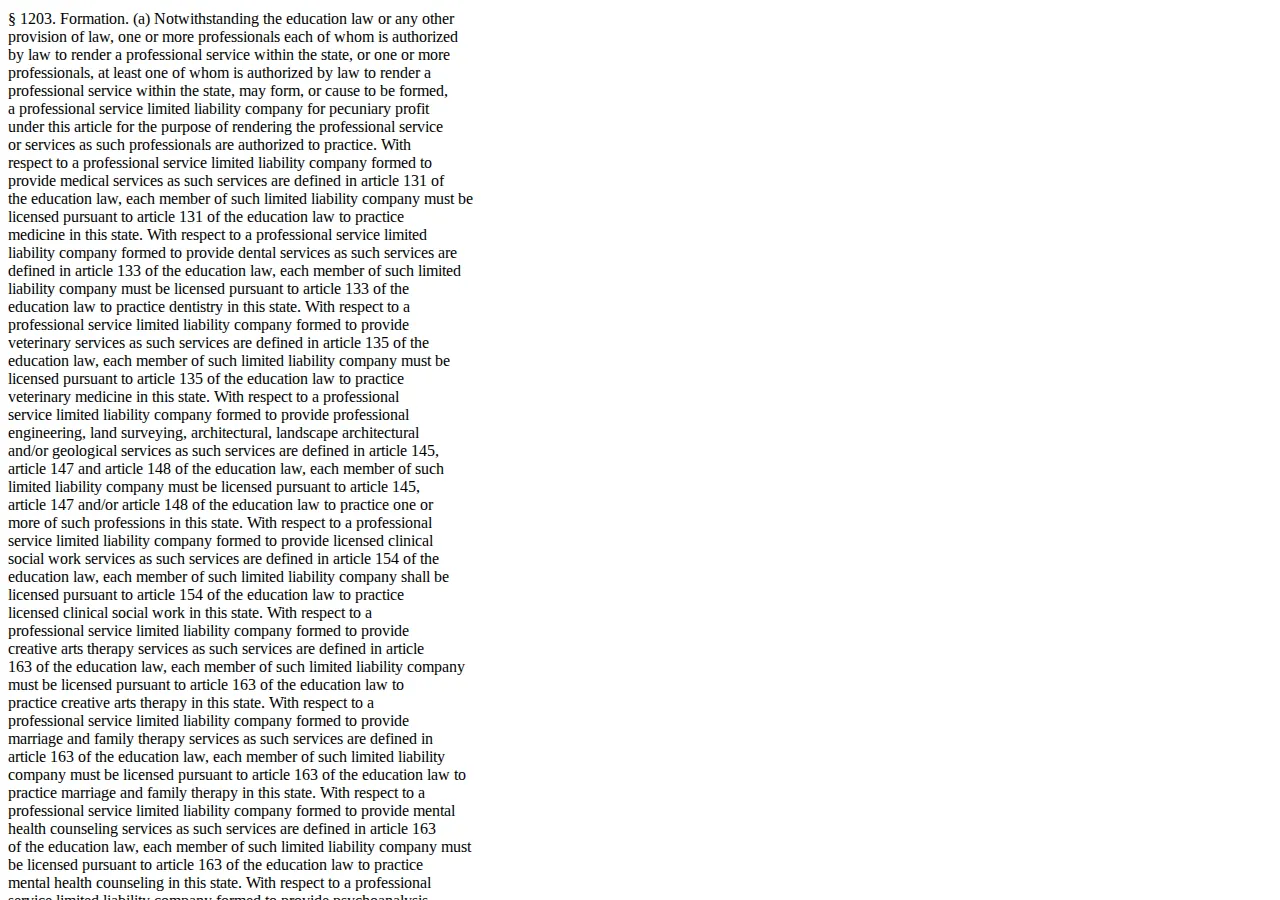
New York: § 1203 formation, and the all-licensed rule
New York LLC Law § 1203 is the formation statute. One or more professionals authorized by law to render a professional service may form a professional service limited liability company for the purpose of rendering that service. The articles of organization must state the profession or professions the company will practice and the names and residence addresses of all original members and managers — the state wants the people, not just the entity, on the record from day one.
For eight professions the rule is absolute: medicine, dentistry, veterinary medicine, licensed clinical social work, mental health counseling, psychoanalysis, creative arts therapy, and marriage and family therapy require that every member be licensed to practice that profession in New York. There is no silent non-licensed partner, no investor member, no spouse holding a share for estate planning. A PLLC may provide multiple professional services — law and accounting under one roof, for example — except for those eight, which are single-service only. A dental practice cannot add a mental-health counseling arm inside the same PLLC; it forms a second one.
The name rule follows the same logic. A New York PLLC name must end with "Professional Limited Liability Company" or "PLLC", and it must include a member's first and last name, or initial and last name. The name is a license disclosure, not a brand: the public reads the name and sees whose license stands behind the practice.
New York: § 1205, and where the shield stops
The liability rule is the part founders misread. New York LLC Law § 1205(a) provides that each member, manager, employee, and agent of a professional service LLC is personally and fully liable for any negligent or wrongful act or misconduct by them, or by any person under their direct supervision and control, while rendering professional services. Read that twice: your own malpractice is yours, and your supervised staff's malpractice is yours too. The PLLC shields the business debts — the lease, the supplier invoices, the loan — and it shields you from a partner's malpractice that you did not supervise. It does not shield you from your own hands or from the people you direct.
Section 1205(c) adds that the licensing authority's jurisdiction is undiminished: the board can still discipline you, suspend you, or revoke your license whatever the entity form. The practical consequence is insurance. A PLLC without professional liability insurance is a shield with a hole exactly where the risk is: the premium is the price of the protection the statute does not give. Our single-member LLC charging-order playbook covers what the LLC shield does protect — a creditor's claim against your membership interest — and the boundary is the same lesson: the shield protects the business from your creditors, not your patients from you.
New York: the licensing gate, the filing, and the publication
Forming a New York PLLC is a two-door process, and the order matters. The State Education Department's Office of the Professions publishes a Domestic PLLC Checklist, and the first door is theirs: articles of organization under § 1203, a $10.00 fee per member or manager, a Corporate Contact Information Form, and an Affidavit: Business Name PPE. NYSED reviews the filing, attaches a Certificate of Authority, and returns it. Only then does the second door open: file with the Department of State, which charges a $200 filing fee for the articles of organization. After the state files the articles, a certified copy goes back to NYSED. A PLLC that files with the Department of State first, without the Certificate of Authority, gets the filing rejected — the board's sign-off is a precondition, not a courtesy.
Then comes the part founders forget to budget: publication. New York LLC Law § 206 requires publication in two newspapers, once a week for six weeks, in the county of the PLLC's office. The cost varies by county and is set by the newspapers, not the state — in Manhattan it can exceed $1,000, in an upstate county it can be a few hundred dollars. The first-year arithmetic is therefore:
A two-member dental PLLC in Manhattan pays $200 + $20 + publication of, say, $1,200 — $1,420 before the practice earns a dollar. The same PLLC upstate might pay $200 + $20 + $300. Run the county number before you file, because the publication bill is the largest line and the only one you cannot predict from the statute. Our break-even calculator turns that first-year cost into the revenue the practice must bill before the entity pays for itself.
Texas: Chapter 301 and the $300 certificate
Texas organizes professional entities in Title 7 of the Business Organizations Code, and Chapter 301 is the definitions chapter that decides who may own one. A "professional entity" is a professional association, a professional corporation, or a professional limited liability company; a "professional limited liability company" is an LLC formed to provide a professional service governed under the title; and a "professional individual" is a person licensed to provide the same service in Texas or another jurisdiction. Section 301.001(c) preserves the professional relationship: the title does not affect the professional or confidential relationship between the professional and the client, or the legal remedies for error, omission, a negligent or incompetent act, or malfeasance. The entity changes the business form, not the duty.
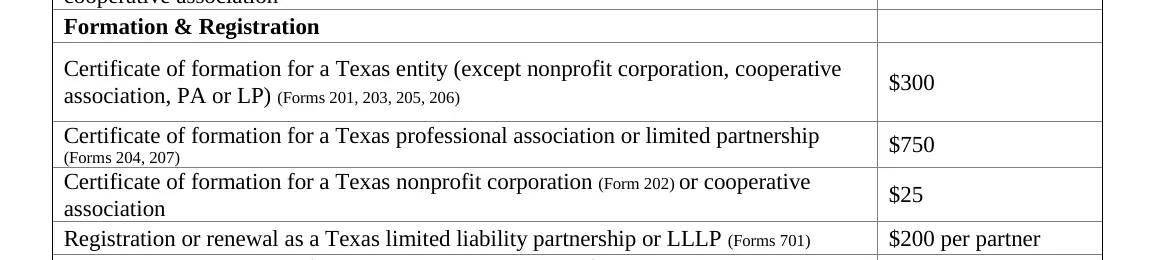
Section 301.007(a) is the ownership gate: a person may be an owner of a professional entity, or a governing person of a PLLC, only if an authorized person — licensed to provide the service. One exception matters for physicians: § 301.003(3) excludes the practice of medicine by physicians from the definition of "professional corporation", so Texas physicians use a professional association under Chapter 302 or a PLLC under Chapter 304, not a PC. The certificate of formation for a Texas PLLC is Form 206, and the Secretary of State's fee schedule (Form 806, revised September 2026) sets the fee at $300 for a certificate of formation on Forms 201, 203, 205, or 206. A professional association certificate costs $750 on a different form, and foreign entity registration is $750 — the $300 figure is the domestic PLLC's, and the form number is the check.
California: no PLLCs at all
California is the counterexample. California Corporations Code § 17701.04(e) provides that a limited liability company may not render professional services. There is no California PLLC, no workaround, and no filing the Secretary of State will accept. Licensed professionals in California form a professional corporation under Corporations Code § 13400 et seq. — the PC is the only entity form the state offers the licensed professions, and it carries its own rules: shareholders must be licensed, the corporation's name must carry the professional designation, and the filing fee is $100 with the $800 minimum franchise tax due annually. A founder who moves a New York PLLC's practice to California does not convert the entity; the founder forms a California PC and winds the PLLC's California operations down.
Delaware: the correction that saves a filing
Delaware has no separate PLLC statute, and the citation that is sometimes offered as one is wrong. 6 Del. C. § 18-1104 is titled "Cases not provided for in this chapter" — the 2013 gap-filler that lets the Court of Chancery apply fiduciary-duty principles where the LLC Act is silent. It says nothing about professional licensing, nothing about who may own a professional LLC, and nothing about formation. A Delaware LLC may render professional services as an ordinary LLC under the Delaware LLC Act, and the licensing board's rules still govern the professional — the board, not the entity statute, decides who may practice. The certificate of formation fee is $90 under § 18-1105, and the annual franchise tax is $300. The correction matters because a founder who files in Delaware expecting a PLLC regime will find no licensing gate at the state level and no statutory protection beyond the ordinary LLC — and will still have to satisfy the licensing board in the state where the services are actually rendered.
| State | Entity for a licensed professional | Filing fee | Licensing gate | Authority |
|---|---|---|---|---|
| New York | PLLC | $200 + $10/member + publication | NYSED Certificate of Authority before DOS filing | NY LLC Law §§ 1203, 1205, 206 |
| Texas | PLLC (Form 206) | $300 | Owner must be an authorized person | Tex. BOC §§ 301.003, 301.007(a) |
| California | Professional corporation | $100 + $800/yr franchise tax | No PLLC; LLCs may not render professional services | Cal. Corp. Code § 17701.04(e) |
| Delaware | Ordinary LLC | $90 + $300/yr tax | None at entity level; licensing board governs | 6 Del. C. §§ 18-1104, 18-1105 |
The formation routine
- Confirm the profession needs a PLLC: check your licensing board's entity rules and your state's statute — New York and Texas require it, California forbids it, Delaware has no PLLC form.
- Verify every owner's license: for New York's eight single-service professions every member must hold the license; in Texas every owner must be an authorized person.
- Clear the name with the board: the name must end PLLC and carry a member's name in New York; get the board's name approval before filing.
- File the licensing gate first: New York — NYSED Certificate of Authority before the Department of State; Texas — Form 206 with the $300 fee.
- Publish, then keep the proof: two newspapers, once a week for six weeks; file the affidavits of publication with the articles.
- Put the operating agreement and insurance in place: the agreement governs decisions and exits — see the LLC operating agreement breakdown — and professional liability insurance covers what § 1205(a) leaves personal.
Three mistakes that cost a practice
Forming a plain LLC first and converting later is the most expensive mistake: the conversion costs a second filing, a name change, and board approval, and the practice operated under the wrong entity in between. If the conversion is not available, the LLC dissolution playbook covers winding the wrong entity down. Adding a non-licensed owner is the second: in New York's eight professions and in Texas, the filing is defective and the board can refuse the Certificate of Authority. Treating the shield as malpractice cover is the third: § 1205(a) keeps your own work and your supervised staff's work personal, and no entity form changes that. Insurance is the cover; the PLLC is the frame.
- [x] Profession confirmed — the board requires a PLLC, or the state forbids one.
- [x] Every owner licensed — § 1203 / § 301.007(a) checked.
- [x] Board sign-off obtained — Certificate of Authority in hand before the DOS filing.
- [x] Publication done — two newspapers, six weeks, affidavits kept.
- [x] Insurance bound — professional liability in place before the first patient or client.
Founder & CEO Insight — Enow A. Jovial