> [!FOUNDER]
> "Founders buy a Wyoming or Delaware LLC for the wrong reason: they want a wall. A charging order is not a wall. It is a valve. It controls what leaves the company and when, and it only works if the operating agreement, the distribution policy, and the state of the lawsuit all point the same way. Get one of those wrong and the valve is open." — Enow A. Jovial, Founder & Chief Executive Officer
What a charging order actually does
A charging order is a court order against a member's transferable interest — the economic right to receive distributions — not against the company. When a personal creditor obtains a judgment against you and then obtains a charging order, the LLC must pay that creditor any distribution it would otherwise have paid you, up to the unsatisfied judgment. The creditor does not become a member, does not vote, does not manage, and cannot order the LLC to sell assets or declare a distribution.
That last point is the whole protection. A creditor who cannot force a distribution can wait a long time for nothing, and in a company that retains earnings instead of distributing them, the wait produces zero cash. The single-member question is whether that limit holds when there are no innocent co-members to protect — because the original policy reason for the charging order was to stop one member's personal creditor from wrecking a business owned by other people too.
> [!KEY TAKEAWAY]
> Wyoming and Delaware answer the single-member question the same way on paper: the charging order is the exclusive remedy whether the LLC has one member or many. The real differences are enforcement geography, the redemption right, and the annual state cost — not the headline promise.
The two statutes, side by side
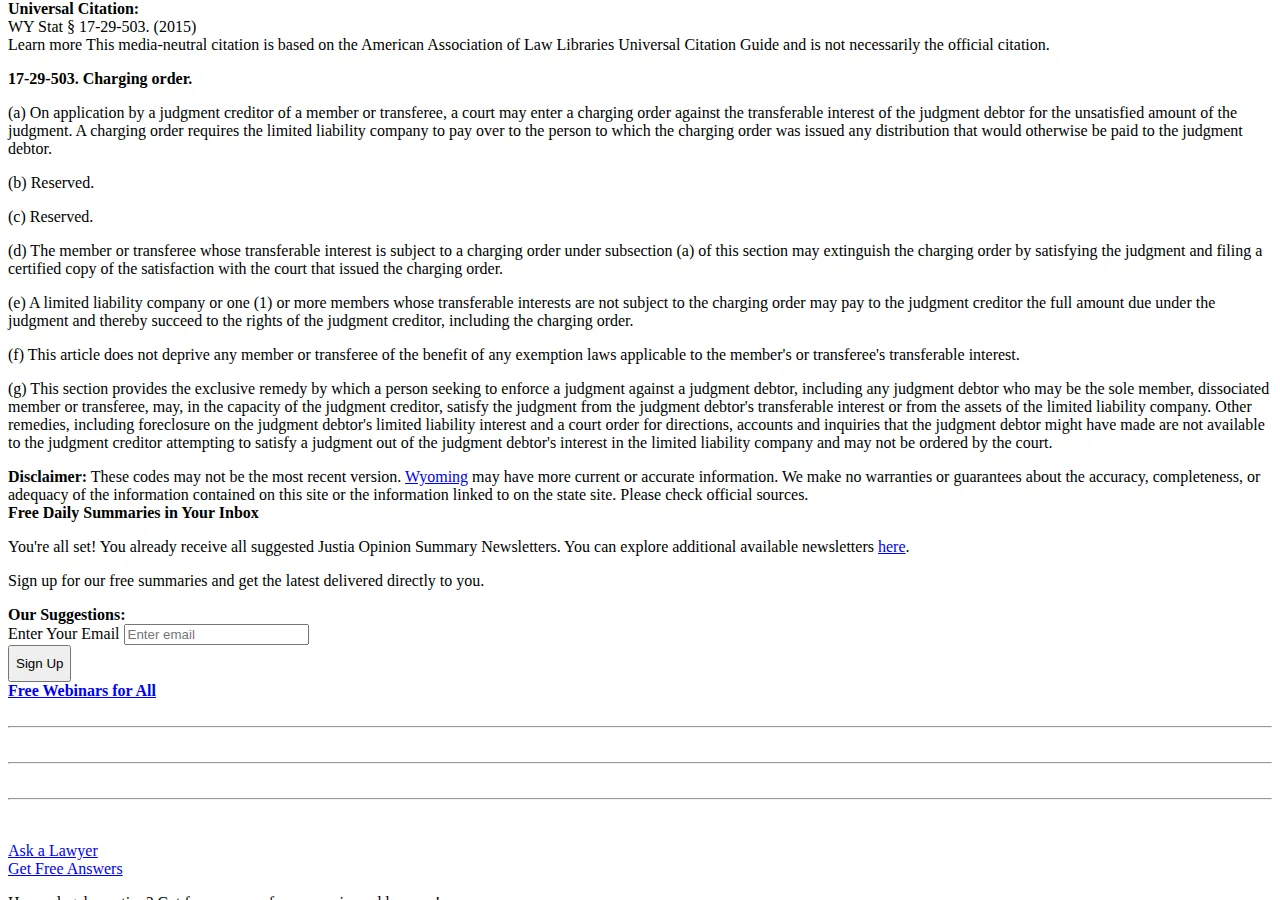
Wyoming's provision, W.S. § 17-29-503(g), states that the section "provides the exclusive remedy by which a person seeking to enforce a judgment against a judgment debtor, including any judgment debtor who may be the sole member, dissociated member or transferee, may, in the capacity of the judgment creditor, satisfy the judgment from the judgment debtor's transferable interest or from the assets of the limited liability company." It then bars the alternatives by name: "Other remedies, including foreclosure on the judgment debtor's limited liability interest and a court order for directions, accounts and inquiries that the judgment debtor might have made are not available."
Delaware reached the same result by amendment. The 2013 session law amending 6 Del. C. § 18-703(d) provides that "the entry of a charging order is the exclusive remedy by which a judgment creditor of a member or a member's assignee may satisfy a judgment out of the judgment debtor's limited liability company interest and attachment, garnishment, foreclosure or other legal or equitable remedies are not available to the judgment creditor, whether the limited liability company has 1 member or more than 1 member." Subsection (e) adds that no creditor of a member "shall have any right to obtain possession of, or otherwise exercise legal or equitable remedies with respect to, the property of the limited liability company," and subsection (f) gives the Court of Chancery jurisdiction over charging-order matters.
Our editorial analysis of the two texts finds one structural difference that matters in practice. Wyoming § 17-29-503(e) gives the LLC itself, or members whose interests are not charged, the right to pay the creditor the full amount due and step into the creditor's rights, including the charging order. Delaware's text contains no equivalent redemption clause. In a multi-member company, the Wyoming redemption right lets the business buy out the problem. In a single-member company, that right is usually theoretical — there is nobody else to exercise it — which is one more reason a single-member LLC should not be treated as a finished asset-protection plan on its own.
The decision table: Wyoming vs Delaware vs Florida vs home state
| Attribute | Wyoming single-member LLC | Delaware single-member LLC | Florida single-member LLC | Typical home-state LLC |
| :--- | :--- | :--- | :--- | :--- |
| Charging order exclusive? | Yes, expressly including the sole member | Yes, expressly whether 1 member or more | No — foreclosure available for single-member only | Varies; many states are silent on single-member |
| Foreclosure of the interest | Barred by § 17-29-503(g) | Barred by § 18-703(d) | Permitted for single-member only, and only where a court finds distributions will not satisfy the judgment within a reasonable time, Fla. Stat. § 605.0503 | Possible where the statute lacks exclusivity |
| Redemption by the LLC | Yes, § 17-29-503(e) | No equivalent clause | No equivalent clause | Rare |
| Charging-order court | Court of competent jurisdiction | Court of Chancery, § 18-703(f) | Circuit court | State court of general jurisdiction |
| Minimum recurring state charge | $60 per year annual report license tax, or $0.0002 per dollar of Wyoming-located assets if greater | $400 per year flat annual tax, due June 1 | Annual report fee set by the state | Varies |
| Regulatory / Operational Authority | W.S. § 17-29-503 | 6 Del. C. § 18-703 | Fla. Stat. § 605.0503; Olmstead v. FTC | Home-state LLC act |
Two cost corrections belong in this table because older guides still print the wrong Delaware number. Delaware's LLC annual tax is now $400, raised from $300 effective January 1, 2026. Wyoming's minimum is $60, and the asset-based formula only bites above $300,000 of Wyoming-located assets, since $0.0002 × $300,000 = $60. On recurring charges alone, five years costs $300 in Wyoming against $2,000 in Delaware at the minimums — a $1,700 difference that buys nothing in charging-order strength, because both statutes already say the same thing.
The exposed math: what a creditor actually recovers
A charging order caps recovery at distributions, and distributions are a management decision. That makes the creditor's position computable before anyone files anything:
$
ext{Creditor Recovery} = min( ext{Unsatisfied Judgment}, sum ext{Distributions Paid to the Debtor})
$
$
ext{Years to Satisfy} = rac{ ext{Unsatisfied Judgment}}{ ext{Annual Distributions to the Debtor}}
$
Worked example. A $500,000 personal judgment is charged against a single-member LLC that distributes $40,000 a year to its owner and retains the rest for operations. Recovery is $40,000 a year, and $500,000 ÷ $40,000 = 12.5 years to satisfy the judgment, before interest and before any year in which the company distributes nothing. If the same company distributes $0 in a given year, the creditor receives $0 that year — the order does not create a distribution obligation.
The mirror image is the phantom-income problem. Under the assignee-tax logic of IRS Revenue Ruling 77-137, a person who holds an economic interest can be taxed on allocated income even without receiving cash. Applied to a charging order, the analysis runs like this:
$
ext{Phantom Tax Exposure} = ext{Allocable Income} imes ext{Holder Marginal Rate}
$
If the LLC allocates $200,000 of taxable income in a year it distributes nothing, and the holder's marginal rate is 32%, the arithmetic is $200,000 × 32% = $64,000 of tax on income never received in cash. Whether a particular charging-order holder is taxed this way depends on how the interest is characterised, so treat the figure as an exposure to model with a tax adviser, not as a guaranteed creditor penalty. Even as an exposure, it changes settlement incentives: a creditor who faces tax on phantom income has a reason to negotiate a discounted payoff, and a debtor who controls distributions has a reason to keep the company solvent while that negotiation happens.
Why the protection does not travel
Formation-state law governs internal affairs: who votes, who manages, how distributions are decided. Enforcement law is different. A court enforces a judgment under its own procedural and remedy rules, and it applies those rules to assets inside its reach. That is why a Wyoming LLC that owns California real estate, holds California bank accounts, and is sued in California cannot count on a Wyoming statute to dictate the California judge's remedy. The company must also register as a foreign LLC where it does business, which hands the forum state a registration, a tax account, and a local address for service — all of which make local enforcement easier, not harder.
The same caution applies to the famous counter-examples. In Olmstead v. FTC, the Florida Supreme Court held that the charging order was not the exclusive remedy for a single-member LLC under the statute then in force, precisely because there were no innocent co-members to protect. Florida's legislature then confined foreclosure to single-member LLCs, and only where a court finds that distributions under a charging order will not satisfy the judgment within a reasonable time. In California, courts have applied forum law to reach interests in out-of-state entities and have allowed reverse veil piercing in cases such as Curci Investments, LLC v. Baldwin, 14 Cal. App. 5th 214 (2017) — a different doctrine from charging orders, but a reminder that a court willing to disregard entity separateness will not stop at a formation-state statute.
Who this is for, and who should not rely on it
This structure fits a founder who already has a real operating business, clean books, and a personal liability risk that is genuinely separate from the business — a car accident, a failed personal guarantee on an unrelated venture, a disputed personal contract. It fits a holding company that owns equipment or intellectual property and leases it to an operating company, where the separation between entities is documented and priced.
It does not fit the following, and our editorial analysis is blunt about each one:
> [!WARNING]
> A charging order never protects a transfer that was fraudulent when made, and it never overrides a personal guarantee. Founders who form an LLC after a demand letter arrives, move personal assets into it, and then cite charging-order exclusivity are building the creditor's fraudulent-transfer case, not a defence.
The single-member operating agreement: five clauses that do the work
The statute sets the ceiling. The operating agreement decides whether the company can actually live under it. Draft or amend for these five points, with counsel, before a claim exists — after a claim exists, amendments look like evasion and may be treated that way.
> [!TIP]
> Do not add a sham second member to manufacture multi-member protection. A member with no capital, no vote in practice, and no economic risk is a fact pattern a creditor's lawyer will enjoy explaining to a judge. If you want a genuine second member, give them genuine capital, genuine rights, and genuine risk — or accept single-member treatment and build the rest of the plan honestly.
Filing and maintenance checklist
Related reading on this site: the Wyoming Close LLC vs Delaware LLC anonymity and nexus comparison, the Delaware statutory trust vs series LLC asset protection guide, and the FinCEN BOI reporting guide for non-residents, because a charging order says nothing about beneficial-ownership filing. To model the phantom-income exposure in dollars, run the numbers through the tax estimator before you promise a creditor, a partner, or yourself a figure. When the company itself must end, see the LLC dissolution and tax clearance playbook, for the winding-up order that must complete before any cancellation filing.