What an API client is, and what you are actually buying
An API client sends requests to an API and reads the response: a REST call, a GraphQL query, a gRPC call, a WebSocket message. The choice decides where the team's API knowledge lives and what the bill looks like as the team grows.
This comparison covers the three clients that dominate that decision in 2026: Postman, the incumbent; Insomnia, the Kong-owned client built around Git sync; and Bruno, the open-source challenger that stores collections as plain files. The money question starts the moment a second person needs the same collection.
> [!KEY TAKEAWAY]
> Postman Team at $19 a seat, Insomnia Pro at $12, and Bruno Pro at $6 look like a simple ranking — until SSO, mock-server overages, and AI credits are added. Price the whole stack, not the headline seat.
The three tools, in one paragraph each
Postman is the platform play: workspaces, a public API Network, an API Catalog, mock servers, monitors, Flows automation, and AI credits. Annual billing saves up to 25% against monthly billing. New buyers choose Solo at $9 a month, Team at $19 a user a month, or Enterprise on a sales quote.
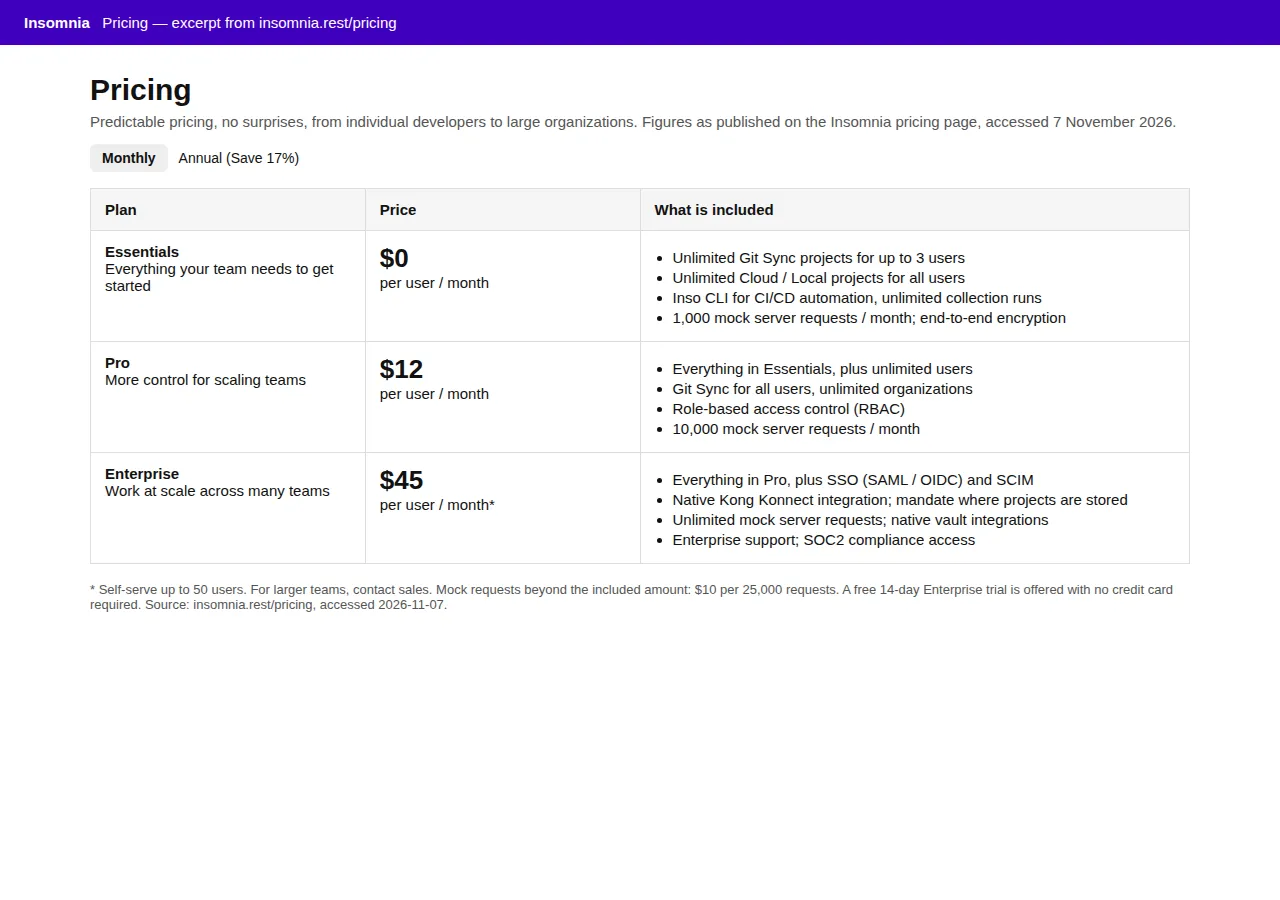
Insomnia is the Git-native play, owned by Kong: the API client for REST, GraphQL, gRPC, and WebSocket, plus OpenAPI linting, mocking, an Inso CLI for CI/CD, and Git Sync. Essentials costs $0, Pro $12 per user per month, and Enterprise $45.
Bruno is the local-first play: an API client that stores collections as files on disk, versioned in Git. Open Source costs $0, Pro $6 per user per month billed annually, Ultimate $11, and Enterprise $18. The free tier gives 2 workspaces, public Git providers, and 5 OpenAPI syncs a month.
The pricing tiers, side by side
!Postman pricing tiers: Free $0, Solo $9, Team $19 per user per month, Enterprise contact sales
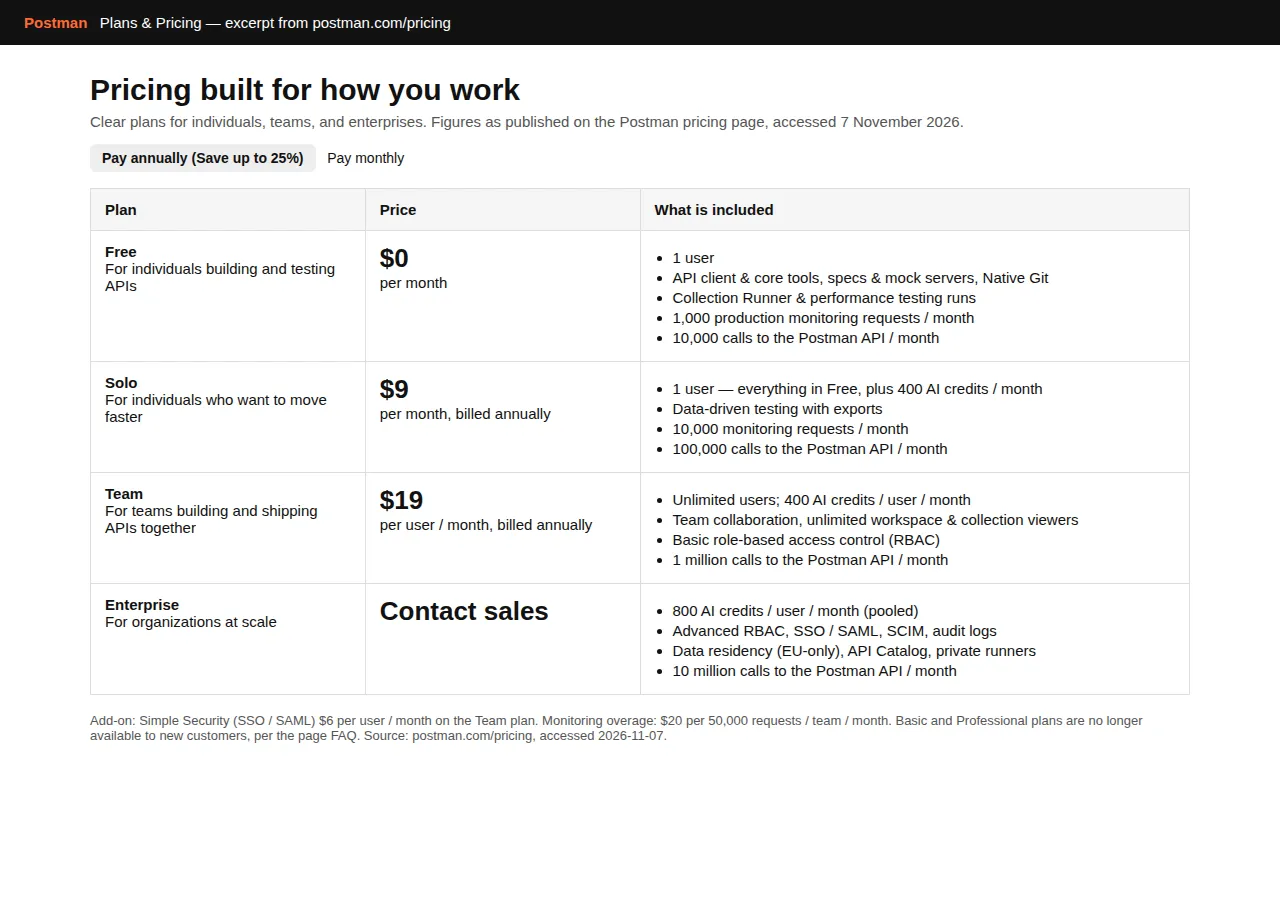
| Plan | Price (per user / month) | Billing basis | Authority |
| :--- | :--- | :--- | :--- |
| Postman Free | $0 | Monthly | Postman pricing page |
| Postman Solo | $9 | Billed annually | Postman pricing page |
| Postman Team | $19 | Billed annually | Postman pricing page |
| Postman Enterprise | Contact sales | Quoted | Postman pricing page |
| Insomnia Essentials | $0 | Monthly | Insomnia pricing page |
| Insomnia Pro | $12 | Monthly (annual saves 17%) | Insomnia pricing page |
| Insomnia Enterprise | $45 | Monthly (annual saves 17%) | Insomnia pricing page |
| Bruno Open Source | $0 | Free | Bruno pricing page |
| Bruno Pro | $6 | Billed annually | Bruno pricing page |
| Bruno Ultimate | $11 | Billed annually | Bruno pricing page |
| Bruno Enterprise | $18 | Billed annually | Bruno pricing page |
Postman prints annual-billed prices ($9 and $19) and no monthly-billed Solo or Team price. Insomnia's page rendered with Monthly selected, so $12 and $45 are monthly-billed prices; the annual equivalents ($9.96 Pro, $37.35 Enterprise) are derived from the stated 17% saving.
!Insomnia pricing tiers: Essentials $0, Pro $12, Enterprise $45 per user per month
The per-seat math at 5, 25, and 100 seats
$
\text{Monthly Cost} = \text{Seats} \times \text{Price per Seat}
$
| Option | 5 seats / month | 5 seats / year | 25 seats / month | 25 seats / year | 100 seats / month | 100 seats / year |
| :--- | :--- | :--- | :--- | :--- | :--- | :--- |
| Postman Team ($19) | $95 | $1,140 | $475 | $5,700 | $1,900 | $22,800 |
| Postman Team + SSO ($25) | $125 | $1,500 | $625 | $7,500 | $2,500 | $30,000 |
| Insomnia Pro ($12) | $60 | $720 | $300 | $3,600 | $1,200 | $14,400 |
| Insomnia Pro annual ($9.96) | $49.80 | $597.60 | $249 | $2,988 | $996 | $11,952 |
| Insomnia Enterprise ($45) | $225 | $2,700 | $1,125 | $13,500 | $4,500 | $54,000 |
| Bruno Pro ($6) | $30 | $360 | $150 | $1,800 | $600 | $7,200 |
| Bruno Ultimate ($11) | $55 | $660 | $275 | $3,300 | $1,100 | $13,200 |
| Bruno Enterprise ($18) | $90 | $1,080 | $450 | $5,400 | $1,800 | $21,600 |
At 25 seats, Postman Team costs $475 a month against $150 for Bruno Pro — a $325 monthly gap, $3,900 a year. Like-for-like, SSO costs $25 a seat on Postman (Team plus the $6 Simple Security add-on), $45 on Insomnia Enterprise, or $18 on Bruno Enterprise: $625, $1,125, and $450 a month. Bruno Enterprise undercuts SSO-capable Postman by $175 a month and Insomnia Enterprise by $675 a month — $2,100 and $8,100 a year.
No seat count flips the order: Bruno Ultimate at $11 undercuts Insomnia Pro at $12 by $1 a seat at every size, and Bruno Enterprise at $18 undercuts Postman Team at $19 by $1. A 100-seat team pays $7,200 a year on Bruno Pro.
> [!WARNING]
> The cheapest seat is not the cheapest stack. Postman Team at $19 excludes SSO, and Insomnia Pro at $12 excludes SSO too — both push single sign-on into a higher tier or a paid add-on. Compare the price of the seat your security policy actually requires.
Free-tier ceilings: where free stops
Postman Free allows exactly 1 user, 1,000 monitoring requests a month, 10,000 calls to the Postman API a month, and up to 5 integrations. There is no free two-person Postman team.
Insomnia Essentials is the most generous free tier for a small crew: unlimited Git Sync projects for up to 3 users, unlimited collection runs, and 1,000 mock server requests a month. The ceiling is the 3-user Git Sync cap: a four-person team that syncs through Git has to pay for Pro.
Bruno Open Source has no published seat cap, but it caps workspaces at 2 and OpenAPI syncs at 5 a month, and it allows public Git providers only. A team that keeps collections in a private repository — the normal case for a company — needs Pro at $6 a seat.
Insomnia charges $10 per 25,000 mock requests beyond the included amount. A team on Essentials serving 50,000 mock requests in a month uses 49,000 beyond its free 1,000 — about $20:
$
\text{Overage} = \frac{49{,}000}{25{,}000} \times \$10 = \$19.60 \approx \$20 \text{ per month}
$
Treat $20 as an approximation. Postman monitoring works the same way: Team includes 10,000 requests a month, and further requests cost $20 per 50,000 per team per month.
Collaboration ceilings: who can see, change, and approve
Postman Team is built for shared work: team collaboration, unlimited workspace and collection viewers, and Basic RBAC. Enterprise adds advanced RBAC, private and Partner workspaces, an API Catalog, and 10 million Postman API calls a month against Team's 1 million.
Insomnia Pro adds the two controls a growing team buys: Git Sync for all users with no 3-user cap, and RBAC on organizations. Enterprise adds SSO with SAML or OIDC, SCIM provisioning, domain capture and invite control, and the right to mandate where projects are stored — local, Git, or cloud.
Bruno's collaboration story is Git itself. Collections are files, so branching, pull requests, and code review are the collaboration model, and the GitUI in Pro adds clone, push, branch creation and checkout, stash, and merge-conflict resolution. Ultimate adds 2 license admins, audit logs, and AI governance; Enterprise adds unlimited license admins, SSO, SCIM, and a 24-hour support SLA against 48 hours on Pro and Ultimate. Bruno has no cloud workspace — a team without Git discipline gets none of the guardrails one provides.
Offline and local-first: where the data lives
This is the sharpest difference between the three. Bruno stores collections as plain files on disk. No account is needed to open the client, no cloud sync is needed to work, and the repository is the source of truth.
Insomnia sits in the middle. Projects can be local-only — the Scratch Pad needs no login — or stored in Git, or stored in Insomnia Cloud, and Enterprise can mandate which of the three a team uses.
Postman is cloud-first. Collections live in workspaces on Postman's servers, with Native Git as the bridge for versioning, not the home for the data. That is not a defect — the cloud is what makes the public API Network possible — but the exit plan is an export, and exports are a project, not a switch.
Worked example: a 25-engineer team prices all three
Worked example: Northwind API Squad is a fictional 25-engineer backend team. Every engineer needs a seat, the security policy requires SSO, and it uses about 1,000 AI credits a month beyond the included allowance.
Postman Team is $19 a seat, plus the $6 Simple Security add-on for SSO, so $25 a seat — $625 a month, $7,500 a year. AI overage on Team is $0.04 a credit, so 1,000 extra credits add $480 a year, taking the honest Postman total to $7,980 a year.
Insomnia Pro is $12 a seat on monthly billing, but it has no SSO — the policy forces Enterprise at $45 a seat: $1,125 a month, $13,500 a year. Annual billing at the stated 17% saving would cut that to $933.75 a month, or $11,205 a year (derived, not vendor-printed).
Bruno Enterprise is $18 a seat with SSO and SCIM included:
$
\text{Bruno Enterprise Annual} = 25 \times \$18 \times 12 = \$5{,}400
$
The verdict is arithmetic: Bruno Enterprise at $5,400 a year against $7,980 for SSO-capable Postman and $13,500 for Insomnia Enterprise on monthly billing. Without an SSO requirement the ranking changes — Bruno Ultimate at $3,300 a year against Insomnia Pro at $3,600 and Postman Team at $5,700 — but the moment the security policy names SSO, Bruno Enterprise is the cheapest compliant seat by a wide margin. Re-run the same arithmetic with the Break-Even Analysis Calculator; the same seat-count discipline applies in the linear-vs-jira-vs-clickup-engineering-issue-tracking comparison and the asana-vs-monday-vs-trello-project-management-pricing-automation comparison.
The risk layer: lock-in, residency, and the export test
Three risks sit behind the price table. Vendor lock-in is the first. Postman's cloud workspaces are the stickiest of the three: collections, environments, monitors, Flows, and mock servers all live in one system. Git-stored Insomnia projects and Bruno's file collections have almost none — the repository is already the exit. Test it on day one: export everything and confirm a new hire could rebuild the workspace from it.
Data residency is the second. Postman Enterprise lists data residency (EU-only), and Insomnia Enterprise lets an admin mandate local or Git storage. A team under a data-residency rule that buys Team or Pro and stores collections in the vendor cloud has bought the wrong tier. Check the residency requirement before the trial, not after the migration.
Account and data export is the third. Bruno's model makes export a non-event, because the files are already local. Postman and Insomnia cloud projects need an explicit export step, Keep a monthly export in the repository — it is the only proof the exit works. The supabase-vs-firebase-vs-planetscale-backend-platform-pricing comparison applies the same export test to backend platforms.
> [!TIP]
> Run the export test during the trial, not after the purchase. Export every collection and confirm the requests and tests survived. A vendor that makes export hard during a trial will make it harder after a year of your data.
Context note: who should pick which
Postman fits the team that wants the platform: public documentation, a partner API network, monitors and Flows in one place, and integrations — up to 50 on Team and 100 on Enterprise, against 5 on Free. The price is the highest of the three at every seat count.
Insomnia fits the team that lives in Git and wants a polished client with Kong behind it. The trap is Enterprise: at $45 a seat it is the most expensive compliant seat here, so a team that will need SSO within a year should price Enterprise on day one, not Pro.
Bruno fits the team that wants files, Git, and the lowest bill. Pro at $6 and Enterprise at $18 are the cheapest paid seats here at every tier, and the local-first design removes the lock-in question entirely. The trade is breadth: no cloud workspace, no public network, no hosted monitors. Bruno's page claims Enterprise can save switching teams more than 60% against Postman — a vendor marketing claim, not a measured result.
The 30-day decision checklist
1. Count the seats that need SSO. Price only SSO-capable seats.
2. Count the free-tier ceiling. Confirm the headcount fits Postman's 1-user Free, Insomnia's 3-user Git Sync, or Bruno's 2-workspace tier.
3. List the overages the team will hit. Write the team's monthly volume beside each meter.
4. Run the export test on day one. Export every collection and confirm the files open cleanly outside the vendor.
5. Check the residency rule. Confirm where collections may legally live and whether the chosen tier enforces it.
6. Trial the paid tier, not the free tier. The free tier hides the ceilings that decide the bill.
7. Price 5, 25, and 100 seats. A $1 gap is $1,200 a year at 100 seats.
8. Confirm the Git workflow. Agree the branching and review rules for collections before the first commit.
9. Put the decision in writing. Record the chosen tool, tier, annual cost, and exit plan.
> [!FOUNDER]
> "An API client is where your team's knowledge of your own systems lives. The cheapest seat is worthless if that knowledge is trapped in a cloud you cannot export. Price the seat, price the exit, and then choose."
> — Enow A. Jovial, Founder & Chief Executive Officer
Who this is not for
This playbook is not for the solo developer who sends a handful of requests a week — any free tier covers that. It is not for the team that needs a hosted public API portal with partner onboarding, where Postman Enterprise is the only one of the three that sells that product. And it is not for the team that refuses Git: Bruno's whole model assumes a repository. For everyone else — a team of five or more, with shared collections and a bill that grows with headcount — the arithmetic above is the decision.