The bill nobody models before the team grows
Asana, Monday, and Trello all sell the same promise — work in one place — and all three charge for it by the seat. The difference is what the seat buys. Asana sells a workflow system with goals, portfolios, and capacity planning. Monday sells a work platform built around boards that can become almost anything, including a CRM or a service desk, at a price that changes with the product you pick. Trello sells boards, and only boards, at the lowest per-seat price of the three, with automation and admin controls gated behind its higher tiers.
That difference is the whole decision. At five seats the gap between Trello Premium and Asana Advanced is about $75 a month. At 100 seats it is about $1,500 a month, or $18,000 a year. This guide runs all three price lists against the same seat counts, with the vendors' own published figures, so the choice is arithmetic instead of brand preference.
> [!KEY TAKEAWAY]
> Trello is the cheapest honest seat at every tier, Monday sits in the middle on its Work Management ladder, and Asana is the most expensive of the three at the advanced tier. Below 25 seats, pick on workflow fit, because the annual gap is under $5,000. Above 25 seats, pick on the ceiling: the tier that can run your automations and reporting is the only tier whose price matters, and buying below it is the most expensive mistake in this comparison.
Who this guide is for, and who should stop here
This guide is for founders, operations leads, and team managers choosing a general project management tool for a production team: marketing, operations, product, and agency work, not engineering issue tracking. It is written around the vendors' pricing pages as published in November 2026, using annual-billing figures throughout, because all three vendors discount annual billing and the monthly figures would make the comparison dishonest. If you need engineering issue tracking with sprints, branches, and code review, read our engineering tracker comparison instead, because these three tools are not built for that job first.
Stop here and get a quote instead if you need enterprise security, data residency, or advanced admin controls at scale, because all three vendors price Enterprise by contract and no list-price math can replace that quote. Stop here too if your team exceeds 100 seats and depends on one vendor's automation engine, because automation limits will then decide your total cost.
The three price lists, side by side
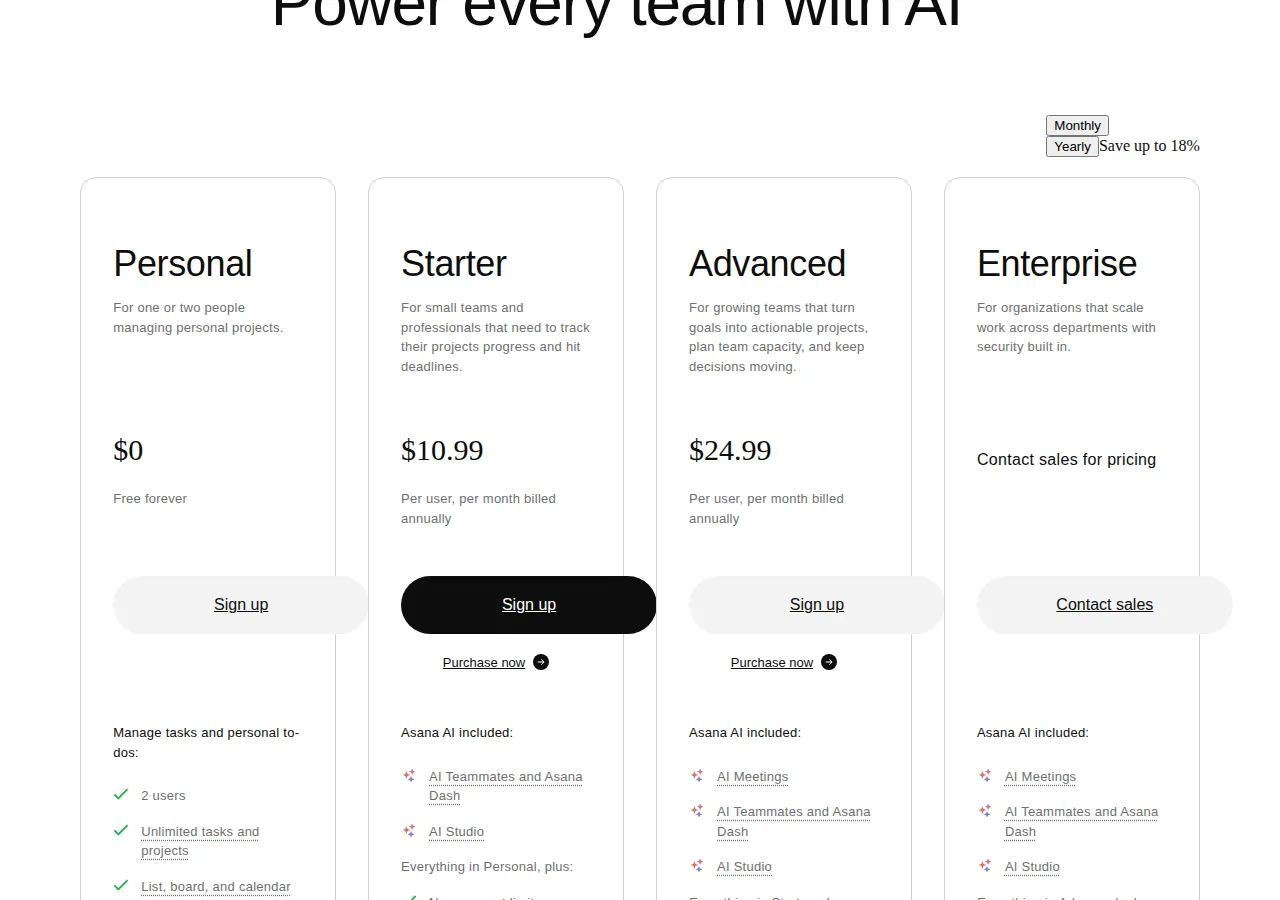
Asana's pricing page lists four tiers. Personal costs $0 and covers one or two people managing personal projects, with 2 users as its practical ceiling. Starter costs $10.99 per user per month billed annually, or $13.49 billed monthly, for small teams tracking projects and deadlines. Advanced costs $24.99 per user per month billed annually, or $30.49 billed monthly, for teams turning goals into projects, planning capacity, and keeping decisions moving. Enterprise and Enterprise+ are priced by contract. Asana also sells AI requests separately: prepaid packs at $0.50 per request, or on-demand at $0.60 with a monthly spend cap.
Monday's Work Management ladder lists five tiers, and the ladder matters because Monday sells other products with different prices on the same site. Free costs $0 for up to 2 seats. Basic costs $9 per seat per month billed annually. Standard costs $12 per seat per month billed annually. Pro costs $19 per seat per month billed annually and is marked the most popular tier. Enterprise is priced by contract. The page applies a limited-time discount to its displayed totals, so this guide uses the per-seat list figures for every calculation below. Monday's AI is sold in credits on top of the seat price — 1,000 credits on Basic, 2,000 on Standard, 3,000 on Pro — which means an AI-heavy team pays a second meter that neither Asana's bundled AI nor Trello's tiered AI matches exactly.
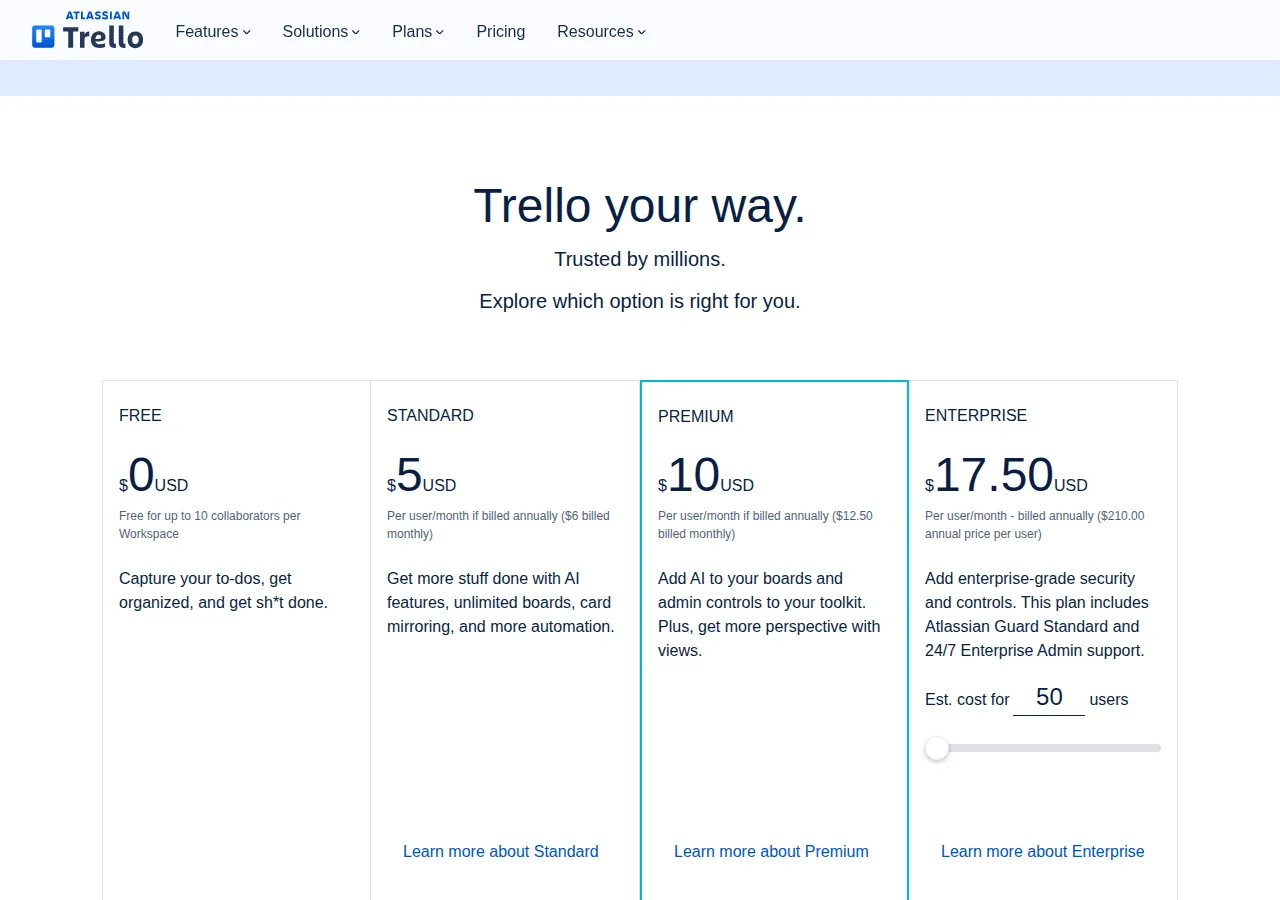
Trello's pricing page lists four tiers. Free costs $0 for up to 10 collaborators per workspace. Standard costs $5 per user per month billed annually, or $6 billed monthly, adding AI features, unlimited boards, and card mirroring. Premium costs $10 per user per month billed annually, or $12.50 billed monthly, adding AI to boards, admin controls, and more views. Enterprise costs $17.50 per user per month billed annually, or $210 per user per year, adding enterprise-grade security, Atlassian Guard Standard, and 24/7 enterprise admin support. Trello's free tier is the most generous of the three — 10 collaborators against Asana's 2 users and Monday's 2 seats — but its paid tiers are also the narrowest in features.
| Attribute | Asana | Monday Work Management | Trello | Authority |
| :--- | :--- | :--- | :--- | :--- |
| Free tier | Personal, $0, 2 users | Free, $0, up to 2 seats | Free, $0, up to 10 collaborators | Vendor pricing pages, November 2026 |
| Entry paid tier | Starter, $10.99 per user per month, annual | Basic, $9 per seat per month, annual | Standard, $5 per user per month, annual | Vendor pricing pages, November 2026 |
| Mid tier | Advanced, $24.99 per user per month, annual | Standard, $12 per seat per month, annual | Premium, $10 per user per month, annual | Vendor pricing pages, November 2026 |
| Popular / upper mid tier | Advanced, $24.99 | Pro, $19 per seat per month, annual | Premium, $10 | Vendor pricing pages, November 2026 |
| Top list tier | Enterprise, by contract | Enterprise, by contract | Enterprise, $17.50 per user per month, annual | Vendor pricing pages, November 2026 |
Worked math: the same team on all three meters
One formula runs every row below, because all three vendors charge per seat:
$
\text{Monthly Cost} = \text{Seats} \times \text{Per-Seat Monthly Price}
$
$
\text{Annual Cost} = \text{Monthly Cost} \times 12
$
At 5 seats, the monthly totals on annual billing are: Trello Standard $25 and Premium $50; Monday Basic $45, Standard $60, and Pro $95; Asana Starter $54.95 and Advanced $124.95. A five-person team comparing mid-tiers faces $50 against $60 against $124.95 — Asana Advanced costs more than double Trello Premium, before any discount negotiation. Annualized, that five-seat mid-tier comparison is $600 on Trello Premium, $720 on Monday Standard, and $1,499.40 on Asana Advanced.
At 25 seats, the monthly totals are: Trello Standard $125 and Premium $250; Monday Basic $225, Standard $300, and Pro $475; Asana Starter $274.75 and Advanced $624.75. The mid-tier gap is now $250 against $300 against $624.75 a month, or $3,000 against $3,600 against $7,497 a year. Monday Pro at $475 undercuts Asana Advanced by $149.75 a month, and Trello Premium at $250 is less than half of Asana Advanced — a team that picks Asana at 25 seats for capacity planning it never uses pays $4,497 a year for a feature it could have bought later.
At 100 seats, the monthly totals are: Trello Standard $500, Premium $1,000, and Enterprise $1,750; Monday Basic $900, Standard $1,200, and Pro $1,900; Asana Starter $1,099 and Advanced $2,499. The ranking holds at every seat count. The annual gap between Trello Premium and Asana Advanced at 100 seats is $12,000 against $29,988, a difference of $17,988 a year — a budget decision, not a preference decision, unless the advanced features are genuinely load-bearing.
There is no price crossover on the mid tiers: Trello Premium never crosses Monday Standard, and Monday Pro never crosses Asana Advanced, at any seat count. The one inversion is at the top: Trello Enterprise at $17.50 undercuts Monday Pro at $19 and Asana Advanced at $24.99, so a team that needs enterprise security should check Trello's enterprise tier before assuming enterprise always costs more.
Automation ceilings: what each tier actually lets you automate
Price without a ceiling comparison misleads in the other direction: the cheapest tier that cannot run your workflow is the most expensive mistake. Asana's ladder gates by planning depth: Starter tracks projects and deadlines; Advanced adds goals, portfolios, capacity planning, and decision tracking. A team whose workflow needs capacity planning cannot buy its way there on Starter at any seat count, and the $14 per seat jump to Advanced is the price of that ceiling.
Monday's ladder gates by platform breadth: Basic plans and manages team work; Standard executes workflows; Pro adds the most popular automation and reporting depth; Enterprise adds governance. Because Monday's boards can become a CRM or a service desk, a team that builds a second system on its boards avoids a second subscription, and that avoided subscription belongs in the comparison.
Trello's ladder gates by board power: Standard adds unlimited boards, card mirroring, and more automation; Premium adds admin controls, more views, and AI on boards; Enterprise adds security and support. Trello never claims a platform play — no goals module, no capacity planning — and its $17.50 enterprise ceiling is the price of that honesty. A team that later needs goals will buy a second system, and that subscription belongs in the comparison too.
Scenario: the agency that outgrows its board
Consider a 12-person agency that starts on Trello Free, because 10 collaborators cover almost the whole team, then hires three more people and hits the free tier's limit. The agency moves to Trello Standard at $5 a seat, or $75 a month for 15 seats, and runs happily for a year. Then a client asks for portfolio reporting across all active projects, and Trello has no portfolio view at any tier. The agency now faces a migration to Asana Advanced at $24.99 a seat, or $374.85 a month for the same 15 seats, plus the migration cost of rebuilding every board as a project, every card as a task, and every automation as a rule. The migration, not the seat price, is the real cost — and it was predictable: the agency sells portfolio reporting, so it needed a portfolio tool from the start.
The reverse is just as common: a 30-person team buys Asana Advanced for capacity planning, uses it for one quarterly cycle, then reverts to board work for eleven months, paying $749.70 a month for a ceiling it touches four weeks a year. A quarterly feature audit that downgrades the tier when no paid feature was used in 90 days prevents that waste.
The second bill: seats you pay for but nobody uses
Per-seat pricing has a failure mode no tier table shows: dormant seats. A team of 25 that hires 30 and forgets to remove five departed contractors pays for 30 seats on every vendor here, because all three meters count seats, not active users. At Asana Advanced rates, five dormant seats cost $124.95 a month, or $1,499.40 a year, for logins nobody opens. At Trello Premium rates, the same five seats cost $50 a month. The discipline is the same as for any per-seat tool: a monthly seat audit tied to the departure checklist, with the workspace admin removing access the same week employment or contracting ends. Put the audit on the calendar the day the contract is signed, not the day the renewal invoice arrives.
Monday adds a second meter: AI credits. A team that burns its 2,000 Standard credits mid-month and buys more pays a second bill the seat comparison never showed. Asana's AI pricing is explicit at $0.50 prepaid or $0.60 on-demand per request, so an AI-heavy team can budget it; Trello's AI is tier-gated rather than metered, making it the most predictable of the three.
> [!WARNING]
> Never sign a per-seat contract on a discounted calculator total. Monday's pricing page applies a limited-time discount to its displayed totals, and Asana's and Trello's annual figures already assume a year of prepayment. Budget the list price, treat any discount as temporary, and get the renewal price in writing before the first term ends. A team that budgets the discount and renews at list price has not saved money; it has scheduled a price shock. The same warning applies to Monday's product picker: confirm you are pricing Work Management, not Service or Sales CRM, because Monday's other products list different per-seat figures on the same site.
Execution checklist
For the engineering tracker view that this general comparison extends, see our Linear vs Jira vs ClickUp guide, and for the CRM automation that sits on top of whichever project tool wins, see our HubSpot vs Salesforce vs Pipedrive guide. Before committing, trial the tier above the one you plan to buy, then buy the tier below it if the trial never touches the higher tier's features, and run the final seat-count total through the pricing calculator with implementation and training added as line items, not absorbed into hope.
> [!TIP]
> Trial the tier above the one you plan to buy, then buy the tier below it if the trial never touches the higher tier's features. Teams routinely buy Advanced or Pro for one feature they use twice, then pay for it on every seat for a year. The trial is the cheapest experiment in the whole purchase; use it to prove the ceiling, not to admire the interface.
> [!FOUNDER]
> "A project tool invoice is a headcount tax, and headcount only grows. The founders who keep it small are the ones who re-run the per-seat math every time the team grows by ten, not the ones who negotiated hardest on day one. Day-one price is a photograph; seat-count math is the film."
> — Enow A. Jovial, Founder & Chief Executive Officer