The Price Nobody Publishes
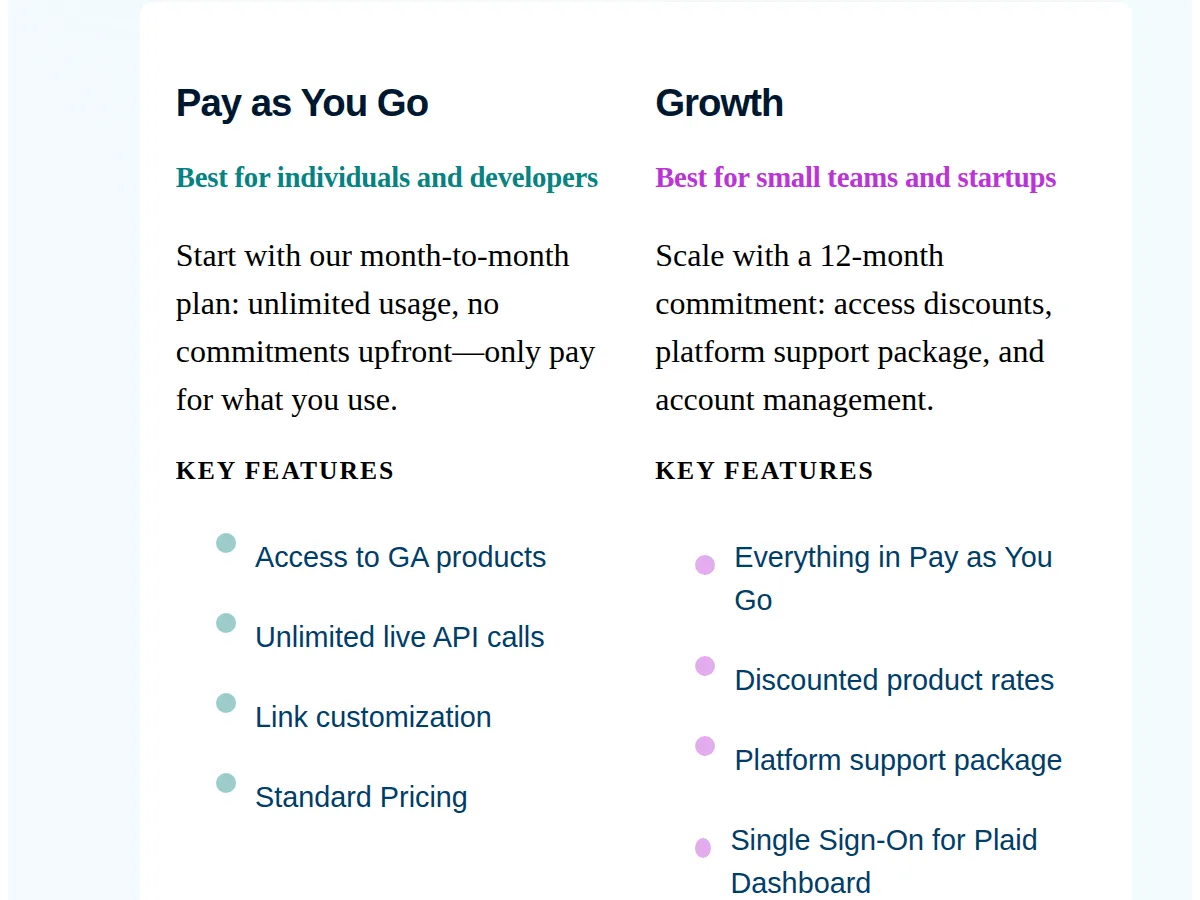
Plaid, Yodlee, and Finicity all sell the same thing — a pipe into a customer's bank accounts — and none of the three publishes what the pipe costs. Plaid's pricing page lists three plans, Pay as You Go, Growth, and Custom, and describes features: unlimited live API calls, Link customization, discounted product rates on a 12-month commitment, volume discounts at Custom. It lists no dollar rate for any product. The page's own summary is candid about the shape of the deal and silent about the number: build with the free tier, pay as you go, or scale with tailored API solutions and volume pricing, with the first 200 API calls free.
That silence is the category. Yodlee's public pages carry a request-a-demo call to action and no plan pricing. Finicity's pages now sit inside Mastercard Open Finance, and its pricing is a sales conversation. A buyer who wants a number has three options: request a quote from each vendor on the same workload, model from industry-reported ranges, or price the workload on the one vendor in the category that does publish a rate card. This guide does all three, and labels which is which.
!Plaid pricing page: Pay as You Go and Growth plans, with features listed and no dollar rates shown
What Each Vendor Actually Sells
Plaid is the broad connectivity platform. Its product list runs from Auth and Balance through Identity, Transactions, Income, Assets, Investments, Liabilities, and Transfer, plus newer products for fraud and onboarding. Transactions retrieves up to 24 months of historical transaction data with merchant, geolocation, and category information. Coverage is 12,000 or more financial institutions with localized support across 20 countries. The billing model is the negotiation: reviews of Plaid's billing documentation describe five charging shapes — a one-time fee per connected account, a monthly subscription per connected account, a flat fee per successful API call, a flexible per-request fee, and a flexible per-item fee — with no published figure attached to any of them. Plaid directs buyers to apply for production access to see pricing.
Yodlee, part of Envestnet, is the oldest aggregator in the category and the deepest on wealth data. It aggregates from 19,000 or more sources across accounts and loans, and its strength is investment accounts, 401(k) plans, and wealth data that newer platforms handle thinly. Its pricing is an enterprise subscription: a platform access fee plus per-user fees, with monthly minimums and volume negotiation. Industry-reported ranges put the platform fee at $5,000 to $15,000 a month and per-user fees at $0.10 to $0.50 per active user a month. Those are reported ranges from contract research, not vendor-published rates, and they should be treated as the opening position in a negotiation, not as a quote.
Finicity built its reputation on account verification for lending, especially mortgage, where its verification of assets and income reports became an industry standard. Mastercard acquired it, and it now operates as Mastercard Open Finance. Pricing is usage-based — per connected account, per API call, or per active user — under enterprise contracts, with no published rates. The buyer here is often a lender, not a consumer fintech, and the negotiation runs through a Mastercard relationship rather than a self-serve checkout.
> [!KEY TAKEAWAY]
> Plaid sells breadth and developer experience, Yodlee sells depth and wealth coverage, Finicity sells lending verification inside Mastercard. The right vendor follows the use case, and the price follows the volume — which is why every quote in this category is a negotiation, not a list price.
The Published Control: Teller's Rate Card
Teller is the fourth vendor, and the useful one for pricing, because it publishes a complete rate card on its homepage. Verify costs $1.50 per account. Balance costs $0.10 per API call. Transactions costs $0.30 per enrollment per month. Identity costs $1.75 per API call. The developer tier includes 100 live connections free. Those four numbers are enough to price any workload exactly, and the arithmetic is the point of this section: the refresh cadence, not the vendor, decides the bill.
Hold one workload constant. A US consumer fintech with 10,000 connected bank accounts, adding 1,000 new connections a month, one depository account per user, needing account verification at signup and transaction history kept current. Price it on Teller's published card at three refresh cadences.
At user-initiated cadence — balances read only when a user opens the app, four sessions per account per month — the Balance calls are 10,000 times 4, which is 40,000 calls at $0.10, or $4,000. Transactions enrollments are 10,000 at $0.30, or $3,000. Verify on 1,000 new connections at $1.50 is $1,500. The monthly bill is:
$
\text{User-initiated bill} = \$4{,}000 + \$3{,}000 + \$1{,}500 = \$8{,}500
$
That is $0.85 per connected account per month, or $102,000 a year. Balance calls are 47.1 percent of the bill.
At nightly cadence — one balance refresh per account per day — the Balance calls are 10,000 times 30, which is 300,000 calls at $0.10, or $30,000. The bill becomes $34,500 a month. At hourly polling — a balance read every hour for every account — the calls are 10,000 times 24 times 30, which is 7,200,000 calls at $0.10, or $720,000. The bill becomes:
$
\text{Hourly bill} = \$720{,}000 + \$3{,}000 + \$1{,}500 = \$724{,}500
$
Balance calls are 99.4 percent of the hourly bill, and the hourly bill is 85.2 times the user-initiated bill for the same 10,000 accounts and the same data. Nothing about the product changed. Only the polling schedule changed. Any vendor quote that does not specify the refresh cadence is not a quote — it is a starting point for a surprise.
Modeled Costs at 5,000, 50,000, and 200,000 Users
The reported ranges let a buyer model Plaid and Yodlee on the same user counts, with the warning attached that these are industry-reported figures, not vendor quotes. For Plaid, reported per-active-user costs run about $0.90 a month at 5,000 users, about $0.60 at 50,000 users, and about $0.40 at 200,000 users or more, with per-connection rates falling 30 to 50 percent on renegotiation above 10,000 monthly active users. For Yodlee, the reported structure is a platform fee of $5,000 to $15,000 a month plus $0.10 to $0.50 per active user a month.
$
\text{Plaid at 5,000 users} = 5{,}000 \times \$0.90 = \$4{,}500\text{/month}
$
$
\text{Plaid at 50,000 users} = 50{,}000 \times \$0.60 = \$30{,}000\text{/month}
$
$
\text{Plaid at 200,000 users} = 200{,}000 \times \$0.40 = \$80{,}000\text{/month}
$
Model Yodlee at the same counts with a mid-range platform fee and the low end of its per-user range at scale. At 5,000 users, a $5,000 platform fee plus 5,000 users at $0.30 is $6,500 a month, or $1.30 per user. At 50,000 users, a $10,000 platform fee plus 50,000 users at $0.15 is $17,500 a month, or $0.35 per user. At 200,000 users, a $15,000 platform fee plus 200,000 users at $0.10 is $35,000 a month, or $0.18 per user. The crossover is the story: Plaid is cheaper at small scale, Yodlee converges and can pass it at large scale, and the platform fee is what makes the small-scale math punishing. A buyer who models only the per-user rate and forgets the platform fee will understate Yodlee by $5,000 to $15,000 a month.
Finicity has no usable reported range to model. That is itself information: a vendor with no reported range is a vendor whose buyers sign enterprise contracts under NDA, and the only honest way to price it is to take the same workload to Mastercard and get a written quote. Mentioning a competitor during that negotiation is reported to reduce quotes by 20 to 30 percent across the category, which is a negotiating observation, not a rate.
The Regulatory Frame: Section 1033 Is On Hold
The pricing negotiation sits inside a rule that is currently not being enforced. Section 1033 of the Dodd-Frank Act required the Consumer Financial Protection Bureau, the CFPB, to write rules giving consumers access to their financial data. The Bureau finalized its Personal Financial Data Rights rule in October 2024, and the final rule prohibited data providers from charging fees for the required access under section 1033.301(c). Compliance was phased from April 1, 2026 for the largest providers to April 1, 2030 for the smallest.
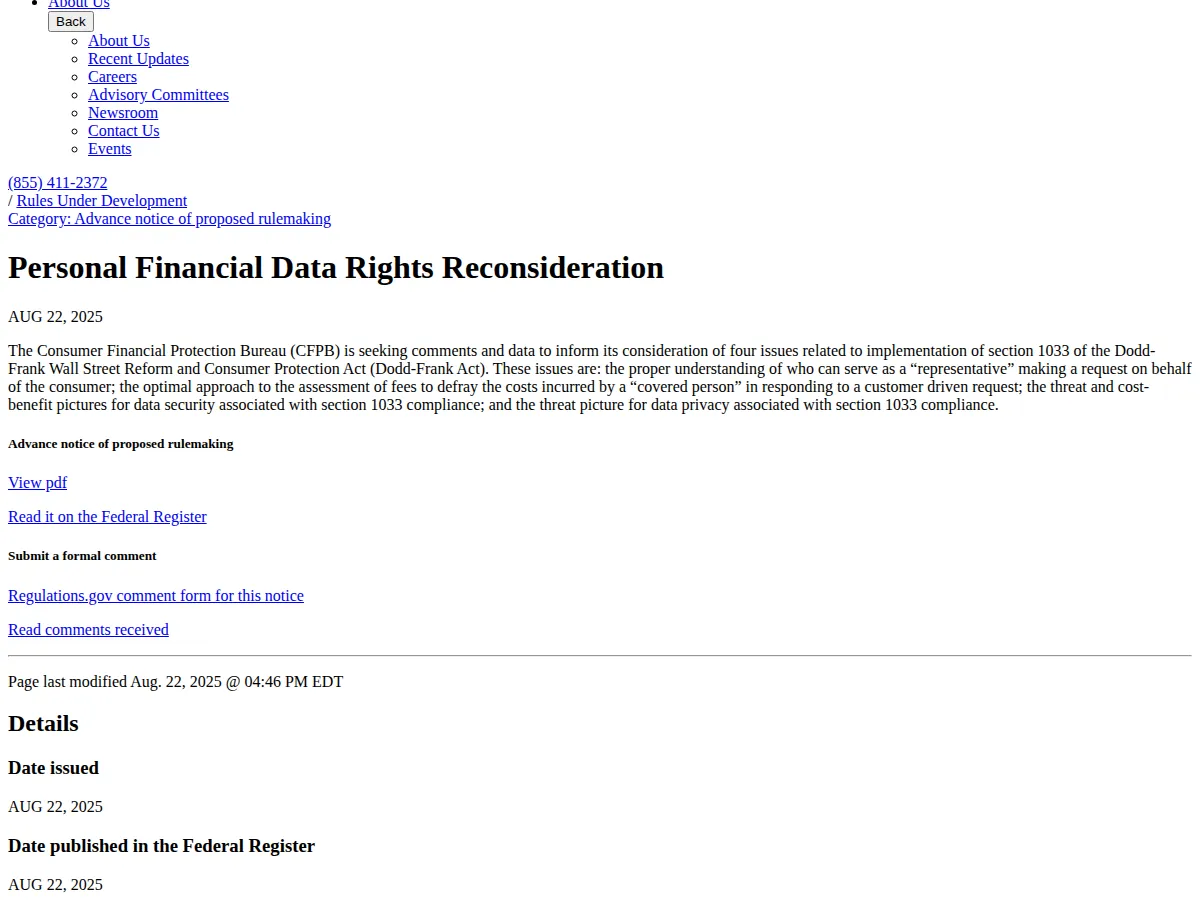
That schedule is not running. On August 22, 2025 the Bureau published an advance notice of proposed rulemaking to reconsider four issues: who can serve as a representative making a request on behalf of the consumer, the optimal approach to fees charged to defray the costs of responding, and the threat and cost-benefit pictures for data security and data privacy. On October 29, 2025 the United States District Court for the Eastern District of Kentucky enjoined the Bureau from enforcing the rule until it has completed its reconsideration, in Forcht Bank, N.A. v. CFPB. A replacement proposal was sent to the White House Office of Information and Regulatory Affairs in August 2026 and had not been published as of late October 2026, with reporting that it is expected to allow banks to charge for data access after a number of free requests.
The practical consequence is that bank data access in the United States still runs on commercial agreements, not on a mandated free interface. The Financial Data Exchange, FDX, is the standards body unifying the industry around a common API for permissioned consumer and business financial data, and it describes itself as a recognized standard setter whose specifications can help providers comply. But FDX is a voluntary standard, not a mandate, and while the rule is enjoined, the price of data is whatever the bank and the aggregator agree.
> [!WARNING]
> Do not build a compliance plan or a unit-economics model on the 2024 rule's fee ban. The ban sits inside a rule a federal court enjoined on October 29, 2025, and the replacement proposal is expected to let banks charge. A product whose margins assume free bank data has no margin — only a hope.
Decision Table
| Attribute | Plaid | Yodlee (Envestnet) | Finicity (Mastercard) | Authority |
| :--- | :--- | :--- | :--- | :--- |
| Published rates | None; plans only, first 200 calls free | None; demo request | None; enterprise quote | Plaid pricing page, read Nov 5, 2026 |
| Pricing shape | Five billing shapes, per Item or per call | Platform fee plus per active user | Usage-based, per account or per call | Plaid billing docs; industry-reported ranges |
| Coverage | 12,000 or more institutions, 20 countries | 19,000 or more sources | US open finance via Mastercard | Vendor comparisons, Sep 2026 verification |
| History depth | 24 months of transactions | Long-history wealth and 401(k) data | Mortgage verification heritage | Plaid Transactions docs; vendor comparisons |
| Best for | US consumer fintech, broad banking | Wealth, long-history aggregation | Lending verification, mortgage | Category positioning |
| Free tier | 200 API calls, sandbox free | None published | None published | Plaid pricing page; Teller card as control |
| Regulatory frame | FDX API, section 1033 enjoined Oct 29, 2025 | FDX API, section 1033 enjoined | Mastercard Open Finance, section 1033 enjoined | CFPB; Forcht Bank v. CFPB, E.D. Ky. |
Operator Boundaries
Do not choose an aggregator on the per-connection rate alone. The platform fee, the monthly minimum, the refresh cadence, and the reconnection rate decide the bill, and a realistic cost per active user runs 40 to 60 percent higher than the base per-link rate once reconnects and refreshes are counted. Do not sign a contract whose pricing depends on a refresh schedule the product team has not written down: hourly polling costs 85 times user-initiated reads on the published control card. Do not build a consumer fintech on credential scraping where a tokenized OAuth flow exists — screen scraping breaks on bank redesigns, stores credentials, and is the practice the FDX standard exists to replace. Do use Plaid where broad US bank coverage and developer experience matter most, Yodlee where wealth and long-history data are the product, and Finicity where the buyer is a lender verifying assets and income. Do get all three quotes on the same written workload, with the same refresh cadence, the same reconnection assumption, and the same user count, before signing anything.
> [!FOUNDER]
> "Every aggregator quote I have seen is a range with a smile. The number that matters is the bill at your refresh cadence, on your user count, in month twelve. If the vendor will not write that number down, you do not have a price — you have a sales call."
> — Enow A. Jovial, Founder & Chief Executive Officer
Execution Checklist
> [!TIP]
> Before signing, send one real week of traffic to the cheapest vendor's free tier and measure the actual calls per user per day. The refresh cadence you assume in the spreadsheet is almost never the cadence your product generates in production — and the difference is the whole bill.
Run the month-twelve bill through the ROI calculator before you commit: the per-account math here gives you the cost, and the calculator turns it into the payback period on the decisions the data drives. The cross-border payout comparison prices the other side of moving money once the accounts are connected, and the payment processor comparison prices what happens when those connected accounts start paying.