Perplexity vs ChatGPT vs Claude: AI Search and Assistant Pricing at $20 a Month
Three flagship AI subscriptions, one price: $20 a month. Perplexity Pro, ChatGPT Plus and Claude Pro each charge the same headline figure, and that sameness is the trap — the three sell different things. Perplexity sells search with citations. ChatGPT sells a general assistant with deep research and coding tools. Claude sells long-form work, code, and projects. Pay for the wrong one and the $20 buys features you never touch while the limit you actually hit stays free.
This playbook reads all three vendors’ own pricing pages on 8 November 2026 and prices the decision at 1, 5 and 25 seats, monthly and annual. Every figure carries its source, and where a vendor page blocked a direct read, the article says so and names the corroboration.
1. The price cards as published
| Vendor | Flagship plan | Monthly | Annual | Headline limit | Authority |
|---|---|---|---|---|---|
| Perplexity | Pro | $20 | $17/mo ($200/yr) | 300+ Pro searches a day | Perplexity Pro page; $20 corroborated |
| OpenAI | ChatGPT Plus | $20 | None — monthly only | Expanded messages, uploads, deep research | OpenAI pricing page; $20 corroborated |
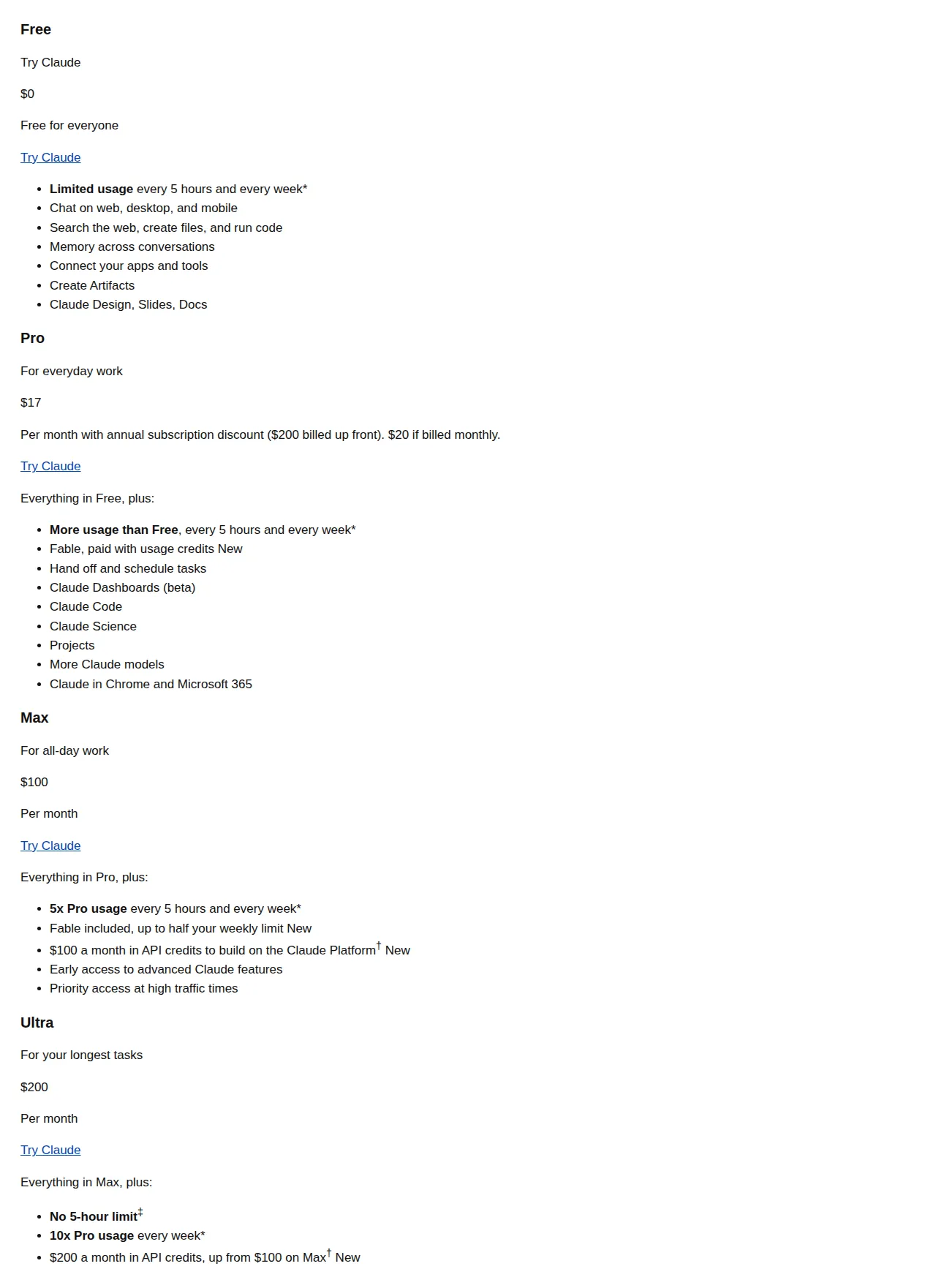
| Anthropic | Claude Pro | $20 | $17/mo ($200/yr) | At least 5x Free usage per 5-hour session | Claude pricing page |
The step above the flagship matters too. Perplexity Max is $167 a month billed annually ($200 a month on monthly billing, per pricing trackers), with maximum Computer usage and frontier models. Claude Max is $100 a month with 5x Pro usage and $100 a month in API credits; Claude Ultra is $200 a month with 10x weekly Pro usage, no 5-hour limit for verified accounts, and $200 a month in API credits. ChatGPT Pro starts at $100 a month with three usage tiers up to $500, GPT-6 Astra reasoning and monthly API credits. The free tier is $0 on all three — section 5 runs them.
Two prices above were read second-hand, and the distinction matters. OpenAI’s pricing page rendered on 8 November 2026 but the extract stripped the dollar amounts, so the Plus $20 rests on independent reads of OpenAI’s own page dated 24 September, 20 October and 3 November 2026. Perplexity’s pages return a Cloudflare challenge to automated fetches, so the monthly $20 rests on trackers that read the vendor page directly and verified it on 8 September 2026; the annual $17 was read on perplexity.ai/pro itself this cycle.
2. What the $20 buys
Perplexity Pro is search-first. Every answer carries inline citations with the source attached, so you can check a claim. Pro raises the ceiling to 300+ Pro searches a day on a rolling 24-hour window, opens the model switcher, adds Deep Research reports that read dozens of sources, allows up to 500 file uploads a day, and includes $5 a month in API credits, with Comet Plus bundled at no extra charge. The free tier keeps unlimited basic searches with citations and 5 Pro searches a day — enough to sample the deeper mode, not to live in it.
ChatGPT Plus is assistant-first. Plus buys GPT-6 advanced reasoning, expanded messages and uploads, more accurate image creation, expanded deep research, expanded memory and context, Projects, scheduled tasks, custom GPTs, expanded Codex usage, and expanded ChatGPT Work access. The free tier is the most generous of the three for plain chat — unlimited text chats with GPT-6 — but uploads, images, voice, deep research, memory and Codex are all limited. Go, at $8 a month, sits below Plus for lighter use and may include ads; Plus is ad-free.
Claude Pro is work-first. Pro unlocks Opus alongside Sonnet and Haiku — the free tier gets Sonnet and Haiku only — and includes Claude Code, Projects, scheduled tasks, Claude Dashboards, Claude Science, and Claude in Chrome and Microsoft 365, with a context window up to 1M tokens. For coding-heavy teams the Cursor vs Windsurf vs Claude Code pricing playbook prices the coding-assistant side. Claude’s free tier covers everyday questions with limited usage every 5 hours and every week.
3. The models behind the price
The model list is where the three stop looking identical. Perplexity is the only one that lets a $20 subscription borrow a rival’s model: the Pro page lists GPT-6.1 Sol, Gemini 3.8 Flash, Claude Sonnet 5.5, Kimi K3, GLM 5.3 and Grok 4.7, and Pro lets you pick between them per query. ChatGPT locks you to OpenAI’s models — GPT-6 on Plus, GPT-6 Astra reasoning on Pro. Claude gives you its own three: Haiku for fast, light work, Sonnet as the default workhorse, and Opus for the heaviest reasoning, on Pro and above.
Only Perplexity sells model choice as a feature. If your work needs Claude’s writing inside a search answer, or a Gemini answer with citations attached, Perplexity Pro is the only subscription of the three that sells it — with the trade that Perplexity must add each new flagship before you can pick it.
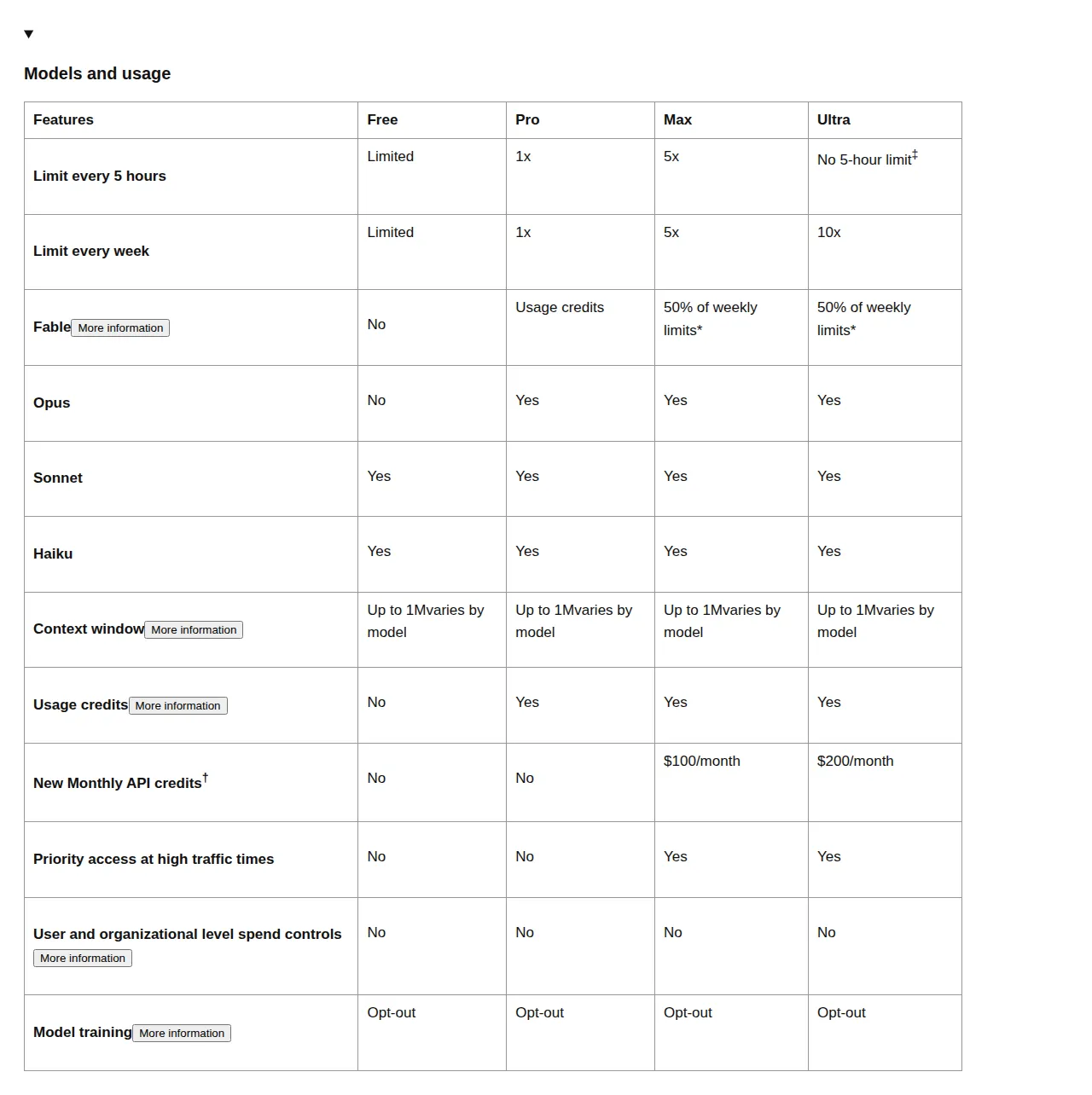
The usage table above is Claude’s own: Pro is 1x, Max is 5x, Ultra is 10x weekly with no 5-hour limit. Note what it does not say: none of the three vendors publishes a fixed message count for its flagship plan. Claude states a multiple of the free tier, ChatGPT publishes no fixed cap for Plus, and Perplexity’s 300+ is a floor on Pro searches, not a ceiling. Treat any roundup quoting an exact monthly message count for these plans as invented.
4. Worked example: a 5-person team
Worked example: a five-person research team buys one flagship subscription per seat. The monthly math is identical for all three; the annual math is where they split.
| Seats | Monthly billing, per year | Annual billing, per year | Saving on annual |
|---|---|---|---|
| 1 | $240 | $200 | $40 |
| 5 | $1,200 | $1,000 | $200 |
| 25 | $6,000 | $5,000 | $1,000 |
Read the table against the right vendor. Perplexity Pro and Claude Pro both offer the annual column, so a 5-seat team pays $1,000 a year instead of $1,200. ChatGPT Plus offers no annual billing, so the same five seats cost $1,200 a year with no way to cut it — $200 a year more than either rival. At 25 seats the gap is $1,000 a year. Before you sign, run the saving through the ROI calculator against the hours the subscription actually saves; a $200 saving counts only if the tool earns its $20.
The per-search math is Perplexity’s alone: 300 Pro searches a day is 9,000 a month, so each Pro search costs about $0.0022 at full use. The free tier’s 5 a day is 150 a month — Pro is 60 times the free allowance. A subscription that sits idle is the most expensive one of all, so the honest test is whether your team runs more than a handful of Pro searches a day.
5. The free tiers are real products
Start free on all three before you pay for any of them. Perplexity Free gives unlimited basic searches with citations — enough to replace quick lookups — and 5 Pro searches a day to sample the deeper mode. ChatGPT Free gives unlimited text chats with GPT-6, the most generous free tier for plain conversation; the limits bite on uploads, images, voice, deep research and memory. Claude Free covers everyday questions with limited usage every 5 hours and every week, Sonnet and Haiku included, Opus excluded.
Run the free tier for two weeks and watch which limit you hit first. If you hit Perplexity’s 5-a-day Pro search cap in the first week, that is your answer. If you never hit a cap on any of them, pay for none of them yet. The free tiers also settle the taste question — citation style, answer length, voice — which no table can.
6. Who should pick which
Pick Perplexity Pro if your day is research with sources: verifying claims, checking a market, building a cited brief. Pick ChatGPT Plus if your day is mixed — writing, images, code, research and custom GPTs in one place, with no single job dominating. Pick Claude Pro if your day is long documents, code, or projects that run for hours: the 1M-token context and Claude Code are the reasons to pay.
Founder & CEO Insight — Enow A. Jovial
Follow this sequence before you pay:
- List the three jobs you do most in AI each week.
- Run all three free tiers for two weeks; note which limit you hit first.
- Buy the one whose paid tier removes that limit, and cancel the others.
- If you buy for a team, bill annually on Perplexity or Claude and bank the $40 a seat a year.
- Re-check the price card at every renewal — the $20 figure has already moved on the tiers around it.
Buying seats for a business changes the paperwork. Put the subscription on the business card of the LLC, S-Corp or C-Corp, keep the EIN on the invoice, and route the receipt to the bookkeeper the same week — SaaS spend is the line item that drifts. Team plans add SSO and SCIM provisioning, SOC 2 reports and GDPR data controls; if your client contracts demand them, the $20 individual plan does not include them, and the team or enterprise tier is the honest buy. API use is billed on top of every subscription here — tokens are metered separately, so a BYO-key setup or a heavy API habit needs its own budget line. Price that side in the OpenAI vs Anthropic vs Google LLM API pricing playbook, and if you would rather run the models yourself, the local LLM fine-tuning vs RAG cost playbook prices the self-hosted route.
7. What the price cards do not tell you
First, the limits are softer than they look. Claude states multiples, not message counts. ChatGPT publishes no fixed cap for Plus. Perplexity’s 300+ Pro searches sit on a rolling 24-hour window, and its Deep Research runs on a separate rolling quota. When you hit a limit, all three let you wait for the reset, move to a higher tier, or — on Claude’s paid plans — switch on usage credits billed at standard API rates.
Second, the prices exclude tax. Claude states it on the pricing page; assume the same elsewhere and check your invoice, not the marketing page.
Third, citations need checking. Perplexity’s answers carry sources — its best feature and its sharpest edge: a Columbia Journalism Review audit cited in reviews found a 37% citation error rate. The citations are real links, and some do not support the sentence attached to them. Verify any citation that carries a decision before you paste it into a brief.
Fourth, the prices move. Go arrived as a cheaper ChatGPT tier, Pro tiers multiplied, and Perplexity’s Max tier repriced around the flagship. The $20 figure has held since ChatGPT Plus launched in February 2023, but the tiers around it have not — check the vendor page on the day you pay, not the roundup you read last quarter.
8. Execution checklist
- [x] Step 1: List your three weekly AI jobs. Write them down before you open any pricing page.
- [x] Step 2: Run all three free tiers for two weeks. Note which limit you hit first.
- [x] Step 3: Buy one flagship, not three. Pay monthly first; switch to annual after a month of real use.
- [x] Step 4: Set the renewal reminder. Calendar the renewal date and the annual switch.
- [x] Step 5: Put business seats on the business card. Keep the EIN on the invoice and the receipt with the bookkeeper.
- [x] Step 6: Check the citation habit. Open the source behind any Perplexity citation that carries a decision.
- [x] Step 7: Re-price at renewal. Open the vendor page and confirm the $20 before the charge lands.
- [x] Step 8: Cancel what you do not use. Zero searches in a month is a $20 donation.
9. Who should not buy
Do not stack all three flagships unless you can name the limit each one removes — $60 a month buys overlap, not coverage. Do not buy Max, Ultra or ChatGPT Pro on day one; the flagship tier is the test, and the higher tiers exist for the week you hit its ceiling three days running. Do not buy any of them if the free tier never limits you — paying for headroom you never use is the commonest waste here. And if your work is mostly API calls rather than chat, buy no subscription until you have priced the token side: the self-hosting LLMs and vector databases cost guide may cover the same work for less.