Nobody publishes a rate card, so price the workload instead
Every LLM vendor publishes prices per million tokens, and none of them publishes the number a buyer actually needs: what a month of your traffic costs. The input price, the output price, the cached-input price, the batch discount, and the price rise already announced for next month all sit in different tables, and the model that looks cheapest per token is often the most expensive per workload, because output tokens cost five to ten times input tokens and your traffic mix decides which column dominates. This guide runs the same three monthly workloads through OpenAI, Anthropic, and Google's published price lists, with every rate taken from the vendor's own pricing page this cycle, so the comparison survives contact with your own usage meter.
> [!KEY TAKEAWAY]
> At the same workload — 10 million input tokens and 2 million output tokens a month — the flagship tier costs $200 on OpenAI's gpt-6-astra, $100 on Anthropic's Claude Opus 4.7, and $40 on Google's Gemini 4 Argon at its current price, which doubles on December 1, 2026. The vendor ranking flips with the tier: at the budget tier the same workload costs $2 on OpenAI's gpt-6-luna, $20 on Claude Haiku 4.5, and $8 on Gemini 2.5 Flash. Buy the tier for the job, not the vendor for the logo.
Who this guide is for, and who should stop here
This guide is for a team buying API tokens by the month: a SaaS product with a chat or agent feature, an internal tool that summarizes documents, or a pipeline that classifies, extracts, or rewrites text at volume. If your usage is a few thousand tokens a month inside a free tier, the price lists below are trivia; pick the model you like and move on. If your usage is measured in tens or hundreds of millions of tokens, the tables below are the budget.
Who should not decide from price alone: a team whose product depends on a capability only one vendor offers, a team under a data-residency or compliance constraint that rules out a vendor, and a team whose latency budget rules out batch processing. OpenAI charges a 10 percent uplift for regional processing endpoints and FedRAMP endpoints on models released on or after March 5, 2026, so a residency requirement adds a tenth to every figure in this guide for the affected models. Price is the tiebreaker among models that can do the job, never the reason to pick a model that cannot.
The price lists, as published this cycle
All rates below are per million tokens (MTok), standard on-demand pricing, from the vendors' pricing pages read this cycle. Cached-input rates are the price of a token that hits the vendor's prompt cache; batch rates are the discounted price for asynchronous, non-urgent requests.
| Vendor tier | Model | Input per MTok | Output per MTok | Cached input per MTok | Authority |
| :--- | :--- | :--- | :--- | :--- | :--- |
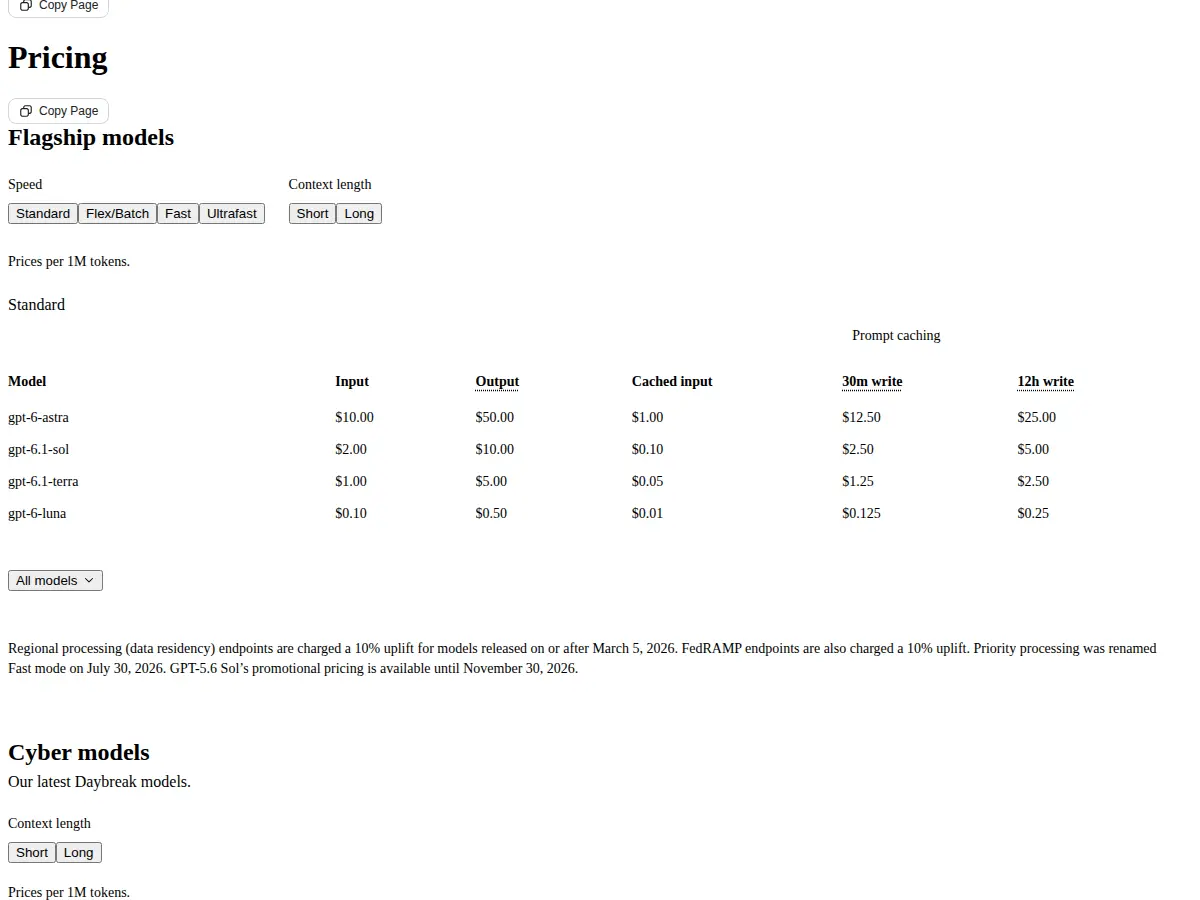
| OpenAI flagship | gpt-6-astra | $10.00 | $50.00 | $1.00 | OpenAI API pricing |
| OpenAI mid | gpt-6.1-sol | $2.00 | $10.00 | $0.10 | OpenAI API pricing |
| OpenAI budget | gpt-6-luna | $0.10 | $0.50 | $0.01 | OpenAI API pricing |
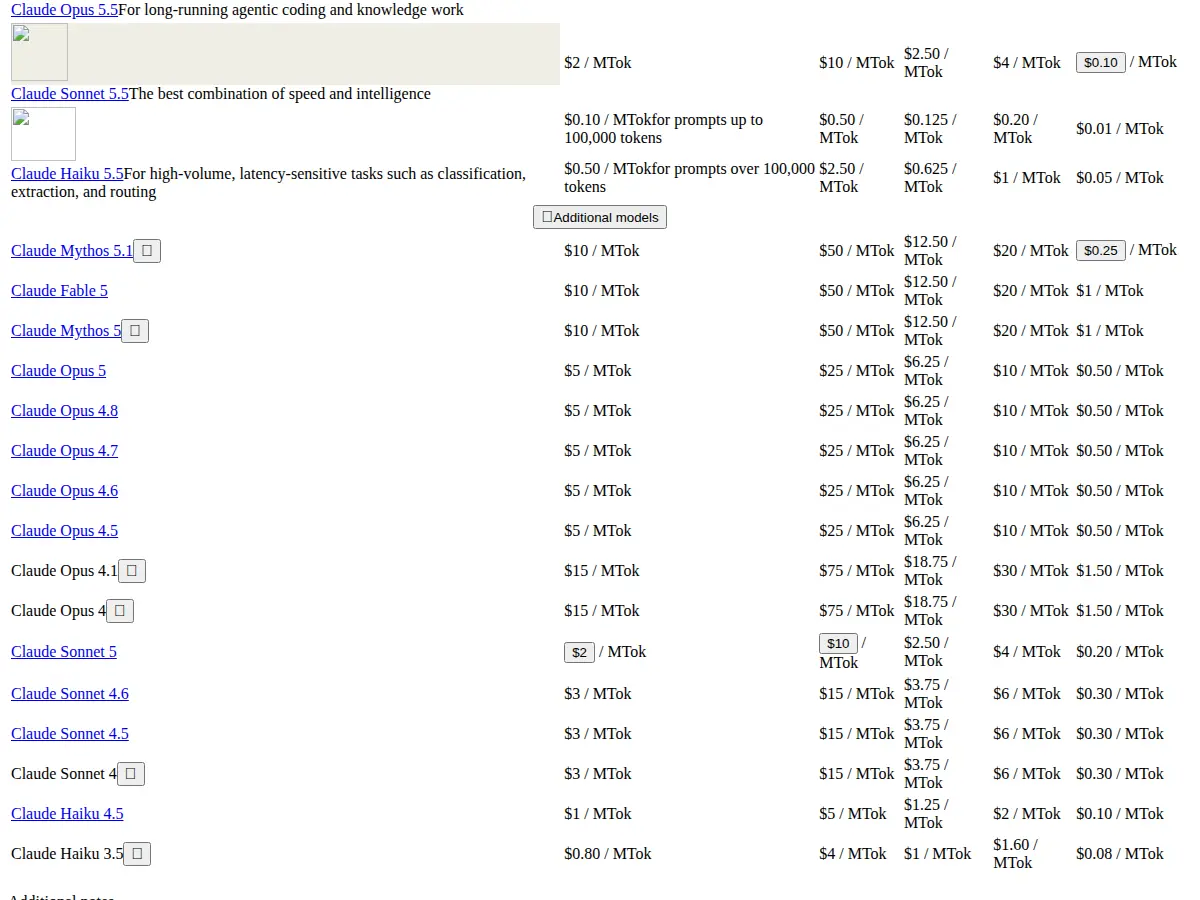
| Anthropic flagship | Claude Opus 4.7 | $5.00 | $25.00 | $0.50 read | Anthropic pricing |
| Anthropic mid | Claude Sonnet 4.6 | $3.00 | $15.00 | $0.30 read | Anthropic pricing |
| Anthropic budget | Claude Haiku 4.5 | $1.00 | $5.00 | $0.10 read | Anthropic pricing |
| Google flagship | Gemini 4 Argon | $2.00 now, $4.00 from Dec 1, 2026 | $10.00 now, $20.00 from Dec 1, 2026 | $0.10 now | Google Gemini API pricing |
| Google mid | Gemini 3.8 Flash | $0.75 now, $1.50 from Jan 1, 2027 | $3.75 now, $7.50 from Jan 1, 2027 | $0.075 now | Google Gemini API pricing |
| Google budget | Gemini 2.5 Flash | $0.30 | $2.50 | $0.03 | Google Gemini API pricing |
Two announced rises matter more than any current rate. Google's flagship doubles on December 1, 2026, and its mid tier doubles on January 1, 2027, so a budget built on today's Gemini prices without the rise date is wrong within weeks. Anthropic's cache-write rates — $6.25 per MTok for Opus, $3.75 for Sonnet, $1.25 for Haiku — are the cost of putting tokens into the cache, paid once, while the cache-read rate is paid on every reuse. OpenAI's batch pricing halves the standard rate on the flagship table — gpt-6.1-sol drops to $1.00 input and $5.00 output — and Anthropic states a 50 percent batch saving as well, so any workload that tolerates asynchronous processing starts at half price before any other optimization.
The cost formula, and three workloads
Every monthly bill in this guide comes from one formula, and the only inputs are your measured token counts and the vendor's rates.
$
\text{Monthly Cost} = (\text{Input MTok} \times \text{Input Rate}) + (\text{Output MTok} \times \text{Output Rate})
$
The workloads use a 5-to-1 input-to-output ratio, which matches retrieval-heavy chat and document work: long prompts in, short answers out. If your product writes long reports, your ratio is closer to 1-to-1 and the output column dominates, which changes the ranking — run your own ratio before copying any winner below.
| Workload | Input | Output | OpenAI flagship | Anthropic flagship | Google flagship now |
| :--- | :--- | :--- | :--- | :--- | :--- |
| Starter | 10 MTok | 2 MTok | $200 | $100 | $40 |
| Growth | 50 MTok | 10 MTok | $1,000 | $500 | $200 |
| Scale | 200 MTok | 40 MTok | $4,000 | $2,000 | $800 |
Worked for the Starter workload on the flagship tier: OpenAI astra costs 10 multiplied by $10 plus 2 multiplied by $50, which equals $200. Anthropic Opus costs 10 multiplied by $5 plus 2 multiplied by $25, which equals $100. Google Argon costs 10 multiplied by $2 plus 2 multiplied by $10, which equals $40 today — and $80 from December 1, 2026, when the rates double to $4 and $20. At Scale, the same doubling moves Google from $800 to $1,600 a month, still below Anthropic's $2,000 but no longer the five-to-one bargain the current table suggests. A buyer who signs an annual commitment on November prices without reading the rise dates has budgeted a discount that expires in four weeks.
| Workload | OpenAI mid (Sol) | Anthropic mid (Sonnet) | Google mid (3.8 Flash now) | OpenAI budget (Luna) | Anthropic budget (Haiku) | Google budget (2.5 Flash) |
| :--- | :--- | :--- | :--- | :--- | :--- | :--- |
| Starter 10/2 MTok | $40 | $60 | $15 | $2 | $20 | $8 |
| Growth 50/10 MTok | $200 | $300 | $75 | $10 | $100 | $40 |
| Scale 200/40 MTok | $800 | $1,200 | $300 | $40 | $400 | $160 |
The mid-tier table is where most products should live. A Starter workload on Sonnet costs $60 against $100 on Opus, a 40 percent saving for the same vendor, and the budget tier collapses the bill further: Luna at $2 a month for the Starter workload is one-hundredth of Astra's $200. The question is never whether the budget tier is cheaper; it is whether the budget tier passes your quality bar on your hardest prompts, which is an evaluation question, not a pricing question.
Caching and batching: the two levers that beat switching vendors
Switching vendors saves tens of percent. Caching and batching save multiples, because they change the meter itself.
$
\text{Blended Input Rate} = (1 - \text{Cache Hit Rate}) \times \text{Input Rate} + \text{Cache Hit Rate} \times \text{Cached Input Rate}
$
Worked on Opus at an 80 percent cache hit rate: 0.20 multiplied by $5 plus 0.80 multiplied by $0.50 equals $1.40 per MTok, against $5.00 uncached. On the Starter workload's 10 MTok of input, that is $14 instead of $50, before the cache-write cost of $6.25 per MTok on the first write. Caching pays when the same system prompt, the same retrieved documents, or the same conversation prefix repeats across requests — which is exactly what retrieval-augmented generation does, and exactly what a chat product with long histories does. It pays nothing on one-shot prompts with no shared prefix, and the cache-write rate means a prefix cached once and used once costs more than no cache at all.
Batching is the second lever. OpenAI's batch rate for gpt-6.1-sol is $1.00 input and $5.00 output against $2.00 and $10.00 standard, so the Starter workload on batch costs 10 multiplied by $1 plus 2 multiplied by $5, which equals $20 instead of $40. Anthropic's stated 50 percent batch saving gives the same halving. The constraint is latency: batch jobs run asynchronously, so nightly classification, bulk extraction, and evaluation pipelines qualify, while a user waiting in a chat window does not. A product that routes its offline work to batch and its interactive work to standard pricing gets the discount where it is free and pays full price only where speed earns it.
Google's counting rule deserves its own line in the budget: output prices on the Gemini API include thinking tokens, so a reasoning-heavy prompt bills its internal reasoning at the output rate. A model that thinks for 2,000 tokens before answering 200 bills 2,200 output tokens, and the thinking share grows with task difficulty. Measure output tokens per request from your own logs, not from the answer length you see on screen, or the output column will surprise you every month.
> [!FOUNDER]
> "The cheapest model is the one whose price list you actually read twice: once for the rate, once for the rise date. Every vendor in this guide has a price change already scheduled, and the team that budgets November rates for a full year has already overspent by January. Price the workload, date the commitment, and re-run the table every quarter."
> — Enow A. Jovial, Founder & Chief Executive Officer
Decision matrix: which tier for which job
| Job | First choice by cost | Why it wins | Authority |
| :--- | :--- | :--- | :--- |
| Flagship reasoning, low volume | Google Argon before Dec 1, then re-price | $40 Starter today; $80 after the rise, still below Opus $100 | Google Gemini API pricing |
| Balanced production chat | OpenAI Sol or Sonnet, by evaluation | $40 to $60 Starter; batch halves either | OpenAI, Anthropic pricing |
| High-volume classification | Luna or 2.5 Flash | $2 to $8 Starter; quality gate decides | OpenAI, Google pricing |
| Retrieval-heavy RAG | The vendor with the best cache economics for your prefix | Cache-read rates from $0.01 to $0.50 change the input column most | All three pricing pages |
| Offline bulk work | Batch on any vendor | 50 percent saving; latency is the only cost | OpenAI, Anthropic pricing |
> [!WARNING]
> Free tiers are not production tiers. Google's free tier covers several of these models at zero price with rate limits, and every vendor's free tier exists to be outgrown. A product that launches on a free tier without a paid-tier budget has a launch date and a shutdown date, and the shutdown date is the day the rate limit meets real traffic. Budget the paid rate from the first user, and treat the free tier as evaluation credit.
Operator boundaries and the quarterly re-price
This guide prices tokens. It does not price the rest of the bill: tool calls, grounding, and search. Google meters grounding with Google Search separately, with a free monthly allowance shared across Gemini 3 and newer models and a per-thousand-request charge beyond it, so a grounded product has a second meter to budget. Image and audio inputs carry their own token conversions on the Gemini API — audio input on 2.5 Flash is $1.00 per MTok against $0.30 for text — so a voice product cannot budget from the text column. Vendor price lists change without a migration guide, model generations turn over, and the model names in this guide will age; the formula and the workloads will not, which is why the article is built around them.
> [!TIP]
> Evaluate the budget tier on your ten hardest prompts before you evaluate it on your average prompt. Averages hide the failure that costs a customer, and the tier that passes the hardest ten at one-fiftieth of the flagship price is the tier your margin was waiting for. If it fails two of the ten, keep the flagship for those two intents and route the rest down — tiering by intent beats a single model for everything.
Related reading on this site: the self-hosting LLMs cost guide for the buy-vs-rent boundary, the vector database comparison for the retrieval layer that makes caching pay, and the local LLM fine-tuning vs RAG guide for when tokens stop being the right meter at all. Price the whole build with the pricing calculator.