Patreon vs Ko-fi vs Gumroad: The Creator Monetization Playbook
A creator with 200 paying supporters on a $5 monthly tier grosses $1,000 a month. What lands in the bank depends on the platform between the supporter and the creator: the gap between the best and worst of the three in this playbook is $88 a month on that exact income — $1,056 a year — before payout fees, currency conversion, and the Apple fee on iOS purchases. This playbook prices all three from their own pages, read on 9 November 2026.
Patreon sells recurring membership: tiers, monthly and annual billing, and a community space. Ko-fi sells direct support: tips, memberships, a shop, and commissions, paid straight to the creator's own PayPal or Stripe account. Gumroad sells products: one-off digital goods, courses, and memberships, as the seller of record.
One disclosure first. Patreon and Ko-fi help pages refused direct reads from this network on 9 November 2026, so Patreon figures come from its pricing page and help-centre articles read through the search fetcher, Ko-fi's Gold mechanics are corroborated across three 2026 fee guides quoting Ko-fi's help pages, and Gumroad's figures come from its own pages, read in full.
Founder & CEO Insight — Enow A. Jovial
Patreon: the membership machine, priced at 10%
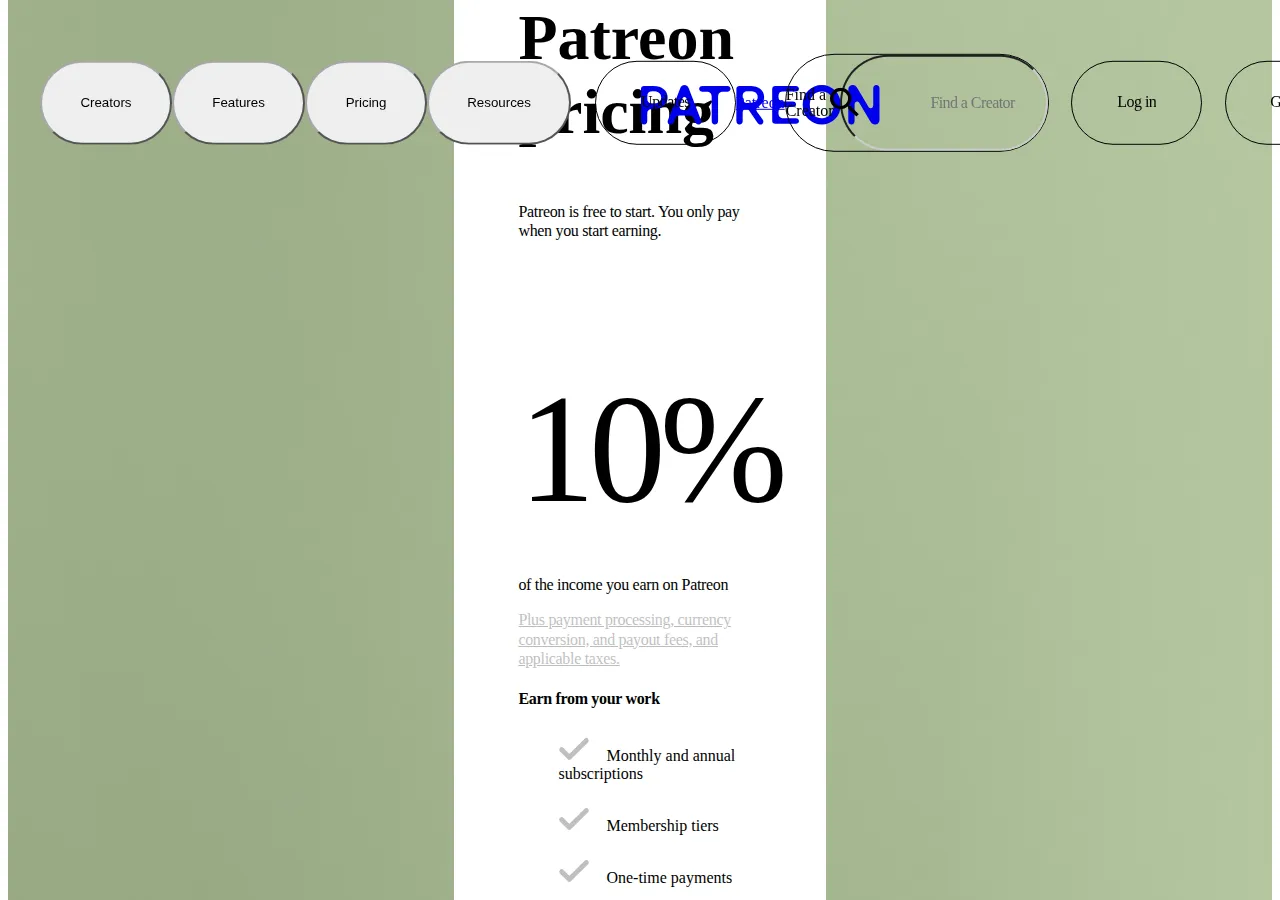
Patreon is free to start. A creator who publishes a page after 4 August 2025 pays a single platform fee of 10% of the income earned on Patreon, plus payment processing, currency conversion, and payout fees, plus applicable taxes. Creators who published on or before 4 August 2025 and stayed published keep legacy rates of 5% on Lite, 8% on Pro, and 12% on Premium; unpublishing a legacy page and republishing it moves the creator onto the 10% plan.
Processing sits on top of the 10%. A payment over $3 costs 2.9% plus $0.30, the same for US PayPal or Venmo, and 3.9% plus $0.30 outside the US. Payments under $3 carry a separate small-charge rate of 5% plus $0.10. A 2.5% currency-conversion fee applies when a member pays in a different currency.
The Apple fee changes the answer for mobile audiences. Purchases inside the Patreon iOS app route through Apple's in-app purchase system, which takes 30% of the price; Patreon charges no processing fee on those sales, but the 10% platform fee still applies. A $5 pledge bought in the iOS app keeps $3.00, against $4.06 on the web.
The email list is the one asset that survives leaving Patreon.
Patreon pays out on the creator's instruction, not on a fixed weekly rhythm. The creator withdraws manually, at most once every 24 hours, or switches on automatic payout, which sends the full available balance on the 5th of each month; deposits typically arrive within 1 to 5 days. Two holds stretch the wait: web and Android funds sit pending up to 7 days, and iOS in-app funds up to 75 days. Payout fees are in the table below.
Ko-fi: the direct pipe, priced at 0 to 5%
Ko-fi's pricing page states its model in one line: the Standard plan costs $0 a month plus a 5% service fee, and Ko-fi Gold costs $12 a month with a 0% service fee. The creator pays only the service fee, no more than 5%, plus standard payment processor fees, with no buyer fees, no payout fees, and no marketing fees. The split by payment type is where the real price sits: one-time tips carry 0% on the free plan when Contributor mode is off, while shop sales, memberships, monthly tips, and commissions carry 5%, and Gold removes that 5%.
Two details catch new creators. New accounts start with Contributor mode switched on, which puts the same 5% on tips too, so the 0% tip rate is real only for a creator who switches Contributor off — and subscribing to Gold does not switch it off by itself. Gold costs $12 a month for new sign-ups, billed monthly only. The break-even is $12 divided by 5%: $240 a month of fee-bearing income.
Ko-fi never holds the money. Supporter payments go directly into the creator's own PayPal or Stripe account as they clear, so there is no Ko-fi balance, no minimum payout, and no payout schedule. Processing is charged by the processor: Stripe's standard US rate is 2.9% plus $0.30 per successful domestic card charge, and PayPal Checkout runs 3.49% plus $0.49 in the US. Processing applies on both plans, so "0%" means 0% platform fee, never 0% total cost. Ko-fi is not the merchant of record: no payment processing, refunds, or dispute handling, and the creator handles VAT and sales tax.

Gumroad: the storefront, priced per sale
Gumroad charges no monthly fee and no subscription. Its help centre states the fee in one line: for sales made on Gumroad's website, 10% plus $0.50 per transaction, plus sales tax, and that figure does not include credit card processing at 2.9% plus $0.30 or PayPal's own fees. Sales through Gumroad's own marketplace, called Discover, cost a flat 30% per transaction, processing included.
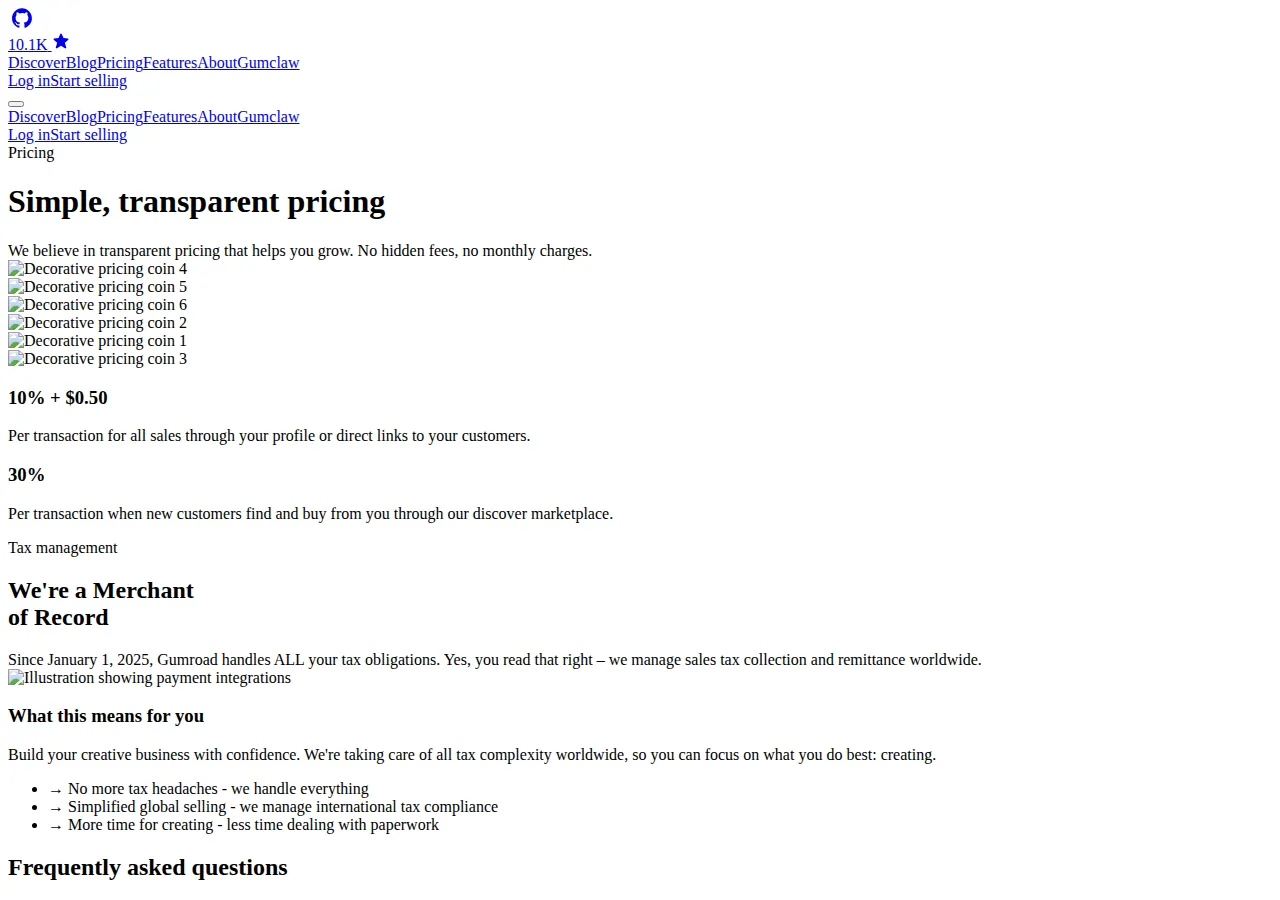
The $0.50 flat fee lands on every transaction, so on a $5 product it is 10% by itself before the percentage fees start. The realistic all-in cost of a direct card sale is about 12.9% plus $0.80: roughly 16% of the price at $25, roughly 14.5% at $50, and roughly 29% at $5. A creator pricing a $3 template keeps far less per sale than a creator pricing a $49 course, and the fee table, not the product, decides that.
Once paid sales in a calendar month reach $20,000, new direct sales that month cost 5% plus $0.50, applied automatically, and the threshold resets on the 1st; a refund can pull the creator back under $20,000. Affiliate sales split the fees in proportion to the commission.
Gumroad has been the merchant of record since 1 January 2025, collecting sales tax, VAT, and GST worldwide.
Payouts run on a schedule the creator chooses — daily, weekly, monthly, or quarterly — with a $100 minimum balance, raised from $10 on 23 March 2026, so a creator earning $25 a month now waits four months for a first payout. Each payout covers sales made through the previous Friday in UTC, and each sale waits at least 7 days. The payout day depends on the rail: Tuesday for most countries, Wednesday for euro accounts, Thursday for US banks, Friday for PayPal. Bank payouts take 2 to 7 business days with no listed fee; PayPal payouts arrive in 1 to 3 business days and carry a 2% fee. Gumroad pays no one through Payoneer, Wise, wire transfer, check, or money order. US creators can take instant payouts up to $10,000 for a 3% fee, after one completed payout and 60 days of processing, with no $100 minimum and no 7-day hold.
The decision table
| Line | Patreon | Ko-fi | Gumroad | Authority |
|---|---|---|---|---|
| Platform fee | 10% (new); 5% / 8% / 12% legacy | 0% tips (Contributor off); 5% rest; Gold 0% | 10% + $0.50 direct; 30% Discover | Pricing pages |
| Processing | 2.9% + $0.30 over $3; 5% + $0.10 under $3 | Stripe 2.9% + $0.30; PayPal 3.49% + $0.49 | 2.9% + $0.30 card, on top | Patreon fee help; Stripe; Gumroad fees help |
| Apple iOS fee | 30% in-app; US web checkout exempt | None | None | Patreon fee help |
| Payout rhythm | Manual, once per 24 hours, or auto on the 5th | Immediate to creator's PayPal/Stripe | Weekly default; sales through previous Friday | Payout help pages |
| Payout minimum | $10 PayPal; $25 Payoneer Wallet | None | $100 (from $10, 23 Mar 2026) | Payout help pages |
| Payout fee | $0.25 US direct deposit; 1% PayPal | None | None bank; 2% PayPal; 3% US instant | Payout help pages |
| Merchant of record | Yes: tax, chargebacks, fraud | No: creator handles VAT, refunds, disputes | Yes since 1 Jan 2025 | Pricing pages; Ko-fi help |
Monthly net at 200 supporters paying $5
200 supporters at $5 a month is $1,000 gross. The math prices that month on the web, by card: processing on a $5 payment is $0.445, or $89.00 across 200 payments.
Our editorial analysis found Ko-fi Gold keeps $899, Ko-fi Free $861, Patreon $811 before its $0.25 payout fee. The $88 gap between Patreon and Ko-fi Gold is the price of Patreon's membership apparatus, its chargeback and fraud handling, and its tax work.
Per-sale net on Gumroad at $25
Forty $25 sales also gross $1,000: platform fee 10% plus $0.50 per sale, processing 2.9% plus $0.30 per card sale.
The same $1,000 gross keeps $839 through the creator's own links and $700 through Discover, a $139 difference that is the price of Gumroad finding the buyer. Discover is the only fee here that buys distribution: a sale that would not have happened keeps $17.50 on a $25 product.
Payout timing is a second price
Fees decide how much of each dollar the creator keeps; payout timing decides when it can be spent. Ko-fi pays out as each payment clears, straight to the creator's own account. Patreon pays on instruction or automatically on the 5th, after holds of up to 7 days web and Android or 75 days iOS. Gumroad holds each sale at least 7 days, then pays on the rail's weekday plus 2 to 7 business days.
Cross-border creators pay a third price: Patreon charges 2.5% when a member pays in a different currency, and a non-US bank payout costs $0.25 plus 1.55% conversion; Gumroad pays in local currency for most countries; Ko-fi passes conversion to Stripe or PayPal. On a $1,000 month, conversion alone can cost more than the gap between the headline fees.
Where each platform fails
Patreon fails on control: the creator rents the membership apparatus, and the audience relationship sits inside Patreon's product. The 10% fee is fixed for new pages, the iOS fee is Apple's, and the 75-day iOS hold cannot be shortened. Ko-fi fails on reach and protection: it brings few new supporters by itself, carries no chargeback or fraud handling, and does no tax work. Gumroad fails on small sellers: the $100 payout minimum makes a creator earning $25 a month wait four months for a first payout, and the $0.50 per-sale fee makes cheap products the most expensive to sell.
All three share one failure: none owns the audience. A fee, minimum, or hold can change with a help-centre update, so the defence is an exported email list and a second channel. For the newsletter side, see ConvertKit vs Beehiiv vs Substack: the newsletter pricing playbook.
Paying creators: the back office
The money sent is half the job; the other half is proving who earned it. A creator paying collaborators needs a W-9 from US payees, a W-8BEN from non-US individuals, or a W-8BEN-E for a foreign company, before the first payout; the business needs an EIN, an individual an SSN or ITIN. The 2026 reporting line moved: the One Big Beautiful Bill Act raised the Form 1099-NEC threshold from $600 to $2,000 per payee per year for payments after 31 December 2025, so a contractor paid less than $2,000 in 2026 gets no 1099-NEC; the 1099-K threshold is $20,000 and 200 transactions. Schedule C has no floor and the $400 self-employment-tax threshold is untouched, so every dollar is taxable. An LLC reports on Schedule C; an S-Corp or C-Corp files separately. Wire and ACH move the money; IBAN and SWIFT identify the account across borders, and FX takes its cut. The deciding numbers are CAC against LTV: cost to win a supporter versus what they pay over their stay. Records are the platforms' own exports: a CSV of sales and payouts, downloaded monthly, kept where GDPR allows.
Execution checklist
- Export the email list from every platform in use.
- Pick the model first: memberships point to Patreon or Ko-fi, products to Gumroad.
- Price the $5 tier test on all three before setting the price.
- On Ko-fi, switch Contributor mode off before promoting a tip link.
- On Patreon, steer US supporters to mobile web checkout to skip the 30% Apple fee.
- On Gumroad, price products above $19 and decide per product whether Discover is on.
- Set the payout method before the first sale.
- Collect a W-9 or W-8BEN from every collaborator, and track payments against the $2,000 1099-NEC threshold.
- Download each platform's monthly CSV and reconcile it against the bank deposit.
- Re-check pricing quarterly; run the numbers through the profit calculator first, and compare with the influencer rate card and affiliate setup.
The choice is not which platform is best, but which fee stack, payout rhythm, and tax load fits how the creator earns — run the numbers, keep the email list outside, and let the arithmetic choose.