Kit vs beehiiv vs Substack: Newsletter Pricing Playbook
A newsletter platform takes your money in one of two ways: a flat monthly bill that climbs with your list, or a share of every payment your readers make. Kit and beehiiv charge the flat bill; Substack charges the share. That difference decides which platform is cheapest for you, and the answer flips as your list grows. This playbook prices all three at 1,000, 10,000 and 50,000 subscribers and names the point where each one stops being the cheap option.
What each platform actually sells
Kit is an email platform for creators who sell things: authors, coaches, course creators, YouTubers. It runs sign-up forms, newsletters, automated sequences and a checkout in one account, and its paid plans add automation rather than just lifting a subscriber cap. Note the name: ConvertKit rebranded to Kit.
beehiiv is a newsletter platform built around growth and monetisation, with a website, podcast, community and digital products inside every plan. The paid tiers add paid subscriptions, an ad network, automations and recommendations. On 1 October 2026 beehiiv renamed its plans: Launch became Free, Scale became Lite, and Max became Pro.
Substack is a hosted publication with a built-in reader network. Publishing is free at any list size, and Substack earns only when you do: it keeps 10% of each paid subscription payment. The trade is that Substack processes payments through its own Stripe account, not yours, so paid subscribers cannot be carried to another platform without re-entering card details.
Free-tier caps: who lets you start for nothing
| Platform | Free plan | Cap | What free leaves out |
|---|---|---|---|
| Kit | Free, $0 a month | 10,000 subscribers | Visual Automations, sequences, RSS campaigns, branding removal |
| beehiiv | Free, $0 forever | 2,500 subscribers | Paid subscriptions, ad monetisation, automations, polls, A/B testing |
| Substack | Free to publish | No cap | Nothing paywalled; 10% fee only on paid subscriptions |
Kit's free cap is four times beehiiv's: 10,000 against 2,500. A writer who only needs broadcasts, landing pages and forms can run a 9,000-subscriber list on Kit and pay nothing. The catch is automation: Kit's free plan has no sequences and no Visual Automations, so the first welcome sequence is usually the trigger that forces an upgrade.
 Neither vendor limits sends on any plan.
Founder & CEO Insight — Enow A. Jovial
The pricing ladders at 1,000, 10,000 and 50,000 subscribers
Both Kit and beehiiv price by subscriber band, not by send volume. Cross a boundary and the bill jumps to the next band in full. Kit counts unique active subscribers and upgrades the account automatically when you pass the limit.
| Plan | 1,000 subs / mo | 10,000 subs / mo | 50,000 subs / mo |
|---|---|---|---|
| Kit Creator | $39 | $139 | $379 |
| Kit Pro | $79 | $189 | $519 |
| beehiiv Lite | $59 | $139 | $299 |
| beehiiv Pro | $109 | $239 | $469 |
| Substack | $0 | $0 | $0 |
Yearly billing cuts the flat bills. Kit advertises "pay yearly, save 17%": Creator is $390 a year at 1,000 subscribers ($33 a month) and $1,390 a year at 10,000; at 50,000 Creator is $3,790 a year ($316 a month) and Pro is $5,190 a year ($433 a month). beehiiv says yearly billing saves up to 20%: Lite is $588 a year at 1,000 subscribers ($49 a month), $1,428 at 10,000 ($119 a month) and $2,988 at 50,000 ($249 a month); Pro yearly: $1,140 / $2,388 / $4,788.
Pro lists at $66 a month on yearly billing, but a limited-time offer cuts the first year to $50 a month, $593 billed, after which the plan renews at the standard rate. And the jump at the free cap is a cliff: cross 10,001 subscribers and the bill goes from $0 straight to the $169-a-month Creator band (the 15,000-subscriber band).
Revenue share and fees: where the real money goes
A flat bill is only half the cost: every paid subscription also pays a card processor, and each platform takes its own cut.
| Charge | Rate | Authority |
|---|---|---|
| Substack platform fee | 10% of each subscription payment | Substack help centre, per independent 2026 guides |
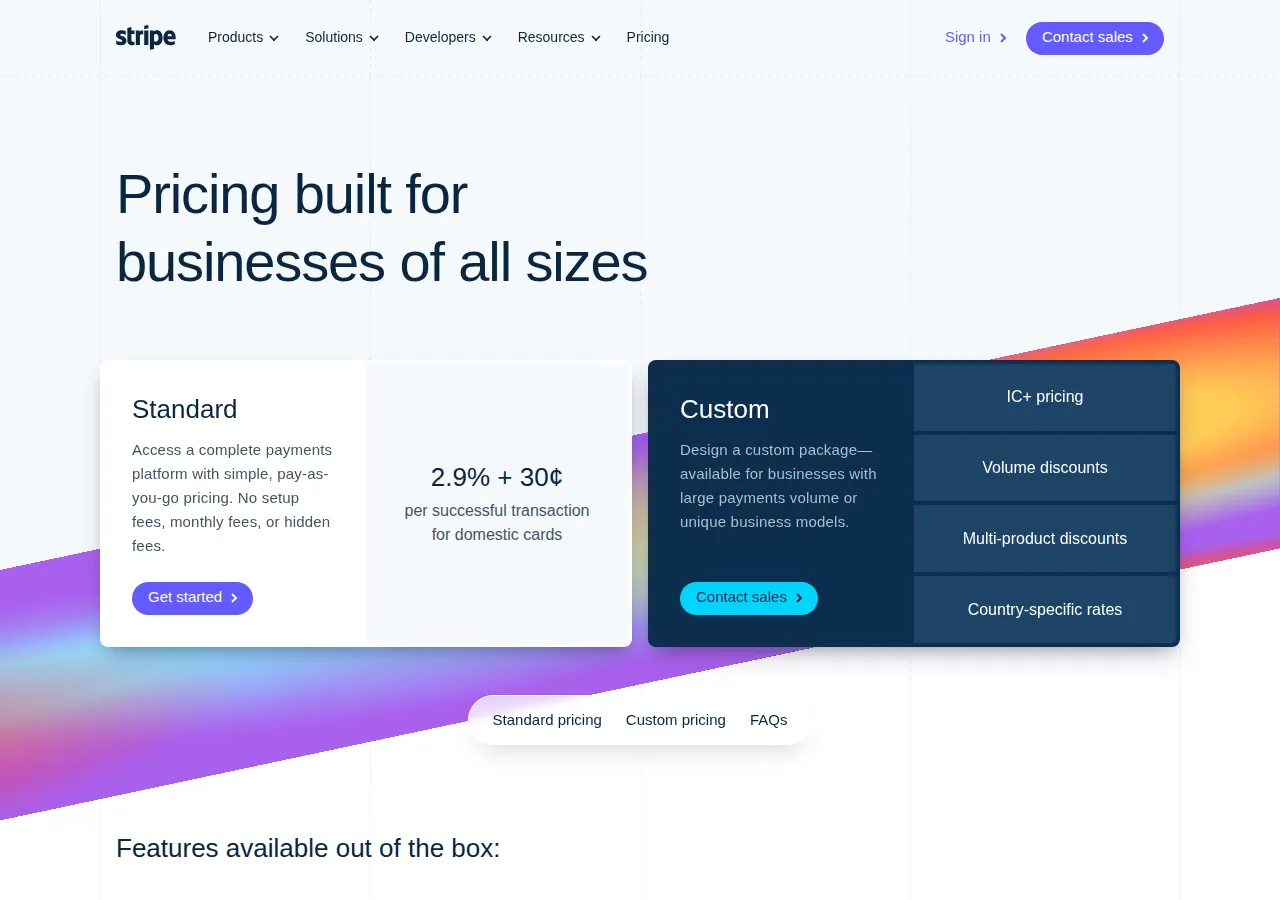
| Stripe card processing | 2.9% + $0.30 per US card payment | Stripe pricing page, opened 8 November 2026 |
| Stripe Billing, recurring payments | 0.7% of billing volume | Stripe pricing page, opened 8 November 2026 |
| beehiiv platform fee on paid subscriptions | 0% | beehiiv pricing page, opened 8 November 2026 |
| beehiiv platform fee on digital products | 0% | beehiiv pricing page, opened 8 November 2026 |
| Kit commerce fee | 3.5% + $0.30 per payment, card processing included | Kit pricing page, opened 8 November 2026 |
| Kit Paid Recommendations fee | 23.5% of recommendation earnings | Kit pricing page, opened 8 November 2026 |
Stripe's own pricing page confirms 2.9% + $0.30 per successful domestic card transaction, 1.5% for international cards, 1% for currency conversion, and a 0.7% Billing fee on recurring volume.
 Kit's commerce fee is 3.5% + $0.30 per payment on every plan, including Free, with card processing inside it; Kit states it takes 0.6% of the total fees. beehiiv takes 0% of paid subscriptions and digital products. Substack's 10% has no volume discount and no annual plan. From 1 December 2026 Substack also calculates, collects and remits sales tax or VAT on paid subscriptions at no extra cost, per 2026 guides that read its tax update page.
The math, exposed
One scenario runs through this playbook: an $8-a-month paid tier, with 5% of the list paying. Gross monthly revenue is subscribers times 5% times $8.
Substack keeps 17.35% of gross here: 10% platform, 2.9% card, 0.7% Billing, and the flat $0.30 per payment, which is 3.75% of an $8 payment. Kit's per-payment cost is 7.25% of the price. beehiiv's is 6.65%.
Worked cost examples at 1,000, 10,000 and 50,000 subscribers
Monthly billing, $8-a-month tier, 5% paying.
| List size | Gross / mo | Substack total | Kit Creator total | beehiiv Lite total |
|---|---|---|---|---|
| 1,000 (50 payers) | $400 | $69 | $68 | $86 |
| 10,000 (500 payers) | $4,000 | $694 | $429 | $405 |
| 50,000 (2,500 payers) | $20,000 | $3,470 | $1,829 | $1,629 |
Check the 1,000-subscriber row. Substack: $40 platform (10% of $400), $26.60 card (50 x $0.53), $2.80 Billing (0.7% of $400) — $69.40 in total, leaving $330.60. Kit Creator: $39 platform plus $29 in commerce fees (50 x $0.58) totals $68, leaving $332. beehiiv Lite: $59 platform plus $26.60 card fees totals $85.60, leaving $314.40.
At 10,000 subscribers the flat bills pull ahead: Substack $694 ($400 platform, $266 card, $28 Billing); Kit Creator $429 ($139 platform, $290 commerce fees); beehiiv Lite $405 ($139 platform, $266 card fees). At 50,000 the gap is wide: Substack $3,470 against Kit Creator $1,829 and beehiiv Lite $1,629. On yearly billing the flat bills fall further: at 50,000 subscribers Kit Creator totals $1,766 a month and beehiiv Lite $1,579 a month.
The crossover: when the flat bill beats the share
The crossover is the monthly gross revenue where Substack's percentage cost equals a flat bill plus its per-payment fees, solved for gross revenue G at an $8 subscription.
At 10,000 subscribers, Kit Creator's $139 bill crosses Substack at $1,376 of monthly gross: about 172 paying readers at $8, or 1.7% of the list paying. beehiiv Lite crosses earlier, at $1,299, on its lower per-payment cost. At 50,000 subscribers, Kit Creator crosses at $3,752 of monthly gross and beehiiv Lite at $2,794. At 1,000 subscribers, Kit Creator crosses at $386, so the $400-gross example is nearly a dead heat: $68 against $69.
Deliverability and monetisation mechanics
No vendor here publishes a verified inbox rate. Kit gives deliverability reporting, a custom tracking domain and engagement scoring on Pro only. beehiiv reserves dedicated IPs for Enterprise. Substack sends from shared infrastructure with a custom domain option. On all three: a custom sending domain with SPF, DKIM and DMARC before the first paid send. Our deliverability setup guide is cold-email-deliverability-spf-dkim-dmarc.
The monetisation mechanics differ more than the prices. beehiiv runs an ad network that places sponsor ads in your newsletter, paid recommendations that pay you for promoting other newsletters, and Boost, its marketplace where you pay to acquire subscribers from other publications. Kit runs Paid Recommendations (Kit takes 23.5% of those earnings), newsletter sponsorships matched through its own network, and a referral system built with SparkLoop, free on Pro. Substack monetises through its reader network and app discovery, pledges and founding-member tiers, and brand partnerships. None of these pays a fixed rate the vendors publish, so budget them as variable income, not as an offset to the platform bill.
Getting paid: the back office nobody prices
The platform bill is the visible cost. The back office is the part that breaks a launch week. A US creator is usually asked for a W-9 and an EIN or SSN; a creator outside the US, for a W-8BEN and an ITIN where a treaty claim is involved. Payouts move by Wire or ACH in dollars, and by IBAN and SWIFT once the money crosses borders, with FX taking its cut on every conversion. The entity behind the account matters too: an LLC, an S-Corp and a C-Corp are taxed differently. None of the three platforms publishes its payout timetable or its tax-form flow on its pricing page, so ask for both before you move a paid list. Keep a CSV export of subscribers and payments, or pull the same records through the API, because the export is the only copy you fully control. GDPR applies to European readers on all three. Track CAC against LTV for the list: our unit-economics guide is saas-unit-economics-cac-payback-ltv-nrr-formulas.
Which platform, for whom
| Situation | Pick | Authority |
|---|---|---|
| List under 10,000, no automations | Kit Free | Kit pricing page: Free to 10,000 subscribers, $0 |
| List under 2,500, monetisation from day one | beehiiv Lite | beehiiv pricing page: paid subscriptions on Lite, 0% take |
| Paid revenue under about $1,300 a month | Substack | Crossover math: Substack cheaper below $1,299 gross |
| Paid revenue above about $1,400 a month | Kit Creator or beehiiv Lite | Crossover math: flat bill wins above the crossover |
| List at 50,000, lowest flat bill | beehiiv Lite | beehiiv ladder: $299 a month against Kit Creator $379 |
| Automations plus product sales | Kit Creator | Kit pricing page: unlimited automations, sequences, commerce |
The email-suite version of this comparison is mailchimp-vs-klaviyo-vs-activecampaign-email-automation-playbook. For the ESP pricing angle on Kit, see klaviyo-vs-mailchimp-vs-convertkit-email-marketing-pricing-automation. A related trio is beehiiv-vs-mailerlite-vs-substack-newsletter-platform-pricing-playbook. Run your own numbers through the pricing-calculator.
Execution checklist
- Count unique active subscribers and write down the band each platform puts that count in.
- Price the list you expect in six months and note the next tier boundary.
- Re-run the worked example with your own price and conversion rate.
- Compute your own crossover: platform bill divided by 0.101 for Kit, or by 0.107 for beehiiv Lite, against Substack's 17.35% of gross.
- Set up a custom sending domain with SPF, DKIM and DMARC before the first paid send.
- Confirm the payout rail, tax form and payout timetable in writing.
- Export subscribers and payments to CSV on launch day, then monthly.
- Start on monthly billing until the list is stable, then switch to yearly billing: 17% off Kit, up to 20% off beehiiv.
- Prune cold addresses before a tier boundary: on Kit, crossing 10,001 subscribers moves a free list to $169 a month.
- Re-check the pricing pages every quarter; beehiiv repriced on 1 October 2026.