A provisional patent application is the cheapest date in American patent law. For $65 as a micro entity, $130 as a small entity, or $325 as a large one, an inventor locks in a filing date, may mark the product "Patent Pending," and gets twelve months to decide whether the invention is worth the full cost of examination. What it does not do is examine anything, grant anything, or protect anything. It is a placeholder with a deadline — and the deadline is the whole game.
What each application is, in the statute
Section 111 of Title 35 draws the line. A nonprovisional application under § 111(a) is the real application: specification, claims, oath or declaration, filing fee, search fee, and examination fee, filed for examination. A provisional application under § 111(b) is a lighter instrument: it must include a specification as prescribed by § 112(a) and a drawing as prescribed by § 113 — and, by § 111(b)(2), "a claim, as required by subsections (b) through (e) of section 112, shall not be required in a provisional application." No claims. No oath. No information disclosure statement, because — as the USPTO puts it — provisional applications are not examined.
The provisional's only job is to hold a date. Section 119(e)(1) gives it effect: a nonprovisional "for an invention disclosed in the manner provided by section 112(a) (other than the requirement to disclose the best mode) in a provisional application filed under section 111(b)" has the same effect, as to that invention, as though filed on the provisional's filing date — provided the nonprovisional is filed not later than 12 months after the provisional and contains a specific reference to it. Two conditions hide in that sentence, and both are failure modes: the invention must actually be disclosed in the provisional under § 112(a), and the reference must be made in time.
| Attribute | Provisional (§ 111(b)) | Nonprovisional (§ 111(a)) | Authority |
|---|---|---|---|
| Claims required | No | Yes — at least one claim | 35 U.S.C. § 111(b)(2) / § 111(a) |
| Oath or declaration | No | Yes | 35 U.S.C. § 111(a) |
| Examined | Never | Yes — search + examination | USPTO provisional page |
| Can issue as a patent | No | Yes | 35 U.S.C. § 111 |
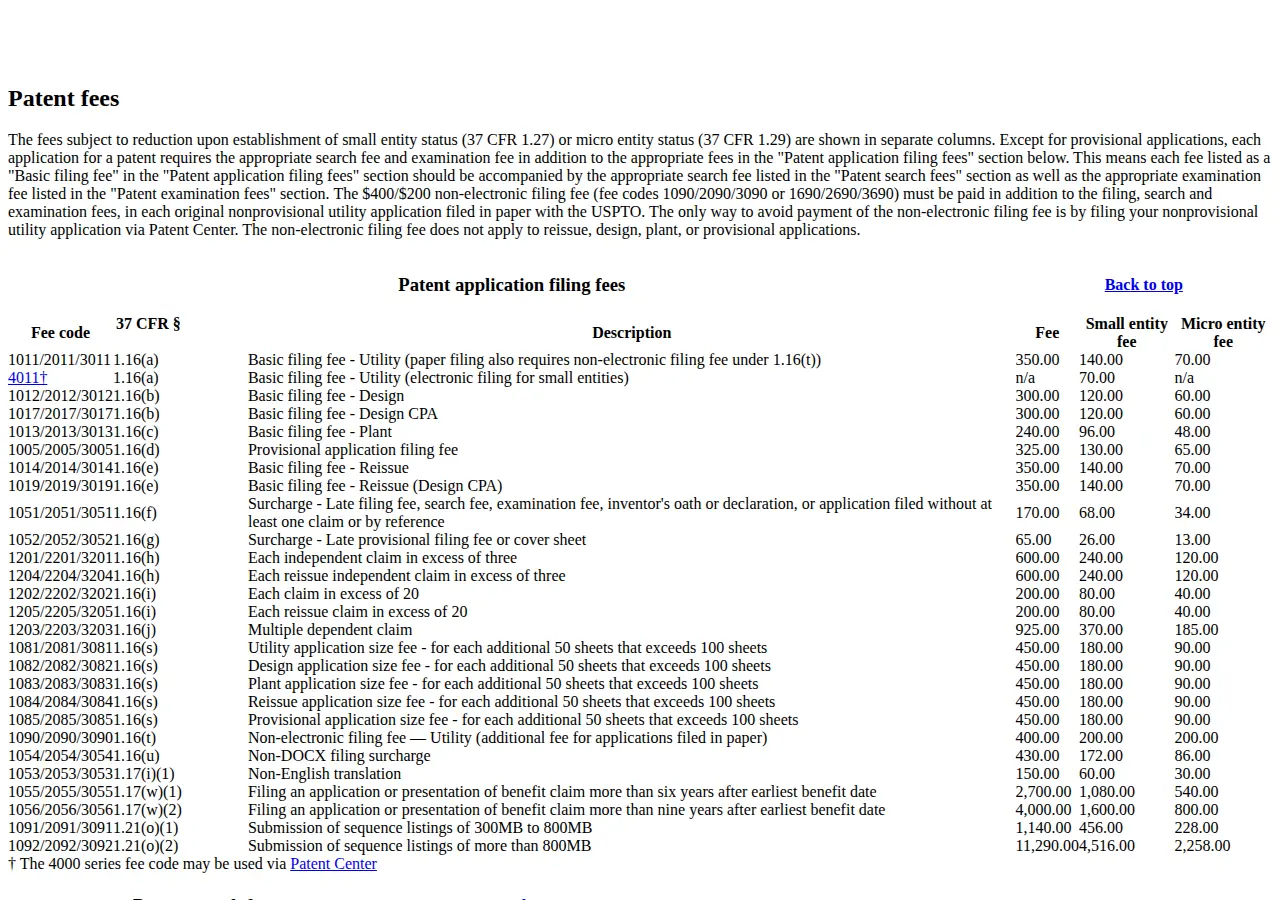
| Filing fee (small entity) | $130 | $140 + $308 search + $352 exam + $516 issue | 37 CFR 1.16(d), (a), (k), (o); 1.18(a) |
| Pendency | 12 months, cannot be extended | Until grant or abandonment | 35 U.S.C. § 111(b)(5) |
| "Patent Pending" | Yes | Yes | USPTO provisional page |
The fee math, by entity size
The current USPTO fee schedule — retrieved November 16, 2026 — reads as follows for a utility invention. The provisional filing fee under 37 CFR 1.16(d) is $325.00 for a large entity, $130.00 for a small entity, and $65.00 for a micro entity. The nonprovisional fees are the filing fee 1.16(a) ($350 / $140 / $70), the search fee 1.16(k) ($770 / $308 / $154), the examination fee 1.16(o) ($880 / $352 / $176), and the issue fee 1.18(a) ($1,290 / $516 / $258). File a nonprovisional on paper instead of through Patent Center and the $400 / $200 non-electronic filing fee applies on top.
Small entity, provisional-first route:
ext{Cost} = $130 + $140 + $308 + $352 + $516 = $1{,}446
Small entity, direct nonprovisional route:
ext{Cost} = $140 + $308 + $352 + $516 = $1{,}316
The provisional premium is exactly $130 for a small entity — the price of twelve months. The same arithmetic at the other sizes: a large entity pays $3,615 provisional-first ($325 + $3,290) against $3,290 direct, a $325 premium; a micro entity pays $723 ($65 + $658) against $658 direct, a $65 premium. Attorney fees are a separate line, not in the schedule.
The 12-month clock, and the 14-month rescue
The rule is absolute: "A provisional application for patent has a pendency lasting 12 months from the date the provisional application is filed. The 12-month pendency period cannot be extended." Section 111(b)(5) is equally blunt: if no request for benefit is made under § 119(e)(3), "the provisional application shall be regarded as abandoned 12 months after the filing date of such application and shall not be subject to revival after such 12-month period."
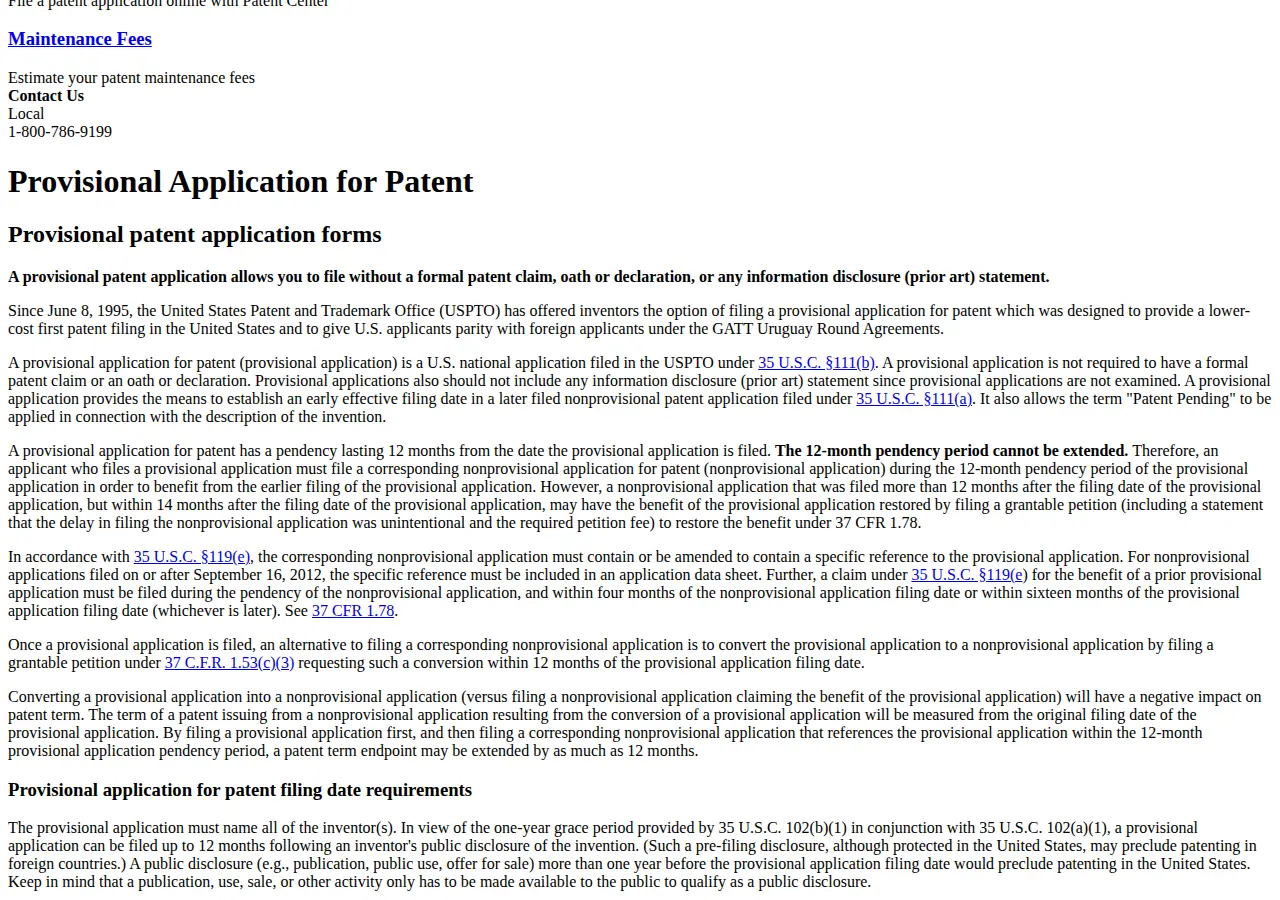
There is one rescue, and it is narrow. A nonprovisional filed more than 12 months but within 14 months after the provisional filing date may have the benefit restored by filing a grantable petition under 37 CFR 1.78, including a statement that the delay was unintentional and the required petition fee. The USPTO's own page also sets the reference deadline: a claim under § 119(e) must be filed during the pendency of the nonprovisional, and within four months of the nonprovisional filing date or within sixteen months of the provisional filing date, whichever is later. Miss the 14-month outer edge and the date is gone permanently — the provisional is abandoned and the priority it carried with it.
Section 102(b)(1) gives a one-year grace period: an inventor's own public disclosure does not count as prior art if it was made within one year before the filing date. The USPTO page states the boundary plainly: "A public disclosure (e.g., publication, public use, offer for sale) more than one year before the provisional application filing date would preclude patenting in the United States." File the provisional before you demo, pitch, or ship — and understand that a disclosure made more than a year before the provisional is already fatal, because the grace period runs from the disclosure, not from the filing.
The term trap: conversion vs claiming benefit
Once a provisional is filed, there are two ways to reach a nonprovisional. The normal route is a separate nonprovisional claiming the benefit under § 119(e). The alternative is conversion by petition under 37 CFR 1.53(c)(3) within 12 months. The USPTO warns against the second route in terms that leave no room for doubt: "Converting a provisional application into a nonprovisional application (versus filing a nonprovisional application claiming the benefit of the provisional application) will have a negative impact on patent term. The term of a patent issuing from a nonprovisional application resulting from the conversion of a provisional application will be measured from the original filing date of the provisional application."
The reason is the term rule: a utility patent's term runs 20 years from the nonprovisional filing date. File a provisional in January 2027 and a separate nonprovisional claiming its benefit in December 2027, and the term runs to December 2047 — the USPTO notes the endpoint may be extended by as much as 12 months. Convert the January provisional instead, and the term is measured from January 2027. Same invention, same fees, eleven months less patent — and the same loss whether the applicant is a solo inventor, an LLC, or a C-Corp.
When a provisional is the wrong filing
The provisional is the right instrument in exactly one situation: the invention is described well enough to support future claims, and the filer needs time before paying for examination. Outside that situation, the failure modes are specific:
- The description is thin. A provisional that sketches the idea without enabling it under § 112(a) holds a date for nothing: the nonprovisional's claims will reach beyond what the provisional disclosed.
- The invention is already public for over a year. The § 102(b)(1) grace period has run out; no filing, provisional or otherwise, can recover patentability in the United States.
- The filer needs enforceable rights now. A provisional confers no right to exclude and no right to sue — whether the IP sits in a founder's name or in an LLC's portfolio, those rights begin only when a patent issues. An infringer can be stopped only after a patent issues, and the provisional does not accelerate that by a day.
- The filer wants foreign protection. A provisional begins the Paris Convention priority year, which is useful — but foreign filings must still be made within 12 months of the provisional date, and a PCT application must be filed within that same window. The provisional starts the foreign clock; it does not pause it.
For the surrounding IP decision — whether the asset is a patent, a trademark, or a copyright at all — our trademark vs copyright vs patent protection playbook runs the three-way comparison with the current fee figures, and the USPTO trademark registration playbook covers the TEAS filing operation for the brand side of the same launch.
Founder & CEO Insight — Enow A. Jovial
The filing sequence
The operation runs in five steps, in order. Skip one and the date is weaker or gone.
- Describe the invention to § 112(a) standard. Write the specification so a person skilled in the art can make and use the invention, with the drawings necessary to understand it. This is the step that decides whether the priority claim survives — the IP is only as strong as the description.
- Decide who owns it. If a C-Corp or an LLC will hold the patent, name the inventors correctly (the humans who conceived it) and record the assignment to the company before filing; ownership and inventorship are different questions, and the cover sheet needs the inventors' names.
- File before disclosure. File the provisional — cover sheet (form PTO/SB/16) plus the 37 CFR 1.16(d) fee — before any public demo, pitch, or sale that would start the § 102(b)(1) clock. Development costs around the filing are R&D spend; under GAAP they are expensed as incurred unless the project meets the narrow capitalization criteria, so the patent budget and the book treatment should be agreed with the finance team in the same week.
- Calendar the 12-month deadline on the filing day. The corresponding nonprovisional claiming benefit under § 119(e) must be filed within 12 months. Foreign filings and any PCT application claiming the same priority must also be filed inside that 12-month window.
- File the nonprovisional, do not convert. File a separate nonprovisional that references the provisional. Conversion under 37 CFR 1.53(c)(3) measures term from the provisional date and is a salvage move, not a plan.
Operator checklist
- [x] Write the description to § 112(a) standard: enable a person skilled in the art to make and use the invention, with the drawings necessary to understand it under § 113 — claims can wait, enablement cannot.
- [x] File before any public disclosure: demo, pitch, publication, or sale more than one year before the provisional filing date is fatal under § 102(b)(1).
- [x] Calendar the 12-month deadline on the filing day: the nonprovisional claiming benefit under § 119(e) must be filed within 12 months; the 14-month restoration under 37 CFR 1.78 is a rescue, not a plan.
- [x] File a separate nonprovisional, never convert: conversion under 37 CFR 1.53(c)(3) measures patent term from the provisional date and costs up to 12 months of term.
- [x] Include the cover sheet and fee: a provisional needs the filing fee under 37 CFR 1.16(d) ($325 / $130 / $65) and a cover sheet identifying the inventors, title, and correspondence address (form PTO/SB/16), filed as a PDF through Patent Center.
- [x] Price the route through the ROI calculator: compare the $130 small-entity provisional premium against the $1,316 examination commitment before the twelve months run out.
A provisional patent application is a disciplined instrument: cheap, fast, and strictly time-limited. Used correctly — a full § 112(a) description, filed before disclosure, followed by a nonprovisional inside twelve months — it buys the most valuable thing in patent law at the lowest price in the schedule: a filing date. Used as a substitute for a real application, it buys twelve months of false confidence and a priority claim that collapses at examination.