Trademark vs Copyright vs Patent: The IP Protection Playbook
A founder with one brand name, one piece of software, and one invention faces three different government filings, three fee schedules, and three clocks. The brand name goes to the USPTO as a trademark for $350 per class. The software goes to the U.S. Copyright Office for $65. The invention goes back to the USPTO as a patent, where a small entity pays $1,316 through grant. All three together cost $545 in the cheapest honest configuration and $1,731 for a small entity that takes a utility patent to grant. The expensive mistake is filing the wrong right: a patent never protects a name, a copyright never protects an idea, and a trademark never protects how a machine works.
The three rights answer different questions. A trademark answers who made this — it protects the name, logo, and slogan buyers use to tell one seller from another. A copyright answers who wrote this — it protects the expression fixed in a book, a song, a photograph, or code. A patent answers who invented this — it protects a new and useful process, machine, or composition of matter, and a design patent protects how a manufactured article looks.
What each right protects
A trademark protects any word, name, symbol, or device used in commerce to identify the source of goods or services. The right grows out of use: selling goods under a mark in interstate commerce creates common-law rights where the mark is used, and federal registration under the Lanham Act extends protection nationwide. After five years of continuous use, a Section 15 declaration under 15 U.S.C. § 1065 makes the registration largely incontestable.
A copyright protects original works of authorship fixed in a tangible medium of expression, under 17 U.S.C. § 102(a): literary, musical, dramatic, pictorial, and graphic works, motion pictures, sound recordings, and architectural works. Protection begins at fixation, and no filing is needed for the right to exist. Registration is a different matter: under 17 U.S.C. § 411(a), no civil action for infringement of a United States work may be instituted until preregistration or registration has been made. An unregistered copyright is a right without a courthouse door.
A patent protects inventions, and the statute draws a hard line the other two rights never draw: a patent is granted only after examination, and nothing is protected until the patent issues. A utility patent covers a new and useful process, machine, manufacture, or composition of matter for 20 years from the filing date under 35 U.S.C. § 154(a)(2).
The trademark route: $350 per class, and the surcharges that punish sloppy drafting
Trademark applications are filed with the USPTO through Trademark Center. Since January 18, 2025, one base application fee of $350 per class covers applications under Sections 1 and 44 of the Lanham Act. The old two-tier system — TEAS Plus at $250 and TEAS Standard at $350 — is gone.
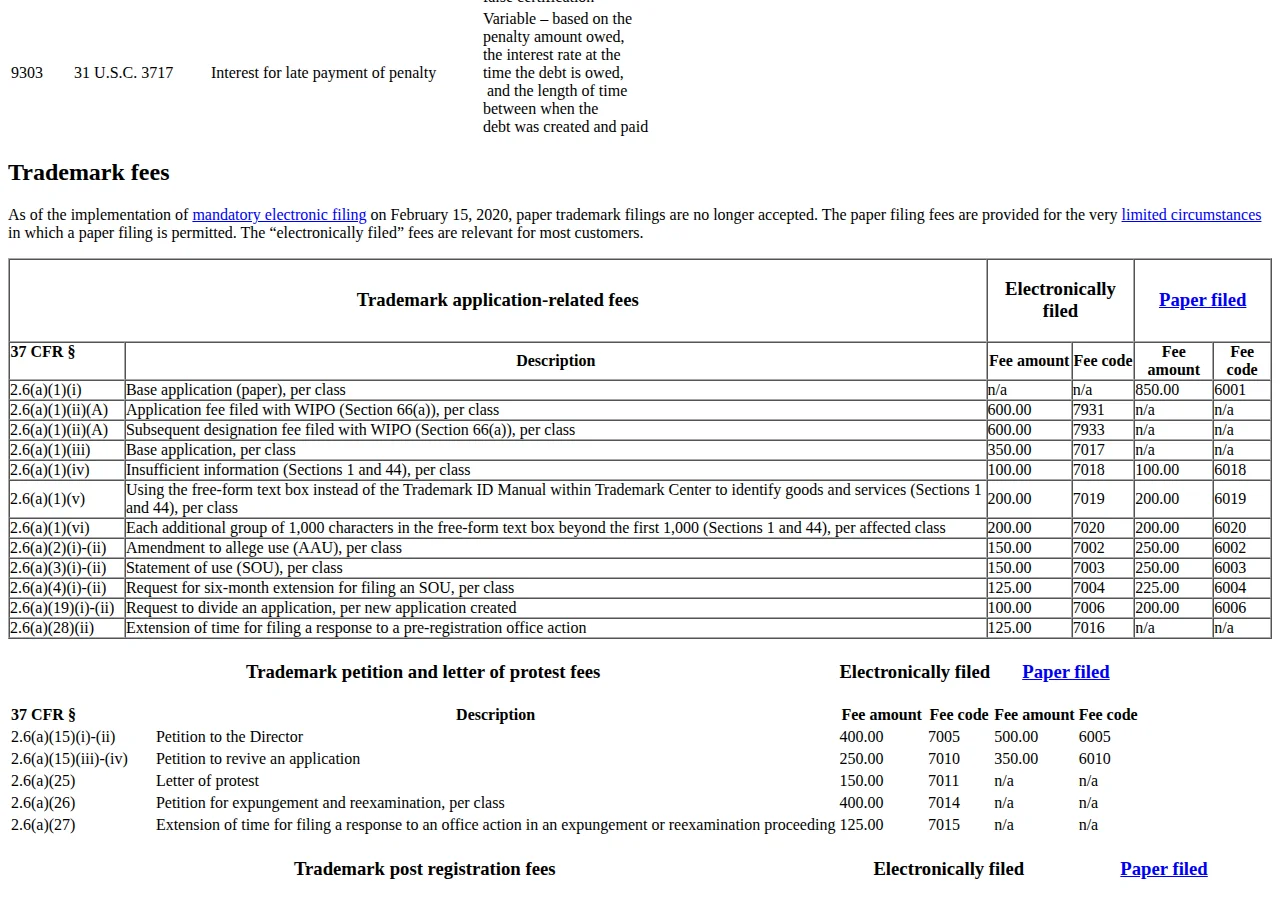
An application that fails to satisfy the base-application requirements draws a $100 per class insufficient-information fee. Identifying goods and services with free-form text instead of the ID Manual costs $200 per class, and each additional group of 1,000 characters of free-form text beyond the first 1,000 costs another $200 per affected class. Filing on paper instead of electronically costs $850 per class. An intent-to-use application under Section 1(b) needs a statement of use at $150 per class before the mark can register.
Under 15 U.S.C. § 1058(a), each registration remains in force for 10 years, and the owner must file a Section 8 declaration of continued use within the one-year period before the sixth anniversary and again within the one-year period before the tenth anniversary. The Section 8 declaration costs $325 per class. Renewal runs in further 10-year periods under 15 U.S.C. § 1059(a); the Section 9 renewal costs $325 per class, and the combined Section 8 declaration and Section 9 renewal at year ten costs $650 per class.
The copyright route: $65, and the courthouse door it opens
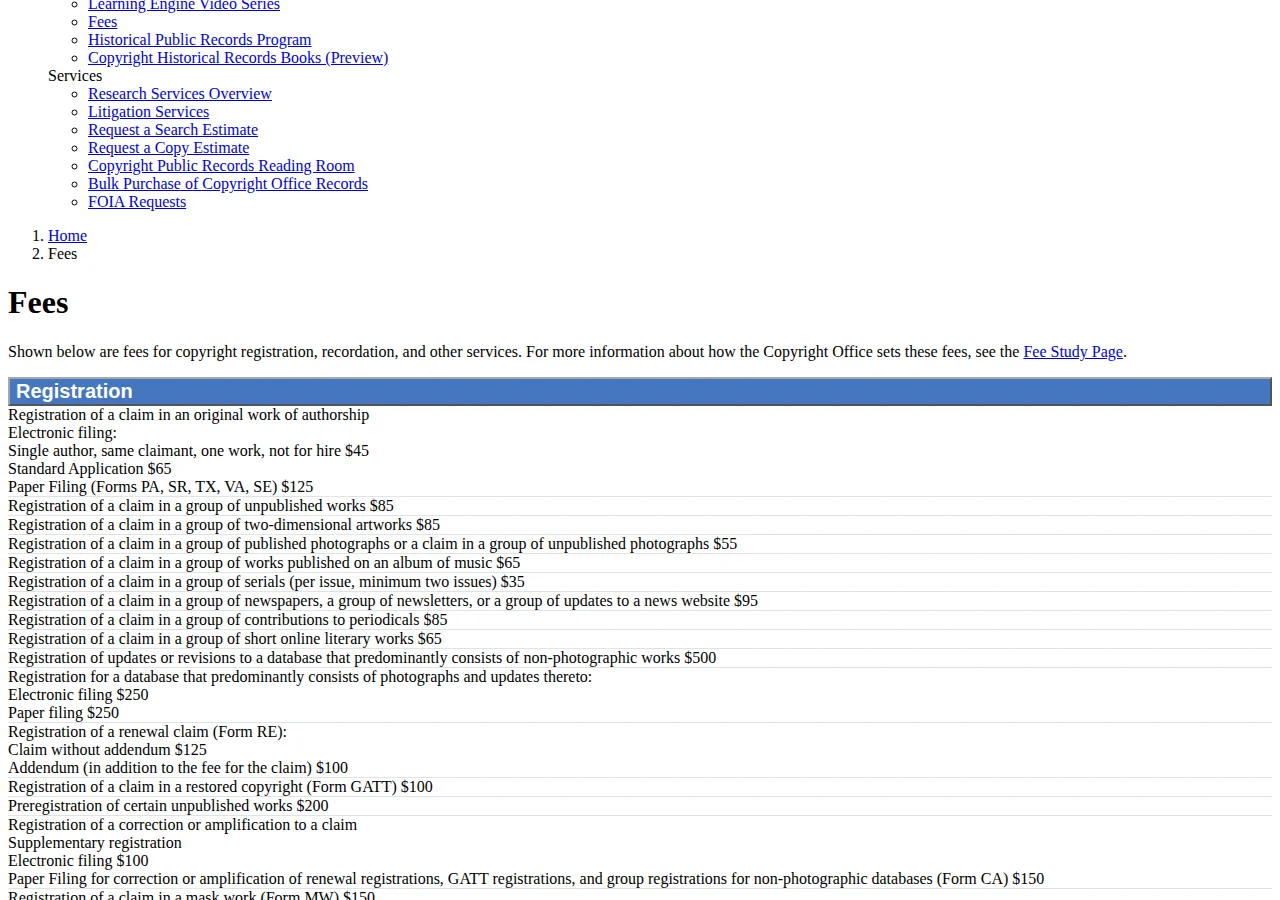
Copyright registration is filed with the U.S. Copyright Office through its online system. A standard application costs $65. A single author registering one work, as the sole claimant, where the work is not made for hire, pays $45. The Office records the claim and issues a certificate.
The duration is the longest of the three rights by a wide margin. Under 17 U.S.C. § 302(a), copyright in a work created on or after January 1, 1978 subsists from creation and endures for the life of the author and 70 years after the author's death. A work made for hire, an anonymous work, or a pseudonymous work runs 95 years from first publication or 120 years from creation, whichever expires first, under § 302(c). There is no renewal, no declaration of use, and no fee to keep the right alive. The $65 buys a right measured in generations; the trademark's $350 buys a right measured in ten-year installments.
The patent route: four fees before grant, three more to keep it alive
A nonprovisional utility application carries four government fees before it can issue, and the USPTO fee schedule states the rule plainly: except for provisional applications, each application requires the search fee and the examination fee in addition to the basic filing fee. For a small entity filing electronically, the filing fee is $140, the search fee is $308, the examination fee is $352, and the issue fee at allowance is $516 — $1,316 from filing to grant. A large entity pays $350 to file, $770 for search, $880 for examination, and $1,290 to issue — $3,290. A micro entity pays $70, $154, $176, and $258 — $658.
The provisional application is the cheap entry point and the most misunderstood filing in the system. It costs $325 for a large entity, $130 for a small entity, and $65 for a micro entity, requires no claims, and is never examined. It holds a filing date for 12 months. If no nonprovisional application claiming its benefit is filed inside that year, the provisional is regarded as abandoned and the priority date is lost.
Maintenance fees are where a patent's true cost hides. A utility patent must be maintained at 3.5 years, 7.5 years, and 11.5 years after grant. For a small entity the three fees are $860, $1,616, and $3,312 — $5,788 in total. A large entity pays $2,150, $4,040, and $8,280 — $14,470. A micro entity pays $430, $808, and $1,656 — $2,894. Design patents pay no maintenance fees at all.
First-year math: three profiles, all reproducible
Profile A is the smallest honest IP position a new business can hold: one trademark in one class, one copyright registration, one provisional patent application. The trademark is $350, the copyright is a $65 standard application, and the provisional is $130 for a small entity:
Profile B is the full utility patent taken to grant, with the same trademark and copyright alongside it. For a small entity, the patent costs $140 to file, $308 for search, $352 for examination, and $516 to issue:
The same package costs $3,705 for a large entity and $1,073 for a micro entity.
The per-class multiplication is the trademark's own cost driver. A clean three-class filing is 3 times $350, or $1,050. Draft the identification of goods and services in free-form text and the bill becomes 3 times $550, or $1,650. File an incomplete application with free-form text and one extra 1,000-character group, and each class costs $850:
Every further 1,000-character group adds $200 per class.
The ten-year and lifetime totals separate the three rights more sharply than any single fee. A trademark in one class, filed on an intent-to-use basis, costs $350 to file, $150 for the statement of use, $325 for the Section 8 declaration at year six, and $650 for the combined Section 8 declaration and Section 9 renewal at year ten:
A small-entity utility patent costs $1,316 through grant and $5,788 in maintenance, or $7,104 across its 20-year life; a large entity pays $17,760 and a micro entity $3,552. The copyright costs $65 once and nothing ever again.
The head-to-head decision table
| Question | Trademark | Copyright | Patent |
|---|---|---|---|
| What it protects | Names, logos, slogans | Original expression in a tangible medium | New inventions; ornamental designs |
| Registration route | USPTO, Trademark Center | U.S. Copyright Office, online registration | USPTO, Patent Center |
| First filing fee | $350 per class (base application) | $65 standard; $45 single author | Utility $140 small; provisional $130 small |
| Examination | Yes, examining attorney | No — recordation only | Yes, patent examiner |
| Duration | 10 years, renewable indefinitely | Life + 70 years; work for hire 95 / 120 years | Utility 20 years from filing; design 15 years from grant |
| Renewal / maintenance | Section 8 at years 6, 10; Section 9 every 10 years | None | Maintenance at 3.5, 7.5, 11.5 years |
| Protection before registration | Common-law rights from use | At fixation; cannot sue until registered | None until the patent issues |
| Enforcement route | TTAB $600 per class; federal court | Federal court, after registration | Federal court; ITC for imports |
| Authority | 15 U.S.C. §§ 1058, 1059, 1065; 37 CFR § 2.6 | 17 U.S.C. §§ 102, 302, 411 | 35 U.S.C. §§ 111, 154, 173; 37 CFR §§ 1.16, 1.18, 1.20 |
Founder & CEO Insight — Enow A. Jovial
Enforcement: where the cheap filing meets the expensive fight
Registration is cheap; enforcement is not. The only enforcement figures in the schedules are the Trademark Trial and Appeal Board filing fees: $600 per class for a notice of opposition, $600 per class for a petition for cancellation, and $225 per class for an ex parte appeal plus $200 per class for the appeal brief. Federal court is the other route, and no fee schedule prices it.
A trademark owner who never registers can still sue on common-law rights, but only where the mark was actually used. A copyright owner who never registers cannot sue at all for a United States work until registration is made, under § 411(a). A patent owner has nothing to enforce until the patent issues, and then the right is the strongest of the three: the owner can exclude others from making, using, selling, or importing the invention for the rest of the term.
Who should file what, and in what order
A business with a name customers will remember files the trademark first, because a name is the only one of the three that a stranger can register out from under the owner. Content businesses register the copyright next: $65, and the work is protected from the moment it is fixed. Technical businesses file the provisional early, because the filing date is the asset and the 12-month clock starts the day it is filed, not the day the product ships.
Our LLC formation tax guide covers the entity that will own these filings, and our LegalZoom vs Bizee vs Northwest registered agent formation pricing playbook prices the formation services. Design-file brands should also read our Canva vs Figma vs Adobe Express design tool pricing playbook. Run the ROI calculator on the filing fees against the revenue they protect.
Execution checklist: protect the name, the work, and the invention in one pass
- Step 1 — Sort the assets into three piles. Names and logos to trademark, fixed expression to copyright, the technical solution to patent.
- Step 2 — Search before filing. Search the USPTO database for the mark, Copyright Office records for the work, and the patent database for the invention.
- Step 3 — File the trademark from the ID Manual. One base application at $350 per class, pre-approved identification, no free-form text.
- Step 4 — Register the copyright. Standard application at $65, or $45 for a single author registering one work as sole claimant.
- Step 5 — File the provisional, then calendar 12 months. Small entity $130, no claims required.
- Step 6 — Budget the maintenance, not just the filing. Trademark Section 8 and 9, $975 per class across the decade; patent maintenance, $5,788 for a small entity.
- [x] Assets sorted: each assigned to the right filing.
- [x] Searches run: all three databases checked before any fee is paid.
- [x] Trademark filed: base application $350 per class, ID Manual identification, no surcharges.
- [x] Copyright registered: $65 standard or $45 single-author application on file.
- [x] Provisional filed and calendared: $130 small entity, 12-month nonprovisional deadline set.
- [x] Maintenance budgeted: Section 8 and 9 dates and patent maintenance dates calendared.