USPTO Trademark Registration: The TEAS Filing Playbook — Fees, Classes, Specimens & Maintenance
Most guides still quote TEAS Plus at $250 a class. That price died on January 18, 2025, when the USPTO retired TEAS Plus and TEAS Standard, moved new applications into Trademark Center, and set a single $350-per-class base fee. This playbook works the filing operation as it stands in November 2026: the statute, the fees, the class and specimen rules, the response and opposition clocks, and the maintenance filings. For how a trademark differs from a copyright and a patent, see the trademark vs copyright vs patent playbook.
The 2025 fee reset
Before January 18, 2025, applicants chose TEAS Plus at $250 per class or TEAS Standard at $350. The current fee schedule lists neither: one base application at $350 per class under 37 CFR 2.6(a)(1)(iii), fee code 7017, with the old TEAS Plus discipline now as surcharges.
| Fee (electronic filing) | Amount | Authority |
|---|---|---|
| Base application, per class | $350 | 2.6(a)(1)(iii) |
| Insufficient information, per class | $100 | 2.6(a)(1)(iv) |
| Free-form text box instead of the ID Manual, per class | $200 | 2.6(a)(1)(v) |
| Extension of time to respond to a pre-registration office action | $125 | 2.6(a)(28)(ii) |
| Section 8 declaration, per class | $325 | 2.6(a)(12) |
| Section 9 renewal, per class | $325 | 2.6(a)(5) |
Two surcharges do the work the old tiers did: $100 per class for missing information, $200 per class for free-form wording instead of the ID Manual, plus $200 per extra 1,000 characters. Paper is effectively gone since February 15, 2020: accepted only in very limited circumstances, at $850 per class.
Worked math 1: first filing
Take a software company filing one mark — app in class 9, hosted service in class 42 — two classes, ID Manual wording, complete information:
Write the class 42 identification in free-form text and the surcharge lands on that class only:
The same mark, the same goods: $700 or $900, decided by drafting. Run the cost against the launch budget with the profit calculator before choosing classes — every class added later is a new filing, not an edit.
Choose the filing basis
Section 1051 of the Lanham Act offers two doors into the register, chosen on facts, not preference.
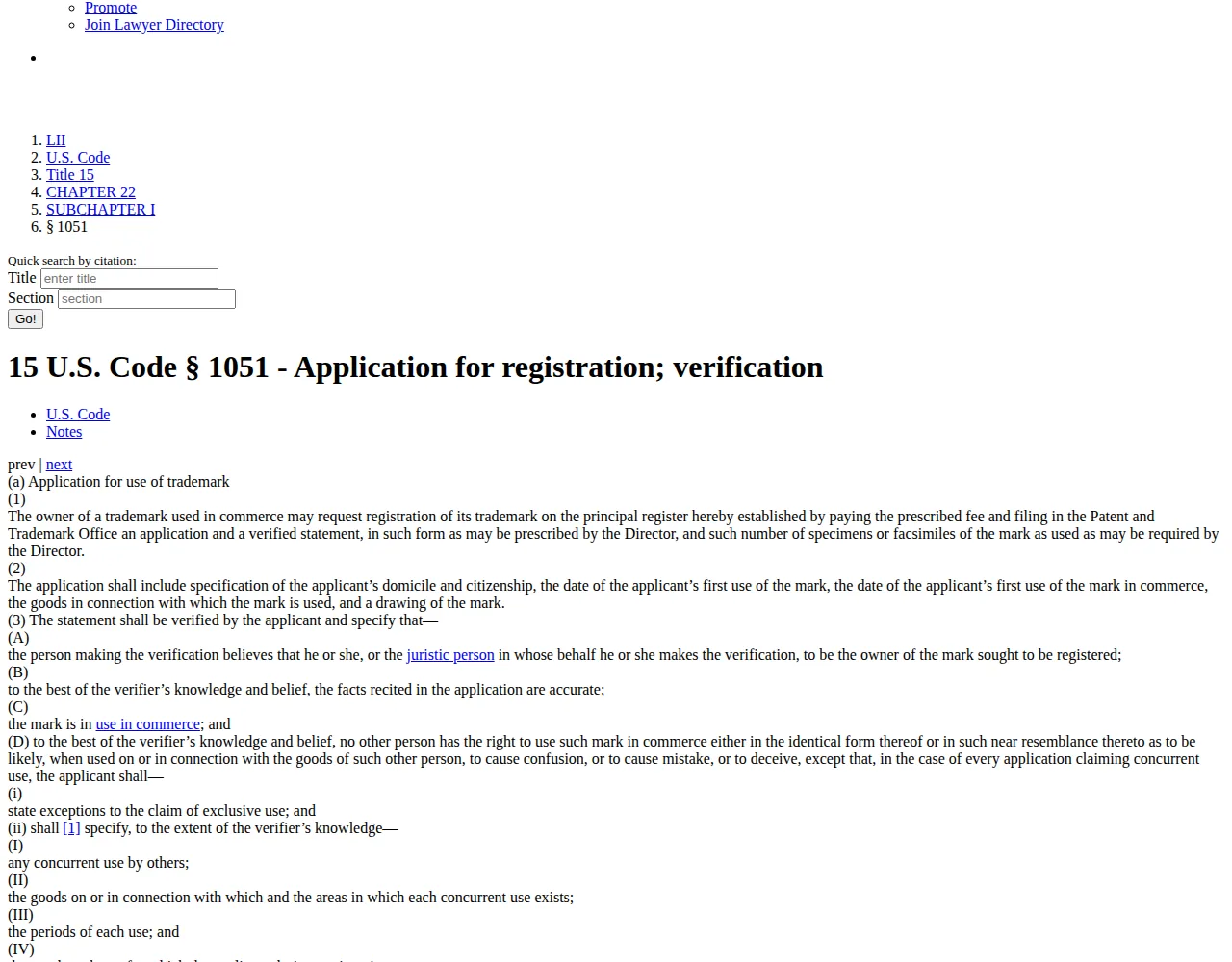 Subsection (a) covers a mark already used in commerce: the owner files an application and a verified statement giving domicile, citizenship, the dates of first use and first use in commerce, the goods or services, and a drawing, with specimens showing the mark as used. Subsection (b) is for a person with a bona fide intention, under circumstances showing good faith, to use the mark. Section 1127 defines the mark as a word, name, symbol, or device identifying and distinguishing goods or services and indicating their source.
| Situation | Filing basis | Authority |
|---|---|---|
| Selling in interstate commerce | Section 1(a), use | 15 U.S.C. 1051(a) |
| Brand chosen, product unlaunched | Section 1(b), intent | 15 U.S.C. 1051(b) |
| Using the mark; filed before launch finished | Amend to allege use | 15 U.S.C. 1051(c) |
The intent-to-use door has a hard limit: under section 1051(b)(3), no mark is registered until the applicant has met subsections (c) and (d), except for applications under section 1126. Filing early reserves the date; it does not register the mark.
Class selection
The USPTO classifies goods and services under the Nice Classification, adopted in 37 CFR 2.85: 45 classes, 1–34 for goods and 35–45 for services. Protection is class-specific: a registration in class 25 for clothing does not protect the same mark for software in class 9. Common mistakes: filing class 35 for a retail store when the product needs its own goods class, and filing class 42 for a SaaS product while forgetting class 9 for the downloadable client.
Use the Trademark ID Manual: its pre-approved wording avoids the $200-per-class free-form surcharge and shortens examination. One application can cover many classes, but the fee multiplies per class; a refusal in one class does not sink the others if the application is divided, at $100 per new application created.
Specimens
A specimen is not the logo file. It is a real-world sample showing how the mark is actually used in commerce, and 37 CFR 2.56(a) requires one per class for a use-based application, an amendment to allege use, a statement of use, and a Section 8 or Section 71 declaration. The goods-versus-services split is where first filings fail.
For goods, section 2.56(b)(1) requires the mark on the goods, on containers or packaging, on labels or tags, or on a point-of-sale display. Advertising is generally not an acceptable specimen for goods: a brochure or promotional page that only tells buyers about the product does not show the mark on the product or at the point of sale.
For services, section 2.56(b)(2) is broader: the specimen must show the mark as used in the sale, performance, or advertising of the services, with a direct association to them. A services website, brochure, or sign qualifies when the mark and the service appear together.
Section 2.56(c) adds two mechanical rules: a web page specimen must include the URL and the access or print date, and an artist's rendering, a printer's proof, a computer illustration, a digital image, or a similar mockup is not a proper specimen. Photograph the actual product — never submit the designer's mockup.
The examination pipeline
After filing, an examining attorney reviews the application for formalities, classification, and the bars of section 1052, including likelihood of confusion with an existing registration. The Trademark Modernization Act shortened the clock: for applications under sections 1 or 44, the response period is three months from the issue date under 37 CFR 2.62(a)(1)(i) and 15 U.S.C. 1062(b)(2), with one three-month extension available before the deadline for $125, for a maximum of six months. Madrid section 66(a) keeps six months with no extension. The examining attorney has no discretion to extend the period; a missed deadline means abandonment. A petition to revive costs $250.
If it survives examination, the mark is published for opposition. Under 15 U.S.C. 1063(a), any person who believes they would be damaged by registration may oppose within thirty days after publication, on payment of $600 per class. On written request before that period expires, the time is extended thirty days, with further extensions for good cause: the first is free, a ninety-day extension costs $200, and a final sixty-day extension costs $400. If no opposition is filed, section 1063(b) sends a use-based application to registration, while an intent-to-use application receives a notice of allowance. A final refusal can be appealed to the Trademark Trial and Appeal Board: an ex parte appeal costs $225 per class, the brief $200 per class.
The intent-to-use clock
The notice of allowance starts the most expensive clock. Under section 1051(d)(1), the applicant has six months from the notice of allowance to file a verified statement of use, with specimens and a $150-per-class fee, specifying first use in commerce and the goods or services used. The Director must extend that period for one additional six-month period on written request before the first period expires. On a showing of good cause, the Director may further extend the time for periods aggregating not more than 24 months, each request needing a verified statement of continued bona fide intention and the $125-per-class fee. Six plus six plus twenty-four is thirty-six months. Section 1051(d)(4): failure to timely file a statement of use or extension request results in abandonment, unless the delay was unintentional.
Worked math 2: the intent-to-use path
Take the same two-class filing, made before launch on intent-to-use and pushed to the last lawful month:
Five extensions is the statute's arithmetic: one automatic six-month extension plus four more aggregating 24 months. Filing intent-to-use a year before launch buys the head start in extension fees; filing on use costs $700 and nothing more at this stage.
Founder & CEO Insight — Enow A. Jovial
Maintenance
Registration is not permanent. Under 15 U.S.C. 1058(a), each registration remains in force for ten years, canceled unless the owner files the required affidavits within the one-year period before six years after registration, and within the one-year period before ten years, and each successive ten-year period. Each deadline carries a six-month grace period, with fee and surcharge.
The first filing is the Section 8 declaration of use, due between the fifth and sixth anniversaries. Under section 1058(b), the affidavit must state that the mark is in use in commerce, list the goods and services on which it is in use, and include specimens showing current use and the fee — or show excusable nonuse due to special circumstances, not an intention to abandon the mark. The Section 8 fee is $325 per class, with a $100-per-class grace-period surcharge. The tenth-year filing combines Section 8 with the Section 9 renewal: $325 per class, $650 combined, again with a $100 grace surcharge per filing. A Section 15 declaration of incontestability, after five years of continuous use, costs $250 per class, or $575 combined with Section 8.
One class, filed on use and maintained on time, costs $1,000 over ten years:
Add Section 15 at year five and the total becomes $1,250. Let the registration cancel for failure to file, and the cost is not the $325 fee — it is a new application, a new examination, a new opposition window, and a lost filing date.
Who this is for
This playbook is for a U.S. founder who owns the brand and sells under it: the LLC or C-Corp holding the mark, filing under its own EIN, with a specimen from a real sale. The applicant of record should be the entity that owns the mark, and the operating agreement should say so — see the LLC operating agreement breakdown — because a mark owned personally by the founder and used by the company creates a licensing question. An S-Corp election changes taxation, not ownership, and your CPA should book the fees as an intangible asset cost under GAAP, not a launch expense. A SaaS company files class 42 for the hosted service and class 9 for the downloadable client; a B2B services company files class 35 or 42 for the service itself. Entity choice changes who the applicant is — see the LLC vs Delaware C-Corp comparison — so settle the entity before filing, not after.
A foreign-domiciled applicant must use a U.S.-licensed attorney under 37 CFR 2.11(a); there is no self-filing route from abroad. Do not file intent-to-use on an unchosen brand name. And a merely descriptive mark draws a section 1052(e) refusal no fee can cure; that is a branding problem, not a filing problem.
Run the operation
- Search before filing. Run the USPTO Trademark Search system for the exact mark and near variants in your classes, and check common-law use in search results and app stores.
- Settle the owner. Confirm the applicant entity, its EIN, and that the operating agreement assigns the mark to the entity.
- Pick the classes from the ID Manual. Claim only classes where you sell or will sell within the intent-to-use window.
- Choose the basis honestly. File under section 1051(a) with specimens if you are selling; under section 1051(b) only with a launch plan inside 36 months.
- File in Trademark Center. A USPTO.gov account with identity verification and multifactor authentication is mandatory; Eastern Time controls the filing date, and a filing received by 11:59 p.m. ET counts as that day.
- Docket every clock on filing day. Office action, three months; publication, thirty days; notice of allowance, six months; Section 8, years five to six; Section 9, years nine to ten.
The filing checklist
- [x] Mark searched in the intended classes
- [x] Applicant entity and ownership settled
- [x] Classes picked from the ID Manual; surcharges budgeted
- [x] Filing basis matches the facts
- [x] One specimen per class, from real use
- [x] Office-action deadline docketed at three months
- [x] Statement of use or extension docketed from the notice of allowance
- [x] Section 8 docketed years five to six; Section 9 years nine to ten
The decision in advance
The system rewards the operator who treats it as a calendar with prices attached. File on use when the product is selling, file on intent only with a launch date inside the thirty-six-month window, draft from the ID Manual, photograph real specimens, and docket Section 8 on certificate day. The $350 fee buys the filing; the discipline buys the registration.